Skip to content
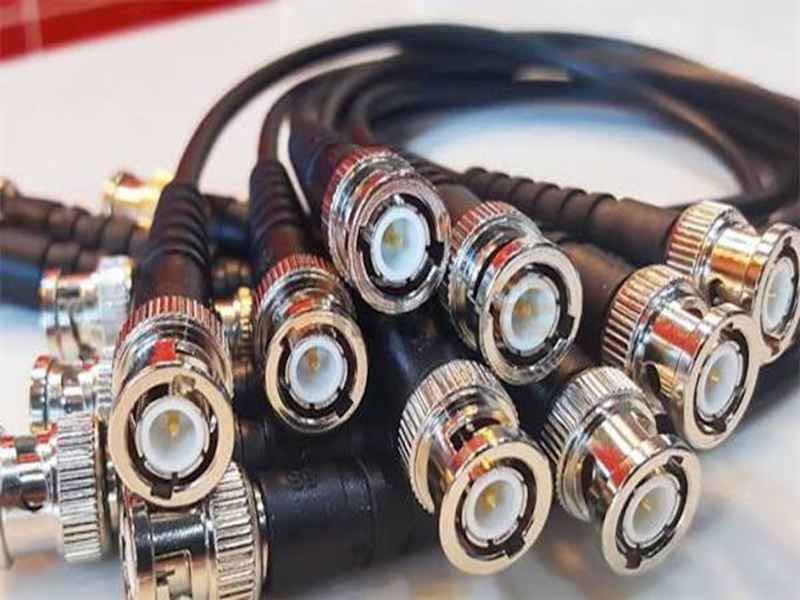
A BNC cable looks simple from the outside. Most people only notice the round metal connector, the twist-lock design, and the black coaxial cable behind it. But when the cable is used in a camera system, medical device, RF test bench, broadcast rack, or industrial machine, that “simple cable” can decide whether the signal is clean or unstable.
A BNC cable is a coaxial cable fitted with one or more BNC connectors. It is used to transmit video, RF, timing, measurement, and control signals with stable impedance and good shielding performance. Most BNC cables are built as either 50 Ohm or 75 Ohm assemblies. 50 Ohm BNC cable is commonly used for RF, test, measurement, and communication equipment. 75 Ohm BNC cable is more common in video, CCTV, broadcast, and SDI systems.
In real sourcing work, the hard part is not knowing the name “BNC cable.” The hard part is knowing which BNC cable is correct for your equipment. Many customers send Sino-Conn a photo of an old cable and ask, “Can you make this?” Some customers provide a connector model, but no cable specification. Some engineers know the impedance and frequency, but still need support on cable OD, flexibility, jacket material, shielding, and connector orientation.
That is why a good BNC cable should not be selected only by connector appearance. It should be selected by signal type, impedance, cable length, shielding requirement, working environment, connector structure, and production consistency. A cable that works on a short test bench may fail after being installed inside a machine, near a motor, beside a power supply, or inside a medical device where EMI control is much stricter.
For procurement teams, BNC cable is often a small part of the BOM. For engineers, it can be the part that creates signal loss, image noise, unstable readings, or repeated troubleshooting. This guide explains what BNC cable is, how it works, where it is used, and what details matter before you send a drawing, photo, sample, or RFQ to a supplier.
What Is BNC Cable?
A BNC cable is a coaxial cable assembly fitted with BNC (Bayonet Neill-Concelman) connectors on one or both ends. It is designed to transmit RF signals, analog and digital video, clock signals, and measurement data while maintaining controlled impedance and excellent shielding against electromagnetic interference (EMI). Depending on the application, BNC cables are typically manufactured in 50 Ohm or 75 Ohm versions, each optimized for different signal types.
Although BNC connectors have existed for decades, they continue to play an important role in modern industries. They are widely found in broadcast television, CCTV surveillance, laboratory instruments, industrial automation, aerospace electronics, telecommunications, and medical equipment because they provide a fast, secure, and highly reliable connection.
Many people assume that a BNC cable is simply “a cable with two BNC connectors.” In reality, the connector is only one component of the complete assembly. Signal performance depends on many factors working together, including cable impedance, conductor material, dielectric stability, shielding coverage, connector precision, cable length, and assembly quality.
For engineers, these factors directly affect measurement accuracy and system stability.
For OEM manufacturers, they influence product reliability and warranty costs.
For purchasing teams, they determine whether a cable assembly can be delivered consistently, pass incoming inspection, and meet long-term production requirements.
This is why two BNC cables that look almost identical can perform very differently in actual use.
For example, a low-cost BNC cable may work perfectly during a five-minute bench test. However, after several months in an industrial factory with motors, servo drives, and switching power supplies operating nearby, signal noise may increase, connectors may loosen, or the cable jacket may begin to crack because the material was selected only for cost rather than application.
Professional cable selection always begins with understanding how the cable will be used instead of simply matching connector shapes.
When customers contact Sino-Conn, they often provide one of the following:
- An existing cable sample
- Equipment photographs
- A connector part number
- A simple hand sketch
- A PDF drawing
- Only the cable length and connector type
Even with limited information, our engineering team can usually identify the connector series, estimate the cable specification, recommend suitable materials, and prepare a production drawing for customer confirmation before manufacturing begins.
This engineering-first approach helps reduce communication errors and shortens product development time.

What Is a BNC Connector?
The BNC connector is one of the world’s most widely used RF connectors. The name comes from Bayonet Neill-Concelman, combining the bayonet locking mechanism with the names of its inventors.
Unlike threaded RF connectors that require several turns to tighten, a BNC connector locks with approximately a quarter turn. This simple mechanism allows engineers and technicians to connect or disconnect equipment quickly without sacrificing mechanical security.
The locking system also performs well in environments where cables may be moved frequently or exposed to vibration.
This is one reason why BNC connectors continue to be widely used in laboratories, production lines, television studios, hospitals, and maintenance facilities.
A standard BNC connector contains several precision components.
| Component | Function | Importance |
|---|---|---|
| Center Contact | Carries the signal | Determines electrical continuity and signal stability |
| Dielectric Insulator | Separates signal from ground | Maintains controlled impedance |
| Connector Body | Provides shielding and mechanical support | Reduces EMI leakage |
| Bayonet Lock | Secures connector to equipment | Prevents accidental disconnection |
| Crimp or Solder Area | Connects connector to coaxial cable | Affects long-term reliability |
| Rear Ferrule | Compresses braid and shield | Improves grounding performance |
Every component influences overall cable performance.
For example, if the center contact is poorly machined, contact resistance may increase.
If the dielectric dimensions are inconsistent, impedance changes occur.
If the braid is not properly terminated, shielding effectiveness decreases.
These problems are rarely visible from outside the connector, but they often become apparent during long-term operation.
One common misunderstanding is that every BNC connector is interchangeable.
Although many connectors share similar dimensions, they are designed for different cable diameters.
For example:
| Cable Type | Typical Outer Diameter | Matching Connector Required |
|---|---|---|
| RG174 | Approx. 2.8 mm | Small cable BNC connector |
| RG179 | Approx. 2.5 mm | Precision small cable connector |
| RG316 | Approx. 2.5 mm | PTFE-compatible connector |
| RG58 | Approx. 5 mm | Standard BNC connector |
| RG59 | Approx. 6.1 mm | Video BNC connector |
Installing the wrong connector onto the wrong cable usually causes poor crimping, unstable impedance, or premature mechanical failure.
For this reason, Sino-Conn verifies connector compatibility with every custom cable design before production begins.
Customers can choose between original branded connectors or high-quality compatible alternatives according to project requirements, delivery schedule, and budget.
For many commercial and OEM projects, compatible connectors provide similar electrical and mechanical performance while offering shorter lead times and greater flexibility for customized designs.

How Does BNC Cable Work?
The reason BNC cable performs so well is not only because of the connector. The real advantage comes from the coaxial cable structure inside the assembly.
Unlike ordinary electrical wires, coaxial cable keeps the signal conductor centered inside multiple protective layers. This structure minimizes signal radiation while protecting the transmitted signal from external interference.
A typical BNC cable consists of five main layers.
| Cable Structure | Typical Material | Primary Function |
|---|---|---|
| Center Conductor | Bare copper, tinned copper, silver-plated copper | Carries electrical signal |
| Dielectric Layer | PE, Foam PE, PTFE, FEP | Maintains constant impedance |
| Foil Shield | Aluminum foil or copper foil | Blocks high-frequency EMI |
| Braided Shield | Bare copper or tinned copper | Improves shielding and grounding |
| Outer Jacket | PVC, TPU, PE, LSZH, FEP | Protects cable mechanically and environmentally |
Every layer contributes to signal quality.
The center conductor determines conductivity.
The dielectric controls impedance.
The shielding reduces electromagnetic interference.
The jacket protects against abrasion, chemicals, UV exposure, moisture, repeated bending, and high temperatures.
When these layers are manufactured accurately, the cable can transmit signals over long distances with minimal loss.
As operating frequency increases, construction accuracy becomes increasingly important.
For example, a cable used for a low-frequency CCTV camera may still operate acceptably even with moderate manufacturing tolerances.
The same cable construction may fail in an RF measurement system operating above several hundred megahertz because impedance variations become much more significant.
This explains why engineers often specify different cable types even when the connector remains identical.
Several factors influence signal quality simultaneously.
| Factor | Effect on Performance |
|---|---|
| Impedance | Reduces signal reflections |
| Shield Coverage | Minimizes EMI |
| Cable Length | Influences attenuation |
| Conductor Material | Affects insertion loss |
| Connector Precision | Maintains electrical continuity |
| Assembly Process | Ensures consistent impedance |
A practical example comes from an equipment manufacturer producing automated optical inspection systems.
The original supplier provided a standard BNC cable that passed continuity testing without issue. However, after installation inside the production machine, image noise appeared intermittently whenever nearby servo motors accelerated.
Rather than replacing cameras or redesigning the electronics, the customer worked with Sino-Conn to analyze the installation environment.
The solution involved changing the cable construction from a standard braided shield to a foil-plus-high-density braid structure while maintaining the same connector style and cable length.
After the updated assemblies were installed, image stability improved significantly without requiring any changes to the customer’s equipment.
This illustrates an important point.
Electrical performance depends on the complete cable assembly rather than the connector alone.
Where Is BNC Cable Used?
Although many consumer products now rely on HDMI, USB, or Ethernet, BNC cable remains the preferred solution in applications where signal stability, shielding performance, and reliable mechanical connection are critical.
Its versatility allows it to support both analog and digital signal transmission across a wide range of industries.
The table below summarizes several common applications.
| Industry | Typical Equipment | Main Customer Concern |
|---|---|---|
| CCTV Security | Cameras, DVRs, monitors | Stable video over long distances |
| Broadcast | SDI cameras, routers, video switchers | Low signal loss and precise impedance |
| Test & Measurement | Oscilloscopes, spectrum analyzers, signal generators | Measurement accuracy |
| Medical Equipment | Patient monitors, diagnostic systems, laboratory analyzers | EMI resistance and long-term reliability |
| Industrial Automation | Machine vision, sensors, inspection equipment | Flexibility and vibration resistance |
| Aerospace & Defense | Communication modules, radar equipment | Reliability under harsh environments |
| Telecommunications | RF infrastructure and testing equipment | Stable RF transmission |
Each industry focuses on different performance priorities.
Broadcast customers pay close attention to insertion loss and impedance stability because poor cable quality directly affects image transmission.
Medical equipment manufacturers often prioritize shielding performance, documentation, material traceability, and manufacturing consistency because electrical noise can influence sensitive diagnostic signals.
Industrial automation customers typically request flexible jackets, oil resistance, and high bending durability to withstand continuous machine movement.
Engineers developing RF systems usually focus on return loss, attenuation, and frequency range rather than simply selecting the lowest-priced cable.
These differences explain why there is no universal BNC cable suitable for every application.
At Sino-Conn, project discussions normally begin with the customer’s application rather than the connector itself.
Typical questions include:
- What equipment will the cable connect?
- Is the signal RF, video, or data?
- What impedance is required?
- Will the cable move continuously?
- Is there strong EMI nearby?
- Is outdoor use expected?
- What is the target production quantity?
Answering these questions allows our engineering team to recommend an appropriate cable structure instead of simply duplicating an existing assembly.
One customer from Europe initially requested “BNC male to BNC male, one meter.”
After discussing the project, additional requirements became clear:
- Right-angle connector on one end
- Oil-resistant TPU jacket
- Double shielding
- 50 Ohm impedance
- Flexible cable for repeated movement
- Laser marking with customer part number
Although the connector description remained almost unchanged, the final cable assembly was completely different from a standard catalog product.
This type of engineering collaboration is becoming increasingly common as manufacturers seek cable assemblies that improve equipment performance rather than simply replacing an existing part.
Whether the requirement is a prototype, a small engineering batch, or high-volume OEM production, understanding the complete application is always the first step toward selecting the right BNC cable.
How Do You Choose BNC Cable?
Choosing the right BNC cable is about much more than selecting a connector that fits your equipment. A cable that performs perfectly in one application may fail completely in another, even though both use the same BNC connector. The differences often come down to impedance, cable construction, shielding, transmission distance, operating frequency, installation environment, and manufacturing quality.
One of the biggest mistakes made during sourcing is assuming that all BNC cables are interchangeable. In reality, every project has different electrical and mechanical requirements. A laboratory oscilloscope, a 4K broadcast camera, a medical ultrasound system, and an industrial vision sensor may all use BNC connectors, but the cable specifications behind them are very different.
When Sino-Conn reviews a new inquiry, our engineers rarely begin by asking only for the connector model. Instead, we focus on the application because understanding how the cable will be used allows us to recommend a solution that balances performance, durability, lead time, and cost.
Before requesting a quotation, it is helpful to prepare the following information:
| Information | Why It Matters |
|---|---|
| Equipment model | Determines connector compatibility |
| Signal type | Identifies whether 50 Ohm or 75 Ohm cable is required |
| Operating frequency | Influences cable selection and attenuation |
| Cable length | Affects signal loss |
| Installation environment | Determines shielding and jacket material |
| Movement or fixed installation | Determines cable flexibility requirements |
| Annual demand | Helps optimize connector selection and pricing |
Even if some of this information is unavailable, a supplier with strong engineering experience should be able to help identify the missing specifications rather than simply quoting the lowest-priced cable.
BNC Cable Impedance
Impedance is the first specification engineers verify because it directly affects signal transmission efficiency.
Most BNC cable assemblies are built using either 50 Ohm or 75 Ohm coaxial cable.
Although both versions look nearly identical, they serve different purposes.
| Impedance | Common Equipment | Main Performance Goal |
|---|---|---|
| 50 Ohm | Oscilloscopes, RF modules, antennas, wireless communication, spectrum analyzers | Maximum RF performance and power handling |
| 75 Ohm | CCTV cameras, DVRs, SDI video equipment, broadcast systems | Minimum signal attenuation and high-quality video transmission |

One of the most common questions from customers is:
“Can I replace a 50 Ohm cable with a 75 Ohm cable?”
Physically, the connectors usually fit.
Electrically, this is rarely recommended.
When impedance does not match the equipment, part of the transmitted signal is reflected back toward the source instead of continuing to the receiver.
This reflected energy becomes more noticeable as frequency increases.
Possible consequences include:
- Reduced transmission efficiency
- Video ghosting or image degradation
- Higher return loss
- Measurement errors
- Increased signal instability
- Reduced communication distance
The higher the operating frequency, the greater the effect of impedance mismatch.
The following comparison illustrates the difference.
| Cable Matching | Performance |
|---|---|
| 50 Ohm cable with 50 Ohm equipment | Stable signal transmission |
| 75 Ohm cable with 75 Ohm equipment | Excellent video quality |
| 50 Ohm cable with 75 Ohm equipment | Signal reflections increase |
| 75 Ohm cable with 50 Ohm equipment | RF measurement accuracy decreases |
Another important consideration is impedance consistency.
A professional coaxial cable maintains nearly constant impedance throughout its entire length. Lower-quality cables may have uneven dielectric thickness or inconsistent conductor positioning, causing impedance to fluctuate.
Although these differences cannot be seen from the outside, they become obvious during high-frequency testing.
For customers developing RF equipment, laboratory instruments, or broadcast systems, Sino-Conn recommends confirming impedance requirements before prototype production begins. Every production drawing clearly identifies the selected cable type to prevent specification errors during future purchasing.
BNC Cable Shielding
Shielding determines how effectively a BNC cable protects signals from electromagnetic interference.
Modern factories, laboratories, hospitals, and communication rooms contain numerous sources of electrical noise.
Typical interference sources include:
- Variable frequency drives
- Servo motors
- Industrial robots
- High-current power cables
- Wireless communication devices
- Switching power supplies
- High-frequency inverters
Without sufficient shielding, electrical noise may enter the cable and reduce signal quality.
The shielding structure should always be selected according to the operating environment rather than simply choosing the least expensive cable.
Several shielding structures are commonly available.
| Shield Structure | EMI Protection | Typical Application |
|---|---|---|
| Single braid | Standard | General commercial equipment |
| Aluminum foil | Excellent high-frequency shielding | Video transmission |
| Foil + braid | Very good overall protection | Industrial automation |
| Double braid | Excellent | RF measurement systems |
| Double foil + braid | Maximum protection | Medical, aerospace and defense |
Shield coverage is another important specification.
Higher braid coverage generally improves shielding performance.
Typical braid coverage ranges from approximately 60% to more than 95%, depending on cable construction.
However, more shielding does not always mean a better cable.
For example:
A robotic arm performing continuous movement may benefit from a lighter, more flexible shield.
A broadcast studio transmitting uncompressed SDI video may prioritize shielding performance over flexibility.
Medical diagnostic equipment often requires both excellent shielding and stable long-term reliability because multiple electronic systems operate within a limited space.
Selecting the correct shield structure depends on balancing several factors.
| Requirement | Recommended Solution |
|---|---|
| Lowest cost | Single braid |
| General CCTV | Foil + braid |
| Industrial factory | High-density braid |
| RF laboratory | Double braid |
| Medical equipment | Double shielding with stable materials |
| Outdoor communication | Corrosion-resistant shield materials |
One manufacturing customer approached Sino-Conn after experiencing intermittent image distortion on an automated inspection system.
Initially, the engineering team suspected a camera issue.
After reviewing the installation environment, it became clear that large servo motors located beside the cable harness generated significant electromagnetic interference.
The solution did not involve changing the camera or controller.
Instead, the original cable was replaced with a custom BNC assembly featuring aluminum foil shielding combined with a high-density tinned copper braid.
After installation, image stability improved significantly without modifying the equipment itself.
This example demonstrates why selecting shielding based on the installation environment often produces better results than simply purchasing a thicker or more expensive cable.
BNC Cable Length
Cable length directly affects signal attenuation.
As electrical signals travel through coaxial cable, a portion of the signal energy is gradually lost.
The amount of attenuation depends on several factors.
- Operating frequency
- Cable diameter
- Conductor material
- Dielectric quality
- Cable length
At relatively low frequencies, signal loss increases slowly.
As frequency rises into hundreds of megahertz or gigahertz, attenuation becomes much more significant.
The table below provides a practical reference.
| Cable Length | General Recommendation |
|---|---|
| Less than 1 meter | Standard coaxial cable is usually sufficient |
| 1–5 meters | Match cable type to application |
| 5–20 meters | Select lower-loss cable whenever possible |
| More than 20 meters | Consider premium coaxial cable or system redesign |
Longer cables also create mechanical challenges.
For example:
- Larger bend radius
- Greater installation force
- Higher connector stress
- Increased cable weight
Many engineers assume that using the thickest available cable always produces the best result.
In reality, this is not always true.
A large-diameter cable may reduce attenuation but can become difficult to route inside compact equipment.
Conversely, miniature coaxial cables improve flexibility but generally exhibit higher signal loss.
Finding the right balance depends on the application.
The following comparison illustrates typical trade-offs.
| Priority | Preferred Cable |
|---|---|
| Lowest attenuation | Larger coaxial cable |
| Small installation space | Miniature coax |
| Frequent movement | Flexible coax |
| Outdoor installation | UV-resistant cable |
| Compact medical device | Small OD shielded coax |
| Industrial machinery | Flexible oil-resistant cable |
A customer manufacturing laboratory analyzers originally specified a large coaxial cable because lower attenuation seemed desirable.
After reviewing the equipment layout, Sino-Conn recommended a smaller flexible cable with similar electrical performance over the required distance.
The redesigned cable reduced installation time, simplified routing, and lowered overall assembly cost without affecting signal quality.
This type of optimization is often overlooked when customers purchase standard catalog products instead of discussing their application with the manufacturer.
BNC Cable Quality
Cable quality cannot be judged by appearance alone.
Many BNC cables look almost identical externally, yet their internal construction, manufacturing accuracy, and long-term reliability can differ considerably.
Professional manufacturers focus on every stage of production.
| Manufacturing Process | Impact on Performance |
|---|---|
| Cable cutting accuracy | Consistent overall dimensions |
| Precision stripping | Stable connector termination |
| Crimp force control | Reliable electrical contact |
| Solder quality | Mechanical strength |
| Shield termination | EMI performance |
| Connector alignment | Stable impedance |
| Final cleaning | Long-term reliability |
High-quality cable assemblies also depend on careful material selection.
Using low-cost substitutes for conductors, dielectric materials, or shielding may reduce manufacturing cost but often increases failure rates over time.
For customers purchasing large production volumes, manufacturing consistency becomes just as important as initial performance.
One cable that performs well during evaluation is not enough.
Every cable produced six months later should perform the same way.
This is why Sino-Conn implements multiple inspection stages rather than relying only on a final visual check.
Every custom BNC cable assembly passes through:
- Incoming material inspection
- Process inspection during manufacturing
- 100% continuity testing
- 100% short-circuit testing
- Finished product inspection before shipment
Additional documentation can also be provided according to project requirements.
These may include:
- Connector specifications
- Cable specifications
- CAD drawings
- PDF production drawings
- RoHS compliance
- REACH compliance
- PFAS-related documentation
- Certificate of Conformance (COC)
- Certificate of Origin (COO)
For engineering teams, another important advantage is drawing confirmation.
Every custom cable assembly is documented before production begins.
Customers review and approve connector orientation, cable length, materials, labels, and wiring before manufacturing starts.
This process greatly reduces production errors and eliminates many common communication problems.
One European OEM customer contacted Sino-Conn after their previous supplier discontinued a custom BNC cable assembly that had been used for more than eight years.
The customer no longer had complete drawings—only an aging cable sample.
Our engineering team measured the assembly, identified the connector models, analyzed the cable structure, recreated the production drawing, and supplied prototype samples within the agreed schedule.
After qualification testing, the customer approved the design for mass production.
Today, the same assembly is delivered repeatedly with consistent specifications, allowing the customer’s production line to continue without redesigning the equipment.
For many OEM manufacturers, this type of engineering support is often more valuable than selecting the lowest quotation because it reduces development risk, shortens project timelines, and ensures stable supply throughout the product lifecycle.
How Can BNC Cable Be Customized?
Very few manufacturers purchase a BNC cable directly from a standard catalog and install it without modification. As equipment becomes smaller, signal frequencies become higher, and operating environments become more demanding, standard cables often fail to meet all technical and mechanical requirements.
For this reason, custom BNC cable assemblies have become the preferred choice for OEM manufacturers, equipment designers, system integrators, medical device companies, industrial automation suppliers, and RF equipment developers.
At Sino-Conn, most BNC cable projects are customized rather than standard products. Customers rarely send a complete drawing during the first discussion. Instead, they usually provide one or more of the following:
- A sample cable
- Several product photos
- Equipment interface pictures
- A connector part number
- A rough hand sketch
- A cable specification
- A BOM
- A PDF drawing
- Only the required cable length
Our engineering team analyzes the available information, confirms the application, prepares CAD drawings, converts them into PDF files for approval, and only begins production after receiving customer confirmation. This process greatly reduces communication errors, especially for international projects.
Unlike standard cable suppliers, Sino-Conn does not simply manufacture according to part numbers. We help customers optimize the cable assembly to improve reliability, reduce assembly difficulty, shorten lead time, or lower production costs while maintaining electrical performance.
Below are the most common areas that can be customized.
BNC Cable Connectors
The connector is usually the first component customers think about, but it is also one of the most frequently customized parts of the entire cable assembly.
Although the BNC locking mechanism is standardized, connector designs vary considerably depending on installation space, cable type, and application.
Common connector configurations include:
| Connector Style | Typical Application |
|---|---|
| Straight BNC Male | General RF equipment |
| Right-Angle BNC Male | Limited installation space |
| BNC Female Bulkhead | Control panels and equipment enclosures |
| Waterproof BNC | Outdoor communication and surveillance |
| Molded BNC | Improved strain relief |
| Mini BNC | High-density equipment |
| Isolated BNC | Medical and laboratory instruments |
Many projects also require hybrid cable assemblies.
Examples include:
- BNC to SMA
- BNC to SMB
- BNC to MMCX
- BNC to MCX
- BNC to N-Type
- BNC to TNC
- BNC to RCA
- BNC to FAKRA
- BNC to DIN
- BNC to open wire
- BNC to PCB connector
The connector orientation is another important consideration.
Changing the connector angle by 90° may appear insignificant during design, but it can greatly simplify installation inside compact equipment.
Typical customization options include:
- Straight to straight
- Straight to right-angle
- Right-angle to right-angle
- Rotated connector orientation
- Different exposed cable lengths
- Customized strain relief
One customer manufacturing industrial vision equipment initially requested a standard straight BNC cable.
During prototype installation, engineers discovered that the connector interfered with a nearby cooling fan.
Instead of redesigning the enclosure, Sino-Conn modified the assembly using a right-angle connector with a shorter rear exit.
Installation time decreased because technicians no longer needed to bend the cable sharply during assembly.
The customer later adopted the revised design for volume production.
Another advantage of customization is connector selection.
Some customers specify original branded connectors because of internal qualification requirements.
Others prioritize shorter lead times and lower costs.
Sino-Conn supports both original connectors and high-quality compatible alternatives.
Compatible connectors often provide nearly identical mechanical compatibility while reducing procurement cost and improving material availability.
BNC Cable Materials
Material selection determines how long a cable will perform reliably under real operating conditions.
Many cable failures are not caused by connector problems but by incorrect material selection.
A cable that works well inside an office may fail quickly inside an industrial machine exposed to oil, vibration, high temperature, or continuous movement.
Every component can be customized.
| Component | Available Materials |
|---|---|
| Center Conductor | Bare copper, tinned copper, silver-plated copper |
| Dielectric | PE, Foam PE, PTFE, FEP |
| Shield | Aluminum foil, copper foil, tinned copper braid, silver-plated braid |
| Jacket | PVC, TPU, PE, TPE, Silicone, FEP, LSZH |
| Heat Shrink | Standard, adhesive-lined, flame-retardant |
| Overmold | PVC, TPU, custom colors |
Each material offers different advantages.
| Jacket Material | Main Advantages | Typical Industries |
|---|---|---|
| PVC | Low cost, flexible | Commercial electronics |
| TPU | Wear resistance, oil resistance | Industrial automation |
| TPE | Excellent flexibility | Robotics |
| PE | UV resistance | Outdoor communication |
| Silicone | High flexibility and high temperature resistance | Medical devices |
| FEP | Chemical resistance | Laboratory equipment |
| LSZH | Low smoke and halogen-free | Rail transportation and public buildings |
Customers increasingly request environmentally compliant materials.
Many international projects require compliance with:
- RoHS
- REACH
- PFAS-related documentation
- UL-recognized materials
- Halogen-free requirements
Sino-Conn can provide supporting documentation according to customer requirements, helping simplify qualification during procurement.
Material customization also includes cable color.
Many OEM manufacturers request different jacket colors to distinguish multiple signal channels.
Common custom colors include:
- Black
- White
- Blue
- Red
- Yellow
- Green
- Gray
- Orange
Customer logos, cable markings, laser printing, labels, QR codes, and heat-shrink identification can also be added to simplify assembly and after-sales maintenance.
A medical equipment customer recently requested twelve BNC cable assemblies that appeared identical externally but connected to different internal modules.
Rather than changing connector structures, Sino-Conn used six jacket colors combined with different laser markings.
Assembly operators could immediately identify the correct cable during production, reducing installation mistakes without increasing equipment complexity.
BNC Cable Manufacturing
A well-designed cable can still perform poorly if manufacturing quality is inconsistent.
Professional cable assembly depends on accurate processing at every stage.
The manufacturing process normally includes:
- Incoming material inspection
- Cable cutting
- Precision stripping
- Shield preparation
- Connector assembly
- Crimping or soldering
- Heat shrink installation
- Overmolding (if required)
- Electrical testing
- Final inspection
- Packaging
Every step influences the finished product.
For example, excessive stripping length changes connector impedance.
Insufficient crimp pressure increases contact resistance.
Incorrect solder temperature may damage dielectric materials.
Professional manufacturers control these variables using standardized work instructions.
The following table shows why manufacturing precision matters.
| Manufacturing Factor | Possible Problem if Poorly Controlled |
|---|---|
| Cable cutting | Incorrect overall length |
| Stripping | Shield damage |
| Crimping | Loose connector |
| Soldering | Cold joints or insulation damage |
| Connector positioning | Installation mismatch |
| Shield termination | Reduced EMI protection |
| Cleaning | Contamination inside connector |
Another important part of manufacturing is drawing confirmation.
Many cable problems begin before production because the customer and supplier interpret the requirements differently.
At Sino-Conn, every custom BNC cable assembly receives an engineering drawing before manufacturing.
The drawing typically includes:
- Connector model
- Cable specification
- Overall length
- Tolerance
- Pin assignment
- Material specification
- Heat shrink position
- Label details
- Customer part number
Customers approve the drawing before production begins.
This process greatly reduces manufacturing errors, particularly for custom OEM projects.
Drawing preparation normally requires around three working days.
Urgent projects can often be completed within thirty minutes if specifications are already clear.
This rapid engineering response is particularly valuable for R&D teams working on prototype development.
One automation customer approached Sino-Conn because their previous supplier required more than one week simply to update a drawing.
After receiving the sample cable, our engineers recreated the drawing the same day, allowing prototype production to begin immediately after approval.
This shortened the customer’s equipment development schedule by several days.
BNC Cable Testing
Testing is the final step that confirms every cable assembly performs as expected.
Visual inspection alone cannot detect electrical defects hidden inside the connector.
For this reason, professional cable manufacturers perform both mechanical and electrical verification.
Standard tests include:
| Test Item | Purpose |
|---|---|
| Continuity Test | Verify complete electrical connection |
| Short Circuit Test | Confirm conductor isolation |
| Pin Assignment Verification | Ensure correct wiring |
| Visual Inspection | Check workmanship |
| Dimensional Inspection | Verify drawing compliance |
| Pull Test | Confirm connector retention strength |
Higher-performance applications may require additional testing.
These include:
- Impedance testing
- Return loss measurement
- Insertion loss testing
- Shield effectiveness testing
- Insulation resistance
- High voltage testing
- Salt spray testing
- Temperature cycling
- Flex life testing
- Vibration testing
Different industries emphasize different tests.
| Industry | Primary Testing Focus |
|---|---|
| Broadcast | Signal attenuation |
| RF Communication | Return loss and impedance |
| Medical Equipment | Electrical reliability and documentation |
| Industrial Automation | Flexibility and durability |
| Aerospace | Environmental resistance |
| Laboratory Instruments | Measurement accuracy |
At Sino-Conn, every custom BNC cable undergoes three inspection stages.
The first inspection verifies incoming materials before production.
The second inspection monitors the assembly process to identify issues before completion.
The third inspection verifies finished products before shipment.
Every cable receives:
- 100% continuity testing
- 100% short-circuit testing
- Process inspection
- Final appearance inspection
Additional testing reports can be arranged when required by the customer.
One European laboratory equipment manufacturer experienced inconsistent RF measurements because cables purchased from multiple suppliers produced slightly different electrical characteristics.
After evaluating the assemblies, Sino-Conn optimized the connector termination process, standardized stripping dimensions, and tightened process tolerances.
The result was a much more consistent production batch.
Although the electrical improvement measured only a small percentage during laboratory testing, it eliminated repeated recalibration on the customer’s production line, reducing equipment setup time and improving manufacturing efficiency.
This illustrates why cable testing is not only about identifying defective products.
Consistent testing creates consistent manufacturing, and consistent manufacturing helps OEM customers maintain stable product quality throughout the entire lifecycle of their equipment.
Why Choose Sino-Conn BNC Cable?
Finding a BNC cable supplier is easy. Finding a supplier that understands your application, responds quickly, supports engineering changes, and delivers consistent quality over the long term is much more difficult.
Many customers first contact Sino-Conn because they cannot find a standard BNC cable that matches their equipment. Others come to us after experiencing repeated issues such as inconsistent cable quality, long lead times, incorrect connector orientation, poor communication, or suppliers who can only manufacture according to existing drawings.
In reality, every customer values different things.
An R&D engineer wants a supplier who can quickly understand a new design and provide technical suggestions.
An OEM manufacturer focuses on stable quality, production capacity, delivery consistency, and cost optimization.
A purchasing manager needs fast quotations, complete documentation, and reliable communication.
A distributor often requires flexible sourcing, small trial orders, and rapid technical support.
Sino-Conn is built around these different requirements. Instead of offering only standard catalog products, we provide complete engineering support from the initial concept to mass production.
Whether you already have detailed drawings or only a sample cable, our engineering team works with you to develop a production-ready solution.
Custom BNC Cable Service
Every cable assembly project is different.
Some customers send complete CAD drawings with detailed specifications.
Others only have an old cable removed from equipment that has been in service for ten years.
Some provide only a connector model number.
Others simply send several photographs and ask whether the cable can be reproduced.
This is a common situation in our daily work.
Rather than asking customers to prepare complex technical documents before requesting a quotation, Sino-Conn helps identify the missing information.
Our engineering team reviews:
- Connector models
- Cable structure
- Cable outside diameter
- Shielding construction
- Connector orientation
- Cable length
- Installation space
- Operating environment
- Frequency requirements
- Flexibility requirements
After confirming these details, we prepare production drawings for customer approval.
This process reduces misunderstandings before manufacturing begins and helps customers avoid unnecessary prototype revisions.
Nearly every aspect of the cable assembly can be customized.
| Customization Item | Available Options |
|---|---|
| Cable Length | From short internal jumpers to long outdoor cables |
| Connector Combination | BNC to BNC, BNC to SMA, BNC to TNC, BNC to N-Type, BNC to RCA and more |
| Cable Type | RG58, RG59, RG174, RG179, RG316, RG400 and custom coaxial cables |
| Connector Orientation | Straight, right-angle, rotated |
| Jacket Material | PVC, TPU, PE, TPE, Silicone, FEP, LSZH |
| Shield Structure | Single braid, foil, double shield, custom shielding |
| Cable Color | Standard or customized |
| Printing | Customer logo, part number, laser marking |
| Packaging | Individual packaging or OEM packaging |
One of our European automation customers originally planned to redesign their machine enclosure because a standard BNC cable could not be installed without excessive bending.
After reviewing the assembly, Sino-Conn recommended changing the connector orientation and shortening the exposed cable section.
No mechanical redesign of the equipment was required.
The revised cable reduced assembly time while improving cable reliability during long-term operation.
Another customer developing laboratory instruments only required five prototype assemblies.
Many suppliers rejected the request because of the low quantity.
Sino-Conn accepted the project, prepared the drawing, manufactured the prototypes, and supported later production after product validation.
This flexibility allows engineering teams to verify new designs without committing to large minimum order quantities.
BNC Cable Quality Control
For OEM manufacturers, product consistency is often more important than achieving the lowest unit price.
A cable that performs well during sampling but changes six months later can create production delays, customer complaints, and expensive field replacements.
Maintaining stable quality begins long before production starts.
Material selection, connector sourcing, process control, operator training, and inspection standards all contribute to consistent cable performance.
At Sino-Conn, every custom BNC cable assembly follows a structured quality control process.
| Inspection Stage | Main Purpose |
|---|---|
| Incoming Material Inspection | Verify connectors, cable materials, and accessories |
| Production Process Inspection | Monitor assembly quality during manufacturing |
| Finished Product Inspection | Verify appearance and dimensions |
| Electrical Testing | Confirm continuity and insulation |
| Final Shipment Inspection | Ensure products meet customer requirements |
Every cable receives:
- 100% continuity testing
- 100% short-circuit testing
- Process inspection
- Final visual inspection
Projects with additional requirements can also include:
- Pull force testing
- Dimensional inspection
- Cable specification verification
- Connector specification verification
- Customer-defined inspection procedures
Many international customers also request supporting documentation during qualification.
Depending on project requirements, Sino-Conn can provide:
- UL-related material information
- RoHS documentation
- REACH documentation
- PFAS-related documentation
- Cable specifications
- Connector specifications
- Certificate of Conformance (COC)
- Certificate of Origin (COO)
For industries such as medical equipment, industrial automation, and professional electronics, these documents simplify supplier approval and incoming inspection.
One medical equipment manufacturer previously purchased similar cable assemblies from several suppliers.
Although all samples passed initial testing, dimensional differences between production batches caused assembly difficulties on the production line.
After switching to Sino-Conn, the customer received engineering drawings before every production order.
Critical dimensions, connector orientation, cable routing, and labels remained consistent from batch to batch.
As a result, assembly efficiency improved and incoming inspection time was reduced because operators no longer needed to verify dimensional differences between deliveries.
Quality is not only about preventing defective products.
Stable manufacturing also helps customers maintain stable production.
BNC Cable Lead Time
Engineering projects often operate under strict development schedules.
Waiting several weeks for drawings or prototype samples can delay an entire equipment program.
Fast response has become one of the reasons many customers choose Sino-Conn.
Our normal project timeline is shown below.
| Project Stage | Typical Lead Time |
|---|---|
| Technical drawing | Around 3 working days |
| Urgent drawing | As fast as 30 minutes when specifications are complete |
| Prototype samples | Approximately 2 weeks |
| Urgent prototype | Around 2–3 days depending on material availability |
| Mass production | Usually 3–4 weeks |
| Urgent production | Approximately 2 weeks for qualifying projects |
Lead time depends on several factors.
Projects using commonly stocked connectors and standard coaxial cables can usually be completed much faster than projects requiring special materials or original branded connectors with limited availability.
To shorten delivery schedules, Sino-Conn discusses different sourcing options with customers before production begins.
For example:
Original branded connectors may be preferred for medical, aerospace, or high-end testing equipment.
For commercial OEM projects, compatible connectors often provide similar electrical and mechanical performance while reducing lead time and procurement cost.
This allows customers to balance performance, budget, and delivery according to their own priorities.
Fast response also applies to communication.
Many customers need immediate confirmation before releasing engineering changes.
Our team can usually respond quickly to technical questions, provide updated drawings after design modifications, and prepare quotations once specifications are confirmed.
One industrial equipment customer contacted Sino-Conn after another supplier estimated more than three weeks simply to revise a cable drawing.
After reviewing the customer’s sample, our engineering team completed the revised drawing the same day.
Prototype production began immediately after approval, allowing the customer to stay on schedule for equipment testing.
For equipment manufacturers, saving several days during development often provides much greater value than saving a small amount on the cable itself.
BNC Cable FAQ
Many first-time customers ask similar questions before placing an order.
The answers below address the topics discussed most frequently during new project evaluations.
Can Sino-Conn manufacture a BNC cable without a drawing?
Yes.
Many projects begin with only a sample cable or equipment photographs.
Our engineers analyze the cable construction, connector type, dimensions, shielding, and application before preparing production drawings for customer approval.
Can you recommend a cable if I only know the equipment model?
Yes.
Knowing the equipment model often provides enough information for our engineering team to recommend suitable connector types, cable specifications, and shielding structures.
Additional application information helps improve recommendation accuracy.
Do you support both original and compatible connectors?
Yes.
Customers can select original branded connectors or high-quality compatible alternatives depending on project requirements, budget, and delivery schedule.
Can I order prototype quantities before mass production?
Yes.
There is no minimum order quantity.
Many R&D projects begin with only one or several prototype assemblies before moving into production.
Can you provide drawings before manufacturing?
Yes.
Every custom cable assembly receives a production drawing for customer confirmation before manufacturing begins.
This significantly reduces communication errors during production.
Can labels and customer part numbers be added?
Yes.
Laser marking, cable printing, labels, barcodes, QR codes, heat-shrink identification, and customer part numbers can all be customized.
A Long-Term Engineering Partner
Many customers initially contact Sino-Conn because they need a single custom cable.
Over time, the relationship often expands beyond one project.
As equipment evolves, cable assemblies also require updates to connector orientation, shielding, materials, or routing.
Working with a supplier that already understands the equipment reduces engineering effort for future revisions.
Instead of starting every project from the beginning, previous drawings, specifications, and manufacturing records can be referenced to speed up development.
For OEM manufacturers, this continuity helps maintain consistent product quality while reducing engineering workload.
Whether your project requires a simple BNC jumper cable, a high-frequency RF assembly, a flexible cable for industrial automation, or a fully customized cable harness integrated with multiple connectors, Sino-Conn provides engineering support throughout the entire development process—from design review and prototype production to stable volume manufacturing.
The objective is not simply to supply a cable, but to deliver a solution that fits your equipment, supports your production schedule, and continues to perform reliably throughout the lifecycle of your product.
Conclusion
Although BNC cable has been used for decades, it remains one of the most dependable solutions for RF, video, testing, medical, and industrial applications. The connector may appear simple, but achieving reliable long-term performance depends on selecting the correct impedance, cable construction, shielding, materials, connector configuration, and manufacturing process.
For standard applications, an off-the-shelf cable may be sufficient. However, when equipment operates in demanding environments or requires exact mechanical dimensions and stable electrical performance, a custom cable assembly often delivers better reliability, easier installation, and lower long-term maintenance costs.
Whether you already have complete engineering drawings, an existing sample, or only a photograph of the cable you need, Sino-Conn can help transform your concept into a production-ready solution. Our engineering team supports drawing creation, connector selection, material recommendations, rapid prototyping, and full-scale manufacturing, ensuring every cable assembly is built to match your application—not just your connector.
If you are planning a new project or looking for a more reliable BNC cable supplier, contact Sino-Conn today. We will review your requirements, recommend the most suitable cable structure, and provide a customized quotation based on your technical needs, production volume, and delivery schedule.