 Skip to content
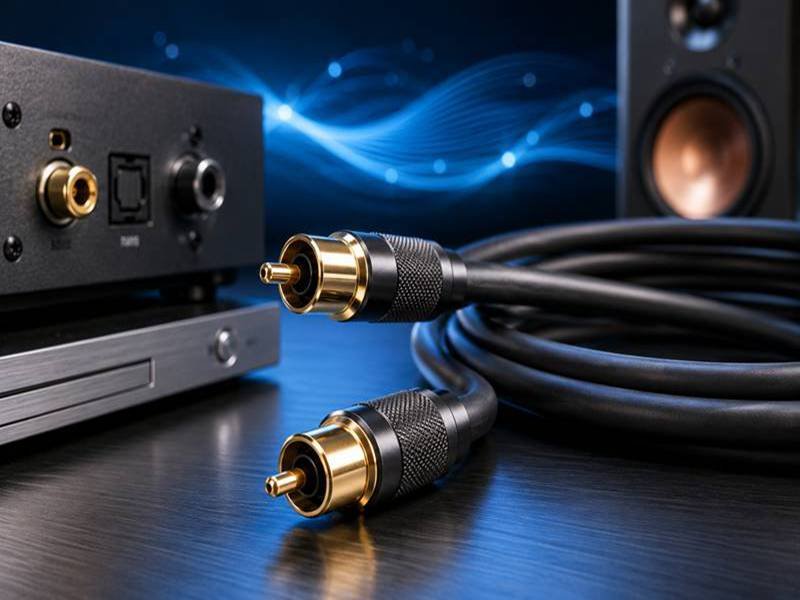
A digital coaxial cable looks simple from the outside. In many cases, it is just one cable with RCA-style plugs at both ends. But inside the cable, the structure is far more important than most users realize. The cable must carry fast digital audio pulses from one device to another without creating too much signal reflection, noise, or timing instability. That is why a real digital coaxial cable is not just “any RCA cable.” It is normally designed as a 75-ohm coaxial cable, with a center conductor, insulation layer, shielding, and an outer jacket working together to protect the signal.
A digital coaxial cable is a shielded 75-ohm cable used to transmit digital audio signals between devices such as TVs, soundbars, AV receivers, CD players, DACs, and professional audio equipment. It commonly uses RCA connectors and carries S/PDIF digital audio signals. Compared with analog RCA cables, it is built for digital pulse transmission, impedance control, and better signal stability.
For most home users, a digital coaxial cable is used when HDMI ARC, Bluetooth, or optical audio is not the best choice. For engineers and OEM buyers, the concern is more practical: Can the cable meet the required impedance? Is the shielding strong enough? Can the connector fit the device housing? Can the supplier provide drawings, specifications, samples, and stable batch production?
This is where cable quality starts to matter. A cheap cable may work on a short home audio connection, but it may fail in a long-distance installation, a noisy electrical environment, or a device that needs stable repeatable performance. In real projects, many audio problems are not caused by the speaker or amplifier. They start from a cable that was never designed for the signal it is carrying.
What Is a Digital Coaxial Cable?
A digital coaxial cable is a specialized 75-ohm cable used to transmit digital audio signals between electronic devices. It is commonly found in home theater systems, televisions, AV receivers, DACs, CD players, media streamers, professional audio equipment, and industrial multimedia systems.

Although many digital coaxial cables use the same RCA connector shape as traditional analog audio cables, the internal construction is completely different. A true digital coaxial cable is engineered to maintain stable impedance, minimize signal reflection, and protect digital data from electromagnetic interference.
For most users, the cable simply carries sound from one device to another. For engineers and equipment manufacturers, however, the cable is a signal transmission component that directly affects system stability, audio synchronization, and long-term reliability.
Digital Coaxial Cable Basics
The easiest way to understand a digital coaxial cable is to think of it as a dedicated pathway for digital audio data.
Unlike analog audio cables that carry continuously changing electrical waveforms, digital coaxial cables transmit digital pulses representing audio information.
These pulses travel at very high speeds. If the cable structure is not properly controlled, signal reflections can occur inside the cable itself, potentially affecting data transmission quality.
This is why digital coaxial cables are built around a controlled 75-ohm impedance standard.
The most common applications include:
| Source Device | Receiving Device |
|---|---|
| Television | Soundbar |
| Television | AV Receiver |
| CD Player | Amplifier |
| DVD Player | Audio Processor |
| DAC | Amplifier |
| Media Player | Home Theater System |
Many people ask whether a digital coaxial cable improves sound quality.
The cable itself does not “improve” the audio signal. Its role is to preserve the original digital data as accurately as possible while it travels between devices.
A poorly designed cable may introduce signal instability, while a properly designed cable helps maintain consistent performance.
The most important specifications buyers usually evaluate include:
| Specification | Typical Value |
|---|---|
| Impedance | 75 Ohm |
| Signal Type | Digital Audio |
| Connector Type | RCA or BNC |
| Shielding | Foil, Braid, or Double Shield |
| Common Length | 0.5m to 10m |
| Protocol | S/PDIF |
Many OEM manufacturers require more than a standard retail cable. They often need custom lengths, special connectors, improved shielding, or specific jacket materials to fit their equipment design.
This is why custom cable assemblies continue to be widely used in professional audio, industrial electronics, and medical equipment manufacturing.
Digital Coaxial Cable Structure
The performance of a digital coaxial cable depends largely on its internal structure.
From the outside, most cables look similar. Inside, however, there can be significant differences in conductor quality, shielding coverage, insulation materials, and manufacturing precision.
A standard digital coaxial cable consists of five primary layers:
| Layer | Function |
|---|---|
| Center Conductor | Carries the digital signal |
| Dielectric Insulation | Maintains impedance |
| Foil Shield | Blocks high-frequency EMI |
| Braided Shield | Improves shielding effectiveness |
| Outer Jacket | Mechanical protection |
Each layer contributes to signal stability.
The conductor is typically made from:
- Bare copper
- Tinned copper
- Silver-plated copper
Copper remains the most widely used material because it offers an excellent balance between conductivity, flexibility, and cost.
The insulation layer plays a critical role in maintaining the cable’s 75-ohm impedance. Even small variations in insulation thickness can affect signal transmission characteristics.
Shielding becomes increasingly important as cable length increases or when the cable is installed near sources of electrical noise.
For example, interference may come from:
- Power supplies
- Motors
- Inverters
- Wi-Fi equipment
- Industrial control systems
- Medical imaging equipment
This is why many professional-grade digital coaxial cables use both foil shielding and braided shielding.
Typical shielding coverage levels include:
| Shield Coverage | Application |
|---|---|
| 60%-70% | Basic consumer products |
| 80%-85% | General audio equipment |
| 90%-95% | Professional audio systems |
| Above 95% | Industrial and medical equipment |
At Sino-Conn, shielding configurations are frequently customized according to the operating environment. A cable used inside a home theater system may require a different shield structure than one installed inside medical monitoring equipment or industrial control hardware.
Digital Coaxial Cable Signals
One of the biggest misunderstandings about digital audio is the belief that “digital is digital,” meaning the cable does not matter.
In reality, signal transmission quality still matters.
Digital audio travels through the cable as a series of electrical pulses. The receiving device must accurately interpret those pulses.
Several factors can influence signal stability:
| Factor | Potential Impact |
|---|---|
| Incorrect Impedance | Signal Reflection |
| Poor Shielding | EMI Noise |
| Excessive Length | Signal Attenuation |
| Inferior Connectors | Intermittent Connection |
| Physical Damage | Signal Loss |
For short consumer installations, users may not notice any obvious difference.
However, challenges become more apparent in:
- Equipment racks
- Broadcast systems
- Audio production studios
- Medical electronics
- Industrial monitoring systems
A useful comparison is shown below:
| Installation Environment | Signal Risk Level |
|---|---|
| Living Room TV System | Low |
| Conference Room | Medium |
| Recording Studio | Medium-High |
| Factory Floor | High |
| Medical Equipment | High |
| Industrial Automation | High |
This is one reason many professional equipment manufacturers insist on verified cable specifications rather than generic audio cables.
One Sino-Conn customer developing an industrial audio monitoring system originally used a standard RCA cable purchased locally. The prototype worked during bench testing, but signal dropouts appeared once the cable was installed inside a cabinet containing power supplies and motor controllers.
After reviewing the application, Sino-Conn engineers redesigned the assembly using:
- True 75-ohm coaxial construction
- Foil and braided shielding
- Higher shielding coverage
- Improved strain relief
The revised cable eliminated the communication issues without requiring any modifications to the customer’s electronics.
Cases like this are common because many signal problems originate from cable design rather than the equipment itself.
For this reason, experienced engineers often evaluate the cable as part of the entire system rather than treating it as a simple accessory.
When selecting a digital coaxial cable, the focus should not only be on connector appearance or price. The actual application environment, cable routing path, required length, shielding requirements, and signal sensitivity all play important roles in determining whether the cable will perform reliably over the long term.
For OEM manufacturers and product developers, this is where a custom cable supplier can add significant value. At Sino-Conn, customers frequently provide only a photo, a sample, or a rough concept. The engineering team then helps define the cable structure, shielding configuration, connector selection, and manufacturing drawing before production begins, helping customers reduce development risk and accelerate product launch schedules.

What Does a Digital Coaxial Cable Do?
A digital coaxial cable transfers digital audio data from one device to another while maintaining signal stability and minimizing data loss. Instead of carrying analog sound waves, it carries digital bitstreams that can be decoded by the receiving device into music, speech, movie soundtracks, or surround sound effects.
In simple terms, the cable acts as a dedicated highway for digital audio information. Its job is not to improve the sound or add audio effects. Its job is to ensure that the audio data leaving one device arrives at the destination accurately and consistently.
This may sound straightforward, but in real-world installations, cable performance can directly affect system reliability. A poorly designed cable can lead to signal dropouts, synchronization issues, intermittent audio loss, or unstable connections, especially when cable lengths increase or equipment operates in electrically noisy environments.
For both consumers and equipment manufacturers, understanding what a digital coaxial cable actually does helps avoid selecting the wrong cable and prevents unnecessary troubleshooting later.
Digital Coaxial Cable for TV
One of the most common uses for a digital coaxial cable is connecting a television to an external audio system.
Although modern TVs often include HDMI ARC or eARC connections, millions of televisions still use digital coaxial outputs because they provide a simple and highly reliable audio path.
A common setup looks like this:
TV → Digital Coaxial Cable → Soundbar
TV → Digital Coaxial Cable → AV Receiver
TV → Digital Coaxial Cable → Home Theater Processor
When a television sends audio through a digital coaxial connection, the audio remains in digital format throughout transmission. The receiving device then processes and converts that digital information into sound.
This approach offers several practical benefits:
| Benefit | Description |
|---|---|
| Stable Connection | No wireless interference |
| Low Latency | Minimal audio delay |
| Easy Installation | Simple plug-and-play setup |
| Strong Compatibility | Supported by many audio devices |
| Consistent Performance | Less affected by environmental factors |
Many commercial installations still prefer digital coaxial connections because they require very little maintenance after installation.
Examples include:
- Hotel entertainment systems
- Conference rooms
- Digital signage systems
- Education facilities
- Public information displays
In these environments, reliability is often more important than having the newest connection technology.
A hotel with 300 televisions cannot afford frequent connectivity issues caused by unstable wireless audio links. A simple wired connection often delivers the best long-term performance.
One Sino-Conn customer producing digital advertising displays required a customized digital coaxial cable assembly because the standard cable length caused installation difficulties inside their display housing. By switching to a custom-length assembly with improved strain relief, installation time was reduced and cable management became significantly cleaner.
Digital Coaxial Cable for Soundbars
Soundbars represent one of the fastest-growing applications for digital coaxial cables.
Many consumers purchase a soundbar because they want better audio than the TV’s built-in speakers can provide.
In these systems, the digital coaxial cable serves as the communication link between the television and the soundbar.
The cable transfers:
- Movie audio
- Music streams
- Voice dialogue
- Sports broadcasts
- Gaming audio
A typical consumer may never think about the cable after installation. However, soundbar manufacturers pay close attention to cable specifications because connection reliability directly affects the customer experience.
Several common customer complaints can often be traced back to poor cable quality:
| Common Issue | Possible Cable Cause |
|---|---|
| Intermittent audio | Loose connector fit |
| Audio cutting out | Shielding problems |
| Connection instability | Poor impedance control |
| Installation difficulty | Oversized connector housing |
| Physical damage | Weak strain relief |
This is why many OEM soundbar manufacturers avoid generic low-cost cables.
Instead, they frequently specify:
- Controlled 75-ohm impedance
- Higher shielding coverage
- Compact connector housings
- Flexible cable jackets
- Exact cable lengths
For example, a cable supplied with a soundbar may only need to be 1.2 meters long. Using a standard 2-meter cable creates unnecessary excess cable inside packaging and often frustrates users during installation.
At Sino-Conn, many soundbar projects involve exact-length cable assemblies produced specifically for the customer’s product line. Even small changes in cable length can improve packaging efficiency, reduce material waste, and create a cleaner user experience.
For manufacturers shipping thousands of units per month, these small improvements can generate meaningful cost savings.
Digital Coaxial Cable for Audio Systems
Digital coaxial cables are widely used in both consumer and professional audio systems because they provide a reliable way to transfer digital audio signals between devices. Unlike analog cables, which transmit continuously varying electrical signals, digital coaxial cables transmit encoded digital data with high accuracy and minimal signal degradation.
Common source devices include CD players, DVD players, Blu-ray players, media streamers, DACs (Digital-to-Analog Converters), audio servers, and professional broadcasting equipment. These devices typically send digital audio data to receiving equipment for decoding and playback.
The receiving equipment may include:
| Receiving Device | Function |
|---|---|
| AV Receivers | Decode and process digital audio signals |
| Amplifiers | Drive speakers with processed audio |
| Digital Processors | Manage audio routing and signal processing |
| Active Speakers | Receive and reproduce digital audio |
| Audio Controllers | Control and distribute audio signals |
| Recording Systems | Capture and store digital audio content |
In these systems, the digital coaxial cable serves as the communication link between components. The transmitted data may include standard PCM stereo audio, Dolby Digital formats, DTS audio streams, and various compressed surround sound formats.
As audio systems become more sophisticated, signal integrity becomes increasingly important. A modern recording studio, broadcast facility, or audio production environment often contains numerous electronic devices operating simultaneously, including mixing consoles, power amplifiers, computer workstations, lighting controllers, network switches, and wireless communication equipment.
Each of these devices can generate electromagnetic interference (EMI). Without proper cable design, interference can affect digital signal transmission, leading to data errors, synchronization issues, or intermittent performance problems.
For this reason, professional installations often require higher-performance cable constructions.
| Feature | Recommended Specification |
|---|---|
| Impedance | 75 Ohm |
| Shielding Structure | Foil + Braided Shield |
| Shield Coverage | 85%–95% |
| Connector Construction | Precision Machined |
| Conductor Material | Copper or Silver-Plated Copper |
Long-term reliability is another major consideration.
A digital coaxial cable installed inside a home theater cabinet may experience little physical stress throughout its lifetime. However, cables used in industrial or commercial equipment often face far more demanding conditions, including continuous vibration, elevated operating temperatures, strong electromagnetic fields, tight installation spaces, and repeated maintenance access.
Under these conditions, a standard consumer cable may not provide adequate performance.
This is why many OEM manufacturers prefer custom-engineered cable assemblies tailored to their specific application requirements. Common customization requests include enhanced shielding structures, specialized jacket materials, reinforced strain relief designs, controlled bend radius specifications, and application-specific connector configurations.
Sino-Conn regularly works with manufacturers of industrial control systems, medical equipment, communication devices, and testing instruments where signal stability is critical. In many cases, customers initially request a simple RCA cable. After reviewing the operating environment and performance requirements, the project often evolves into a customized digital coaxial cable assembly designed specifically for the application.
One example involved a customer developing an industrial monitoring platform. During laboratory testing, the prototype system operated normally because the cable runs were short and installed in a relatively clean electromagnetic environment. After deployment, however, the cable was routed alongside motor controllers and power distribution wiring, resulting in intermittent communication issues.
Instead of redesigning the electronics, the engineering team upgraded the cable assembly to include true 75-ohm impedance control, foil-and-braid shielding, increased braid coverage, and improved connector grounding. Following installation of the new assembly, communication stability improved significantly without any hardware modifications.
This example highlights an important point: a digital coaxial cable is not merely a connection accessory. In many systems, it becomes an integral part of the signal transmission architecture.
Whether used in a home theater, soundbar system, professional recording studio, broadcast facility, or industrial control platform, the purpose remains the same—delivering digital audio data accurately, consistently, and reliably throughout the service life of the equipment.

Digital Coaxial Cable vs Optical Cable
When choosing an audio connection, one of the most common questions is whether a digital coaxial cable or an optical cable is the better option.
The reality is that both technologies are capable of transmitting high-quality digital audio. The better choice depends on the equipment being connected, the installation environment, cable routing conditions, durability requirements, and long-term reliability expectations.
Many consumers assume optical is newer and therefore automatically better. Many engineers assume coaxial is more robust and therefore always preferable. Neither assumption is completely accurate.
The right answer depends on the application.
Understanding the strengths and limitations of both technologies can help avoid compatibility issues, unnecessary costs, and future maintenance problems.
Signal Quality Comparison
One of the biggest misconceptions in the audio industry is that digital coaxial and optical cables produce dramatically different sound quality.
In most normal installations, both can deliver excellent audio performance when used correctly.
Both technologies transmit digital data rather than analog sound waves. The receiving device decodes the digital information and converts it into audio.
However, the transmission methods are completely different.
A digital coaxial cable uses electrical pulses traveling through a copper conductor.
An optical cable uses pulses of light traveling through a fiber core.
Basic comparison:
| Feature | Digital Coaxial Cable | Optical Cable |
|---|---|---|
| Transmission Method | Electrical Signal | Light Signal |
| Common Interface | RCA, BNC | TOSLINK |
| Physical Medium | Copper Conductor | Optical Fiber |
| EMI Immunity | High (with shielding) | Complete |
| Ground Loop Isolation | No | Yes |
| Connector Strength | High | Moderate |
| Cable Flexibility | Better | More Limited |
| Impact Resistance | Better | More Fragile |
In short cable runs found in home entertainment systems, most users will not hear a noticeable difference between the two.
The more important concern is signal stability.
For example:
TV → Soundbar
TV → AV Receiver
CD Player → DAC
Media Player → Amplifier
In these common setups, both technologies perform extremely well when quality cables are used.
The situation changes when cables are exposed to:
- Electrical interference
- Frequent movement
- Tight installation spaces
- Industrial environments
- Long service life requirements
In those situations, cable construction often matters more than the transmission technology itself.
A well-manufactured digital coaxial cable will usually outperform a poorly made optical cable.
Likewise, a high-quality optical cable will outperform a low-grade coaxial cable with inadequate shielding.
One issue frequently seen by OEM manufacturers is connector quality rather than transmission technology. A loose connector can cause more problems than the actual cable type.
This is why many equipment manufacturers pay close attention to connector retention force, shielding coverage, and cable durability during qualification testing.
Distance Comparison
Cable length is another important factor when comparing digital coaxial and optical solutions.
Many installations involve short cable runs of 1 to 3 meters, where both technologies perform very well.
As distance increases, the quality of the cable becomes increasingly important.
The following table provides a practical comparison:
| Cable Length | Digital Coaxial Cable | Optical Cable |
|---|---|---|
| 0.5m – 2m | Excellent | Excellent |
| 2m – 5m | Excellent | Excellent |
| 5m – 10m | Very Good | Good |
| 10m – 15m | Depends on cable quality | Depends on fiber quality |
| Above 15m | Application-specific | Application-specific |
For most consumer applications, distance is rarely a deciding factor because the cable length remains relatively short.
For equipment manufacturers, however, routing conditions can significantly influence cable selection.
Consider several common examples:
| Application | Typical Cable Length |
|---|---|
| TV to Soundbar | 1m – 2m |
| Home Theater Rack | 2m – 5m |
| Commercial Display System | 3m – 10m |
| Industrial Control Cabinet | 2m – 8m |
| Broadcast Equipment Rack | 5m – 15m |
In industrial and commercial systems, cables are often routed through:
- Metal enclosures
- Cable trays
- Equipment cabinets
- Control panels
Digital coaxial cables generally tolerate these environments better because the cable structure is mechanically stronger.
Optical cables require greater attention to bending radius.
Excessive bending can damage the fiber and reduce transmission performance.
Typical bending comparison:
| Characteristic | Digital Coaxial Cable | Optical Cable |
|---|---|---|
| Bend Resistance | High | Moderate |
| Crush Resistance | High | Lower |
| Pull Strength | Better | More Sensitive |
| Connector Durability | Better | More Delicate |
For customers developing equipment that will be transported frequently, vibration and mechanical durability often become important decision factors.
This is one reason why many industrial equipment manufacturers continue to use digital coaxial solutions even when optical interfaces are available.
Which Connection Is Better?
The better question is not which technology is superior.
The better question is which technology fits the actual application.
The answer often depends on five key factors:
| Selection Factor | Digital Coaxial | Optical |
|---|---|---|
| Durability | Excellent | Good |
| EMI Protection | Very Good | Excellent |
| Mechanical Strength | Excellent | Moderate |
| Ground Isolation | Moderate | Excellent |
| Customization Options | Excellent | Limited |
For home users:
Both are excellent choices.
If your TV and soundbar support both interfaces, either connection will usually provide excellent audio performance.
For commercial equipment:
Digital coaxial is often preferred because of its mechanical durability and connector strength.
For industrial applications:
Digital coaxial frequently offers better long-term reliability when combined with proper shielding.
For environments with severe electrical noise:
Optical may have an advantage because light transmission is completely immune to electromagnetic interference.
For OEM equipment manufacturers:
The decision often depends on product design constraints rather than audio performance alone.
Important engineering considerations include:
- Available installation space
- Connector size
- Cable routing path
- Production cost
- Assembly efficiency
- Serviceability
- Long-term durability
A practical example comes from a customer developing an industrial audio monitoring platform.
The first prototype used optical transmission because the engineering team wanted maximum immunity to electrical noise.
During field testing, however, maintenance personnel frequently disconnected and reconnected the cables.
After several months, damaged optical connectors became a recurring issue.
The engineering team reviewed the installation environment and determined that a reinforced digital coaxial cable assembly would provide better long-term reliability.
Sino-Conn developed a customized solution featuring:
- True 75-ohm construction
- High-coverage foil and braid shielding
- Reinforced strain relief
- Ruggedized connector housing
- Custom cable length
The updated design improved durability while maintaining stable signal transmission throughout the installation.
This type of situation is common in real projects.
The decision is rarely based solely on signal performance.
Mechanical reliability, installation requirements, maintenance conditions, and manufacturing practicality often have a greater impact on the final choice.
For this reason, many OEM customers evaluating digital coaxial versus optical cables begin by answering a few practical questions:
| Question | Why It Matters |
|---|---|
| Will the cable move frequently? | Affects durability requirements |
| Is there significant EMI nearby? | Influences shielding requirements |
| Is installation space limited? | Determines connector selection |
| What is the expected service life? | Influences material selection |
| Will the cable be customized? | Affects manufacturability |
| What certifications are required? | Impacts material choices |
At Sino-Conn, customers frequently approach us believing they need either an optical cable or a digital coaxial cable based solely on the connector type used by a competitor’s product.
After reviewing the application environment, routing conditions, cable length, durability requirements, and production targets, the recommended solution is sometimes different from the original request.
The goal is not simply to match an existing cable.
The goal is to provide the most reliable signal transmission solution for the actual operating environment.
That is why successful cable selection starts with understanding how the system will be used, not just how the connector looks.
How Do You Choose a Digital Coaxial Cable?
Choosing a digital coaxial cable is easier when you focus on the factors that actually affect performance. Many buyers spend too much time comparing marketing claims while overlooking the specifications that determine whether the cable will work reliably in their application.
For a home user, the right cable may simply be a 1-meter 75-ohm cable connecting a TV to a soundbar. For an OEM manufacturer, medical device company, or industrial equipment builder, the decision becomes much more complex because cable length, shielding, connector design, flexibility, certifications, and production consistency all matter.
Before purchasing a digital coaxial cable, it is worth evaluating five key areas:
- Impedance
- Shielding
- Length
- Connector quality
- Installation environment
A cable that performs well in a living room may not survive inside a factory control cabinet or a medical imaging system. The best cable is not necessarily the most expensive one. It is the one that matches the real operating conditions.
Digital Coaxial Cable Impedance
The first specification to check is impedance.
A true digital coaxial cable should have a characteristic impedance of 75 ohms.
This specification is important because S/PDIF digital audio signals are designed around the 75-ohm standard. When impedance is not controlled correctly, part of the signal can be reflected back through the cable instead of reaching the receiving device cleanly.
This effect becomes more noticeable as cable length increases.
Many buyers assume all RCA cables are the same because they use similar connectors.
In reality, there is a major difference between a digital coaxial cable and a standard analog RCA cable.
| Cable Type | Typical Impedance |
|---|---|
| Digital Coaxial Cable | 75 Ohm |
| Video Coaxial Cable | 75 Ohm |
| RF Communication Cable | 50 Ohm |
| Standard Analog RCA Cable | Often Unspecified |
| Speaker Wire | Not Controlled |
A standard RCA audio cable may work temporarily in some digital audio systems, especially with short cable runs.
However, when the application requires:
- Long cable lengths
- Stable signal transmission
- Professional audio equipment
- Industrial electronics
- OEM production
Using a true 75-ohm cable becomes increasingly important.
Many equipment manufacturers specifically request impedance-controlled cables because production consistency matters.
For example, one cable may work during prototype testing, but hundreds of units produced later could behave differently if impedance control is not maintained during manufacturing.
At Sino-Conn, impedance-controlled cable assemblies are commonly supplied for digital audio equipment, communication systems, industrial electronics, and medical devices where signal integrity requirements are more demanding than typical consumer applications.
Digital Coaxial Cable Shielding
After impedance, shielding is usually the next most important consideration.
Digital audio signals can be affected by electromagnetic interference generated by nearby equipment.
Common interference sources include:
- AC power cables
- Power supplies
- Industrial motors
- Variable frequency drives
- Wireless transmitters
- High-speed communication systems
A cable installed behind a television may encounter very little interference.
A cable routed inside an industrial cabinet may be surrounded by multiple noise sources.
This is why shielding design matters.
Common shielding structures include:
| Shield Type | Protection Level | Typical Application |
|---|---|---|
| Aluminum Foil | Basic | Home audio |
| Braided Shield | Medium | Consumer electronics |
| Foil + Braid | High | Professional audio |
| Double Braid | Very High | Industrial systems |
| Multi-Layer Shield | Maximum | Medical and specialized equipment |
Shield coverage is another important specification.
| Braid Coverage | Performance |
|---|---|
| 60% | Basic protection |
| 75% | Standard protection |
| 85% | Professional grade |
| 95%+ | Industrial and medical grade |
Many buyers never ask about braid coverage.
Engineers usually do.
This is because shielding effectiveness can directly influence signal stability when equipment operates in challenging environments.
One Sino-Conn customer manufacturing industrial monitoring equipment experienced intermittent audio communication faults during field testing.
The electronics passed all laboratory tests.
The actual issue turned out to be EMI generated by nearby motor controllers.
The solution was not redesigning the electronics.
The solution was upgrading the cable from a foil-only structure to a foil-and-braid shield design with higher coverage.
The communication issue disappeared after installation.
This is why experienced engineers often evaluate the operating environment before selecting a cable.
Digital Coaxial Cable Length
Length is often overlooked until installation begins.
Many buyers simply purchase whatever length is available.
However, selecting the correct length can improve:
- Signal reliability
- Installation efficiency
- Product appearance
- Inventory management
- Manufacturing costs
Typical lengths include:
| Length | Common Application |
|---|---|
| 0.5m | DAC connections |
| 1m | TV to soundbar |
| 2m | Home theater systems |
| 3m | Equipment racks |
| 5m | Commercial displays |
| 10m+ | Professional installations |
Several problems can occur when the cable is too long:
- Excess cable clutter
- Difficult cable routing
- Higher material costs
- Increased risk of cable damage
Conversely, cables that are too short may:
- Stress connectors
- Restrict equipment placement
- Increase installation difficulty
For OEM products, custom lengths often make more sense than standard retail lengths.
Consider the following example:
| Installation | Standard Cable | Actual Requirement |
|---|---|---|
| Display Controller | 2m | 1.2m |
| Soundbar System | 3m | 1.5m |
| Equipment Rack | 5m | 3.8m |
Using the correct length can reduce assembly time and improve cable management.
At Sino-Conn, custom lengths are one of the most frequently requested modifications. Many customers specify exact cable lengths because they want every product assembled consistently without unnecessary cable loops or excess material.
Digital Coaxial Cable Connectors
The connector may seem like a small detail, but it often determines whether the cable integrates smoothly into the final product.
Most digital coaxial cables use RCA connectors.
However, there are significant differences in connector quality.
Important factors include:
| Feature | Why It Matters |
|---|---|
| Contact Material | Affects conductivity |
| Plating Quality | Influences corrosion resistance |
| Connector Retention | Prevents loose connections |
| Housing Size | Determines fit in tight spaces |
| Strain Relief | Improves durability |
Many equipment manufacturers face space limitations.
A standard RCA connector may physically fit but leave insufficient clearance for neighboring ports.
Common connector options include:
| Connector Style | Application |
|---|---|
| Straight RCA | Standard audio equipment |
| Right-Angle RCA | Limited space installations |
| Slim RCA | Compact devices |
| Locking Connector | High-vibration environments |
| BNC Connector | Professional equipment |
One customer developing an audio controller discovered that standard RCA connectors interfered with nearby ports because of limited panel spacing.
Instead of redesigning the enclosure, a custom low-profile connector assembly was developed.
The solution reduced costs and accelerated product launch.
Connector selection often affects usability more than buyers initially expect.
Installation Environment
The final selection factor is the environment where the cable will actually operate.
This is often the factor that separates a successful project from one that experiences ongoing reliability issues.
The following table illustrates how cable requirements change across different applications:
| Environment | Recommended Cable Structure |
|---|---|
| Home Theater | Standard 75-ohm cable |
| Soundbar System | Shielded coaxial cable |
| Conference Room | Foil + braid shielding |
| Recording Studio | Professional-grade shielding |
| Factory Equipment | Enhanced shielding |
| Medical Device | Custom-engineered cable |
| Test Equipment | Controlled impedance assembly |
Questions worth asking before selecting a cable include:
- Will the cable be installed near power wiring?
- Will the cable experience vibration?
- Does the cable need frequent movement?
- Is flexibility important?
- Are there space limitations?
- Are regulatory certifications required?
- Does the product require long-term production support?
Many OEM customers approach Sino-Conn with only a device photo or rough concept.
Once the application is reviewed, the recommended cable often differs from the original request because environmental conditions reveal additional requirements.
For example:
| Original Request | Final Solution |
|---|---|
| Standard RCA Cable | 75-ohm digital coaxial cable |
| Single Shield | Double Shield |
| Standard Length | Custom Length |
| Straight Connector | Right-Angle Connector |
| PVC Jacket | Flexible TPU Jacket |
The most successful projects usually begin with a detailed discussion of how the cable will actually be used.
A digital coaxial cable may appear simple from the outside, but selecting the correct impedance, shielding, length, connector, and materials can significantly improve reliability, reduce installation problems, and lower long-term maintenance costs.
That is why professional equipment manufacturers rarely choose cables based solely on appearance or price. They choose cables based on performance requirements, operating conditions, and long-term production goals.
Can a Digital Coaxial Cable Be Customized?
Yes. In fact, a large percentage of digital coaxial cables used inside commercial equipment, industrial systems, medical devices, communication products, and OEM electronics are customized rather than purchased as standard retail products.
Most off-the-shelf cables are designed to satisfy the widest possible range of users. Equipment manufacturers often have completely different requirements. They may need a specific cable length, a particular connector orientation, enhanced shielding, a special jacket material, or documentation to support regulatory compliance.
For example, a standard 2-meter RCA digital coaxial cable sold online may work perfectly in a living room. However, it may be completely unsuitable for:
- A medical imaging device
- An industrial control cabinet
- A digital signage system
- A rack-mounted audio processor
- A broadcast communication system
These applications often require the cable to fit precise spaces, survive harsh environments, or integrate into production assembly processes.
This is where customization becomes valuable.
The goal is not simply to make a cable look different. The goal is to make the cable fit the actual product and operating environment.
Custom Digital Coaxial Cable Lengths
Length customization is one of the most common requests received from OEM manufacturers.
Many standard cables are available in lengths such as:
- 0.5 meter
- 1 meter
- 2 meters
- 3 meters
- 5 meters
These lengths work well for general consumer applications.
Product manufacturers often need something completely different.
Examples include:
| Application | Required Length |
|---|---|
| Medical Monitor | 0.35m |
| Digital Signage Controller | 1.25m |
| Industrial Audio Module | 2.8m |
| Broadcast Rack System | 4.3m |
| Test Equipment | 7.6m |
Using an incorrect cable length creates several challenges:
| Problem | Result |
|---|---|
| Cable Too Long | Clutter, wasted material |
| Cable Too Short | Installation difficulties |
| Excess Loops | Reduced airflow inside equipment |
| Inconsistent Lengths | Slower production assembly |
Many customers underestimate how much time is spent managing excess cable during manufacturing.
A production line assembling 10,000 devices per year may save hundreds of labor hours simply by using the correct cable length.
One Sino-Conn customer manufacturing commercial display systems originally used a standard 3-meter cable because it was easy to source.
The actual installation only required 1.7 meters.
After switching to a custom assembly:
- Installation time decreased
- Cable management improved
- Packaging volume was reduced
- Material waste was minimized
The change was simple, but the long-term savings were significant.
Custom Digital Coaxial Cable Connectors
Connector customization is often just as important as cable length.
Most consumer digital coaxial cables use standard RCA connectors.
For equipment manufacturers, connector selection is often driven by:
- Space limitations
- Mechanical requirements
- Assembly requirements
- Product appearance
- Durability expectations
Common customization options include:
| Connector Option | Benefit |
|---|---|
| Right-Angle RCA | Saves installation space |
| Slim RCA | Fits crowded panels |
| Locking Connector | Prevents accidental disconnection |
| BNC Connector | Professional applications |
| Custom Overmold | Improved appearance and durability |
Many modern electronic devices have increasingly compact designs.
Engineers frequently encounter situations where:
- Ports are closely spaced
- Internal clearances are limited
- Connector access is restricted
A standard connector may technically fit but still create assembly challenges.
For example, one OEM audio equipment manufacturer approached Sino-Conn because their standard RCA connector interfered with an adjacent USB port.
Rather than redesigning the enclosure, a lower-profile connector housing was developed.
This allowed the existing product design to move forward without expensive tooling changes.
For many projects, connector customization helps avoid much larger redesign costs.
Custom Digital Coaxial Cable Shielding
Not all operating environments are the same.
A cable installed behind a television experiences very different conditions compared to a cable installed inside:
- Factory equipment
- Medical systems
- Automated test equipment
- Communication hardware
- Transportation systems
This is why shielding customization is often required.
The appropriate shielding structure depends on:
- Cable length
- EMI exposure
- Equipment sensitivity
- Installation location
Common shielding configurations include:
| Shield Structure | Typical Application |
|---|---|
| Foil Shield | Consumer electronics |
| Braided Shield | Commercial products |
| Foil + Braid | Professional audio |
| Double Shield | Industrial equipment |
| Multi-Layer Shield | Medical and specialized systems |
Higher shielding coverage typically provides greater protection against interference.
Examples:
| Braid Coverage | Typical Use |
|---|---|
| 60% | Basic consumer products |
| 80% | General electronics |
| 85% | Professional equipment |
| 95%+ | Industrial and medical applications |
One customer producing industrial monitoring equipment experienced intermittent communication problems after installation.
The electronics passed all laboratory tests.
The problem only appeared when the system was installed next to motor drives and switching power supplies.
After reviewing the application, Sino-Conn upgraded the cable to:
- True 75-ohm construction
- Foil and braided shielding
- Higher braid coverage
- Improved grounding termination
The issue disappeared without modifying the customer’s electronics.
This type of situation is extremely common because many signal problems originate from cable design rather than the equipment itself.
Custom Digital Coaxial Cable Materials
Cable material selection often receives less attention than connectors and shielding, but it can have a major impact on durability and compliance.
Different applications require different jacket materials.
Common options include:
| Jacket Material | Advantages |
|---|---|
| PVC | Cost-effective, widely used |
| TPU | Flexible and abrasion-resistant |
| TPE | Excellent flexibility |
| LSZH | Low smoke, halogen-free |
| FEP | High temperature resistance |
Environmental conditions often influence material selection.
Questions customers frequently ask include:
- Will the cable be exposed to oil?
- Will the cable operate outdoors?
- Is UV resistance required?
- Is flame resistance required?
- Does the cable need to bend repeatedly?
- Are medical-grade materials required?
For export projects, compliance requirements are also important.
Common requests include:
| Requirement | Purpose |
|---|---|
| RoHS | Restriction of hazardous substances |
| REACH | Chemical compliance |
| PFAS | Material disclosure requirements |
| UL | Safety compliance |
| COC | Certificate of Conformity |
| COO | Country of Origin |
At Sino-Conn, material selection is often reviewed during the early design stage to ensure the cable meets both performance and regulatory requirements before production begins.
Custom Digital Coaxial Cable Assemblies
The cable itself is often only one part of a complete assembly.
Many OEM customers require additional customization beyond the cable and connectors.
Common assembly requirements include:
| Custom Feature | Purpose |
|---|---|
| Product Labels | Traceability |
| Laser Marking | Identification |
| Color Coding | Assembly efficiency |
| Custom Packaging | Retail or OEM use |
| Overmolding | Improved durability |
| Strain Relief | Longer service life |
| Protective Sleeving | Mechanical protection |
Manufacturers frequently request supporting documentation as part of the project.
Typical deliverables include:
| Document | Purpose |
|---|---|
| CAD Drawing | Design review |
| PDF Drawing | Production approval |
| Specification Sheet | Technical verification |
| Inspection Report | Quality verification |
| Material Declaration | Compliance support |
One advantage many customers appreciate is engineering support during product development.
In many cases, the customer only provides:
- A photograph
- A hand sketch
- A competitor sample
- A rough specification
The complete design may not yet exist.
This is especially common among:
- Startups
- Product developers
- Engineering teams
- Industrial equipment manufacturers
- Medical device companies
At Sino-Conn, the engineering team regularly assists customers in defining:
- Cable structure
- Connector selection
- Shielding requirements
- Material choices
- Drawing development
For most projects, drawings are provided before production begins so customers can verify:
- Length
- Connector orientation
- Cable routing
- Appearance
- Materials
This process helps reduce misunderstandings and improves first-pass approval rates.
Another reason customers choose custom cable assemblies is flexibility.
Unlike many large connector brands that focus on high-volume standardized products, custom cable assembly manufacturers can often accommodate:
- Low-volume prototypes
- Small production runs
- Rapid design changes
- Special cable configurations
Sino-Conn supports projects starting from a single prototype all the way to mass production. Customers can choose original-brand connectors or compatible alternatives depending on budget, lead time, and availability requirements.
For many equipment manufacturers, customization is not a luxury feature. It is simply the most efficient way to obtain a cable that fits the product correctly, performs reliably, meets compliance requirements, and supports long-term production goals.
Conclusion
Digital coaxial cables may appear simple, but their performance depends on far more than the connector at each end.
The right cable combines controlled 75-ohm impedance, appropriate shielding, reliable connectors, suitable materials, and a design matched to the actual application. Whether the cable is being used in a home theater system, a professional audio installation, an industrial monitoring platform, or a medical device, choosing the correct structure can significantly improve long-term reliability.
For many projects, off-the-shelf products are sufficient. However, OEM manufacturers, engineers, and equipment designers often need something more specific:
- Custom lengths
- Special connectors
- Enhanced shielding
- Flexible jackets
- Exact drawings
- Compliance documentation
- Stable production support
That is where a custom cable assembly partner becomes valuable.
At Sino-Conn, we specialize in custom digital coaxial cable assemblies and other coaxial cable solutions for consumer electronics, industrial equipment, medical devices, test systems, and communication applications.
Whether you already have complete specifications or only a sample photo, our engineering team can help develop the right solution.
We can provide:
- Product photos and technical specifications
- CAD and PDF drawings for approval
- Original or compatible connector options
- Custom cable lengths and structures
- RoHS, REACH, PFAS, COC, and COO support
- Prototype samples
- Low-volume and high-volume production
- 100% inspection before shipment
Many successful projects begin with a simple question:
“Can you make a cable like this?”
If you have a digital coaxial cable project, send Sino-Conn your drawing, specification, sample, or even a photo. Our team will review the requirements and recommend a solution that balances performance, manufacturability, delivery time, and cost.
Your next digital coaxial cable assembly may be much easier to develop than you think.



