 Skip to content
RF Connector Types: Which One Is Right for Your Application?
- andy
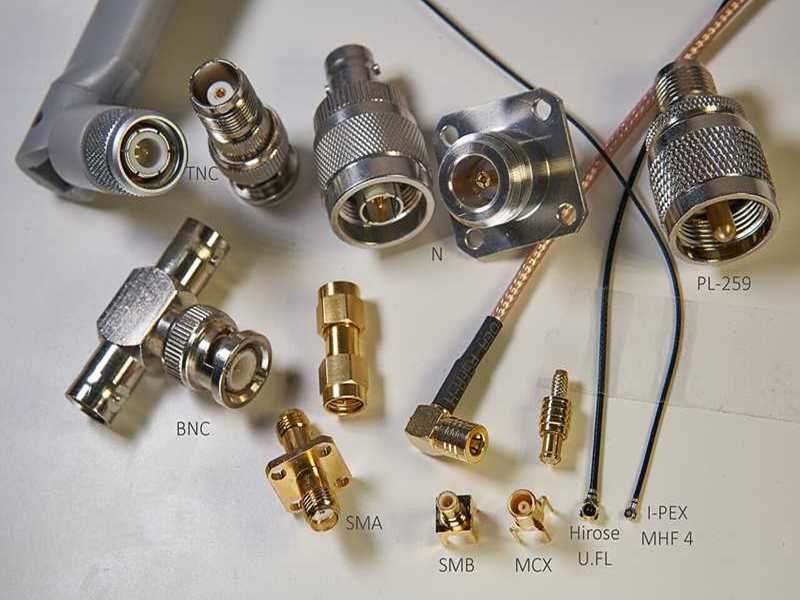
A small RF connector can decide whether a device works smoothly or keeps failing during testing. Many engineers first focus on the antenna, module, PCB design, or coaxial cable, but the connector is often where problems start. If the connector impedance is wrong, the signal reflects. If the coupling is too loose, vibration causes intermittent contact. If the plating or shielding is poor, insertion loss increases and EMI problems appear. If the connector is not suitable for outdoor use, moisture may enter the cable assembly and shorten the product life.
RF connector types differ by frequency range, impedance, size, coupling method, cable compatibility, power capacity, waterproof performance, and mechanical strength. Common RF connector types include SMA, SMB, SMC, BNC, TNC, N-Type, F-Type, MCX, MMCX, U.FL, 7/16 DIN, and QMA. The right choice depends on signal frequency, installation space, operating environment, mating cycles, and whether the product needs stable long-term performance.
This is why many customers do not simply ask, “Can you supply this connector?” Instead, they ask for photos, drawings, specifications, cable options, test data, and replacement solutions. At Sino-Conn, many RF cable assembly projects begin with only a connector model, a product photo, or an old sample. Our job is to help the customer confirm the connector type, match the right cable, create the drawing, test the assembly, and make sure the final product can be used safely in the real application.
One customer once sent us a photo of an outdoor wireless device cable. The connector looked similar to a standard SMA, but the system still had unstable signal performance after installation. After checking the cable structure, connector thread, impedance, and waterproof requirement, the problem was traced to a mismatch between connector choice and outdoor vibration exposure. The final solution used a stronger threaded RF connector with better sealing and a suitable coaxial cable. The cable was not complicated, but the original choice was wrong. That is exactly why understanding RF connector types matters before placing an order.
What Are RF Connector Types?
RF connector types are specialized coaxial connectors designed to transfer radio frequency signals between antennas, coaxial cables, wireless modules, communication equipment, medical devices, industrial systems, testing instruments, and many other electronic products. Unlike ordinary electrical connectors, RF connectors must maintain precise impedance, stable shielding, low signal loss, and consistent electrical performance throughout the entire signal path.
The reason RF connector types are so important is simple: every connection point introduces potential signal degradation. Even if you use a high-quality coaxial cable, poor connector selection can increase insertion loss, create impedance mismatches, generate signal reflections, and ultimately reduce system performance.
In modern communication systems, frequencies commonly range from several MHz to more than 40 GHz. As frequencies increase, connector quality becomes increasingly critical. A connector that performs well at 100 MHz may become a major source of signal loss at 10 GHz.
For many customers, RF connector selection directly affects:
- Signal transmission quality
- Communication distance
- Data transmission stability
- Antenna efficiency
- EMI shielding performance
- Product reliability
- Maintenance frequency
- Product certification success rate
This is why RF connector selection should be treated as an engineering decision rather than a purchasing decision.

What Is an RF Connector?
An RF connector is a connector specifically designed to carry high-frequency electrical signals while maintaining the characteristic impedance of the transmission line.
Most RF connectors are built around a coaxial structure consisting of:
- Center conductor
- Dielectric insulator
- Outer conductor
- Shielding structure
- Connector housing
The goal is to keep the signal path as uniform as possible from one device to another.
A simplified RF transmission path looks like this:
Antenna → RF Connector → Coaxial Cable → RF Connector → Device
Every connector in this path can affect performance.
Many engineers focus heavily on cable specifications while overlooking the connector. However, in practical applications, connectors are often the weakest point in the RF chain because they experience:
- Frequent mating and unmating
- Mechanical stress
- Vibration
- Moisture exposure
- Installation errors
- Wear over time
At Sino-Conn, customers frequently send us an existing RF cable assembly and ask why their signal performance has deteriorated over time. In many cases, the cable itself remains functional, while connector wear, corrosion, poor shielding contact, or damaged center contacts are responsible for the issue.
How Do RF Connectors Work?
RF connectors work by extending the controlled impedance structure of a coaxial cable through the connection interface.
Unlike low-frequency circuits, radio frequency signals are extremely sensitive to discontinuities.
When the signal encounters sudden changes in geometry or impedance, part of the signal energy reflects backward rather than continuing forward.
This phenomenon is called signal reflection.
Signal reflection can cause:
| Problem | Impact on System |
|---|---|
| Return Loss | Reduced transmission efficiency |
| VSWR Increase | Lower antenna performance |
| Signal Distortion | Data errors |
| Reduced Range | Communication instability |
| EMI Leakage | Increased interference |
This is why RF connector manufacturers carefully control dimensions inside the connector.
The center contact diameter, dielectric dimensions, air gaps, plating thickness, and connector geometry all influence RF performance.
For example, a standard SMA connector may contain tolerances measured in hundredths of a millimeter. Small manufacturing deviations can become significant at microwave frequencies.
A customer developing a wireless sensor network once approached Sino-Conn because devices installed 200 meters apart experienced unstable communication. The original assumption was that the antenna design was inadequate. After reviewing the assembly, we found that a low-quality connector introduced excessive signal loss. Replacing the connector and improving the assembly process significantly improved communication reliability without changing the antenna design.
Why Do RF Connector Types Matter?
Different RF connector types were developed because no single connector can satisfy every application requirement.
Each connector family is optimized for specific priorities.
Some prioritize frequency performance.
Others prioritize mechanical durability.
Some prioritize compact size.
Others focus on outdoor reliability.
The following comparison illustrates these differences:
| Connector Type | Main Strength | Common Industry |
|---|---|---|
| SMA | High frequency capability | Wireless communication |
| BNC | Quick connect/disconnect | Test equipment |
| TNC | Vibration resistance | Industrial systems |
| N-Type | Outdoor durability | Telecom infrastructure |
| MMCX | Compact size | Medical devices |
| MCX | Lightweight design | GPS equipment |
| F-Type | Cost-effective | Broadcast and TV |
| 7/16 DIN | High power handling | Cellular networks |
Choosing the wrong RF connector can create hidden costs throughout the product lifecycle.
For example:
An inexpensive connector may save $2 during manufacturing.
However, if field failures require technician visits, downtime, and replacement costs, the actual expense can become hundreds of dollars per unit.
For OEM manufacturers, connector reliability directly affects:
- Product warranty claims
- Customer satisfaction
- Installation costs
- Long-term maintenance expenses
This is why experienced engineers often spend more time evaluating connectors than many buyers expect.
What Specifications Are Important?
When evaluating RF connector types, customers should look beyond the connector model number.
Several key specifications determine whether a connector is suitable for an application.
Frequency Range
Frequency capability is usually the first parameter engineers review.
| RF Connector Type | Maximum Frequency |
|---|---|
| UHF | 300 MHz |
| BNC | 4 GHz |
| TNC | 11 GHz |
| SMA | 18 GHz |
| 3.5 mm | 34 GHz |
| 2.92 mm | 40 GHz |
| 2.4 mm | 50 GHz |
Selecting a connector with adequate frequency margin helps ensure long-term performance.
Impedance
Most RF systems use either:
- 50 Ohm
- 75 Ohm
Common 50 Ohm applications:
- Cellular communication
- WiFi systems
- GPS equipment
- RF testing
- Wireless modules
Common 75 Ohm applications:
- Broadcast equipment
- CCTV systems
- Video transmission
- Satellite systems
Impedance mismatches can create significant signal reflection and performance degradation.
Insertion Loss
Insertion loss measures how much signal power is lost as the signal passes through the connector.
Lower insertion loss means better efficiency.
Even a small increase becomes important in long cable runs or weak signal environments.

VSWR
VSWR (Voltage Standing Wave Ratio) indicates how effectively power is transferred.
Lower VSWR values generally indicate better RF performance.
Many communication systems target:
- VSWR ≤ 1.3
- VSWR ≤ 1.5
depending on application requirements.
Mating Cycles
Connector durability is often overlooked.
Different connectors support different mating cycle ratings.
| Connector Type | Typical Mating Cycles |
|---|---|
| SMA | 500+ |
| BNC | 500+ |
| N-Type | 500+ |
| MMCX | 100-500 |
| U.FL | 30-50 |
This becomes especially important in testing environments where connectors may be connected and disconnected multiple times daily.
Environmental Resistance
For industrial and outdoor applications, environmental specifications often determine connector lifespan.
Important factors include:
- Operating temperature
- Waterproof protection
- Corrosion resistance
- UV resistance
- Salt spray resistance
- Vibration resistance
Outdoor telecom customers often prioritize these specifications above frequency performance because long-term reliability directly affects maintenance costs.
What Information Should You Prepare Before Requesting a Quote?
Many RF cable assembly projects are delayed because critical information is missing.
The most efficient RF connector projects usually begin with the following information:
| Required Information | Why It Matters |
|---|---|
| Connector Type | Determines interface compatibility |
| Frequency Range | Determines connector suitability |
| Cable Type | Affects performance and assembly |
| Cable Length | Influences attenuation |
| Connector Gender | Ensures mating compatibility |
| Connector Orientation | Straight or right-angle |
| Environment | Indoor or outdoor |
| Quantity | Influences pricing and lead time |
| Compliance Requirements | RoHS, REACH, UL, etc. |
If complete information is unavailable, a photo or sample is often enough to begin evaluation.
This is very common at Sino-Conn.
Many customers initially send:
- A connector photo
- An old cable sample
- A product drawing
- A competitor’s cable assembly
Our engineering team then identifies the connector, recommends cable options, prepares drawings, and develops a complete RF cable assembly solution.
This approach is particularly valuable for distributors, OEM manufacturers, and engineering teams that understand the application but may not know the exact RF connector model required.
The result is a faster development cycle, reduced engineering risk, and a higher probability of achieving the required RF performance on the first production run.
Which RF Connector Types Are Most Common?
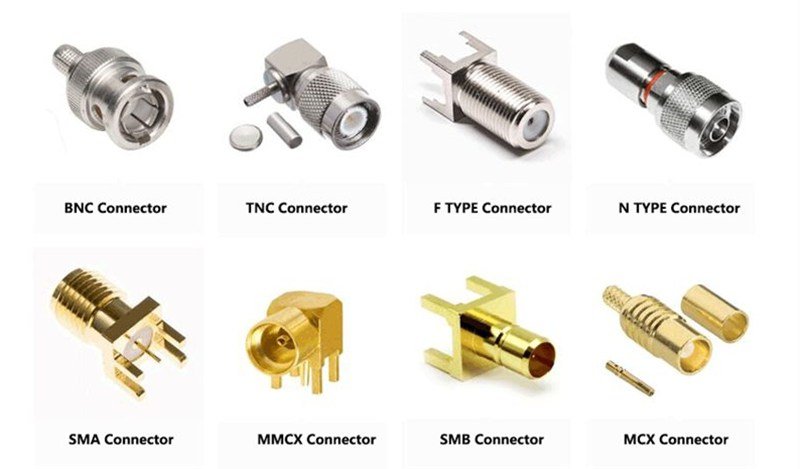
The most common RF connector types used today are SMA, SMB, SMC, BNC, TNC, N-Type, F-Type, MCX, MMCX, U.FL, 4.3-10, and 7/16 DIN connectors. Each connector family was developed to solve a specific engineering challenge, whether that challenge is high-frequency performance, compact installation space, outdoor durability, vibration resistance, or high-power transmission.
One of the biggest mistakes customers make is assuming that RF connectors with a similar appearance can be used interchangeably. In reality, two connectors that look nearly identical may support completely different frequency ranges, power levels, and operating environments.
At Sino-Conn, RF cable assembly inquiries usually fall into three categories:
- Engineers who already know the exact connector model they need.
- OEM manufacturers looking for a lower-cost alternative to an existing connector.
- Customers who only have a photo or sample and need help identifying the connector.
Understanding the strengths and limitations of the most common RF connector types helps customers make faster and more informed decisions.
RF Connector Types for General Use
Several RF connector types dominate the market because they offer a good balance of performance, reliability, availability, and cost.
The four most commonly requested connector families are:
| Connector Type | Frequency Range | Coupling Method | Common Industries |
|---|---|---|---|
| BNC | Up to 4 GHz | Bayonet Lock | Testing, Broadcast |
| TNC | Up to 11 GHz | Threaded | Industrial, Wireless |
| SMA | Up to 18 GHz | Threaded | RF Communication |
| N-Type | Up to 18 GHz | Threaded | Telecom, Outdoor Systems |
These connectors account for a significant portion of RF cable assembly demand worldwide because they cover most commercial and industrial applications.
For example:
BNC connectors remain popular in laboratories because technicians can connect and disconnect them quickly.
TNC connectors are often selected for industrial equipment because vibration resistance is better.
SMA connectors have become one of the most widely used RF connector types due to their compact size and excellent high-frequency performance.
N-Type connectors remain the preferred choice for many outdoor communication systems because they combine strong mechanical construction with excellent electrical characteristics.
A practical rule many engineers follow is:
- Indoor testing → BNC
- Wireless equipment → SMA
- Industrial equipment → TNC
- Outdoor communication → N-Type
While this is not always true, it provides a useful starting point.
RF Connector Types for High Frequency
As operating frequencies increase, connector selection becomes more critical.
Signal losses that are barely noticeable at 100 MHz can become significant at 6 GHz, 12 GHz, or higher.
High-frequency RF connector types are designed with tighter manufacturing tolerances and improved impedance control.
The most commonly used high-frequency connector families include:
| Connector Type | Maximum Frequency |
|---|---|
| SMA | 18 GHz |
| 3.5 mm | 34 GHz |
| 2.92 mm (K Connector) | 40 GHz |
| 2.4 mm | 50 GHz |
| 1.85 mm | 67 GHz |
Many customers assume they need the highest-frequency connector available.
However, this often increases cost unnecessarily.
For example:
A 2.4 GHz WiFi product generally does not require a 40 GHz connector.
An SMA connector usually provides more than enough performance while reducing overall system cost.
One European wireless equipment customer contacted Sino-Conn looking for 2.92 mm connectors because they believed higher frequency ratings automatically meant better performance.
After reviewing the project, we determined the system operated below 6 GHz.
Switching to a properly specified SMA assembly reduced connector costs significantly while maintaining excellent electrical performance.
The lesson is simple:
Select the connector based on actual operating frequency rather than the highest available specification.
RF Connector Types for Compact Devices
Electronic devices continue becoming smaller.
This trend has driven strong demand for miniature RF connector types.
Compact RF connectors are commonly used in:
- GPS devices
- WiFi modules
- Bluetooth products
- Medical devices
- IoT sensors
- Drones
- Portable instruments
- Embedded systems
The most common miniature RF connector families include:
| Connector Type | Relative Size |
|---|---|
| MCX | Very Small |
| MMCX | Ultra Small |
| U.FL | Miniature |
| IPEX | Miniature |
| MHF | Miniature |
These connectors are designed to save valuable space inside compact products.
However, customers should understand that miniaturization creates trade-offs.
Smaller connectors often have:
- Lower mating cycle ratings
- Lower pull strength
- More delicate center contacts
- Higher installation precision requirements
A U.FL connector may be ideal inside a wireless module but completely unsuitable as an external antenna connection that users will repeatedly disconnect.
One customer developing a handheld wireless monitoring device originally specified a U.FL connector for an external antenna port.
During testing, repeated connector handling caused failures.
The final design switched to SMA, which increased reliability without significantly increasing product size.
This type of design review is common during RF cable assembly development.
RF Connector Types for Outdoor Systems
Outdoor applications place far greater demands on RF connectors than indoor installations.
Outdoor RF cable assemblies may face:
- Rain
- Snow
- Salt spray
- UV exposure
- High humidity
- Temperature cycling
- Mechanical vibration
In these environments, connector durability often becomes more important than frequency performance.
The most common outdoor RF connector types include:
| Connector Type | Outdoor Suitability |
|---|---|
| N-Type | Excellent |
| TNC | Good |
| Waterproof SMA | Good |
| 7/16 DIN | Excellent |
| 4.3-10 | Excellent |
N-Type connectors have remained popular for decades because they combine:
- Strong threaded coupling
- Excellent weather resistance
- Good power handling
- Long service life
Many outdoor communication systems continue using N-Type connectors even as newer connector technologies emerge.
For cellular infrastructure, 4.3-10 connectors have become increasingly common.
Compared with traditional 7/16 DIN connectors, they provide:
- Smaller size
- Lower weight
- Easier installation
- Excellent passive intermodulation performance
At Sino-Conn, outdoor RF cable assembly projects often include additional protection features such as:
- Adhesive-lined heat shrink
- Waterproof boots
- UV-resistant cable jackets
- Corrosion-resistant connector plating
- Overmolded strain relief
These features can significantly extend service life in harsh environments.
RF Connector Types for High Power
Not all RF systems operate at low power.
Many communication systems, broadcast systems, and telecom installations require connectors capable of handling substantial RF power.
High-power RF connector types are specifically designed to manage:
- Higher current
- Higher voltage
- Increased thermal loads
- Greater mechanical stress
Common high-power RF connector families include:
| Connector Type | Power Handling Capability |
|---|---|
| N-Type | High |
| 4.3-10 | High |
| 7/16 DIN | Very High |
| EIA Flange | Extremely High |
These connectors are frequently used in:
- Cellular base stations
- Broadcast transmitters
- Radar systems
- RF amplifiers
- Military communication systems
The connector itself is only part of the solution.
Power handling also depends on:
- Cable diameter
- Dielectric material
- Connector plating
- Contact resistance
- Assembly quality
For example, a high-power connector installed on an undersized cable will not achieve its rated performance.
One telecom customer approached Sino-Conn with overheating issues in a base station feeder assembly.
The connector model itself was suitable.
However, the cable diameter was too small for the power level being transmitted.
After redesigning the cable assembly using a larger low-loss cable, operating temperatures decreased significantly and system reliability improved.
Which RF Connector Types Are Requested Most Often?
Based on RF cable assembly inquiries received by Sino-Conn, the most frequently requested RF connector types are:
| Ranking | Connector Type | Typical Application |
|---|---|---|
| #1 | SMA | Antennas, wireless devices |
| #2 | N-Type | Outdoor communication systems |
| #3 | BNC | Testing equipment |
| #4 | TNC | Industrial wireless systems |
| #5 | MMCX | Compact medical and IoT devices |
| #6 | MCX | GPS equipment |
| #7 | U.FL / IPEX | Internal wireless modules |
| #8 | 4.3-10 | Cellular infrastructure |
| #9 | 7/16 DIN | Telecom base stations |
| #10 | F-Type | Broadcast and TV systems |
The actual connector selected depends on much more than frequency.
Most successful RF cable assembly projects consider:
- Operating frequency
- Mechanical requirements
- Installation environment
- Available space
- Cable routing
- Budget targets
- Lead time requirements
- Long-term reliability
This is why many customers prefer discussing their application before finalizing a connector model.
In many cases, a small connector change can improve performance, simplify installation, reduce maintenance, or lower overall project costs.
For customers who are unsure which RF connector type is best, Sino-Conn can review product photos, samples, drawings, or application requirements and recommend suitable connector and cable assembly solutions before production begins.
How Do You Choose RF Connector Types?
Choosing RF connector types is not simply a matter of selecting the connector with the highest frequency rating or the lowest price. The correct connector must match the electrical requirements, mechanical requirements, environmental conditions, installation space, cable structure, and expected service life of the entire system.
Many RF performance issues originate from connector selection mistakes made during the design stage. In fact, several customers who contact Sino-Conn for troubleshooting discover that the cable itself is not the problem. The issue is often caused by an unsuitable connector type, incorrect impedance selection, poor mating stability, or environmental conditions that were not considered during development.
A practical RF connector selection process should evaluate five key factors:
- Operating frequency
- Impedance
- Installation environment
- Available space
- Installation method
Customers who consider all five factors early in the project typically experience fewer design revisions, lower maintenance costs, and faster product validation.
RF Connector Types by Frequency
Frequency should always be one of the first parameters reviewed when selecting RF connector types.
Every RF connector has a maximum operating frequency. Beyond that frequency, insertion loss, return loss, and signal reflections increase rapidly.
The following table provides a useful reference:
| Connector Type | Maximum Frequency |
|---|---|
| UHF | 300 MHz |
| F-Type | 1 GHz+ |
| BNC | 4 GHz |
| SMB | 4 GHz |
| TNC | 11 GHz |
| SMA | 18 GHz |
| 3.5 mm | 34 GHz |
| 2.92 mm | 40 GHz |
| 2.4 mm | 50 GHz |
| 1.85 mm | 67 GHz |
However, selecting a connector based only on maximum frequency can lead to unnecessary costs.
For example:
A 2.4 GHz WiFi device does not require a 40 GHz connector.
A GPS module operating at 1.575 GHz generally performs perfectly with a properly designed SMA or MCX connector.
Many first-time RF product developers assume that a higher-frequency connector automatically delivers better system performance. In reality, the connector should be matched to the actual operating range of the equipment.
A wireless communication customer once requested a precision microwave connector for an industrial gateway project. After reviewing the system, Sino-Conn engineers found that the equipment operated below 5 GHz. By selecting a properly specified SMA connector instead, the customer reduced connector costs substantially while maintaining excellent RF performance.
A good engineering rule is to choose a connector with sufficient frequency margin above the operating frequency rather than selecting the most expensive option available.
RF Connector Types by Impedance
Impedance matching is one of the most important factors in RF system performance.
Most RF systems use either:
- 50 Ohm impedance
- 75 Ohm impedance
The choice depends on the application.
| Impedance | Common Applications |
|---|---|
| 50 Ohm | Wireless communication, antennas, RF modules, GPS, test equipment |
| 75 Ohm | CCTV, broadcast, satellite TV, video transmission |
Many customers are surprised to learn that connectors with nearly identical appearances can have different impedance values.
For example:
A 50 Ohm BNC connector and a 75 Ohm BNC connector may look almost identical externally, but their internal geometry differs.
Using the wrong impedance can create:
- Signal reflection
- Higher VSWR
- Reduced transmission efficiency
- Data transmission instability
- Reduced communication distance
The impact becomes more noticeable as frequency increases.
The table below shows typical performance differences caused by impedance mismatch:
| Condition | Performance Impact |
|---|---|
| Correct Impedance | Stable signal transmission |
| Minor Mismatch | Small increase in return loss |
| Significant Mismatch | Noticeable signal degradation |
| Severe Mismatch | Communication failure possible |
At Sino-Conn, impedance verification is always confirmed before production. This is particularly important when customers provide only a sample cable or a product photo without detailed specifications.
RF Connector Types by Environment
The operating environment often determines connector selection more than electrical specifications.
A connector that works perfectly in an office environment may fail quickly in a factory, outdoor installation, or vehicle application.
Environmental conditions commonly include:
- Moisture
- Rain
- UV exposure
- Vibration
- Dust
- Salt spray
- Extreme temperatures
- Chemicals
The following comparison provides a practical guide:
| Environment | Recommended Connector Types |
|---|---|
| Laboratory | BNC, SMA |
| Industrial Automation | TNC, SMA |
| Outdoor Telecom | N-Type, 4.3-10 |
| Vehicle Systems | TNC, SMA |
| Broadcast Equipment | BNC, F-Type |
| Military Equipment | TNC, N-Type |
| Medical Devices | SMA, MMCX |
Outdoor installations deserve special attention.
For outdoor antenna systems, customers should evaluate:
- Waterproof performance
- Corrosion resistance
- Connector sealing
- UV-resistant cable jackets
- Long-term reliability
One telecom customer approached Sino-Conn after repeated failures in an outdoor wireless monitoring project. Investigation revealed that moisture was entering through the rear connector termination area rather than through the connector interface itself.
The final solution included:
- Waterproof N-Type connectors
- Adhesive-lined heat shrink
- UV-resistant cable jackets
- Additional sealing protection
The redesigned assembly significantly improved field reliability.
This example highlights an important point:
Choosing the connector alone is not enough. The entire RF cable assembly must be designed for the operating environment.
RF Connector Types by Size
Modern electronic products continue becoming smaller, creating new challenges for RF connector selection.
Available installation space often limits connector choices.
Connector size becomes particularly important in:
- IoT devices
- Medical equipment
- GPS systems
- Drones
- Portable electronics
- Embedded systems
The following table compares connector sizes:
| Connector Type | Relative Size |
|---|---|
| N-Type | Large |
| BNC | Medium |
| TNC | Medium |
| SMA | Small |
| MCX | Very Small |
| MMCX | Ultra Compact |
| U.FL | Miniature |
Smaller connectors offer obvious advantages:
- Reduced product size
- Lower weight
- Easier routing
- Better fit in compact devices
However, there are trade-offs.
As connectors become smaller:
- Pull strength decreases
- Mating cycle ratings often decrease
- Assembly precision becomes more critical
- Mechanical robustness may decrease
For example:
A U.FL connector may be perfect for an internal WiFi antenna connection.
The same connector may be a poor choice for an external antenna connection that users frequently disconnect.
One medical device manufacturer contacted Sino-Conn during development of a portable monitoring system. The engineering team initially selected U.FL connectors to save space. During testing, repeated servicing caused connector damage.
After reviewing the application, the design was modified to use MMCX connectors, which provided better durability while still meeting size constraints.
Space savings should always be balanced against long-term reliability.
RF Connector Types by Installation
The connector installation method affects both manufacturing efficiency and long-term performance.
Different RF connector families use different coupling mechanisms.
| Coupling Style | Connector Examples |
|---|---|
| Threaded | SMA, TNC, N-Type |
| Bayonet | BNC |
| Snap-On | SMB |
| Push-On | MCX, MMCX |
| Micro Snap-On | U.FL |
Each approach offers specific advantages.
Threaded Connectors
Threaded connectors provide:
- Excellent vibration resistance
- Secure mating
- Reliable long-term performance
Common examples:
- SMA
- TNC
- N-Type
These connectors are often preferred for:
- Industrial equipment
- Outdoor systems
- Vehicle applications
- Telecom infrastructure
Bayonet Connectors
Bayonet connectors provide:
- Fast installation
- Quick removal
- Simple operation
Common example:
- BNC
These connectors are widely used in:
- Laboratories
- Broadcast equipment
- Test environments
Technicians may connect and disconnect BNC connectors hundreds of times during equipment testing.
Snap-On Connectors
Snap-on connectors provide:
- Fast assembly
- Compact design
- Good convenience
Common examples:
- SMB
- MMCX
These are frequently used in compact electronic products.
The trade-off is lower vibration resistance compared with threaded connectors.
Push-On Connectors
Push-on connectors are primarily used when space is extremely limited.
Examples include:
- MCX
- U.FL
- IPEX
These connectors simplify assembly inside compact products but are generally not intended for frequent field servicing.
When reviewing installation requirements, customers should consider:
- How often the connector will be connected and disconnected
- Whether vibration is present
- Whether users will access the connector
- Available installation space
- Production assembly speed
These factors often influence connector selection as much as electrical specifications.
What Questions Should You Ask Before Choosing RF Connector Types?
Before requesting quotations or approving drawings, customers should answer the following questions:
| Question | Importance |
|---|---|
| What frequency does the system use? | Determines connector performance requirements |
| Is the system 50 Ohm or 75 Ohm? | Prevents impedance mismatch |
| Is the product indoor or outdoor? | Determines environmental protection requirements |
| How much installation space is available? | Limits connector size options |
| Will vibration occur? | Influences coupling method selection |
| How often will connectors be mated? | Affects connector lifespan requirements |
| What cable type will be used? | Determines connector compatibility |
| Is waterproof protection required? | Impacts connector and cable assembly design |
| What quantity is required? | Influences cost and lead time |
Customers who prepare these answers before contacting suppliers typically receive more accurate quotations, better technical recommendations, and fewer design revisions.
At Sino-Conn, many RF cable assembly projects begin with only a connector photo, a product sample, or a rough application description. Our engineering team helps customers identify suitable RF connector types, recommend compatible cable structures, prepare drawings for approval, and develop complete cable assembly solutions that balance performance, reliability, lead time, and cost.
The most successful RF projects are rarely the ones using the most expensive connector. They are usually the projects where the connector, cable, environment, and application requirements are properly matched from the beginning.
Where Are RF Connector Types Used?
RF connector types are used in almost every industry that relies on wireless communication, signal transmission, radio frequency measurement, data acquisition, navigation, broadcasting, or remote monitoring. From a small GPS antenna inside a handheld device to a large cellular base station serving thousands of users, RF connectors are the physical interface that allows signals to move efficiently between devices and systems.
Many customers assume RF connectors are only used in telecommunications. In reality, RF cable assemblies are now found in medical equipment, industrial automation, robotics, military systems, transportation, IoT devices, test instruments, aerospace equipment, and smart infrastructure projects.
The application environment often determines which RF connector type should be used.
For example:
- A laboratory may prioritize convenience and frequent connection cycles.
- A telecom operator may prioritize low signal loss and weather resistance.
- A medical device manufacturer may prioritize compact size and reliability.
- An industrial automation company may prioritize vibration resistance.
- A military contractor may prioritize durability under extreme conditions.
This is why experienced engineers usually begin connector selection by understanding the application rather than simply choosing a connector model.
At Sino-Conn, RF cable assembly projects come from a wide variety of industries. Although many customers request similar connector types, the final cable assembly design often differs significantly depending on where the product will be used.
RF Connector Types in Telecom
Telecommunications remains one of the largest users of RF connector technology worldwide.
Every cellular network depends on thousands of RF connections working continuously.
RF connectors are commonly found in:
- Cellular base stations
- Antenna feeder systems
- Distributed antenna systems (DAS)
- Small cell installations
- Signal repeaters
- Microwave backhaul systems
- Network testing equipment
- Wireless infrastructure cabinets
The rapid growth of 4G, 5G, private wireless networks, and industrial wireless communication continues to increase demand for high-performance RF cable assemblies.
Common telecom RF connector types include:
| Connector Type | Common Telecom Application |
|---|---|
| N-Type | Antenna feeder cables |
| 4.3-10 | Modern base stations |
| 7/16 DIN | Legacy cellular infrastructure |
| SMA | RF modules and radio equipment |
| TNC | Wireless communication devices |
Telecom operators are particularly sensitive to insertion loss because signal losses accumulate across long cable runs.
For example:
A signal loss increase of only 1 dB may reduce effective transmission performance and network efficiency.
For this reason, telecom customers often focus on:
- Low VSWR
- Low insertion loss
- Weather resistance
- Long service life
- Corrosion resistance
- Consistent impedance
One telecom customer approached Sino-Conn for antenna feeder cable assemblies used in an outdoor wireless monitoring project. The original supplier used standard connectors without sufficient environmental protection. After several months, moisture exposure caused performance degradation.
The replacement design incorporated:
- Outdoor-rated N-Type connectors
- UV-resistant cable jackets
- Waterproof heat shrink
- Enhanced strain relief
The upgraded assembly significantly improved long-term reliability.
RF Connector Types in Medical Devices
Medical devices often require a completely different approach to RF connector selection.
Unlike telecom applications where connector size may be less critical, medical equipment frequently demands compact designs, high reliability, and precise signal transmission.
RF connectors are commonly found in:
- Patient monitoring systems
- Wireless medical devices
- Surgical equipment
- Medical imaging systems
- Portable diagnostic instruments
- Telemedicine equipment
- Wearable healthcare devices
Common connector choices include:
| Connector Type | Medical Application |
|---|---|
| SMA | Imaging and communication modules |
| SMB | Internal signal connections |
| MMCX | Compact medical devices |
| MCX | Portable diagnostic equipment |
| U.FL | Internal wireless modules |
Medical equipment designers often prioritize:
- Compact size
- Reliable mating
- Consistent signal quality
- Lightweight assemblies
- Long operating life
One portable healthcare device manufacturer contacted Sino-Conn while developing a wireless patient monitoring system.
The engineering team initially selected a larger connector due to familiarity with the product. However, the connector consumed too much space inside the enclosure.
After reviewing the mechanical layout, a smaller MMCX solution was introduced while maintaining the required signal performance.
The result was:
- Reduced product size
- Simplified internal routing
- Improved assembly efficiency
Medical customers also frequently request supporting documentation such as:
- RoHS compliance
- REACH compliance
- Material specifications
- Product drawings
These documents help support product qualification and regulatory submissions.
RF Connector Types in Military Systems
Military systems often represent some of the most demanding RF environments.
Equipment must continue operating under conditions that would quickly damage standard commercial products.
RF connectors are commonly used in:
- Tactical communication systems
- Vehicle communication networks
- Radar systems
- Satellite communication equipment
- Surveillance systems
- Battlefield monitoring equipment
- Electronic warfare platforms
Military environments often involve:
- Extreme temperatures
- Continuous vibration
- Dust exposure
- Moisture
- Shock loading
- Long deployment periods
Connector selection focuses heavily on reliability.
Common military RF connector types include:
| Connector Type | Typical Military Use |
|---|---|
| TNC | Mobile communication equipment |
| SMA | RF modules |
| N-Type | Outdoor communication systems |
| Specialized RF Connectors | Harsh environment applications |
Military customers often evaluate more than electrical performance.
They also examine:
- Connector durability
- Mechanical retention strength
- Environmental sealing
- Long-term reliability
- Maintenance requirements
A connector failure in military equipment can affect communication capability during critical operations, making reliability a primary concern.
RF Connector Types in Industrial Equipment
Industrial automation is one of the fastest-growing application areas for RF cable assemblies.
Modern factories increasingly rely on wireless communication systems to support:
- Robotics
- Automated guided vehicles (AGVs)
- Machine monitoring
- Industrial IoT devices
- Wireless sensors
- Remote diagnostics
- Smart manufacturing systems
Industrial environments introduce unique challenges.
RF cable assemblies may operate near:
- High-power motors
- Variable frequency drives
- Welding systems
- High-voltage equipment
- Moving machinery
These conditions create significant EMI exposure and mechanical stress.
The most common industrial RF connector types include:
| Connector Type | Industrial Usage |
|---|---|
| TNC | Wireless control systems |
| SMA | Industrial communication modules |
| N-Type | Outdoor industrial installations |
| BNC | Testing and maintenance equipment |
Industrial customers typically prioritize:
- Vibration resistance
- EMI shielding
- Mechanical durability
- Flexible cable routing
- Ease of maintenance
One automation customer approached Sino-Conn after repeated communication interruptions in an AGV system.
Investigation revealed that the original connector selection was not suitable for continuous movement.
The redesigned assembly incorporated:
- Threaded RF connectors
- Flexible coaxial cable
- Reinforced strain relief
The resulting assembly achieved substantially longer service life in daily operation.
RF Connector Types in Test Labs
Testing and measurement environments have different priorities than production equipment.
Engineers working in laboratories often connect and disconnect RF cables dozens or even hundreds of times each week.
Convenience becomes a major consideration.
Common applications include:
- Oscilloscopes
- Spectrum analyzers
- Signal generators
- Network analyzers
- EMC testing equipment
- Research laboratories
Popular connector choices include:
| Connector Type | Typical Lab Application |
|---|---|
| BNC | General testing |
| SMA | RF measurements |
| 3.5 mm | Precision measurements |
| 2.92 mm | Microwave testing |
Unlike industrial environments, laboratories usually experience:
- Minimal vibration
- Controlled temperature
- Limited environmental exposure
This allows engineers to focus primarily on measurement accuracy.
Many test laboratories require:
- Stable impedance
- Low insertion loss
- Consistent repeatability
- High mating cycle life
A testing laboratory customer worked with Sino-Conn to develop RF cable assemblies used for equipment calibration.
Because measurement accuracy was critical, the project emphasized:
- Tight dimensional control
- High-quality connectors
- Consistent assembly processes
This helped ensure reliable measurement performance across multiple test setups.
RF Connector Types in Wireless Networks and IoT Devices
The growth of wireless connectivity has created enormous demand for compact RF connector solutions.
RF connectors are now used in:
- WiFi equipment
- Bluetooth devices
- Smart sensors
- Asset tracking systems
- GPS trackers
- Smart agriculture systems
- Smart city infrastructure
- Remote monitoring systems
Space limitations often drive connector selection.
Common IoT connector choices include:
| Connector Type | IoT Application |
|---|---|
| SMA | External antennas |
| MMCX | Compact wireless devices |
| MCX | GPS systems |
| U.FL | Internal antennas |
| IPEX | Embedded wireless modules |
IoT developers typically balance:
- Cost
- Size
- Reliability
- Ease of assembly
One customer developing an environmental monitoring network needed RF cable assemblies for remote sensor stations installed across multiple locations.
The project required:
- Compact connectors
- Weather resistance
- Long-term reliability
- Low maintenance requirements
Sino-Conn recommended a combination of outdoor-rated SMA connectors and low-loss coaxial cable, helping the customer achieve stable communication performance across the deployment network.
RF Connector Types in Aerospace and Navigation Systems
Aerospace applications require some of the highest performance standards in the RF industry.
RF connectors are widely used in:
- Aircraft communication systems
- Navigation systems
- Satellite equipment
- GPS receivers
- Avionics equipment
- Ground communication systems
Aerospace customers often prioritize:
- Weight reduction
- Signal integrity
- Reliability
- Vibration resistance
- Temperature performance
Connector failures in these systems can have significant operational consequences, making connector quality and assembly consistency extremely important.
Many aerospace projects use custom RF cable assemblies rather than standard catalog products because installation space, routing paths, and performance requirements are often unique.
This is one reason why custom cable assembly manufacturers such as Sino-Conn frequently work closely with engineering teams to develop application-specific solutions rather than simply supplying standard RF connectors.
Across all of these industries, the same principle applies: the best RF connector is not necessarily the most expensive or the highest frequency model. The best RF connector is the one that matches the actual operating environment, signal requirements, installation conditions, and long-term reliability goals of the project.
Why Choose Custom RF Connector Types?
Custom RF connector types are often the difference between a cable assembly that simply works and a cable assembly that performs reliably for years in real-world conditions. While standard RF connectors and off-the-shelf cable assemblies are readily available, they are usually designed to fit the widest possible range of applications rather than being optimized for a specific product.
Many engineers discover this problem during product testing. The connector may fit physically, but the cable routing is awkward. The assembly may pass electrical testing, but the connector is difficult to install. The signal performance may be acceptable, but the cable is too rigid for the application. These issues often lead to design revisions, production delays, and additional costs.
Custom RF connector solutions allow every part of the assembly to be matched to the actual application, including connector type, cable type, impedance, shielding, length, strain relief, waterproof protection, labeling, and testing requirements.
For OEM manufacturers, industrial equipment builders, medical device companies, and telecom system integrators, custom RF cable assemblies often provide lower total project costs than standard catalog products.
Can RF Connector Types Be Customized?
Almost every aspect of an RF cable assembly can be customized.
Many customers assume customization only means changing the cable length. In reality, professional RF cable assembly customization involves much more than that.
Common customization options include:
| Custom Item | Available Options |
|---|---|
| Connector Type | SMA, SMB, SMC, BNC, TNC, N-Type, MMCX, MCX, U.FL, 4.3-10, 7/16 DIN |
| Connector Gender | Male, Female |
| Connector Angle | Straight, Right Angle, Custom Orientation |
| Cable Type | RG174, RG178, RG316, RG58, RG400, Low Loss Cable |
| Cable Length | Custom Lengths |
| Impedance | 50 Ohm, 75 Ohm |
| Shielding | Single Shield, Double Shield, Triple Shield |
| Jacket Material | PVC, TPU, TPE, Silicone, LSZH |
| Waterproof Design | IP-Rated Structures |
| Labeling | Custom Part Numbers, Barcodes |
| Packaging | Individual, Bulk, Retail |
One industrial customer approached Sino-Conn because a standard RF cable assembly created installation problems inside a compact control cabinet.
The original cable was:
- Too long
- Too stiff
- Difficult to route
The custom solution included:
- Exact cable length
- Right-angle connector
- Smaller cable diameter
- Improved strain relief
Installation time per unit was reduced significantly, helping improve production efficiency.
This is a common reason why OEM manufacturers move away from standard RF cable assemblies once production volumes increase.
How Do Custom RF Connector Types Improve Performance?
Many signal quality problems originate from compromises made by universal cable assemblies.
Standard products are often designed to fit as many applications as possible.
Custom RF cable assemblies are designed around one application.
This creates several performance advantages.
Better Signal Integrity
Signal performance depends on the entire transmission path.
A custom design allows engineers to optimize:
- Connector selection
- Cable impedance
- Shielding structure
- Cable routing
- Cable length
Even small reductions in cable length can improve performance in high-frequency applications.
For example:
A customer developing a wireless communication system originally used a standard 3-meter RF cable because it was readily available.
Actual installation required only 1.5 meters.
After switching to a custom assembly, signal loss was reduced and cable management improved.
Improved EMI Protection
Industrial environments often contain:
- Motors
- Drives
- Power supplies
- High-current equipment
These devices generate electromagnetic interference.
Custom cable assemblies can incorporate:
- High-density braided shields
- Aluminum foil shields
- Double shielding
- Specialized grounding structures
This improves signal stability and reduces communication errors.
Better Mechanical Reliability
Connector failures often occur because mechanical conditions were not considered.
Common causes include:
- Excessive bending
- Connector stress
- Vibration
- Pulling forces
Custom assemblies can incorporate:
- Strain relief
- Flexible cable jackets
- Reinforced connector termination
- Specialized overmolding
This can dramatically extend service life.
Why Do OEM Manufacturers Prefer Custom RF Connector Types?
OEM manufacturers frequently choose custom RF cable assemblies because their priorities differ from those of individual buyers.
An OEM typically focuses on:
- Production efficiency
- Installation consistency
- Long-term reliability
- Cost control
- Supply chain stability
A standard cable may work electrically, but if it increases assembly time by even 30 seconds, the impact becomes significant when producing thousands of units.
Consider a production run of 10,000 units:
| Additional Assembly Time | Total Added Labor |
|---|---|
| 10 Seconds | 27.8 Hours |
| 30 Seconds | 83.3 Hours |
| 60 Seconds | 166.7 Hours |
Small design improvements can generate substantial savings.
One automation equipment manufacturer worked with Sino-Conn to redesign several RF cable assemblies used in a production system.
The changes included:
- Connector orientation optimization
- Reduced cable length
- Improved routing path
- Better strain relief
The resulting assemblies simplified installation and reduced assembly labor requirements.
For OEM manufacturers, these improvements often deliver more value than a small reduction in component cost.
Why Are Custom RF Connector Types Important for Harsh Environments?
Harsh environments expose cable assemblies to conditions rarely encountered in laboratories.
Examples include:
- Outdoor communication towers
- Mining equipment
- Construction machinery
- Agricultural equipment
- Marine systems
- Transportation systems
Environmental challenges often include:
- UV exposure
- Rain
- Salt spray
- Temperature cycling
- Vibration
- Dust
Standard RF cable assemblies are not always designed for these conditions.
Custom solutions can include:
| Environmental Challenge | Custom Solution |
|---|---|
| Moisture | Waterproof connectors |
| UV Exposure | UV-resistant jackets |
| Vibration | Threaded connectors |
| Mechanical Stress | Overmolded strain relief |
| Corrosion | Nickel or stainless components |
| Flexing | High-flex cable structures |
One wireless monitoring customer contacted Sino-Conn after repeated failures in an outdoor deployment.
The original assembly used:
- Standard connector
- Standard PVC jacket
- No environmental sealing
The upgraded design incorporated:
- Waterproof N-Type connectors
- Adhesive-lined heat shrink
- UV-resistant cable jacket
- Additional strain relief
The result was a substantial improvement in field reliability and reduced maintenance requirements.
Can Custom RF Connector Types Reduce Total Project Cost?
Many customers initially assume custom assemblies are more expensive.
The unit price may sometimes be higher than a standard cable, but the total project cost often tells a different story.
A custom RF cable assembly can reduce costs through:
- Faster installation
- Fewer field failures
- Lower maintenance costs
- Improved production efficiency
- Reduced inventory complexity
- Better product reliability
Consider the following comparison:
| Cost Factor | Standard Cable | Custom Cable |
|---|---|---|
| Initial Price | Lower | Slightly Higher |
| Installation Labor | Higher | Lower |
| Inventory Complexity | Higher | Lower |
| Field Service Risk | Higher | Lower |
| Long-Term Reliability | Lower | Higher |
For many OEM projects, the custom solution becomes less expensive when evaluated over the full product lifecycle.
This is particularly true for industrial equipment, telecom infrastructure, medical systems, and transportation applications.
How Does Sino-Conn Support Custom RF Connector Projects?
Many custom RF cable assembly projects begin with incomplete information.
Customers often provide:
- A connector photo
- An existing sample
- A rough sketch
- A product drawing
- A competitor’s cable assembly
This is completely normal.
At Sino-Conn, our engineering team regularly assists customers with:
- Connector identification
- Cable selection
- RF connector alternatives
- Drawing creation
- Prototype development
- Production optimization
Typical project support includes:
| Service | Support Available |
|---|---|
| Connector Identification | Yes |
| Cable Recommendation | Yes |
| CAD Drawings | Yes |
| PDF Drawings | Yes |
| Sample Production | Yes |
| Prototype Testing | Yes |
| Mass Production | Yes |
| Compliance Documents | Yes |
Many customers are surprised to learn that drawings can often be prepared within a few days, and urgent sample projects can sometimes be arranged even faster depending on connector availability.
Unlike many catalog suppliers, Sino-Conn focuses on helping customers develop a solution rather than simply supplying a part number.
When Should You Choose Custom RF Connector Types?
Custom RF connector types are usually the better choice when any of the following conditions apply:
- The standard cable length is not suitable.
- Installation space is limited.
- Connector orientation is critical.
- Waterproof protection is required.
- The equipment experiences vibration.
- The product operates outdoors.
- EMI performance is important.
- A unique cable structure is required.
- Production efficiency matters.
- Long-term reliability is a priority.
For engineering teams, OEM manufacturers, industrial equipment builders, telecom companies, and medical device developers, custom RF cable assemblies often provide a better balance of performance, reliability, installation efficiency, and long-term cost control than standard off-the-shelf solutions.
The most successful RF cable assemblies are rarely selected directly from a catalog. They are designed around the actual application, operating environment, and performance requirements. This is exactly where custom RF connector solutions create the greatest value.
Why Choose Sino-Conn for RF Connector Types?
Finding a supplier for RF connector types is easy. Finding a supplier that understands RF performance, cable assembly design, connector compatibility, manufacturing processes, and real-world application requirements is much more difficult.
Many RF cable assembly projects fail not because of the connector itself, but because important details are overlooked during the development stage. The connector may not match the cable. The cable may not fit the installation space. The shielding may be insufficient. The connector may not survive vibration, moisture, or repeated mating cycles.
This is where engineering support becomes just as important as manufacturing capability.
At Sino-Conn, we do not simply sell RF connectors or RF cable assemblies. We help customers develop practical solutions based on their application, budget, installation requirements, and production goals.
Whether you are an R&D engineer developing a new product, an OEM manufacturer preparing for mass production, a telecom contractor deploying infrastructure, or a distributor looking for a reliable supply partner, the objective remains the same:
Reliable RF performance delivered on time and at a competitive cost.
Can Sino-Conn Support Both Prototypes and Production Orders?
One of the biggest frustrations customers face is finding a supplier willing to support small prototype quantities.
Many large manufacturers focus primarily on volume production and have little interest in small engineering projects.
However, almost every successful RF cable assembly project starts with samples.
Typical sample quantities requested by Sino-Conn customers include:
| Customer Type | Typical Sample Quantity |
|---|---|
| R&D Engineer | 1-10 pcs |
| Startup Company | 5-20 pcs |
| Medical Device Developer | 5-50 pcs |
| Industrial OEM | 10-50 pcs |
| Telecom Equipment Manufacturer | 10-100 pcs |
Many suppliers impose minimum order quantities that make prototyping expensive.
Sino-Conn supports:
- Single-piece prototypes
- Engineering validation samples
- Pilot production runs
- Low-volume production
- Full-scale manufacturing
No MOQ requirements allow customers to validate designs before committing to larger investments.
Several long-term customers initially started with only one or two prototype assemblies before eventually moving to recurring production orders.
How Fast Can Sino-Conn Deliver RF Connector Assemblies?
Development schedules rarely move as slowly as planned.
Engineers often need samples urgently because:
- Product testing is delayed
- Certification schedules are approaching
- Customer demonstrations are planned
- Design validation must be completed
Lead time frequently becomes a deciding factor when selecting a supplier.
Typical Sino-Conn delivery capabilities include:
| Project Type | Typical Lead Time |
|---|---|
| Urgent Sample | 2-3 Days |
| Standard Sample | About 2 Weeks |
| Production Order | 3-4 Weeks |
| Expedited Production | Around 2 Weeks |
Actual lead times depend on:
- Connector availability
- Cable availability
- Assembly complexity
- Testing requirements
- Order quantity
Because Sino-Conn works with a wide range of connector and cable suppliers, alternative solutions can often be recommended when a particular component has long lead times.
This flexibility is especially valuable when customers are working against aggressive project schedules.
Does Sino-Conn Help Identify RF Connector Types?
A surprisingly large number of RF inquiries begin without a complete specification.
Customers frequently send:
- Product photos
- Existing cable samples
- Competitor products
- Equipment photos
- Connector images
Often the customer knows what the connector looks like but does not know the exact part number.
This situation is common among:
- Purchasing teams
- Maintenance departments
- Distributors
- System integrators
Instead of requiring a complete specification package, Sino-Conn helps customers identify:
- Connector family
- Connector gender
- Connector orientation
- Cable compatibility
- Possible alternatives
For example, a customer recently sent photos of an old antenna cable assembly used in an industrial communication system.
The original manufacturer was no longer supporting the product.
Using only photographs and dimensions, the engineering team identified the connector type, recommended a replacement cable structure, prepared drawings, and supplied new assemblies that matched the original installation requirements.
This type of reverse engineering support is frequently requested by industrial and telecom customers.
Does Sino-Conn Provide Drawings and Technical Documents?
Many RF projects require much more than a quotation.
Engineers and purchasing teams often need technical documentation before approving a supplier.
Common documentation requests include:
- Connector specifications
- Cable specifications
- Product drawings
- Material information
- Compliance certificates
- Inspection reports
Sino-Conn regularly provides:
| Document Type | Available |
|---|---|
| PDF Drawings | Yes |
| CAD Drawings | Yes |
| Connector Specifications | Yes |
| Cable Specifications | Yes |
| RoHS Documents | Yes |
| REACH Documents | Yes |
| PFAS Information | Yes |
| COO Documents | Yes |
| COC Documents | Yes |
One advantage valued by many customers is drawing support.
Before production begins, drawings are prepared and submitted for approval.
This helps eliminate misunderstandings related to:
- Connector selection
- Cable length
- Connector orientation
- Labeling requirements
- Assembly dimensions
Most drawing revisions can be completed quickly, helping projects move forward efficiently.
Can Sino-Conn Supply Original and Compatible RF Connector Types?
Customers often ask whether they should choose original branded connectors or compatible alternatives.
Both options have advantages.
Original connectors are often preferred for:
- Medical equipment
- Aerospace systems
- Military applications
- High-end communication equipment
However, original connectors may involve:
- Higher costs
- Longer lead times
- Larger purchasing requirements
Compatible connectors often provide:
- Lower cost
- Faster delivery
- Better flexibility
- Easier support for custom projects
The comparison below illustrates the difference:
| Factor | Original Connector | Compatible Connector |
|---|---|---|
| Cost | Higher | Lower |
| Lead Time | Longer | Shorter |
| Flexibility | Limited | Greater |
| Small Orders | Difficult | Easier |
| Availability | Variable | Usually Better |
Sino-Conn supports both approaches.
Some customers choose original connectors for qualification projects and compatible connectors for cost-sensitive production programs.
The final recommendation depends on application requirements rather than connector branding alone.
How Does Sino-Conn Control Quality?
RF cable assemblies require more than visual inspection.
A cable may appear perfect externally while still failing electrically.
Quality control begins long before final inspection.
Sino-Conn follows a multi-stage inspection process:
Incoming Material Inspection
Before production begins, materials are verified.
This includes:
- Connector verification
- Cable verification
- Material confirmation
- Dimensional inspection
In-Process Inspection
During production, technicians monitor:
- Crimp quality
- Solder quality
- Shield termination
- Assembly dimensions
- Connector positioning
Issues identified during production are corrected immediately.
Finished Product Inspection
Completed assemblies undergo:
- Visual inspection
- Dimensional verification
- Electrical testing
- Continuity testing
Pre-Shipment Inspection
Before shipment, assemblies are inspected again.
This final inspection helps ensure consistency and reduce the risk of field failures.
The quality control workflow can be summarized as:
| Inspection Stage | Purpose |
|---|---|
| Incoming Inspection | Verify materials |
| Process Inspection | Monitor assembly quality |
| Finished Inspection | Verify product performance |
| Pre-Shipment Inspection | Confirm shipment quality |
This three-level inspection approach helps ensure every shipment meets customer requirements.
Why Do Engineers Prefer Working with Sino-Conn?
Engineers and purchasing departments often evaluate suppliers differently.
Purchasing teams may focus on:
- Cost
- Lead time
- Availability
Engineers often focus on:
- Technical capability
- Problem-solving ability
- Product reliability
- Design support
Sino-Conn works closely with engineering teams during product development.
Customers frequently request assistance with:
- Connector selection
- Cable selection
- Shielding design
- Waterproof structures
- Flexibility requirements
- Installation constraints
For example, an industrial automation customer developing a wireless communication system required a cable assembly capable of withstanding continuous movement.
Several standard solutions failed during testing.
After reviewing the application, Sino-Conn recommended:
- High-flex coaxial cable
- Threaded RF connectors
- Reinforced strain relief
The redesigned assembly achieved significantly longer service life during continuous motion testing.
This type of engineering collaboration often reduces development time and helps customers avoid costly redesigns.
Why Do Customers Continue Working with Sino-Conn?
Long-term customer relationships are usually built on several factors rather than price alone.
Customers frequently cite the following reasons:
| Customer Priority | Sino-Conn Support |
|---|---|
| Fast Response | Yes |
| Engineering Support | Yes |
| Customization Capability | Yes |
| Drawing Assistance | Yes |
| Prototype Support | Yes |
| Low MOQ | Yes |
| Quality Inspection | Yes |
| Compliance Documents | Yes |
| Flexible Manufacturing | Yes |
Many RF connector suppliers can provide a part number.
Fewer suppliers can help identify a connector from a photograph, recommend a suitable cable structure, prepare drawings, produce prototypes quickly, support engineering revisions, and scale to production when the project succeeds.
This combination of engineering support, manufacturing flexibility, quality control, and fast response is why customers from telecommunications, industrial automation, medical devices, wireless communication, testing equipment, and OEM manufacturing continue choosing Sino-Conn as their RF cable assembly partner.
Whether the requirement involves a simple SMA jumper cable, a custom N-Type outdoor assembly, a compact MMCX medical cable, or a fully customized RF solution, the goal remains the same: delivering a cable assembly that works reliably in the customer’s real-world application, not just on a specification sheet.
Real Customer Case Studies
Outdoor Wireless Monitoring Project
A customer developing an outdoor monitoring system experienced unstable communication performance.
Initial design:
- Standard SMA connector
- Basic coaxial cable
- No environmental sealing
Problems observed:
- Signal instability after installation
- Moisture exposure
- Connector loosening due to vibration
Solution:
- Upgraded connector design
- Improved sealing structure
- Enhanced strain relief
- Outdoor-rated cable assembly
Result:
System reliability improved significantly during field deployment.
Industrial Automation Project
An automation customer required RF communication cables for moving equipment.
Initial challenge:
Repeated cable movement caused connector stress and intermittent communication failures.
Solution:
- Threaded RF connector
- Flexible coaxial cable
- Reinforced strain relief
- Improved routing design
Result:
The assembly achieved substantially longer service life under continuous motion.
Frequently Asked Questions
Which RF Connector Type Is Best?
There is no universal best RF connector type.
The correct choice depends on frequency, environment, size constraints, cable type, and reliability requirements.
What Is the Difference Between SMA and BNC?
SMA connectors generally support higher frequencies and provide threaded coupling.
BNC connectors allow faster connection and disconnection.
Is TNC Better Than BNC?
In vibration environments, TNC often performs better because threaded coupling provides stronger retention.
Can RF Connector Types Be Customized?
Yes.
Connector type, cable type, length, shielding, waterproofing, labeling, and packaging can all be customized.
Can Sino-Conn Build RF Cable Assemblies From Photos?
Yes.
Many customers provide only a connector photo, sample, or model number.
Our engineering team can help identify the connector, recommend cable options, prepare drawings, and develop a complete RF cable assembly solution.
Get a Custom RF Connector Solution
Whether you need a single prototype cable or large-volume RF cable assembly production, choosing the right RF connector type is one of the most important decisions in your project.
The connector affects signal quality, reliability, installation efficiency, maintenance requirements, and overall product performance.
If you are unsure which RF connector type is suitable for your application, Sino-Conn can help.
Simply send us:
- A connector model
- A product photo
- A drawing
- A specification sheet
- Or even just a description of your application
Our engineering team can recommend suitable RF connector types, matching cable options, provide drawings for approval, and develop a custom RF cable assembly solution tailored to your project.
From RF prototypes to production orders, Sino-Conn supports flexible customization, fast response, no MOQ requirements, complete technical documentation, and quality-controlled manufacturing to help bring your RF project from concept to deployment.
Related Keywords :RF Connector Types, RF Connector, RF Cable Assembly, SMA Connector, BNC Connector, N Type Connector, TNC Connector, F Type Connector, MMCX Connector, MCX Connector, RF Cable Manufacturer, Coaxial Cable Assembly, 50 Ohm Connector, 75 Ohm Connector, RF Signal Cable, Custom RF Cable, RF Cable Supplier, Antenna Cable, RF Testing, Sino-Conn

With over 18 years of OEM/ODM cable assemblies industry experience, I would be happy to share with you the valuable knowledge related to cable assemblies products from the perspective of a leading supplier in China.
manufacturer catalogue
Get A Sample Now From Factory→
Get a quote quickly
Here, developing your OEM/ODM custom cable assemblies collection is no longer a challenge—it’s an excellent opportunity to bring your creative vision to life.



