Skip to content
What Is an F Type Coaxial Cable?
- andy
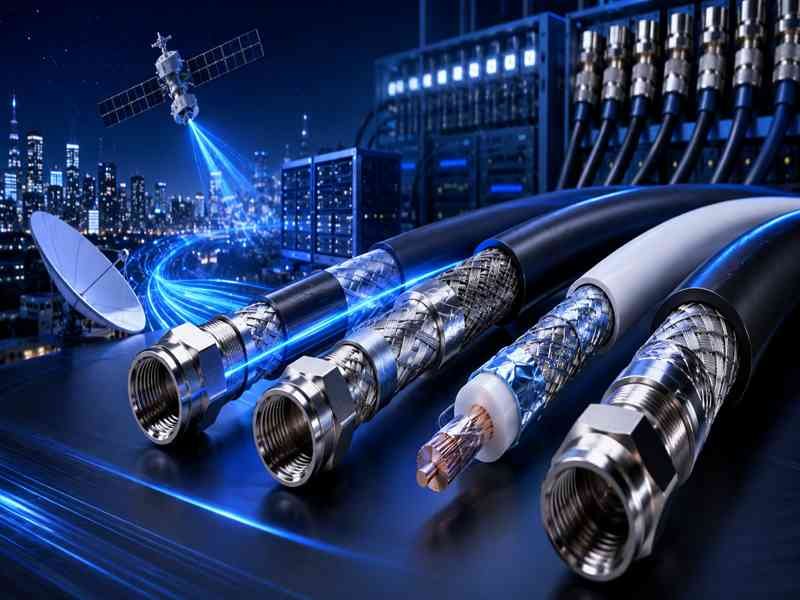
An F type coaxial cable looks simple from the outside: a round cable, a threaded metal connector, and a center conductor that plugs into a TV, modem, satellite receiver, splitter, amplifier, or RF device. But once the cable is installed, it quietly controls signal stability every day. A weak connector, poor shielding, wrong cable type, or excessive cable loss can cause problems that are hard to trace, such as unstable internet, snowy TV images, weak satellite signal, poor CCTV video, or RF distribution errors in a building system.
An F type coaxial cable is a 75-ohm coaxial cable fitted with F type connectors. It is commonly used for cable TV, broadband internet, satellite TV, CCTV, RF distribution, and communication equipment. The cable uses a center conductor, dielectric insulation, shielding layers, and an outer jacket to transmit RF signals while reducing signal loss and external interference.
For many customers, the real question is not only “What is an F type coaxial cable?” The more practical question is: “Which F type coaxial cable should I use for my project?” RG6, RG59, and RG11 can all use F type connectors, but they are not the same. Cable diameter, signal loss, shielding, flexibility, jacket material, installation environment, and connector quality all affect the final performance.
At Sino-Conn, many F type coaxial cable inquiries start with a photo, an existing sample, or a simple requirement such as “F male to F male, 2 meters, for RF equipment.” Some customers already know the exact RG cable type. Others only know the application. In both cases, the best result comes from checking the cable structure and connector together before production. A cable that fits the port is not always the cable that performs best in the system.
What Is an F Type Coaxial Cable?
An F type coaxial cable is a 75-ohm RF cable assembly that uses F type connectors to transmit television, broadband internet, satellite, CCTV, and other radio frequency signals. It is one of the most widely installed coaxial cable systems in the world and can be found in homes, apartments, hotels, office buildings, hospitals, schools, communication rooms, and commercial facilities.
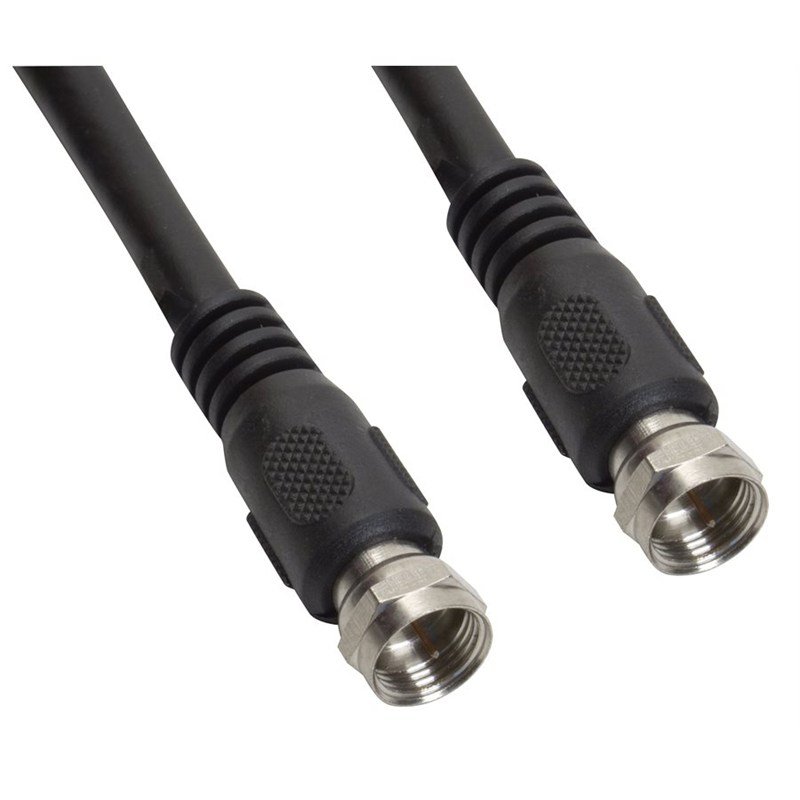
Most people recognize the threaded metal connector on the end of the cable, but the connector is only a small part of the system. The actual performance depends on the entire cable structure, including the conductor, dielectric, shielding layers, outer jacket, and connector installation quality.
This is why two F type coaxial cables may look nearly identical while delivering very different results in actual use.
One cable may provide stable internet service for years.
Another may experience signal loss, intermittent connections, or excessive attenuation after installation.
Understanding how an F type coaxial cable is constructed and where it should be used can help avoid costly mistakes during product development, system installation, and procurement.
What Is an F Type Connector?
The F type connector is a threaded RF connector developed specifically for 75-ohm coaxial transmission systems.
Unlike many RF connectors that use a separate center contact, the F connector often uses the cable’s own center conductor as the mating pin.
This design offers several advantages:
| Advantage | Benefit |
|---|---|
| Fewer Components | Lower manufacturing cost |
| Simple Installation | Faster assembly |
| Compact Structure | Suitable for dense installations |
| Reliable Threaded Connection | Prevents accidental loosening |
| High Compatibility | Works with many RF devices |
Today, F connectors are commonly used on:
- Cable modems
- Television receivers
- Satellite receivers
- Signal amplifiers
- RF splitters
- Distribution panels
- Broadband equipment
- CCTV video systems
Because the interface has remained largely unchanged for decades, compatibility is one of its biggest strengths.
A cable installed today will often mate with equipment produced many years ago.
This long-term compatibility is one reason the connector remains dominant in television and broadband infrastructure.
How Does an F Type Coaxial Cable Work?
The purpose of an F type coaxial cable is simple:
Move RF signals from one device to another while minimizing signal loss and external interference.
The cable accomplishes this through a layered structure.
| Cable Layer | Primary Function |
|---|---|
| Center Conductor | Carries signal |
| Dielectric Insulation | Maintains impedance |
| Foil Shield | Blocks EMI |
| Braided Shield | Improves shielding effectiveness |
| Outer Jacket | Protects against physical damage |
The center conductor carries the signal.
The dielectric keeps the conductor positioned precisely within the cable structure.
The shielding prevents external electromagnetic interference from entering the signal path.
The jacket protects the cable from mechanical damage and environmental exposure.
One important characteristic is impedance.
Most F type coaxial cable systems operate at:
75 Ohms
Maintaining this impedance throughout the cable helps reduce signal reflections and preserve signal quality.
Even small variations in cable construction can affect impedance stability.
This becomes increasingly important as signal frequencies increase.
For broadband internet, satellite systems, and RF distribution networks, impedance consistency directly affects performance.
What Makes an F Type Coaxial Cable Different?
Many customers ask why they should use an F type coaxial cable instead of another RF cable assembly.
The answer depends on the application.
Different RF connectors were designed for different purposes.
| Connector | Common Application |
|---|---|
| F Type | TV, Internet, Satellite |
| BNC | CCTV, Test Equipment |
| SMA | Wireless Communication |
| TNC | Outdoor RF Systems |
| N Type | Base Stations, High Power RF |
The F type connector became popular because it offers a practical balance between:
- Cost
- Performance
- Installation speed
- Availability
- Compatibility
For example:
A cellular base station may use N type connectors.
A wireless communication module may use SMA connectors.
A cable internet modem almost always uses an F connector.
The connector was designed around the requirements of large-scale RF distribution rather than specialized laboratory or wireless applications.
This distinction is important because selecting the wrong connector family often increases cost without improving performance.
Why Does Cable Construction Matter More Than Most People Think?
One of the most common sourcing mistakes is assuming that all RG6 or RG59 cables perform the same.
In reality, cable construction can vary significantly.
The following factors influence performance:
| Parameter | Impact |
|---|---|
| Conductor Material | Signal efficiency |
| Shielding Coverage | EMI protection |
| Dielectric Quality | Impedance stability |
| Jacket Material | Environmental durability |
| Connector Quality | Mechanical reliability |
| Assembly Process | Long-term consistency |
For example, two RG6 cables may have:
- Different braid coverage
- Different conductor materials
- Different shielding structures
- Different connector quality
The result may be substantial differences in attenuation and long-term reliability.
Customers often discover this only after installation.
At Sino-Conn, when evaluating custom F type coaxial cable projects, we typically review:
- Operating frequency
- Cable length
- Installation environment
- Shielding requirements
- Connector configuration
- Mechanical routing requirements
before recommending a cable structure.
This helps avoid situations where a customer pays for a cable that technically works but is not optimized for the application.
Why Do Different Industries Use F Type Coaxial Cables?
The same connector may be used in completely different industries.
For example:
| Industry | Common Application |
|---|---|
| Residential | TV and broadband |
| Hospitality | Hotel television systems |
| Commercial Buildings | RF distribution networks |
| Telecommunications | Broadband infrastructure |
| Security | CCTV systems |
| Broadcasting | Signal distribution equipment |
Each industry focuses on different priorities.
A homeowner may focus on price.
A hotel operator may focus on reliability.
A telecommunications provider may focus on signal performance.
An OEM manufacturer may focus on installation efficiency and long-term serviceability.
This is why there is no single “best” F type coaxial cable.
The best solution depends on the actual application.
What Information Should Be Collected Before Ordering?
Many customers contact Sino-Conn with only a photo of an existing cable.
While this is often enough to start a discussion, additional information helps ensure the correct cable is selected.
Useful information includes:
| Information | Why It Matters |
|---|---|
| Cable Type | Determines attenuation and flexibility |
| Connector Type | Ensures compatibility |
| Cable Length | Affects signal loss |
| Indoor or Outdoor Use | Determines jacket material |
| Frequency Range | Influences cable selection |
| Shielding Requirement | Impacts signal quality |
| Quantity | Influences production planning |
Even when customers do not know the cable specification, an existing sample or photo often allows our engineering team to identify the cable family and develop a suitable replacement.
Many projects begin exactly this way.
A customer sends a picture.
We identify the connector, estimate the cable structure, prepare a drawing, and then verify all specifications before production.
This process is especially valuable for replacement projects where original documentation is unavailable.
A Real Project Example
A customer operating a chain of commercial properties contacted Sino-Conn because they were experiencing inconsistent signal quality across multiple buildings.
Several different cable suppliers had been used over the years.
Although the cables all appeared similar externally, the actual constructions varied.
Some used dual shielding.
Others used lower braid coverage.
Connector quality also varied significantly.
After reviewing the installation, we supplied standardized RG6 quad-shield F type cable assemblies with consistent connector specifications and controlled cable lengths.
The result was not simply better signal performance.
The customer also reduced installation variability, simplified inventory management, and made future maintenance easier because every cable assembly followed the same specification.
This is a good example of how an F type coaxial cable should be viewed.
It is not merely a connector attached to a cable.
It is part of the entire signal transmission system, and the quality of that system depends on every component working together correctly.
Which F Type Coaxial Cable Should You Use?
The most common mistake when selecting an F type coaxial cable is assuming that every cable with an F connector performs the same.
In reality, the connector is often the easiest part of the decision.
The cable itself determines:
- Signal loss
- Transmission distance
- Shielding performance
- Flexibility
- Installation difficulty
- Outdoor durability
- Long-term reliability
Many customers initially ask:
“Should I use RG6, RG59, or RG11?”

The better question is:
“What is the cable actually being used for?”
A cable connecting a modem to a wall outlet has very different requirements than a cable running 300 feet through a commercial building.
A CCTV camera installation has different priorities than a satellite TV system.
A low-cost residential project has different priorities than a commercial RF distribution network.
The correct cable choice depends on the complete application, not simply the connector type.
RG6 F Type Coaxial Cable
RG6 is by far the most commonly used F type coaxial cable today.
If a customer is installing:
- Broadband internet
- Cable television
- Satellite TV
- Home RF distribution
- Commercial RF distribution
RG6 is usually the first option considered.
The reason is simple.
RG6 provides a strong balance between performance, flexibility, availability, and cost.
| Specification | RG6 |
|---|---|
| Impedance | 75 Ohms |
| Outer Diameter | Approximately 6.8-7.0 mm |
| Shielding Options | Dual, Tri, Quad Shield |
| Flexibility | Good |
| Signal Loss | Low |
| Installation Difficulty | Easy |
One reason internet providers frequently recommend RG6 is its ability to support higher frequencies with lower attenuation than RG59.
For example:
| Cable Length | Relative Signal Retention |
|---|---|
| 25 ft | Excellent |
| 50 ft | Excellent |
| 100 ft | Very Good |
| 150 ft | Good |
| 200 ft+ | Application dependent |
Most residential installations fall comfortably within RG6’s performance range.
This is why RG6 has effectively become the default choice for modern cable television and broadband networks.
At Sino-Conn, more than half of custom F type cable assembly inquiries involve RG6-based solutions because it works well across such a wide range of applications.
RG59 F Type Coaxial Cable
RG59 is often misunderstood.
Many people assume it is simply an older version of RG6.
That is not entirely accurate.
RG59 still offers advantages in specific applications.
The biggest advantage is flexibility.
Compared with RG6, RG59 is:
- Smaller
- Lighter
- Easier to route
- Easier to install in confined spaces
Typical applications include:
| Application | Why RG59 Works Well |
|---|---|
| CCTV Systems | Short-distance video transmission |
| Equipment Wiring | Smaller cable size |
| Internal Cabinet Wiring | Easier routing |
| Analog Video Systems | Adequate performance |
| Test Setups | Flexible handling |
However, there is a tradeoff.
RG59 generally exhibits higher signal loss than RG6.
This difference becomes more noticeable as:
- Cable length increases
- Signal frequency increases
Many customers try to reduce cost by choosing RG59.
Sometimes that works.
Sometimes it creates signal quality problems that cost much more to solve later.
For example, one customer approached Sino-Conn looking to replace existing RG6 cables with RG59 because of pricing concerns.
After reviewing the installation, we discovered several runs exceeded 150 feet.
The small material savings would have introduced unnecessary attenuation.
The customer ultimately retained RG6 and avoided future performance issues.
The lesson is straightforward:
Choose RG59 because it fits the application, not simply because it costs less.
RG11 F Type Coaxial Cable
When signal transmission distance becomes a priority, RG11 often enters the discussion.
RG11 uses a larger conductor and a larger overall cable structure.
The result is lower attenuation over long distances.
This makes it attractive for:
- Campus networks
- Multi-building installations
- Large commercial facilities
- Distribution backbone systems
- Long outdoor cable runs
Comparison:
| Feature | RG6 | RG11 |
|---|---|---|
| Diameter | Smaller | Larger |
| Flexibility | Better | Lower |
| Signal Loss | Higher | Lower |
| Installation Ease | Easier | More Difficult |
| Material Cost | Lower | Higher |
Many engineers automatically assume RG11 is better because it offers lower signal loss.
However, lower loss is only one part of the equation.
RG11 is also:
- Heavier
- Stiffer
- Harder to terminate
- More difficult to route
A common commercial strategy is:
- RG11 for long backbone runs
- RG6 for equipment connections
This approach balances performance and installation practicality.
One office building project reviewed by Sino-Conn used RG11 for floor-to-floor distribution and RG6 for workstation connections.
The result was lower overall attenuation without unnecessarily increasing installation complexity.
Indoor F Type Coaxial Cable
Indoor cable selection is often driven by installation requirements rather than signal requirements.
Inside buildings, customers typically focus on:
- Cable flexibility
- Appearance
- Flame performance
- Ease of routing
- Cost
Common indoor environments include:
- Homes
- Offices
- Hotels
- Schools
- Hospitals
- Equipment rooms
Important considerations include:
| Requirement | Reason |
|---|---|
| Flexible Jacket | Easier installation |
| Consistent Diameter | Cleaner routing |
| Reliable Connectors | Reduced service calls |
| Flame-Rated Materials | Building compliance |
| Accurate Lengths | Faster installation |
One issue frequently encountered during commercial projects is excess cable length.
Installers often purchase standard retail lengths because they are readily available.
The result:
- Cable clutter
- Difficult maintenance
- Reduced airflow inside cabinets
Custom-length cable assemblies can eliminate these issues.
For example, a customer building RF distribution cabinets requested exact cable lengths from Sino-Conn.
By eliminating excess cable slack, installation time decreased and cabinet organization improved significantly.
Outdoor F Type Coaxial Cable
Outdoor installations place much greater demands on cable assemblies.
The cable may be exposed to:
- Direct sunlight
- Rain
- Snow
- Temperature cycling
- Humidity
- Wind
- Mechanical stress
For this reason, outdoor cable selection should focus on durability as much as signal performance.
Important factors include:
| Outdoor Requirement | Importance |
|---|---|
| UV Resistance | Prevent jacket cracking |
| Waterproofing | Prevent moisture ingress |
| Corrosion Resistance | Extend connector life |
| Temperature Stability | Improve reliability |
| Mechanical Strength | Survive installation |
One of the most common outdoor failures is water intrusion.
Once moisture enters a coaxial cable, signal quality often degrades rapidly.
Corrosion may then spread through the connector system.
This is why outdoor cable assemblies frequently include:
- Weather-resistant connectors
- UV-resistant jackets
- Enhanced sealing
- Corrosion-resistant materials
A customer installing rooftop communication equipment initially specified standard indoor RG6 because it was readily available.
After reviewing the project, Sino-Conn recommended an outdoor-rated assembly with UV-resistant materials and weather-protected F connectors.
The material cost increased slightly, but the expected service life improved dramatically.
Replacing rooftop cables later would have cost significantly more than the original upgrade.
How Should You Make the Final Decision?
Many customers spend too much time comparing connector specifications while overlooking application requirements.
A more practical approach is to start with the project itself.
The following table provides a useful starting point:
| Application | Recommended Cable |
|---|---|
| Broadband Internet | RG6 |
| Cable Television | RG6 |
| Satellite TV | RG6 or RG11 |
| CCTV Video | RG59 or RG6 |
| Long Commercial Runs | RG11 |
| RF Distribution Cabinet | Custom RG6 |
| Outdoor Antenna | Outdoor RG6 or RG11 |
| Commercial Building Backbone | RG11 |
Before finalizing a cable, it is worth confirming:
- Actual cable length
- Signal type
- Frequency range
- Indoor or outdoor installation
- Required shielding level
- Available installation space
- Connector configuration
At Sino-Conn, customers frequently provide only a photo, cable sample, or equipment picture.
Our engineering team can then review the application and recommend a cable structure that balances performance, installation convenience, lead time, and cost.
This process often prevents over-specifying the cable and paying for performance that is never used, while also avoiding under-specifying the cable and creating signal problems later in the project.
Where Is an F Type Coaxial Cable Used?
One reason F type coaxial cables have remained popular for more than 50 years is their versatility.
The same connector can be found behind a home television, inside a hotel distribution cabinet, on a rooftop satellite installation, or integrated into commercial RF equipment.
Although the connector looks the same, the actual application requirements can be completely different.
For example:
A homeowner may only need a 2-meter cable between a wall outlet and a modem.
A commercial building may require hundreds of cable assemblies connecting amplifiers, splitters, and distribution panels across multiple floors.
A communication equipment manufacturer may need custom F type coaxial jumpers with specific lengths, labels, and shielding requirements.
This is why understanding the application is often more important than understanding the connector itself.
The F connector is simply the interface.
The cable assembly, installation environment, signal frequency, transmission distance, and shielding requirements determine how the cable should be designed.
F Type Coaxial Cable for Television Systems
Television systems remain the largest application for F type coaxial cables worldwide.
Even as streaming services continue to grow, cable television infrastructure still serves millions of homes, hotels, hospitals, schools, and commercial facilities.
A typical television signal path may include:
- Service provider feed
- Signal amplifier
- RF splitter
- Wall outlet
- Set-top box
- Television receiver
Every connection point usually relies on F type connectors.
The reason is simple:
The television industry standardized around 75-ohm coaxial transmission decades ago, and F connectors became the preferred interface because they offered a good balance of cost, reliability, and ease of installation.
Television applications typically prioritize:
| Requirement | Importance |
|---|---|
| Stable Signal Transmission | Clear image quality |
| Low Signal Loss | Maintain channel quality |
| Reliable Connector Contact | Prevent intermittent issues |
| Cost Control | Large-scale installations |
| Easy Maintenance | Faster servicing |
Large hospitality projects often highlight the importance of consistency.
A hotel may require hundreds of identical cable assemblies.
If connector quality varies from room to room, troubleshooting becomes much more difficult.
One hospitality customer approached Sino-Conn after purchasing television cables from multiple suppliers. Although the connectors looked identical, cable lengths, shielding coverage, and connector quality varied significantly.
After standardizing the cable assembly specification, installation became more predictable and maintenance efficiency improved.
F Type Coaxial Cable for Broadband Internet
Many people interact with F type coaxial cables every day through their internet connection.
Cable internet infrastructure continues to rely heavily on coaxial transmission networks.
A typical broadband installation may include:
- Street distribution network
- Building entry point
- Splitters
- Wall outlet
- Cable modem
- Router or gateway
The connection between the wall outlet and modem is often an RG6 F type coaxial cable.
Internet applications place greater demands on cable quality than many users realize.
Factors affecting broadband performance include:
| Parameter | Impact |
|---|---|
| Signal Loss | Influences modem performance |
| Shielding Quality | Reduces external interference |
| Connector Quality | Maintains stable connection |
| Cable Length | Affects attenuation |
| Installation Quality | Influences long-term reliability |
A common misconception is that internet speed is determined only by the service provider.
In reality, poor cable quality can introduce signal degradation before the signal even reaches the modem.
In large residential buildings, replacing aging coaxial infrastructure can sometimes improve connection stability without changing the internet package.
Many broadband projects supplied by Sino-Conn involve:
- Custom RG6 assemblies
- Quad-shield configurations
- Precise cable lengths
- Commercial distribution systems
- Equipment cabinet jumpers
In these projects, signal consistency often matters more than simply selecting the cheapest cable available.
F Type Coaxial Cable for Satellite Systems
Satellite installations create challenges that are not always present in television or internet systems.
Unlike indoor equipment, satellite components are frequently exposed to outdoor conditions.
Common installations include:
- Residential satellite dishes
- Commercial satellite systems
- Hotel entertainment networks
- Remote communication stations
- Marine satellite equipment
Satellite systems often require:
| Requirement | Reason |
|---|---|
| Low Attenuation | Weak signals must be preserved |
| Weather Resistance | Outdoor installation |
| Stable Impedance | Signal integrity |
| Secure Connections | Long-term reliability |
| UV Resistance | Continuous sun exposure |
Signal loss becomes especially important because satellite signals are often weaker than locally distributed cable signals.
Long cable runs can quickly reduce signal strength if the wrong cable is selected.
For this reason:
- RG6 is commonly used for standard installations.
- RG11 is frequently selected for longer distances.
A customer working on a multi-building satellite project contacted Sino-Conn because standard retail cable lengths created excessive waste and routing problems.
Custom-length cable assemblies reduced installation time and improved cable management while maintaining signal quality.
F Type Coaxial Cable for CCTV Systems
Although many modern surveillance systems now use IP cameras, coaxial cable remains widely used throughout the security industry.
Many existing installations continue operating on coaxial infrastructure because replacing an entire system can be expensive.
Common applications include:
- Analog CCTV
- HD-over-Coax systems
- DVR installations
- Hybrid security systems
- Video monitoring networks
Security integrators typically focus on:
| Requirement | Importance |
|---|---|
| Video Stability | Clear image transmission |
| Cost Efficiency | Large camera deployments |
| Installation Simplicity | Faster project completion |
| Cable Durability | Reduced maintenance |
| Consistent Performance | Easier troubleshooting |
Cable selection usually depends on transmission distance.
Shorter runs may use RG59.
Longer runs often benefit from RG6.
One security contractor approached Sino-Conn after experiencing image quality differences across cameras installed in the same facility.
Investigation revealed that multiple cable types had been mixed throughout the installation.
After standardizing cable construction and connector specifications, image consistency improved significantly.
This illustrates a common lesson:
In large CCTV systems, consistency is often just as important as cable performance.
F Type Coaxial Cable for RF Distribution Systems
Many people associate F connectors exclusively with televisions.

In reality, F type coaxial cables are widely used in commercial RF distribution systems.
Examples include:
- Signal distribution cabinets
- RF amplifiers
- Communication equipment
- Broadcast support systems
- Multi-building distribution networks
- Monitoring equipment
These systems often contain:
- Splitters
- Filters
- Amplifiers
- Signal processors
- Patch panels
The challenge is maintaining signal quality as the signal passes through multiple devices.
Engineers working on RF distribution systems often focus on:
| Consideration | Importance |
|---|---|
| Signal Loss | Network performance |
| Shielding Effectiveness | Noise reduction |
| Cable Organization | Maintenance efficiency |
| Connector Reliability | Long-term operation |
| Serviceability | Faster troubleshooting |
One customer manufacturing RF distribution cabinets required dozens of short coaxial jumpers inside each cabinet.
Standard retail cables were too long and created excessive cable congestion.
Sino-Conn supplied custom-length assemblies with consistent connector orientation and labeling.
The result:
- Cleaner cabinet layouts
- Easier maintenance
- Improved airflow
- Faster assembly
This is a common example of how custom cable assemblies provide value beyond signal transmission alone.
F Type Coaxial Cable for Commercial Buildings
Commercial buildings often contain some of the largest coaxial cable infrastructures.
Examples include:
- Hotels
- Hospitals
- Universities
- Office complexes
- Apartment buildings
- Convention centers
These projects frequently require:
| Requirement | Importance |
|---|---|
| High Cable Volume | Hundreds or thousands of assemblies |
| Consistency | Easier maintenance |
| Documentation | Installation management |
| Reliable Performance | Reduced service calls |
| Cost Control | Project profitability |
Unlike residential installations, commercial projects often involve multiple contractors, installers, and maintenance teams.
A cable assembly that saves only a few minutes during installation can generate significant labor savings across hundreds of connections.
For this reason, many commercial customers request:
- Exact cable lengths
- Custom labels
- Connector identification
- Documentation support
At Sino-Conn, commercial building projects often start with a simple request such as:
“Can you duplicate this cable?”
After reviewing the application, we frequently recommend improvements in cable length, shielding, connector orientation, or labeling that simplify installation and future maintenance.
Why Understanding the Application Matters
The same F connector can be used in:
- A home television system
- A broadband internet network
- A satellite installation
- A CCTV system
- A commercial RF cabinet
- A large building distribution network
Yet the cable requirements may be completely different.
The table below summarizes the primary priorities for each application:
| Application | Main Priority |
|---|---|
| Television | Cost and reliability |
| Broadband Internet | Signal quality |
| Satellite | Low attenuation |
| CCTV | Video consistency |
| RF Distribution | Shielding and organization |
| Commercial Buildings | Scalability and maintenance |
This is why there is no universal “best” F type coaxial cable.
The best cable is the one that matches the actual application, transmission distance, installation environment, and maintenance requirements.
When customers provide drawings, photos, samples, or even a basic description of the project, Sino-Conn can help identify the most suitable cable structure before production begins, helping avoid unnecessary cost while ensuring reliable long-term performance.
How Do You Choose an F Type Coaxial Cable?
Choosing an F type coaxial cable is not simply a matter of selecting an RG6, RG59, or RG11 cable and adding F connectors.
In many projects, the connector is actually the easiest part of the decision.
The real challenge is ensuring that the cable can deliver stable signal performance throughout its service life while fitting the installation environment, budget, and maintenance requirements.
Many cable failures are not caused by defective connectors.
Instead, they result from:
- Excessive signal loss
- Incorrect cable type
- Inadequate shielding
- Poor environmental suitability
- Improper cable routing
- Incorrect connector selection
The problem is that these issues often do not appear immediately.
A cable may work perfectly during installation but begin showing signal degradation months later.
For this reason, experienced engineers usually start with the application rather than the connector.
Before selecting an F type coaxial cable, it is worth answering five questions:
- How far must the signal travel?
- What signal is being transmitted?
- Is the installation indoor or outdoor?
- Is there significant electromagnetic interference?
- What is the expected service life?
The answers will usually determine the most suitable cable structure.
F Type Coaxial Cable by Distance
Distance is one of the biggest factors affecting coaxial cable performance.
Every coaxial cable introduces attenuation.
As cable length increases, signal strength decreases.
The amount of loss depends on:
- Cable type
- Signal frequency
- Connector quality
- Installation quality
Many customers assume a cable either works or does not work.
In reality, signal loss occurs gradually.
The signal may still reach the destination but with reduced quality.
General comparison:
| Cable Type | Short Runs | Medium Runs | Long Runs |
|---|---|---|---|
| RG59 | Excellent | Acceptable | Limited |
| RG6 | Excellent | Excellent | Good |
| RG11 | Good | Excellent | Excellent |
For example:
A 3-foot jumper between a modem and wall plate can use almost any suitable coaxial cable.
A 200-foot run between equipment rooms requires much more careful selection.
One customer contacted Sino-Conn for a commercial building project and initially specified RG59 because it was less expensive.
After reviewing the cable lengths, several runs exceeded 180 feet.
Switching to RG6 improved signal retention while avoiding future troubleshooting costs.
This highlights an important point:
Choosing the wrong cable to save a few dollars often costs significantly more later in labor and maintenance.
F Type Coaxial Cable by Frequency
Not all signals place the same demands on a cable.
Higher frequencies generally experience greater attenuation.
This means the cable that works well for one application may not be ideal for another.
Common applications include:
| Application | Frequency Demand |
|---|---|
| Analog Video | Lower |
| Cable Television | Moderate |
| Broadband Internet | Higher |
| Satellite Systems | Higher |
| RF Distribution | Application Dependent |
As frequency increases, several factors become increasingly important:
- Impedance stability
- Conductor quality
- Dielectric consistency
- Shielding effectiveness
- Connector installation quality
For broadband internet systems, maintaining stable impedance is particularly important.
A poorly manufactured cable may create reflections along the signal path.
This can reduce system performance even when the cable appears physically intact.
When customers contact Sino-Conn for internet or RF projects, frequency requirements are usually one of the first questions discussed because they often influence cable selection more than cable length.
F Type Coaxial Cable by Shielding
Shielding is one of the most misunderstood aspects of coaxial cable selection.
Many customers automatically assume more shielding is always better.
That is not necessarily true.
The correct shielding level depends on the environment.
Common shielding structures include:
| Shield Type | Construction |
|---|---|
| Single Shield | Foil only |
| Dual Shield | Foil + Braid |
| Tri Shield | Dual foil + braid |
| Quad Shield | Dual foil + dual braid |
Shielding protects signals from:
- Electrical noise
- Power cables
- Motors
- Wireless devices
- Industrial equipment
- Communication systems
Consider two installations:
Scenario A:
A short RG6 cable connecting a television to a wall outlet in a residential home.
Scenario B:
A coaxial cable routed through an industrial facility containing motors, drives, switching power supplies, and communication equipment.
The first installation may work perfectly with standard shielding.
The second may benefit significantly from tri-shield or quad-shield construction.
More shielding does have tradeoffs:
| Benefit | Tradeoff |
|---|---|
| Better EMI Protection | Higher Cost |
| Improved Signal Stability | Increased Cable Stiffness |
| Better RF Isolation | Larger Diameter |
One manufacturing customer approached Sino-Conn after experiencing intermittent RF communication issues.
The original cable length and connector were correct.
The issue was electromagnetic interference from nearby equipment.
Upgrading the shielding structure resolved the problem without changing the overall system design.
F Type Coaxial Cable by Environment
Environmental conditions often determine cable lifespan more than electrical specifications.
A cable installed inside a living room may operate reliably for decades.
The same cable exposed to direct sunlight, moisture, and temperature cycling may fail much sooner.
Environmental considerations include:
| Condition | Potential Risk |
|---|---|
| UV Exposure | Jacket cracking |
| Moisture | Corrosion |
| Temperature Cycling | Material fatigue |
| Mechanical Stress | Connector damage |
| Chemicals | Jacket degradation |
| Abrasion | Outer jacket wear |
Indoor installations typically focus on:
- Flexibility
- Appearance
- Flame performance
- Cost
Outdoor installations often require:
- UV-resistant jackets
- Waterproof connectors
- Corrosion resistance
- Enhanced durability
One customer requested standard indoor RG6 cables for rooftop antenna installations because they were less expensive.
After reviewing the project, Sino-Conn recommended an outdoor-rated version with UV-resistant materials and weather-protected connectors.
The difference in material cost was relatively small.
The difference in expected service life was substantial.
This is why selecting cable solely based on price can be risky when environmental conditions are demanding.
F Type Coaxial Cable by Connector Quality
Many customers focus heavily on cable specifications while overlooking connector quality.
Yet the connector is often where failures occur.
Common issues include:
- Loose threading
- Poor plating
- Weak crimping
- Inconsistent dimensions
- Poor shielding continuity
A high-quality cable combined with a poor connector may still create:
- Signal reflections
- Intermittent connections
- Increased insertion loss
- Mechanical failures
Important connector considerations include:
| Factor | Importance |
|---|---|
| Thread Quality | Secure connection |
| Plating Quality | Corrosion resistance |
| Connector Material | Mechanical durability |
| Assembly Process | Long-term reliability |
| Shield Continuity | Signal integrity |
At Sino-Conn, cable assemblies are not evaluated solely on cable performance.
The complete assembly is reviewed, including:
- Connector selection
- Connector installation
- Pull strength
- Shield termination
- Mechanical durability
This approach helps ensure consistent performance throughout the life of the product.
F Type Coaxial Cable by Installation Cost
Material cost is only one part of the total project cost.
In large installations, labor often exceeds cable cost.
Consider the following example:
| Cost Area | Impact |
|---|---|
| Cable Material | Initial purchase |
| Installation Labor | Deployment cost |
| Maintenance | Long-term expense |
| Troubleshooting | Service visits |
| Downtime | Operational impact |
A cable that saves 10% on material cost but creates installation or maintenance problems may ultimately become the more expensive option.
Commercial customers frequently request:
- Exact cable lengths
- Connector orientation control
- Cable labels
- Documentation
These details may seem minor but can significantly reduce installation time.
One RF cabinet customer worked with Sino-Conn to replace standard retail cables with custom-length assemblies.
The shorter, organized cables improved airflow, reduced installation time, and simplified future maintenance.
The cable cost increased slightly.
The labor savings more than offset the difference.
A Practical Selection Checklist
Before finalizing an F type coaxial cable, it is useful to verify the following information:
| Selection Item | Confirmed |
|---|---|
| Cable Type (RG6/RG59/RG11) | ✓ |
| Cable Length | ✓ |
| Signal Type | ✓ |
| Frequency Range | ✓ |
| Indoor or Outdoor Installation | ✓ |
| Shielding Requirement | ✓ |
| Connector Type | ✓ |
| Installation Space | ✓ |
| Maintenance Requirements | ✓ |
| Expected Service Life | ✓ |
Customers who review these points before ordering typically experience fewer installation issues and better long-term performance.
At Sino-Conn, many projects begin with nothing more than:
- A photo
- An old sample
- A cable model number
- A description of the application
From there, our engineering team helps determine the most suitable cable structure, shielding level, connector configuration, and assembly design.
The goal is not simply to build a cable.
The goal is to ensure the cable performs reliably in the environment where it will actually be used.
Can an F Type Coaxial Cable Be Customized?
Yes, and in many industrial, commercial, communication, and OEM projects, custom F type coaxial cables are actually more common than standard retail cables.
When people think about F type coaxial cables, they often picture the ready-made cables sold in electronics stores. These products work well for simple home installations, but they rarely meet the exact requirements of equipment manufacturers, system integrators, contractors, telecommunications companies, or commercial building projects.
In real projects, engineers often need much more than a standard cable.
They may require:
- Exact cable lengths
- Specific connector orientations
- Different cable constructions
- Higher shielding performance
- Outdoor-rated materials
- Product labels
- Custom packaging
- Special testing requirements
This is where customization becomes important.
At Sino-Conn, most F type coaxial cable inquiries are custom projects rather than off-the-shelf products.
Many customers contact us with:
- A hand sketch
- A cable sample
- A product photo
- A connector model number
- An equipment drawing
Even when the customer does not know the exact cable specification, we can usually identify the connector family and recommend a suitable cable structure based on the application.
Custom F Type Coaxial Cable Lengths
Length is the most common customization request.
Retail cables are usually available in fixed lengths such as:
- 1 ft
- 3 ft
- 6 ft
- 10 ft
- 25 ft
- 50 ft
Unfortunately, equipment installations rarely match those dimensions exactly.
As a result, installers often face two problems:
| Problem | Result |
|---|---|
| Cable Too Long | Excess cable clutter |
| Cable Too Short | Installation impossible |
In residential applications, extra cable may simply look messy.
In commercial installations, excess cable can create:
- Difficult routing
- Reduced airflow
- Longer installation time
- More difficult maintenance
A customer manufacturing RF distribution cabinets previously used standard retail cables because they were easy to purchase.
However, each cabinet contained dozens of unnecessary cable loops.
After switching to custom-length cable assemblies from Sino-Conn, the customer achieved:
- Cleaner cable routing
- Improved cabinet airflow
- Faster assembly
- Easier maintenance
Custom lengths can range from a few inches to hundreds of feet depending on the application.
Custom F Type Coaxial Cable Connectors
Not every project uses a standard F male to F male cable.
Many systems require specialized connector combinations.
Examples include:
| Connector Configuration | Common Application |
|---|---|
| F Male to F Male | TV and broadband |
| F Male to F Female | Extension applications |
| F Male to BNC | CCTV systems |
| F Male to SMA | RF equipment |
| F Male to N Type | Communication systems |
| F Male to TNC | RF integration projects |
Connector orientation can also be customized.
For example:
- Straight connectors
- Right-angle connectors
- Panel-mount connectors
- Bulkhead connectors
- Waterproof connectors
One common challenge occurs inside compact equipment.
A straight connector may extend too far and interfere with the enclosure.
In these cases, a right-angle connector can significantly improve cable routing without changing the system design.
Sino-Conn regularly supports OEM customers who require connector configurations that are not available from standard retail suppliers.
Custom F Type Coaxial Cable Types
The connector may remain the same while the cable changes completely.
This is an area many customers overlook.
The F connector only defines the interface.
The cable determines:
- Signal loss
- Flexibility
- Shielding performance
- Mechanical durability
- Installation characteristics
Common cable options include:
| Cable Type | Typical Use |
|---|---|
| RG59 | CCTV and short runs |
| RG6 | Internet and television |
| RG11 | Long-distance transmission |
| Low-Loss Coax | RF distribution |
| High-Flex Coax | Moving equipment |
| Outdoor Coax | Harsh environments |
A customer may initially request:
“F connector cable.”
However, that description alone is often insufficient.
The same connector can be installed on dozens of different cable constructions.
This is why Sino-Conn engineering reviews typically begin with understanding:
- Signal type
- Frequency
- Installation environment
- Cable length
- Equipment layout
before selecting the cable structure.
Custom F Type Coaxial Cable Shielding
Shielding is another area where customization can have a significant impact.
Not every installation requires the same level of protection.
Common shielding structures include:
| Shield Structure | Typical Application |
|---|---|
| Single Shield | Basic residential use |
| Dual Shield | Broadband systems |
| Tri Shield | Commercial installations |
| Quad Shield | High EMI environments |
Many customers automatically choose quad-shield cable because it sounds superior.
In reality, that is not always necessary.
Higher shielding levels can increase:
- Cable cost
- Cable diameter
- Cable stiffness
The goal should be selecting the shielding level that matches the environment.
For example:
A short television cable inside a residential living room may perform perfectly with dual shielding.
An industrial installation located near:
- Motors
- Drives
- High-current power systems
- Wireless equipment
may benefit from quad-shield construction.
One manufacturing customer approached Sino-Conn after experiencing intermittent signal issues in an RF monitoring system.
The connector and cable length were both correct.
The issue was electrical noise.
After upgrading the shielding structure, the signal became stable without modifying the equipment itself.
Custom F Type Coaxial Cable Materials
Cable jacket material is often overlooked during purchasing decisions.
However, it has a major impact on service life.
Different environments require different materials.
Common options include:
| Material | Main Advantage |
|---|---|
| PVC | Economical |
| PE | Outdoor durability |
| LSZH | Low smoke emission |
| TPU | Abrasion resistance |
| TPE | Flexibility |
| UV-Resistant PE | Outdoor installations |
The correct material depends on the environment.
Examples:
| Environment | Recommended Material |
|---|---|
| Home Installation | PVC |
| Commercial Building | PVC or LSZH |
| Public Transportation | LSZH |
| Outdoor Antenna | UV-Resistant PE |
| Industrial Equipment | TPU |
| Flexible Equipment | TPE |
A rooftop antenna project may fail prematurely if standard indoor PVC cable is used.
Similarly, an industrial cable exposed to constant abrasion may require TPU instead of standard PVC.
Selecting the proper material often increases cable lifespan significantly.
Custom Labels and Identification
Large installations frequently require cable identification.
Without labels, maintenance becomes more difficult as systems grow.
Common customization options include:
- Heat shrink labels
- Printed markers
- Laser marking
- Serial numbers
- QR codes
- Customer logos
- Installation references
These additions may seem minor but can save substantial labor during installation and servicing.
A commercial building project using several hundred coaxial cable assemblies requested custom labels from Sino-Conn.
The labels allowed installers to identify each cable immediately, reducing installation errors and simplifying future maintenance.
Custom Drawings and Engineering Support
Many customers do not have complete engineering documentation.
This is particularly common when:
- Replacing existing cables
- Reverse-engineering assemblies
- Upgrading legacy systems
- Switching suppliers
Typical starting points include:
| Customer Provides | Frequency |
|---|---|
| Existing Sample | Very Common |
| Product Photo | Very Common |
| Connector Model | Common |
| Cable Specification | Common |
| Complete Drawing | Less Common |
At Sino-Conn, engineering support is often part of the project.
We can assist with:
- Connector identification
- Cable selection
- Drawing creation
- Material recommendations
- Connector alternatives
- Shielding recommendations
Drawings are usually provided before production for customer approval.
Depending on project complexity:
| Service | Turnaround |
|---|---|
| Connector Identification | Same Day |
| Standard Drawing | Around 3 Days |
| Urgent Drawing | Sometimes Within Hours |
This process helps reduce production errors and ensures the final assembly matches the intended application.
Custom Production, MOQ, and Lead Time
Many suppliers focus primarily on high-volume orders.
However, development projects often begin with only a few pieces.
Sino-Conn supports both prototype and production quantities.
Typical project stages include:
| Stage | Quantity |
|---|---|
| Engineering Validation | 1-10 pcs |
| Functional Testing | 10-50 pcs |
| Pilot Production | 50-500 pcs |
| Mass Production | 500+ pcs |
For many customers, the ability to obtain a small quantity quickly is critical.
Current capabilities include:
| Service | Typical Lead Time |
|---|---|
| Standard Samples | Around 2 Weeks |
| Urgent Samples | 2-3 Days |
| Production Orders | 3-4 Weeks |
| Expedited Production | Around 2 Weeks |
This flexibility allows customers to move from concept to validation faster.
Why Do OEM Customers Prefer Custom F Type Coaxial Cables?
OEM manufacturers rarely select cables based solely on connector type.
They focus on the complete product.
Questions often include:
- Will the cable fit the enclosure?
- Will installation be efficient?
- Will the cable survive the operating environment?
- Can the cable be sourced consistently?
- Can future revisions be supported?
A custom cable assembly helps address these concerns because it is designed around the equipment rather than forcing the equipment to adapt to a standard retail cable.
This is why many OEM projects eventually move toward custom cable assemblies.
The cable may look simple from the outside, but small changes in length, shielding, materials, connector orientation, labeling, and documentation can create significant improvements in manufacturing efficiency, installation speed, maintenance simplicity, and long-term reliability.
For many projects, the question is no longer whether an F type coaxial cable can be customized.
The better question is how much customization can improve the performance and usability of the final product.
Conclusion
F type coaxial cables remain one of the most widely used RF cable solutions in the world because they offer a practical balance of performance, affordability, and installation simplicity.
Whether the application involves:
- Cable television
- Broadband internet
- Satellite systems
- CCTV infrastructure
- RF distribution equipment
- Communication systems
the cable selection process should go beyond the connector itself.
The right cable depends on:
- Distance
- Frequency
- Shielding
- Environment
- Connector configuration
- Long-term reliability requirements
For simple installations, standard cables may be sufficient.
For OEM equipment, commercial projects, industrial systems, or specialized RF applications, custom cable assemblies often provide a better fit and lower overall project cost.
At Sino-Conn, we support customers with:
- Custom F type coaxial cable assemblies
- RG6, RG59, and RG11 solutions
- Custom lengths
- Custom connector configurations
- Indoor and outdoor cable options
- Shielding customization
- Drawing support
- Rapid sample development
- No MOQ requirements
- 100% electrical testing
Whether you have a complete drawing, an existing sample, a connector model number, or only a product photo, our engineering team can help develop a cable assembly that matches your application.
Contact Sino-Conn today to discuss your F type coaxial cable project and request a custom quotation.
Related Keywords :f type coaxial cable, f connector cable, rg6 coaxial cable, rg59 coaxial cable, rg11 coaxial cable, f type connector, coaxial cable for internet, coaxial cable for tv, satellite coaxial cable, cctv coaxial cable, rf coaxial cable, custom coaxial cable, quad shield coaxial cable, broadband coaxial cable, outdoor coaxial cable, indoor coaxial cable, coaxial cable manufacturer, rf cable assembly, custom cable assembly, sino-conn

With over 18 years of OEM/ODM cable assemblies industry experience, I would be happy to share with you the valuable knowledge related to cable assemblies products from the perspective of a leading supplier in China.
manufacturer catalogue
Get A Sample Now From Factory→
Get a quote quickly
Here, developing your OEM/ODM custom cable assemblies collection is no longer a challenge—it’s an excellent opportunity to bring your creative vision to life.