Skip to content

When you think of connecting a computer to a display, your mind probably jumps to HDMI or DisplayPort — sleek digital connections promising 4K clarity. But before those, there was the VGA cable, a rugged analog workhorse that powered decades of monitors, projectors, and industrial control systems. Even today, countless machines and displays around the world still rely on VGA, proving that “old-school” technology doesn’t always mean outdated.
A VGA cable (Video Graphics Array cable) is an analog signal cable that transmits video data between a computer and a display. It uses a 15-pin D-sub connector and carries red, green, blue (RGB), and sync signals through coaxial conductors, ensuring stable analog video transmission for monitors, projectors, and industrial displays.
Why does a technology from the 1980s still matter? Because VGA cables bridge generations — connecting legacy systems with modern needs. From hospital equipment and factory control panels to classrooms and office projectors, VGA remains a global standard.
And at Sino-conn, we’ve spent years designing custom VGA cable assemblies that keep these systems running — combining precision engineering, flexibility, and speed. Let’s explore what VGA cables are, how they work, and why custom manufacturing still plays a vital role in modern electronics.
What Is a VGA Cable and How Does It Work?
A VGA cable works by transmitting analog video signals — red, green, blue, and synchronization — from a computer’s GPU to a display device using a 15-pin connector. Each color and signal line travels through coaxial shielding to minimize interference, allowing the monitor to reconstruct the complete image.
A VGA (Video Graphics Array) cable is designed to carry analog signals rather than digital data. Inside its thick jacket lie multiple coaxial conductors, each carrying one component of the video signal — typically red, green, and blue channels, plus horizontal and vertical synchronization lines.
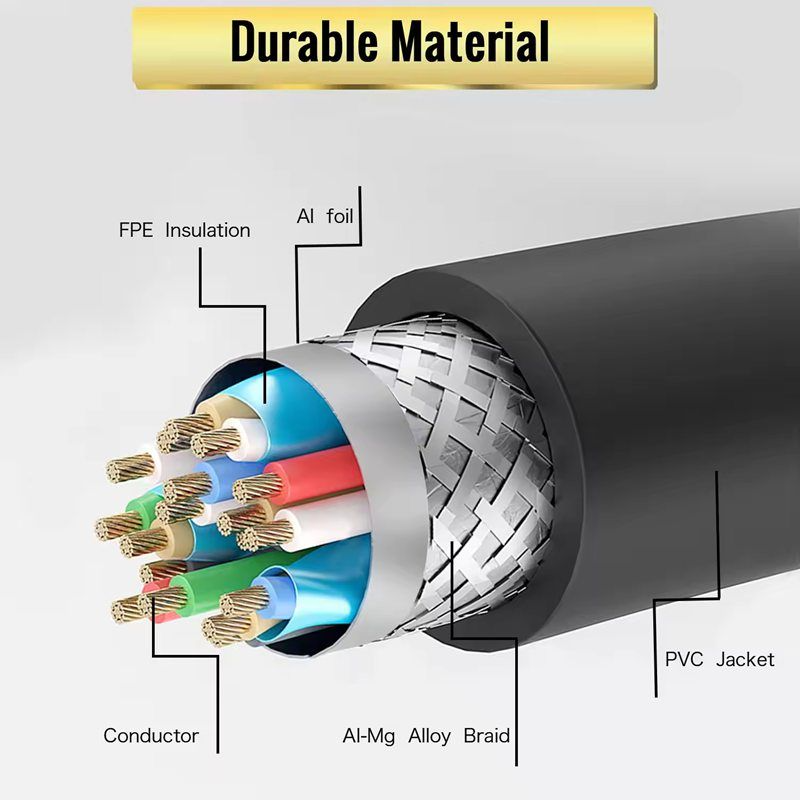
Each conductor includes:
- Central copper wire for signal transmission
- Insulation to prevent crosstalk
- Braided or foil shielding for EMI protection
- Outer jacket (PVC, TPE, or LSZH) for durability
This structure allows VGA cables to transmit analog video up to 1920×1080 (Full HD) when properly shielded. Signal quality depends heavily on impedance (typically 75 ohms) and cable length — beyond 5 meters, analog degradation becomes noticeable.
What Does a VGA Connector Look Like?
The VGA connector is a 15-pin D-subminiature (DE-15) plug — trapezoidal, usually blue, with two screws for secure locking.
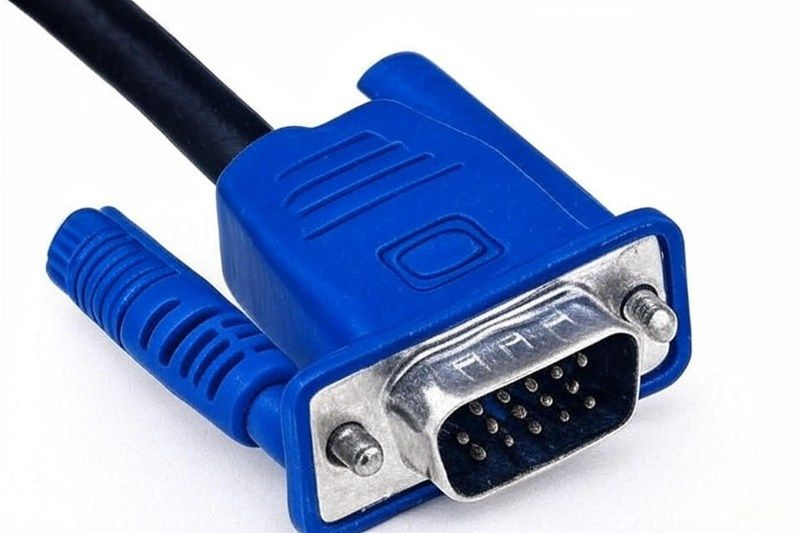
- Male connectors are found on cables and PC graphics cards.
- Female connectors are mounted on monitors, projectors, or adapters.
Pins 1, 2, and 3 carry the RGB color channels, while others handle ground and sync signals. VGA’s iconic shape makes it instantly recognizable and still present in industrial and embedded systems where reliability matters more than modern aesthetics.
What Is the VGA Cable Used For?
Originally developed by IBM in 1987, VGA cables became the universal video interface for computers, monitors, and projectors.
Today, they remain essential for:
- Legacy desktop PCs and KVM (keyboard-video-mouse) switches
- Industrial machinery and control panels
- Medical imaging equipment
- Educational projectors and training displays
In short — wherever an analog video signal is needed without latency or encryption, VGA still serves.
What Are the Main Types of VGA Cables?
VGA cables come in standard, high-resolution, and hybrid interface types. Standard VGA cables serve PCs and projectors, high-resolution models use coaxial shielding for clarity, and hybrid types connect VGA to HDMI, DVI, or BNC interfaces.
| VGA Cable Type | Description | Typical Use | Key Specs |
|---|---|---|---|
| Standard VGA Cable | Basic 15-pin analog cable | PC → Monitor | 1.5–5m, PVC jacket |
| High-Resolution VGA Cable | 75Ω coaxial structure with ferrite cores | HD monitors, long runs | 1080p+, EMI-resistant |
| VGA to DVI Cable | Analog DVI-A interface | Legacy systems | Converts analog signals |
| VGA to HDMI Cable | Includes built-in converter chip | Modern TVs/projectors | Analog → Digital |
| VGA to BNC Cable | Professional video equipment | Broadcast or industrial | 5 BNC connectors (RGBHV) |
High-quality VGA cables often include ferrite cores to filter electromagnetic noise, gold-plated pins for corrosion resistance, and double shielding for consistent analog performance.
Which VGA Cable Is Best for Your Application?
The best VGA cable depends on your application. Use standard cables for office PCs, high-resolution shielded versions for industrial displays, and hybrid VGA-HDMI or VGA-DVI cables for compatibility with newer devices.
Do You Need a VGA Cable for a Monitor?
If your monitor and computer both have VGA ports, then yes — a VGA cable is essential.

However, if your display supports HDMI or DisplayPort, those may deliver sharper digital images. VGA remains valuable for:
- Older monitors or office setups
- Industrial equipment with VGA-only output
- Backup or diagnostic connections
For OEMs or system integrators, VGA cables are still the go-to option for connecting embedded boards or machine displays due to their universal compatibility and low cost.
Choosing the Right VGA for Your Setup
- Office and home use: Standard VGA, 1.5–3m
- Industrial environments: Shielded heavy-duty VGA, ferrite cores
- OEM applications: Custom lengths and molded ends for tight enclosures
- Professional audio-visual systems: VGA to BNC or VGA to HDMI hybrids
At Sino-conn, we help customers choose the ideal VGA configuration — from conductor gauge to overmolding style — ensuring optimal signal integrity for each project.
How to Choose the Right VGA Cable Specifications
To choose the right VGA cable, evaluate conductor gauge (AWG), shielding quality, cable length, impedance stability, and connector materials. These determine how clearly analog RGB signals travel from a computer to a display. For industrial or OEM applications, always choose cables with 75-ohm impedance, double shielding, and gold-plated connectors to minimize signal loss and electromagnetic interference.
Selecting a VGA cable may seem straightforward, but when it comes to signal integrity, durability, and EMI resistance, the details make all the difference.
A properly specified cable ensures sharper images, longer lifespan, and consistent performance — especially for industrial or OEM environments where noise and heat are everyday realities.
Let’s break down the most critical parameters one by one.
1. Cable Gauge (AWG) and Conductor Material
The American Wire Gauge (AWG) defines the conductor’s diameter — and thus how well it carries analog signals. Lower AWG means a thicker conductor, resulting in lower resistance and less signal degradation over distance.
| Conductor Size | Typical Use | Max Recommended Length | Resistance (Ω/km) |
|---|---|---|---|
| 24 AWG | High-quality, long-distance VGA | Up to 10 m | 85 Ω/km |
| 26 AWG | Standard office monitors | Up to 5 m | 133 Ω/km |
| 28 AWG | Compact or portable VGA | Up to 3 m | 212 Ω/km |
Sino-conn recommends:
- 24 AWG oxygen-free copper (OFC) conductors for industrial or HD display applications.
- Tinned copper for better solderability and corrosion resistance.
- Bare copper when cost is the priority but environment is controlled (e.g., indoor offices).
The conductor’s purity directly influences analog clarity — poor copper quality can result in fuzzy or ghosting images, especially at high resolutions.
2. Shielding: Your First Line of Defense Against EMI
Electromagnetic interference (EMI) and radio-frequency interference (RFI) are the biggest enemies of analog VGA signals. Shielding acts like armor, blocking unwanted electrical noise from motors, power lines, and Wi-Fi equipment.
Common VGA shielding structures include:
| Shield Type | Structure | EMI Protection | Flexibility | Typical Use |
|---|---|---|---|---|
| Foil Shielding | Aluminum foil wrapped around each conductor | Moderate | High | Short cables (<3m) |
| Braided Shielding | Copper braid (80–95% coverage) | High | Medium | Industrial use |
| Double Shielding | Foil + braid | Very High | Medium | OEM & industrial |
| Triple Shielding | Foil + braid + ferrite cores | Excellent | Lower | Long-distance & mission-critical systems |
Each RGB channel in a high-quality VGA cable is actually a miniature coaxial line — shielded individually for the red, green, and blue signals.
This internal coaxial construction is what allows premium VGA cables to maintain image clarity even at 1080p resolution.
Sino-conn’s Advantage:
Our VGA assemblies use multi-layer EMI protection, combining foil + braided copper with ferrite beads at connector ends, ensuring superior performance in noisy environments like factories or hospitals.
3. Impedance and Signal Integrity
VGA signals are analog and depend on consistent impedance (usually 75 ohms) along the entire transmission path.
Impedance mismatch causes signal reflections and ghosting artifacts on the display.
A well-engineered cable maintains impedance within ±5% tolerance across its length. This is achieved through:
- Precise control of conductor spacing and dielectric material
- Uniform cable geometry during extrusion
- Proper shielding continuity at both connectors
Pro Tip:
For runs longer than 5 meters, choose cables with 75Ω coaxial construction and ferrite chokes to suppress high-frequency noise.
Sino-conn Quality Check:
Every custom VGA cable undergoes impedance and continuity testing during QC, verified using a vector network analyzer (VNA) to ensure signal integrity meets spec.
4. Cable Length and Signal Degradation
Cable length directly affects analog performance. The longer the cable, the more the signal weakens due to resistance, capacitance, and inductance.
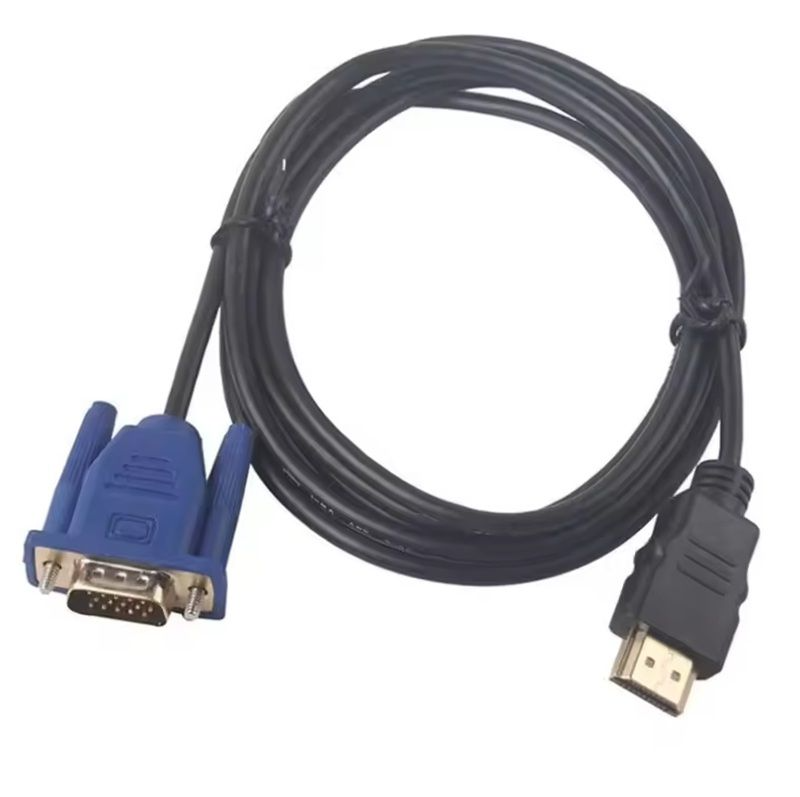
This can cause color bleeding, ghosting, or shimmering on the display.
| Cable Length | Recommended Use | Performance Level |
|---|---|---|
| 1–2 m | Standard PC to monitor | Excellent |
| 3–5 m | Office, projector setups | Good |
| 5–10 m | Industrial / large display | Requires high-quality shielding |
| 10 m+ | Professional video systems | Use active VGA extender or amplifier |
Tips:
- Keep cables under 5 meters for best analog clarity.
- For longer distances, Sino-conn recommends thicker gauge (24 AWG) and triple shielding.
- If your system exceeds 10 meters, consider an active VGA extension solution (Sino-conn can integrate amplifiers directly into the connector housing).
5. Connector Material and Plating
The VGA connector is the interface between your signal and device — its build quality matters as much as the cable itself.
Connector Material Options:
- Brass or Zinc Alloy Shells: Provide mechanical strength.
- Gold-Plated Pins: Ensure stable contact resistance (<15mΩ).
- Nickel-Plated Shells: Offer corrosion protection in humid environments.
- Overmolded Housings: Reinforce strain relief and maintain long-term flexibility.
| Plating Type | Corrosion Resistance | Signal Contact Quality | Typical Application |
|---|---|---|---|
| Gold (≥15µ”) | Excellent | Superior | Industrial / medical |
| Nickel | Good | Moderate | Office environments |
| Tin | Fair | Cost-efficient | Short-term use |
Sino-conn’s standard VGA connectors use nickel shells with 15µ” gold-plated contacts, balancing cost, durability, and signal reliability.
6. Jacket Material and Environmental Resistance
The outer jacket not only protects the inner conductors but also determines flexibility, temperature resistance, and environmental safety.
| Jacket Type | Temperature Range | Flame Rating | Features | Application |
|---|---|---|---|---|
| PVC | -10°C to 70°C | UL VW-1 | Cost-effective, flexible | General use |
| TPE | -40°C to 105°C | UL 94V-0 | Excellent flexibility, oil-resistant | Industrial |
| LSZH | -30°C to 90°C | IEC 60332 | Low smoke, halogen-free | Medical, public buildings |
| Silicone | -60°C to 200°C | UL 94V-0 | Heat and UV resistant | Outdoor, aerospace |
Sino-conn can customize jacket materials for specific environmental demands — e.g., oil-resistant for manufacturing plants, UV-resistant for outdoor kiosks, or halogen-free for medical and public safety systems.
7. Special Requirements: Fire, Flex, and Certification
For professional buyers and OEM engineers, cable selection often includes compliance and performance certifications:
| Requirement | Standard | Description |
|---|---|---|
| Flame Resistance | UL VW-1 / IEC 60332 | Ensures self-extinguishing capability |
| RoHS / REACH | EU Directives | Restricts hazardous materials |
| ISO 9001 | Quality system | Consistent process control |
| UL File Number | Product traceability | Certified safety for North America |
Sino-conn’s VGA cables are UL, ISO, RoHS, REACH, and PFAS-free certified — ready for international compliance documentation including COC and COO certificates upon request.
8. Example: Matching VGA Cable to Use Case
| Application | Recommended Specs | Notes |
|---|---|---|
| Office PC → Monitor | 26 AWG, PVC jacket, standard VGA | Cost-effective |
| Factory Control Display | 24 AWG, double-shielded, TPE jacket | EMI-heavy environments |
| Medical Imaging | 24 AWG, LSZH jacket, gold-plated pins | Safety and hygiene critical |
| OEM Equipment Assembly | Custom length, pinout-defined, overmolded ends | Space-constrained builds |
| Outdoor Kiosk / Digital Signage | 24 AWG, silicone jacket, UV-resistant | Harsh environment |
These recommendations ensure each VGA cable assembly matches its intended electrical and mechanical environment — balancing performance, safety, and cost.
9. Customization from Sino-conn
When off-the-shelf VGA cables fail to meet your requirements, Sino-conn delivers precision-engineered alternatives:
- Length: From 10 cm prototypes to 10 m assemblies
- Pinout definition: Fully configurable based on system wiring
- Connector type: Straight, right-angle, screw-lock, or mini D-sub variants
- Shielding level: Single to triple-layer, plus ferrite cores
- Branding: Custom labeling and overmold colors available
Sino-conn’s rapid prototyping ensures:
- Drawings within 30 minutes
- Samples in 3 days
- Mass production in 2–4 weeks
Every order is verified through 3-stage quality inspection (IPQC, FQC, OQC) for electrical, mechanical, and visual standards.
10. Sino-conn: Your Partner for Precision VGA Cable Design
Choosing the right VGA cable is more than matching connectors — it’s about ensuring stable analog performance in your environment.
From engineering consultation to high-volume OEM supply, Sino-conn provides:
- Custom specifications based on your design
- Flexible pricing (original or equivalent components)
- Fast global delivery and full documentation
Ready to specify your VGA cable?
Reach out to Sino-conn’s engineering team today for a free technical consultation or custom drawing — and get your sample delivered within days.
Do VGA Cables Still Matter in Modern Displays?
Yes. VGA cables remain relevant for industrial, educational, and medical applications due to their reliability, availability, and compatibility with legacy equipment.
While digital video dominates consumer markets, analog VGA still thrives where stability, simplicity, and compatibility matter most:
- Factories: Industrial PCs and PLCs often use VGA due to EMC compliance.
- Medical imaging: Legacy systems still rely on analog video interfaces.
- Education: Thousands of classrooms and conference halls use VGA projectors.
- Military & aerospace: Proven reliability and custom shielding options.
Digital alternatives (HDMI, DP) may offer higher resolution, but they also require encryption chips, firmware updates, and more fragile connectors. VGA’s robustness, especially when custom-built with coaxial shielding, ensures signal consistency in demanding conditions.
How Does Sino-conn Customize and Manufacture VGA Cable Assemblies
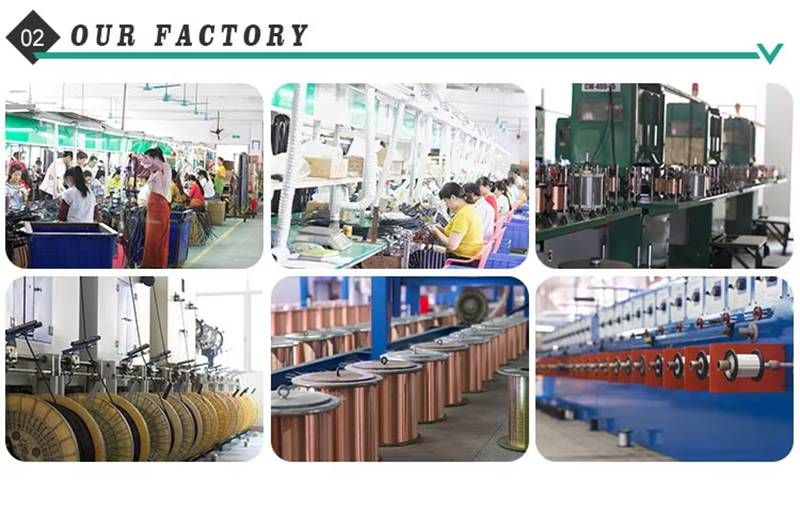
Sino-conn customizes and manufactures VGA cable assemblies through a precision-controlled process that includes engineering design, rapid prototyping, strict quality inspection, and full certification. Each cable is tailored for application-specific requirements—length, pinout, shielding, and materials—ensuring optimal signal integrity, EMI protection, and mechanical strength. From CAD drawings to mass production, Sino-conn delivers fast, flexible, and fully certified VGA solutions for OEMs, engineers, and distributors worldwide.
At Sino-conn, custom VGA cable assemblies are not just products—they’re engineered solutions.
Each order begins with an understanding of the customer’s application environment, electrical parameters, and mechanical constraints, ensuring the final cable performs perfectly under real-world conditions.
Whether the client is an OEM, a design engineer, or a distributor, Sino-conn’s process combines engineering expertise, certified materials, and agile production to achieve exceptional quality with short lead times.
1. Engineering Design & Consultation
Everything starts with communication and understanding. Sino-conn’s engineering team works directly with clients to define the exact requirements.
Customer Input Options
- Technical drawings (PDF, CAD, or hand sketches)
- Reference samples or photos
- Performance requirements: voltage, current, impedance, flexibility
- Environmental conditions: temperature, oil, UV, moisture, or EMI exposure
If the customer only provides an image or a basic description, Sino-conn’s engineers reverse-engineer the product by identifying:
- Connector type (original brand or equivalent)
- Pinout and wiring definition
- Conductor gauge (AWG) and shielding layout
- Overmold geometry and strain-relief requirements
Rapid Engineering Response:
- CAD drawing within 30 minutes – 3 hours
- Formal PDF confirmation before production
- BOM and cost analysis prepared simultaneously
This phase ensures complete technical transparency—clients know exactly what will be produced before manufacturing begins.
2. Prototyping and Sampling
After engineering approval, Sino-conn quickly transitions to sample production.
Samples are typically ready in 2–3 days, and urgent requests can be prioritized for same-week shipment.
Prototype Objectives:
- Validate connector fit and mechanical strength
- Test impedance (target 75Ω ±5%)
- Measure EMI shielding effectiveness
- Confirm cable flexibility and bend radius
| Prototype Type | Typical Lead Time | Testing Performed |
|---|---|---|
| Standard VGA | 3 days | Continuity, appearance |
| Custom Length/Pinout | 4–5 days | Electrical + mechanical test |
| Hybrid VGA (VGA-HDMI/BNC) | 5–7 days | Signal integrity test |
| Overmolded Industrial VGA | 5–7 days | Pull test, environmental test |
Every prototype includes a test report, dimension verification sheet, and digital image set for client confirmation.
3. Material Selection and Customization Options
Sino-conn offers a broad range of component and material configurations to match cost, performance, and environmental goals.
| Component | Available Options | Typical Use |
|---|---|---|
| Conductor | Bare copper, tinned copper, OFC | Signal quality & flexibility |
| Shielding | Foil, braid, double, or triple | EMI protection level |
| Insulation | PVC, PE, XLPE | Electrical insulation & durability |
| Jacket | PVC, TPE, LSZH, Silicone | Environment & temperature rating |
| Connector | Original DE-15, equivalent replacement, or right-angle type | Mechanical fit |
| Overmold | PVC or TPE molded strain relief | Mechanical reinforcement |
Customization Scope:
- Cable length: from 10 cm to 10 m
- Pin-out definition: standard or client-specified
- Connector orientation: straight, right-angle, panel-mount, or compact versions
- Branding: custom color, logo embossing, labeling, or serial marking
- Special builds: halogen-free, PFAS-free, flame-retardant, or low-odor compounds
Sino-conn’s flexible sourcing of both original-brand connectors (Amphenol, Molex, Hirose) and cost-effective equivalents allows clients to balance price and performance according to project size and urgency.
4. Production Process and Quality Control
Manufacturing at Sino-conn follows a three-stage quality system, ensuring every cable meets strict international standards before it leaves the facility.
Step 1: Process Control (IPQC)
During assembly:
- Wires are crimped or soldered under controlled temperature settings.
- Each conductor is tested for continuity and correct pin mapping.
- Shielding and drain wires are checked for full contact.
- Overmolding temperature and pressure are verified to prevent cable deformation.
Step 2: Finished Quality Inspection (FQC)
Each cable undergoes:
- Visual inspection (cosmetic defects, labeling accuracy)
- Mechanical testing (pull force ≥ 60N)
- Electrical continuity check (pin-to-pin resistance < 0.05Ω)
- Impedance verification with oscilloscope or TDR test.
Step 3: Outgoing Quality Control (OQC)
Before shipment:
- 100% function test on random sample basis.
- Packaging inspection (anti-static bag or client-specified packaging).
- Label cross-check for traceability (batch + QC code).
| QC Stage | Test Type | Frequency | Target Standard |
|---|---|---|---|
| IPQC | Crimp inspection, soldering verification | Every batch | ±0.05mm tolerance |
| FQC | Electrical & visual test | 100% | ISO 9001 |
| OQC | Final verification | 100% | Client-approved drawings |
This 3-step QC loop minimizes risk, ensuring every VGA cable assembly aligns perfectly with customer drawings.
5. Certification and Compliance
Sino-conn’s manufacturing and materials meet the most demanding international standards:
| Certification | Description | Importance |
|---|---|---|
| UL Listed (E-file) | Verified cable safety under UL standards | U.S. market compliance |
| ISO 9001:2015 | Quality management certification | Consistent process control |
| RoHS / REACH | EU environmental compliance | Restricts hazardous substances |
| PFAS-Free | Emerging sustainability requirement | For eco-sensitive markets |
| COC / COO | Certificate of Conformity / Origin | For customs & documentation |
Customers from North America, Europe, and Japan trust Sino-conn’s documentation for import, audit, and traceability.
6. Lead Time, Logistics, and Flexibility
Sino-conn’s supply chain is optimized for speed and transparency, ensuring customers get products on time — even under tight deadlines.
| Stage | Standard Lead Time | Rush Order Option |
|---|---|---|
| Engineering Drawing | 30 min – 1 day | Immediate response |
| Sample Production | 3–5 days | 2–3 days express |
| Mass Production (Batch) | 3–4 weeks | 2-week fast track |
| Inspection & Shipping | 1–2 days | Same-day dispatch available |
MOQ: No minimum order quantity — from 1 prototype piece to thousands of units.
Delivery Options: Air express, sea freight, or customer’s designated forwarder.
Packaging: Custom labeling, barcode tracking, and anti-static packaging available.
7. Manufacturing Technology & Equipment
Sino-conn’s production lines are equipped with:
- Automatic wire cutting and stripping machines
- Precision crimping and soldering stations
- Digital microscopes for pin inspection
- TDR and impedance testers
- Pull-force and bending test machines
- Overmolding injection systems with precision temperature control
These facilities ensure dimensional accuracy, repeatability, and aesthetic consistency, even across large batches.
8. Typical VGA Assembly Configurations
| Product Type | Description | Customer Segment |
|---|---|---|
| Standard VGA (Male–Male) | 15-pin D-sub, molded ends | Office & consumer electronics |
| VGA Extension (Male–Female) | Panel-mount compatible | OEM assembly lines |
| Industrial VGA (Double Shielded) | Foil + braid, ferrite cores | Factory automation & control |
| Hybrid VGA-HDMI | Built-in signal converter | AV equipment & education |
| Right-Angle VGA | Space-saving overmold | Embedded devices & kiosks |
Each configuration can be adjusted for length, flexibility, impedance, and connector type to meet the specific performance envelope of the target application.
9. Continuous Improvement and After-Sales Support
Sino-conn doesn’t stop at production.
The team actively gathers performance feedback from end-users, engineers, and distributors to refine designs and improve future runs.
This proactive approach has resulted in:
- Reduced defect rate below 0.2% per 10,000 pcs
- Improved assembly consistency through process automation
- Enhanced cable flexibility without compromising shielding
Clients enjoy lifetime technical support, including:
- Revisions of pinouts or drawings for future upgrades
- Documentation updates for compliance
- Rapid replacements in case of rare failures
10. Why OEMs and Engineers Choose Sino-conn
Sino-conn has become a trusted supplier to global OEMs, research institutions, and system integrators because it delivers the rare combination of speed, customization, and reliability.
Key Advantages at a Glance:
| Capability | Benefit to Customer |
|---|---|
| Rapid drawing and sample turnaround | Faster design validation |
| No MOQ & flexible pricing | Perfect for prototype and production |
| Certified materials and full traceability | Compliance made simple |
| Mixed connector sourcing | Original or alternative to fit budget |
| 3-stage QC system | Reliable, consistent performance |
| Multilingual sales & engineering support | Smooth communication and documentation |
FAQ About VGA Cables
Is VGA digital or analog?
VGA is purely analog, using voltage variations to represent colors and brightness.
Can VGA support 1080p or higher?
Yes, high-quality coaxial VGA cables can transmit up to 1080p and even 1600×1200 resolutions, depending on signal strength and length.
Are VGA and D-sub the same?
VGA uses a 15-pin D-sub (DE-15) connector, so the terms are often used interchangeably.
Can Sino-conn produce VGA to HDMI adapters?
Yes — Sino-conn can build custom VGA to HDMI or VGA to DVI assemblies with integrated signal conversion chips.
Conclusion:
VGA may be one of the oldest video interfaces, but it remains one of the most trusted, stable, and versatile. From office monitors to industrial control systems, it continues to deliver.
However, not all VGA cables are created equal — signal loss, EMI, or poor connectors can degrade performance. That’s where Sino-conn steps in.
With engineering expertise, rapid prototyping, and full certification, Sino-conn provides custom VGA cable assemblies that meet every customer’s technical and environmental requirement — from a single prototype to full OEM mass production.
Need a reliable VGA cable or custom design?
Contact Sino-conn today for a drawing, quotation, or consultation — and experience fast delivery, technical precision, and true manufacturing partnership.