Skip to content
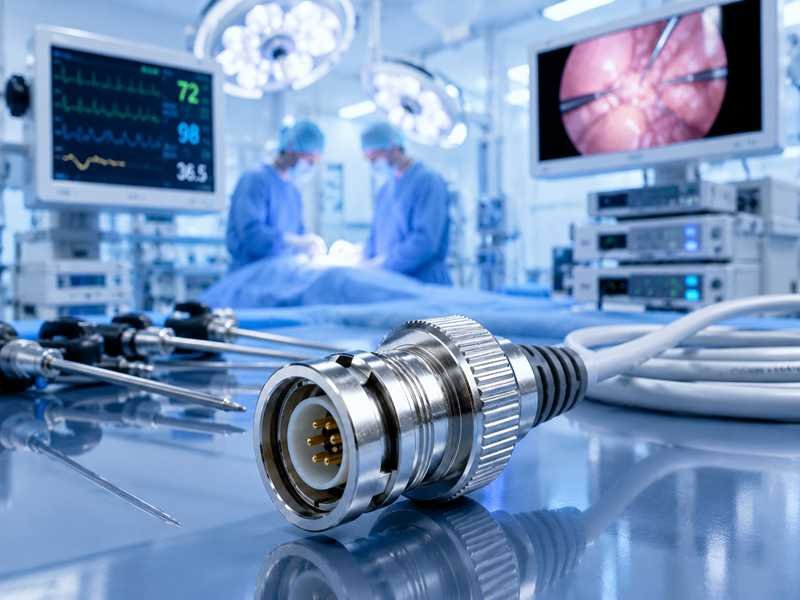
In a surgical system, a cable is never just a cable. It may carry high-definition video from an endoscope, deliver power to a surgical tool, transmit control signals inside a robotic arm, or connect sensors that guide real-time decisions during a procedure. If the cable is too stiff, the surgeon feels resistance. If shielding is weak, image noise appears. If the jacket cannot handle cleaning chemicals, the surface cracks or becomes sticky. If the connector loosens, the device may fail at the worst possible moment.
Designing cable assemblies for surgical equipment requires careful control of materials, shielding, flexibility, connector selection, strain relief, sterilization resistance, and documentation. The right cable assembly must support stable signal transmission, repeated movement, cleaning cycles, patient safety, and long-term production consistency.
This is why surgical cable design should start before the final mechanical layout is locked. Many problems that appear during validation are not caused by the PCB or software. They come from cable routing, material selection, bending stress, or insufficient EMI protection. In real projects, the cable often becomes the part that exposes whether the full system design is truly ready for clinical use.
What Are Cable Assemblies for Surgical Equipment?
Cable assemblies for surgical equipment are specialized interconnect systems designed to transmit power, data, video signals, sensor feedback, and control commands within surgical devices and operating-room equipment. Unlike standard industrial cables, they must operate reliably in environments where equipment failure, signal interruption, or communication errors can directly affect medical procedures.

A surgical cable assembly is often a small part of the overall system cost, but it plays a critical role in overall device performance. Whether it is installed inside a surgical robot, connected to an endoscopic camera, routed through a powered handpiece, or used in a surgical imaging platform, the cable assembly must continue performing under constant movement, repeated cleaning, electromagnetic interference, and demanding reliability requirements.
For this reason, surgical equipment manufacturers typically evaluate cable assemblies based on far more than electrical specifications alone. Factors such as flexibility, sterilization compatibility, shielding effectiveness, connector durability, strain relief design, and long-term service life often become equally important.
Surgical Equipment Basics
Many people assume a surgical cable assembly is simply a group of wires with connectors attached.
In reality, modern surgical cable assemblies are engineered systems composed of multiple elements working together.
A typical assembly may include:
- Conductors
- Insulation layers
- Shielding structures
- Connector systems
- Overmolds
- Strain reliefs
- Protective jackets
- Grounding components
- Identification labels
Each element contributes to the overall performance of the device.
For example:
| Component | Function |
|---|---|
| Conductor | Carries power or signals |
| Shielding | Protects against EMI |
| Connector | Creates secure connection |
| Jacket | Provides environmental protection |
| Strain Relief | Prevents cable fatigue |
| Overmold | Improves durability and sealing |
In many surgical devices, cable assemblies are expected to remain operational for years while enduring thousands of movement cycles and cleaning procedures.
A poorly designed cable can become one of the first components to fail, even if the electronics themselves remain fully functional.
This is why experienced medical OEMs often involve cable suppliers early in the design process rather than treating the cable as a simple purchased component.
Common Applications
Cable assemblies are used throughout modern surgical systems.
As surgical equipment becomes more advanced, the number of cable assemblies inside each device continues to increase.
Common applications include:
| Equipment Type | Cable Function |
|---|---|
| Surgical Robots | Motor control, sensor feedback, power |
| Endoscopy Systems | Video transmission, illumination |
| Electrosurgical Units | Energy delivery and control |
| Surgical Navigation Systems | Data communication |
| Medical Imaging Systems | High-speed signal transmission |
| Powered Surgical Tools | Power and control signals |
| Operating Room Displays | Video and data connections |
A surgical robot may contain dozens of cable assemblies routed through moving joints and articulated arms.
An endoscopic imaging system may rely on high-density micro coax cables to transmit high-definition video with minimal signal loss.
A powered surgical handpiece may require a cable capable of carrying both power and control signals while remaining lightweight and flexible.
Because each application presents different challenges, cable structures are often customized rather than selected from standard catalog products.
One customer working with Sino-conn was developing a minimally invasive surgical device with limited internal space.
The original cable occupied too much room inside the enclosure and restricted airflow.
By redesigning the cable structure and optimizing connector orientation, the customer reduced assembly complexity while maintaining signal performance.
Projects like this illustrate why cable assemblies often influence the overall device design more than many engineers initially expect.
Critical Functions
A surgical cable assembly performs much more than basic electrical transmission.
In many systems, it acts as the communication pathway between critical device functions.
Examples include:
- Transmitting surgical camera images
- Carrying motor-control commands
- Delivering energy to surgical instruments
- Providing real-time sensor feedback
- Supporting synchronization between subsystems
When these functions are interrupted, device performance may be affected immediately.
For example:
| Function | Potential Impact of Failure |
|---|---|
| Video Transmission | Image loss or distortion |
| Sensor Feedback | Inaccurate measurements |
| Motor Control | Reduced movement precision |
| Power Delivery | Device shutdown |
| Data Communication | System errors |
Unlike consumer electronics, surgical systems often operate under strict uptime requirements.
Even brief interruptions may trigger alarms, require troubleshooting, or delay procedures.
A surgical imaging manufacturer once approached Sino-conn after experiencing occasional image artifacts during system movement.
After investigation, the issue was traced to shielding degradation near a high-flex section of the cable.
The camera, monitor, and electronics all performed correctly.
The cable assembly was the root cause.
Once the shielding structure and strain relief design were upgraded, the issue disappeared.
This example highlights a reality often seen in medical device development:
Cable performance directly affects overall system reliability.
Design Challenges
Designing cable assemblies for surgical equipment involves balancing multiple engineering requirements simultaneously.
A cable may need to be:
- Flexible enough for movement
- Strong enough for long-term use
- Small enough for compact equipment
- Shielded against EMI
- Resistant to cleaning chemicals
- Compatible with sterilization procedures
- Easy to assemble during manufacturing
Improving one characteristic can sometimes reduce another.
For example:
| Goal | Possible Trade-Off |
|---|---|
| Smaller Diameter | Reduced durability |
| Additional Shielding | Increased stiffness |
| Higher Flex Life | Higher cost |
| Greater Protection | Larger cable size |
| Softer Material | Lower abrasion resistance |
These trade-offs become especially important in surgical equipment where space is limited and reliability expectations are extremely high.
One of the most common mistakes in early-stage development is optimizing only for cable size.
Many engineers initially request the smallest possible cable diameter.
However, reducing cable size may affect:
- Shield coverage
- Mechanical strength
- Flex life
- Service life
A customer developing a robotic-assisted surgical system initially specified an extremely compact cable structure to save space inside the robotic arm.
After reviewing movement requirements, Sino-conn recommended a slightly larger construction with improved strain relief and shielding support.
The revised design occupied only a few millimeters more space but significantly improved long-term reliability.
Why Surgical Cable Assemblies Are Different
The biggest difference between surgical cable assemblies and ordinary industrial cables is the consequence of failure.
In a factory environment, a damaged cable may stop production temporarily.
In a surgical environment, equipment downtime can affect procedure schedules, increase service costs, and create significant operational challenges for hospitals.
This is why surgical cable assemblies are often designed around reliability first.
Medical OEMs typically evaluate:
- Material quality
- Connector durability
- Shielding effectiveness
- Cleaning resistance
- Flex-life performance
- Documentation availability
- Manufacturing consistency
Many also request:
- Material specifications
- Connector specifications
- RoHS declarations
- REACH declarations
- PFAS information
- COC
- COO
At Sino-conn, surgical cable projects frequently begin with detailed discussions about the application itself rather than the cable part number.
Understanding:
- How the device moves
- How often it is cleaned
- Where the cable is installed
- What signals it carries
- How long the product is expected to last
often reveals more useful information than electrical specifications alone.
The most successful surgical cable assemblies are not simply designed to pass initial testing. They are engineered to remain reliable throughout years of clinical use, repeated maintenance cycles, and continuous operation in demanding medical environments.
Which Materials Suit Cable Assemblies for Surgical Equipment?
Material selection is one of the most important decisions in surgical cable assembly design.
Many cable-related failures can be traced back to material choices made during the early stages of development. A cable may pass electrical testing, function correctly during initial validation, and even perform well in short-term use. However, after months of repeated bending, cleaning, sterilization exposure, and daily operation, material weaknesses often begin to appear.
Common symptoms include:
- Jacket cracking
- Surface hardening
- Loss of flexibility
- Shield fatigue
- Discoloration
- Sticky surfaces
- Reduced abrasion resistance
For surgical equipment manufacturers, material selection is not simply about choosing the most expensive option. It is about finding the right balance between flexibility, durability, cleaning resistance, sterilization compatibility, mechanical performance, and long-term availability.
Modern surgical cable assemblies typically combine several material systems within a single product:
- Cable jacket
- Conductor insulation
- Shielding materials
- Connector housing
- Overmold material
- Strain relief
- Sealing components
Each material influences the overall performance of the cable.
This is why experienced medical OEMs often review materials at the same time they evaluate connector selection, shielding structure, and cable routing.
Medical Silicone
Medical silicone remains one of the most widely used materials in surgical cable assemblies.

Its reputation comes from decades of successful use in healthcare applications where flexibility and durability are critical.
Medical silicone is commonly found in:
- Surgical robot cables
- Electrosurgical accessories
- Patient monitoring systems
- Surgical imaging equipment
- Diagnostic devices
One of its biggest advantages is flexibility.
Compared with many conventional materials, silicone maintains softness across a wide temperature range and remains flexible even after years of use.
Performance comparison:
| Property | Medical Silicone |
|---|---|
| Flexibility | Excellent |
| Temperature Resistance | Excellent |
| Low-Temperature Performance | Excellent |
| Aging Resistance | Very Good |
| Patient Comfort | Excellent |
| Repeated Bending | Excellent |
In robotic-assisted surgery systems, cable flexibility directly affects system movement.
A stiff cable can create additional resistance inside robotic arms and increase stress on connectors.
Many surgical robot manufacturers therefore prioritize flexibility over small reductions in material cost.
One surgical robotics customer worked with Sino-conn to improve the movement performance of a cable assembly routed through multiple articulated joints.
The original cable used a standard TPU jacket.
Although it met electrical requirements, the stiffness created unwanted resistance during arm movement.
After switching to a silicone-based structure and optimizing conductor construction, cable handling improved significantly without changing the overall device design.
However, silicone is not suitable for every project.
Potential limitations include:
- Higher material cost
- Lower abrasion resistance
- Increased attraction to dust and lint
- More complex processing
The best choice depends on the actual operating environment.
Medical TPU
Medical TPU has become increasingly popular in modern surgical equipment.
Many engineers consider TPU one of the most balanced materials available because it combines flexibility with strong mechanical durability.
TPU is commonly used in:
- Endoscopic systems
- Portable surgical devices
- Imaging equipment
- Surgical carts
- Powered handpieces
Compared with silicone, TPU generally provides:
| Property | Medical TPU |
|---|---|
| Abrasion Resistance | Excellent |
| Tear Resistance | Excellent |
| Surface Finish | Excellent |
| Cleaning Resistance | Very Good |
| Flexibility | Very Good |
| Durability | Excellent |
One challenge faced by many surgical devices is frequent handling.
A cable connected to a portable imaging system may be moved dozens of times per day.
Repeated friction against equipment housings, brackets, and carts gradually wears the cable surface.
Medical TPU often performs better than silicone in these situations because of its superior abrasion resistance.
A customer developing a mobile surgical imaging platform approached Sino-conn after experiencing premature jacket wear.
The original cable remained electrically functional, but cosmetic damage appeared after several months of use.
After switching to a medical TPU formulation, surface durability improved significantly while maintaining flexibility requirements.
For many surgical applications, TPU provides an effective balance between performance and cost.
Sterilization Materials
Sterilization and cleaning requirements can have a major influence on material selection.
Not every surgical cable is fully sterilized, but nearly every cable used in an operating room encounters some form of cleaning or disinfectant exposure.
Common methods include:
| Method | Design Consideration |
|---|---|
| Alcohol Wipes | Surface compatibility |
| Hydrogen Peroxide | Chemical resistance |
| Quaternary Ammonium | Material stability |
| EtO Sterilization | Material compatibility |
| Steam Sterilization | Heat resistance |
| Plasma Sterilization | Surface durability |
The challenge is that cleaning procedures are repeated throughout the product lifecycle.
A cable may encounter hundreds or even thousands of cleaning cycles during its service life.
A material that performs well during laboratory testing may behave differently after years of exposure.
Potential issues include:
- Surface cracking
- Hardening
- Color fading
- Loss of flexibility
- Reduced tensile strength
Many medical OEMs now include cleaning-cycle simulations during validation because material degradation often appears long before electrical failure.
One surgical tool manufacturer initially selected a standard industrial-grade jacket material.
Electrical testing results were excellent.
However, repeated exposure to hospital disinfectants caused the jacket surface to deteriorate.
The material was eventually replaced with a medical-grade alternative before production release.
This prevented future service issues and reduced qualification risk.
Flex Life
Few applications challenge cable materials more than surgical robotics.
A cable routed through a robotic arm may experience:
- Continuous bending
- Twisting
- Rotation
- Repetitive motion
over thousands of procedures.
In these applications, conductor construction and jacket material must work together.
Flex-life performance depends on:
| Design Factor | Impact |
|---|---|
| Conductor Strand Count | Flexibility |
| Conductor Diameter | Durability |
| Jacket Hardness | Movement Performance |
| Shield Structure | Fatigue Resistance |
| Bend Radius | Stress Reduction |
| Strain Relief Design | Cable Protection |
Many engineers focus heavily on the jacket material while overlooking conductor construction.
In reality, both are equally important.
A highly flexible jacket cannot compensate for a conductor that fatigues prematurely.
At Sino-conn, robotic surgical cable projects often involve reviewing:
- Motion range
- Bend radius
- Rotation angle
- Movement frequency
- Expected service life
before finalizing the cable structure.
This approach helps avoid situations where a cable performs well during prototyping but struggles during long-term operation.
Material Selection
The most effective material selection process begins with the application rather than the material name.
Instead of asking:
“Should we use silicone or TPU?”
A better question is:
“What conditions will this cable experience during its service life?”
Important considerations include:
- Will the cable move continuously?
- Will it be cleaned daily?
- Does it require sterilization compatibility?
- Is space limited?
- Is appearance important?
- How many years is the product expected to remain in service?
The following comparison illustrates how many surgical OEMs evaluate materials:
| Requirement | Silicone | TPU | TPE | PVC |
|---|---|---|---|---|
| Flexibility | Excellent | Very Good | Good | Moderate |
| Abrasion Resistance | Good | Excellent | Good | Good |
| Cleaning Resistance | Very Good | Very Good | Moderate | Moderate |
| Long-Term Softness | Excellent | Very Good | Good | Moderate |
| Surface Appearance | Good | Excellent | Good | Standard |
| Cost | Higher | Medium | Medium | Lower |
No material excels in every category.
The best surgical cable assemblies are built around the actual operating environment rather than assumptions.
This is why Sino-conn typically begins surgical cable projects by discussing:
- Equipment type
- Cleaning procedures
- Mechanical movement
- Connector requirements
- Service expectations
- Production volume
before recommending a cable structure.
These conversations often reveal opportunities to improve performance, extend service life, reduce maintenance costs, or shorten development timelines.
Ultimately, successful material selection is not about choosing the most advanced material. It is about choosing the material that continues performing reliably after years of operation in one of the most demanding environments found in modern healthcare.
How Do Cable Assemblies for Surgical Equipment Handle EMI?
Electromagnetic interference (EMI) is one of the most common causes of unexpected performance issues in modern surgical equipment.
Many engineers spend weeks investigating software, processors, sensors, displays, or power systems before discovering that the real problem originates from the cable assembly itself.
In surgical equipment, EMI rarely appears as a complete failure.
More often, it shows up as:
- Intermittent image noise
- Unstable sensor readings
- Communication errors
- Touchscreen glitches
- Random device resets
- Data transmission failures
- Positioning inaccuracies in robotic systems
These problems can be extremely difficult to diagnose because the equipment may work perfectly during bench testing but behave differently once integrated into a complete surgical system.
The challenge is that modern operating rooms contain numerous electronic devices operating simultaneously.
A single surgical suite may include:
- Surgical robots
- Electrosurgical generators
- Medical displays
- Endoscopic cameras
- Imaging systems
- Wireless communication devices
- Monitoring equipment
- High-frequency power supplies
Every one of these devices can generate electromagnetic noise.
The role of a properly designed cable assembly is not only to carry signals but also to prevent unwanted interference from affecting system performance.
EMI Sources
Understanding where EMI originates is the first step toward solving it.
Many engineers initially focus on external interference, but in surgical equipment, internal EMI sources often create more problems than external ones.
Common EMI sources include:
| Source | Typical Frequency Range | Potential Impact |
|---|---|---|
| Electrosurgical Units | High Frequency | Signal disruption |
| Servo Motors | Switching Noise | Sensor instability |
| DC Motor Controllers | Broadband Noise | Communication errors |
| Switching Power Supplies | Wide Spectrum | Display artifacts |
| Wireless Modules | RF Interference | Data corruption |
| LED Drivers | Switching Frequencies | Image distortion |
| Imaging Systems | High-Speed Signals | Crosstalk |
Electrosurgical generators are particularly challenging.
These devices intentionally generate high-frequency energy that can easily couple into nearby cables if shielding is inadequate.
A surgical navigation customer approached Sino-conn after experiencing occasional positioning drift during procedures.
The navigation system itself passed all laboratory tests.
However, once integrated with the electrosurgical unit, sensor readings became unstable.
The root cause was electromagnetic coupling between high-power energy cables and low-level sensor cables routed too closely together.
By redesigning the cable structure and adjusting routing paths, the customer eliminated the issue without changing the electronics.
This demonstrates an important lesson:
Many EMI problems are actually cable-management problems.
Shielding Types
Shielding is the primary defense against EMI.
However, many engineers assume all shielded cables provide the same level of protection.
In reality, shielding effectiveness varies significantly depending on cable construction.
Common shielding structures include:
| Shield Type | Coverage | Flexibility | EMI Protection |
|---|---|---|---|
| Aluminum Foil | 100% | Moderate | Very Good |
| Copper Braid | 70-95% | Good | Excellent |
| Spiral Shield | Variable | Excellent | Good |
| Foil + Braid | Near 100% | Good | Excellent |
| Double Braid | High | Moderate | Excellent |
| Individually Shielded Pairs | Very High | Moderate | Excellent |
Foil shields provide excellent coverage and are frequently used for:
- LVDS cables
- eDP cables
- High-speed video transmission
- Medical imaging systems
Braided shields are commonly selected when mechanical durability is important.
Advantages include:
- Better flex life
- Stronger mechanical protection
- Improved grounding
For many surgical applications, a foil-and-braid combination offers the best balance.
This dual-layer structure is commonly used in:
- Endoscopic video systems
- Surgical robot communication cables
- Medical imaging equipment
- Navigation systems
One imaging equipment manufacturer initially selected a single foil shield to reduce cable diameter.
During system integration, image noise appeared whenever nearby equipment powered on.
Adding a braided shield layer solved the problem while increasing cable diameter by only a small amount.
The cost increase was minimal compared with the cost of redesigning the imaging system.
Signal Protection
Protecting signals becomes increasingly important as surgical systems transmit more data.
Modern devices routinely handle:
- HD video
- 4K video
- Sensor data
- Control signals
- Motor feedback
- Real-time imaging information
As data rates increase, signal quality becomes more sensitive to cable design.
Several factors influence signal protection:
| Design Factor | Impact |
|---|---|
| Impedance Control | Signal consistency |
| Shield Coverage | EMI reduction |
| Grounding Quality | Noise suppression |
| Pair Geometry | Signal integrity |
| Connector Design | Transmission stability |
| Cable Routing | Crosstalk prevention |
For example, medical micro coax cables are frequently used in endoscopic systems because they support:
- High-speed video
- Compact size
- Controlled impedance
- Reduced signal loss
However, these cables require careful termination.
A poorly terminated shield can reduce the effectiveness of an otherwise excellent cable design.
Sino-conn frequently supports customers who already have a connector model and cable specification but need assistance optimizing shielding termination.
In many projects, improving shield termination provides greater EMI improvement than changing the entire cable.
Cable Routing
Even the best shielded cable can perform poorly if routed incorrectly.
Cable routing is often treated as a mechanical design issue, but it plays a major role in EMI performance.
Good routing practices include:
- Separating power and signal cables
- Avoiding long parallel cable runs
- Maintaining shield continuity
- Minimizing exposed conductor length
- Controlling bend radius
- Avoiding unnecessary cable loops
Consider the following comparison:
| Routing Method | EMI Risk |
|---|---|
| Signal Cable Next to Power Cable | High |
| Separate Routing Paths | Low |
| Long Parallel Runs | High |
| Cross at 90 Degrees | Lower |
| Broken Shield Continuity | High |
| Continuous Shielding | Low |
One robotic surgery project involved multiple motor-control cables and sensor-feedback cables routed through a compact arm structure.
During testing, sensor accuracy varied slightly depending on arm position.
The cable itself met specification.
The issue came from routing power cables directly alongside sensitive signal lines.
Reorganizing cable paths significantly improved performance.
No changes to the electronics were required.
This type of issue is surprisingly common in surgical equipment development.
Noise Control
EMI control should never rely on a single solution.
Successful cable assemblies typically combine multiple techniques.
These may include:
- Shielding
- Grounding
- Twisted-pair construction
- Controlled impedance
- Differential signaling
- Routing optimization
- Connector shielding
Each layer contributes to overall system performance.
For example:
| Noise Control Method | Benefit |
|---|---|
| Twisted Pair | Cancels common-mode noise |
| Differential Signals | Improves immunity |
| Foil Shield | Blocks external EMI |
| Braided Shield | Enhances grounding |
| Shielded Connector | Protects termination area |
| Ground Strategy | Reduces noise loops |
One common misconception is that increasing shielding always solves EMI.
Sometimes the actual problem is grounding.
A cable with excellent shielding but poor ground termination may perform worse than a simpler cable with proper grounding.
This is why many surgical OEMs now evaluate the complete signal path rather than focusing on individual components.
Grounding Strategy
Grounding is often the most overlooked part of EMI control.
A poorly designed grounding scheme can create:
- Ground loops
- Noise injection
- Signal instability
- Increased emissions
Important grounding considerations include:
| Grounding Area | Design Goal |
|---|---|
| Shield Ground | Continuous low-impedance path |
| Chassis Ground | Noise dissipation |
| Signal Ground | Stable reference |
| Connector Ground | Reliable shield termination |
In medical equipment, grounding requirements are often influenced by:
- Safety requirements
- EMC testing
- Device architecture
- Regulatory considerations
One surgical imaging customer worked with Sino-conn after repeatedly failing EMC validation.
The cable shield itself was adequate.
The problem was inconsistent shield grounding between connector interfaces.
After redesigning the grounding strategy, EMC performance improved significantly without changing the cable structure.
This highlights an important engineering reality:
EMI control is rarely about a single component.
It is about how every part of the cable system works together.
Why Early EMI Design Matters
Many EMI problems become expensive because they are discovered too late.
A shielding adjustment during the design phase may add only a small cost.
The same change after validation may require:
- New drawings
- New prototypes
- Additional EMC testing
- Production delays
- Certification updates
Medical OEMs increasingly involve cable suppliers early because cable assemblies influence:
- EMC performance
- Signal integrity
- Reliability
- Device architecture
At Sino-conn, surgical cable projects often begin with discussions about:
- Signal type
- Data rate
- Routing constraints
- Connector selection
- Grounding requirements
- Operating environment
before a cable drawing is finalized.
These early conversations frequently identify potential EMI risks that would be much more expensive to solve later.
The most successful surgical cable assemblies do not simply pass electrical testing. They maintain stable signal performance inside complex operating-room environments where dozens of electronic systems operate simultaneously. Achieving that level of performance requires the right combination of shielding, grounding, routing, connector design, and engineering experience from the very beginning of the project.
How Do Cable Assemblies for Surgical Equipment Stay Reliable?
Reliability is often the factor that separates a successful surgical device from a product that generates constant service calls and maintenance costs.
Most surgical cable assemblies do not fail because they cannot carry electrical signals.
They fail because they operate in environments that continuously challenge every part of their construction.
A surgical cable may be:
- Bent thousands of times
- Twisted repeatedly
- Pulled during equipment movement
- Cleaned several times per day
- Exposed to disinfectants
- Installed in confined spaces
- Subjected to vibration and handling
A cable that performs perfectly during initial validation may encounter very different conditions after months or years of clinical use.
For this reason, reliability should be designed into the cable assembly from the beginning rather than evaluated only after prototypes are built.
Experienced medical OEMs often review reliability requirements before connector selection, shielding design, or material choice is finalized.
Connector Strength
One of the most common misconceptions in cable design is that the cable itself is the weakest component.
In reality, many failures occur at the connector interface.
The transition area between the cable and connector experiences the highest mechanical stress during operation.
Common failure mechanisms include:
- Connector loosening
- Contact wear
- Broken conductors near termination
- Shield separation
- Crimp degradation
- Solder joint fatigue
Areas receiving the greatest stress are often:
- Cable exits
- Connector backshells
- Strain relief transitions
- Moving cable joints
Reliability-focused connector evaluation typically considers:
| Connector Factor | Why It Matters |
|---|---|
| Mating Cycle Rating | Long-term durability |
| Locking Mechanism | Connection security |
| Contact Material | Wear resistance |
| Shielding Design | Signal stability |
| Cable Retention | Pull resistance |
| Housing Strength | Mechanical durability |
A surgical imaging manufacturer contacted Sino-conn after experiencing intermittent signal interruptions.
Initial troubleshooting focused on the display electronics.
However, investigation revealed microscopic movement within the connector assembly caused by repeated handling.
The connector contacts remained functional, but long-term wear had increased connection instability.
A revised connector design significantly improved reliability without altering the overall cable architecture.
This illustrates why connector selection should never be based solely on electrical specifications.
Strain Relief
If connector reliability is critical, strain relief is equally important.
Many cable failures originate not inside the cable itself, but within a few centimeters of the connector.
This area experiences concentrated stress whenever the cable bends, twists, or is pulled.
A properly designed strain relief helps distribute forces across a larger section of the cable.
Benefits include:
- Reduced conductor fatigue
- Improved shield durability
- Better pull resistance
- Longer service life
A comparison illustrates the difference:
| Design Condition | Reliability Impact |
|---|---|
| No Strain Relief | High stress concentration |
| Short Strain Relief | Moderate improvement |
| Optimized Strain Relief | Improved durability |
| Reinforced Design | Maximum protection |
One robotic surgery project required cables to pass through multiple moving joints.
The first prototype functioned correctly but showed conductor fatigue during long-term movement testing.
By modifying strain relief geometry and extending stress-distribution length, the cable survived significantly more movement cycles without increasing connector size.
These improvements often appear minor in drawings but have a substantial effect on field reliability.
Repeated Bending
Few environments place more stress on cables than robotic-assisted surgery systems.
Unlike stationary medical devices, robotic platforms subject cable assemblies to constant movement.
Typical stresses include:
- Bending
- Torsion
- Rotation
- Compression
- Repeated repositioning
Over time, these movements can damage:
- Conductors
- Shielding
- Insulation
- Connector terminations
Flex-life performance depends on multiple factors:
| Design Factor | Reliability Influence |
|---|---|
| Strand Count | Flexibility |
| Conductor Diameter | Fatigue resistance |
| Shield Structure | Mechanical durability |
| Jacket Material | Stress distribution |
| Bend Radius | Service life |
| Routing Path | Wear reduction |
A cable rated for stationary equipment may fail quickly inside a robotic arm.
This is why robotic applications often require:
- Fine-stranded conductors
- Flexible shielding structures
- Optimized cable lay lengths
- Enhanced strain relief
One customer developing a robotic surgical platform initially selected a cable structure used successfully in an imaging system.
Although electrically identical, the robotic environment introduced far greater mechanical stress.
A redesigned high-flex cable structure ultimately solved the issue.
The lesson is straightforward:
Reliability requirements must match actual movement conditions.
Environmental Protection
The operating room presents several environmental challenges that can affect cable lifespan.
Many of these factors are overlooked during early development.
Examples include:
- Daily disinfectant exposure
- Temperature fluctuations
- Humidity changes
- Mechanical abrasion
- Fluid contact
- Transportation stress
Potential consequences include:
- Jacket cracking
- Material hardening
- Color fading
- Surface degradation
- Corrosion
The severity depends heavily on material selection.
Common environmental concerns include:
| Environmental Factor | Potential Effect |
|---|---|
| Alcohol Cleaning | Surface aging |
| Hydrogen Peroxide | Material degradation |
| Humidity | Corrosion risk |
| Abrasion | Jacket wear |
| Repeated Handling | Surface damage |
| Storage Conditions | Long-term aging |
One portable surgical system manufacturer initially selected a jacket material based primarily on flexibility.
After several months of field use, the cable showed premature wear caused by frequent cleaning.
The electrical performance remained acceptable, but cosmetic and mechanical degradation created service concerns.
A revised material selection improved long-term durability while maintaining flexibility requirements.
This example demonstrates why reliability evaluation must extend beyond electrical testing.
Manufacturing Consistency
A prototype that performs well is valuable.
A production process that delivers the same performance across thousands of units is even more important.
Medical OEMs increasingly focus on manufacturing consistency because variability often creates hidden reliability risks.
Areas commonly reviewed include:
- Material control
- Crimp quality
- Solder quality
- Shield termination
- Inspection procedures
- Process traceability
Production controls may include:
| Control Area | Purpose |
|---|---|
| Incoming Inspection | Material verification |
| Process Inspection | Quality control |
| Crimp Validation | Connection integrity |
| Shield Inspection | EMI consistency |
| Final Inspection | Functional verification |
| Traceability Records | Product tracking |
At Sino-conn, custom medical cable assemblies typically undergo:
- Incoming material inspection
- In-process inspection
- Finished-product inspection
- Pre-shipment inspection
This multi-stage approach helps reduce variation and improve consistency across production batches.
For medical equipment manufacturers, consistency is often just as important as performance.
Reliability Testing
Testing provides confidence that a cable assembly can survive its intended environment.
However, not all testing methods provide the same value.
The most useful tests simulate actual operating conditions as closely as possible.
Examples include:
| Test Type | Purpose |
|---|---|
| Flex Testing | Evaluate movement durability |
| Pull Testing | Verify retention strength |
| Torsion Testing | Assess rotational stress |
| Thermal Cycling | Evaluate temperature effects |
| Chemical Exposure | Validate cleaning resistance |
| Continuity Monitoring | Detect intermittent failures |
Many OEMs now request application-specific testing rather than relying only on standard electrical checks.
For example:
A robotic cable may require:
- Continuous flex testing
- Torsion testing
- Dynamic monitoring
An imaging cable may prioritize:
- Signal integrity testing
- Shield effectiveness evaluation
- Connector durability
A powered surgical handpiece may require:
- Pull testing
- Abrasion testing
- Cleaning resistance evaluation
The testing strategy should always reflect actual use conditions.
Service Life Expectations
One of the first questions many surgical equipment manufacturers ask is:
“How long should this cable last?”
The answer depends on how the device is used.
A stationary cable inside an imaging system may remain functional for many years with minimal stress.
A cable routed through a robotic arm may experience significantly greater wear.
Service-life expectations often depend on:
| Factor | Influence |
|---|---|
| Movement Frequency | Fatigue rate |
| Cleaning Cycles | Material aging |
| Connector Mating Cycles | Contact wear |
| Environmental Exposure | Degradation speed |
| Maintenance Practices | Lifespan extension |
Rather than focusing on calendar years alone, many engineers evaluate service life based on operating cycles.
This provides a more realistic measure of reliability.
Why Reliability Starts Early
Many reliability issues become expensive because they are discovered too late.
A design change made during concept development may require only a drawing revision.
The same issue discovered after validation may require:
- New prototypes
- Additional testing
- Certification updates
- Production delays
- Field corrections
For this reason, successful surgical cable projects often begin with discussions about:
- Device movement
- Cleaning procedures
- Routing paths
- Service expectations
- Connector usage
- Environmental conditions
before the first prototype is built.
At Sino-conn, these discussions frequently reveal reliability risks that are not visible on drawings alone.
The most reliable surgical cable assemblies are not simply those built with premium materials. They are the products designed around real-world operating conditions, validated through appropriate testing, manufactured consistently, and supported by a supply chain capable of maintaining the same quality throughout the product lifecycle.
How Can Cable Assemblies for Surgical Equipment Be Customized?
Most surgical equipment manufacturers eventually discover the same reality:
Standard cable assemblies rarely fit perfectly.
A surgical robot may require a specific bend radius inside an articulated arm.
An endoscopic system may have limited internal space for video transmission cables.
A surgical imaging platform may need a unique combination of power, data, and shielding within a single cable.
Even when a standard cable appears to work, compromises often emerge later:
- Difficult installation
- Excessive cable stress
- EMI problems
- Connector interference
- Limited service life
- Assembly inefficiencies
This is why custom cable assemblies have become the preferred solution for many medical OEMs.
Customization is not simply about changing cable length.
A properly customized surgical cable assembly is designed around the actual device architecture, operating environment, manufacturing process, and long-term service requirements.
For many medical equipment projects, the cable becomes part of the product design itself rather than a purchased accessory.
Cable Length
Length customization is often the first requirement customers mention.
However, experienced engineers know that cable length affects far more than physical reach.
Cable length can influence:
- Signal integrity
- Voltage drop
- EMI susceptibility
- Routing flexibility
- Assembly efficiency
- Maintenance accessibility
A cable that is too short may create constant tension on connectors.
A cable that is too long may create routing difficulties and increase noise exposure.
Common length considerations include:
| Design Factor | Impact |
|---|---|
| Internal Routing | Installation difficulty |
| Device Movement | Mechanical stress |
| Service Access | Maintenance convenience |
| Signal Transmission | Data stability |
| Power Delivery | Voltage performance |
One surgical imaging customer initially specified cable lengths based solely on CAD measurements.
After the first prototype build, technicians discovered additional routing requirements around cooling systems and mechanical supports.
The original lengths left almost no installation tolerance.
Sino-conn revised the cable layout and adjusted lengths before final validation, preventing assembly delays during production.
Length optimization often appears simple, but it frequently affects reliability, manufacturability, and serviceability.
Custom Pinout
Pinout customization is one of the most valuable advantages of a custom cable assembly.
Two cables may use identical connectors while having completely different electrical functions.
Custom pinouts allow engineers to optimize:
- Power distribution
- Grounding strategy
- Shield termination
- Signal separation
- Communication architecture
Common customization scenarios include:
| Requirement | Objective |
|---|---|
| Additional Ground Pins | EMI reduction |
| Power Isolation | Improved safety |
| Shield Optimization | Better EMC performance |
| Signal Rearrangement | Device compatibility |
| Hybrid Functions | Reduced cable count |
One robotic surgery customer approached Sino-conn while upgrading a legacy control system.
The existing connector could not be changed because it was already approved within the device architecture.
Instead of redesigning the entire system, engineers optimized the pin assignment and grounding arrangement.
The result was improved signal stability without changing the connector platform.
Many medical OEMs underestimate the impact of pinout design.
In reality, thoughtful pin assignments often solve problems that would otherwise require significant hardware modifications.
Connector Choices
Connector selection is rarely a one-size-fits-all decision.
Different surgical applications prioritize different characteristics.
For example:
- Surgical robots may prioritize durability.
- Endoscopic systems may prioritize compact size.
- Imaging equipment may prioritize shielding performance.
- Portable devices may prioritize ease of handling.
Connector evaluation often includes:
| Evaluation Area | Importance |
|---|---|
| Mating Cycles | Long-term durability |
| Locking Method | Connection security |
| Size | Space efficiency |
| Shielding | EMI control |
| Availability | Supply stability |
| Cost | Project budget |
Many customers request original-brand connectors because of existing approvals or corporate standards.
Others seek compatible alternatives to improve flexibility, reduce lead times, or lower project costs.
A common challenge in medical device development is balancing qualification requirements with supply chain realities.
Original connectors may offer strong brand recognition and validation history but sometimes involve:
- Longer lead times
- Higher minimum order quantities
- Higher procurement costs
Compatible solutions may provide:
- Faster delivery
- More flexible quantities
- Competitive pricing
- Similar functionality
At Sino-conn, both approaches are commonly supported depending on customer requirements.
The goal is not simply selecting a connector.
The goal is selecting a connector strategy that aligns with the product lifecycle.
Hybrid Cables
Modern surgical equipment continues to become smaller and more sophisticated.
As space becomes limited, many manufacturers seek ways to reduce cable count inside the device.
Hybrid cable assemblies have become increasingly popular because they combine multiple functions into a single structure.
A hybrid surgical cable may contain:
- Power conductors
- Sensor wiring
- Communication pairs
- Video transmission channels
- Grounding systems
Benefits include:
| Advantage | Result |
|---|---|
| Fewer Cables | Simplified assembly |
| Lower Weight | Improved ergonomics |
| Reduced Space Usage | Compact device design |
| Fewer Connectors | Increased reliability |
| Cleaner Routing | Easier maintenance |
Hybrid structures are especially common in:
- Surgical robots
- Endoscopic systems
- Medical imaging devices
- Surgical navigation systems
One robotic platform customer originally used three separate cable assemblies inside a moving arm section.
The design functioned correctly but created routing complexity and assembly challenges.
Sino-conn developed a hybrid cable structure combining power, control, and feedback circuits into a single assembly.
The customer reduced assembly time and simplified cable management without compromising performance.
As surgical systems continue becoming more compact, hybrid cable designs will likely become even more common.
Custom Materials
Material customization is often just as important as electrical customization.
Different applications require different combinations of:
- Flexibility
- Abrasion resistance
- Cleaning resistance
- Sterilization compatibility
- Temperature performance
Material options may include:
| Material | Common Benefit |
|---|---|
| Medical Silicone | Maximum flexibility |
| Medical TPU | Abrasion resistance |
| TPE | Cost-performance balance |
| High-Temperature Materials | Thermal stability |
| Halogen-Free Materials | Regulatory compliance |
Many surgical cable projects begin with a customer requesting a specific material.
After reviewing operating conditions, a different material may prove more suitable.
One customer developing a powered surgical instrument initially specified silicone because of its flexibility.
However, the cable would be exposed to repeated abrasion during normal use.
After evaluation, a TPU-based solution offered a better balance between flexibility and durability.
This type of material review frequently improves long-term product performance.
Custom Drawings
Many medical device projects start with incomplete information.
Customers may provide:
- Existing cable samples
- Product photos
- Connector references
- Hand sketches
- Preliminary CAD files

A fully developed drawing often does not exist at the beginning.
This is where engineering support becomes valuable.
At Sino-conn, cable development frequently begins with:
- Application review
- Connector identification
- Material selection
- Preliminary cable structure
- Drawing generation
- Customer approval
- Prototype production
Typical drawing information includes:
| Drawing Item | Description |
|---|---|
| Cable Length | Overall dimensions |
| Connector Models | Interface definition |
| Pin Assignment | Electrical configuration |
| Material Specification | Jacket and insulation |
| Shield Structure | EMI protection |
| Assembly Notes | Manufacturing requirements |
Customers often appreciate receiving drawings before production because potential issues can be identified early.
This reduces the likelihood of expensive changes later.
Rapid Prototyping
Medical device development schedules are often aggressive.
Engineering teams may need samples quickly to support:
- Proof-of-concept builds
- Functional testing
- EMC validation
- Clinical evaluation
- Mechanical integration
Prototype support therefore becomes a key part of customization.
A typical development timeline may include:
| Stage | Typical Time |
|---|---|
| Drawing Preparation | About 3 days |
| Urgent Drawing Support | Sometimes same day |
| Prototype Production | Around 2 weeks |
| Expedited Samples | As fast as 2–3 days in certain cases |
| Production Orders | About 3–4 weeks |
| Expedited Production | Around 2 weeks depending on materials |
One endoscopic imaging customer contacted Sino-conn after discovering that an existing supplier could not provide samples within the required development schedule.
By reviewing the design immediately and preparing drawings before material procurement was completed, prototype lead time was significantly reduced.
For many medical projects, shortening development time by even a few weeks can create substantial value.
Sino-conn Support
Every surgical equipment project has different priorities.
Some customers focus on reliability.
Others prioritize flexibility, shielding performance, rapid development, or cost optimization.
Sino-conn supports custom surgical cable assembly development through:
- Connector selection assistance
- Material recommendations
- Custom pinout design
- Hybrid cable development
- Engineering drawing support
- Prototype manufacturing
- Production scaling
- Quality inspection
Customers frequently request:
- Material specifications
- Connector specifications
- RoHS declarations
- REACH declarations
- PFAS information
- COC
- COO
- CAD drawings
- PDF drawings
These documents often become just as important as the cable itself during qualification and procurement.
The most successful surgical cable projects are usually the result of early collaboration between device engineers and cable specialists.
When routing constraints, signal requirements, cleaning procedures, movement conditions, and service expectations are discussed early, the resulting cable assembly is more likely to achieve long-term reliability while reducing development risk and overall project cost.
Conclusion
Choosing Cable Assemblies for Surgical Equipment
Designing cable assemblies for surgical equipment requires far more than selecting a connector and wire.
Successful projects balance:
- Reliability
- Flexibility
- EMI protection
- Material performance
- Cleaning resistance
- Long-term manufacturability
Every decision influences the final outcome.
The cable jacket affects durability.
Shielding influences signal integrity.
Connector selection impacts reliability.
Routing affects service life.
Material choices influence maintenance requirements and long-term performance.
For surgical equipment manufacturers, the goal is not simply to build a cable that functions during initial testing.
The goal is to create a cable assembly that continues performing reliably through thousands of procedures, repeated cleaning cycles, and years of service.
This is where engineering support becomes valuable.
Sino-conn works with medical OEMs, surgical equipment manufacturers, R&D teams, and procurement departments to develop custom cable assemblies tailored to specific device requirements.
Whether you already have detailed drawings or only a sample cable, our engineering team can assist with:
- Cable design review
- Connector selection
- Material recommendations
- Shielding optimization
- Prototype development
- Drawing creation
- Manufacturing support
If you are developing a surgical robot, endoscopic system, medical imaging device, electrosurgical unit, or other surgical equipment, contact Sino-conn to discuss your project requirements and request a custom quotation.
The earlier cable design considerations are addressed, the easier it becomes to build a reliable, manufacturable, and cost-effective medical device.