Skip to content
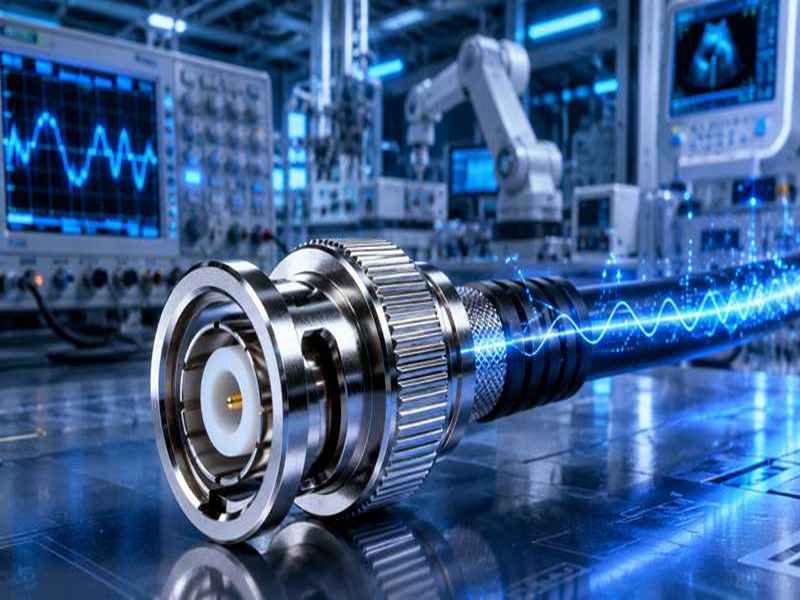
A BNC connector may look like a small metal connector at the end of a coaxial cable, but in many systems, it carries a much bigger responsibility than its size suggests. It may be used to transmit video from a CCTV camera, send RF signals into a test instrument, connect a medical device sensor, or link measurement equipment inside an industrial control system. When the connector is correct, the signal is stable. When the connector is wrong, problems such as signal loss, poor image quality, unstable test data, EMI noise, or intermittent connection can appear quickly.
A BNC connector is a quick-lock coaxial connector used for RF, video, and signal transmission. It uses a bayonet locking structure, usually works with 50 Ohm or 75 Ohm impedance systems, and is widely used in CCTV, RF testing, broadcast equipment, medical devices, and industrial electronics. The right BNC connector must match the cable, impedance, frequency, environment, and installation space.
Many customers do not begin with a complete drawing. They may only have a photo, an old sample, a device interface, or a short description such as “BNC male to open end, 1 meter, shielded cable.” That is normal. In real projects, the important part is not only identifying the BNC connector, but also understanding the cable behind it, the signal it carries, and the environment where it will be used. This guide explains BNC connectors from a practical sourcing and engineering point of view, so you can make better decisions before asking for a quotation or approving a drawing.
What Is a BNC Connector?
A BNC connector is a type of coaxial connector used to transmit RF signals, video signals, data signals, and measurement signals between electronic devices. It is most recognizable by its bayonet locking mechanism, which allows the connector to be connected and disconnected with a simple push-and-twist motion rather than a threaded connection.

Although the design was introduced decades ago, BNC connectors continue to be widely used in modern equipment because they offer a practical combination of reliable signal transmission, strong shielding performance, fast installation, and relatively low cost.
Today, BNC connectors can be found in CCTV systems, RF communication equipment, oscilloscopes, signal generators, medical devices, industrial automation systems, military electronics, broadcast equipment, and laboratory instruments.
For many engineers, a BNC connector is not simply a connector. It is part of a complete signal transmission system. The performance of the connector directly affects signal integrity, impedance matching, shielding effectiveness, and long-term reliability.
A common misconception is that all BNC connectors are the same. In reality, BNC connectors vary significantly in impedance, frequency capability, material construction, shielding performance, mounting style, and environmental resistance.
Choosing the wrong BNC connector may result in:
- Signal reflection
- Increased insertion loss
- Video quality degradation
- Measurement inaccuracies
- EMI interference
- Reduced equipment reliability
This is why engineers often spend considerable time selecting the correct BNC connector and cable combination during product development.
What Does BNC Mean?
BNC stands for Bayonet Neill-Concelman.
The word “Bayonet” refers to the connector’s locking structure, while Neill and Concelman are the surnames of the engineers who helped develop the connector design.
The bayonet locking system remains one of the connector’s biggest advantages today.
Unlike threaded RF connectors that require several turns to tighten, a BNC connector can typically be connected in less than two seconds.
This becomes particularly valuable in environments where connectors are frequently connected and disconnected.
Examples include:
| Industry | Typical Connection Frequency |
|---|---|
| Electronics Labs | Dozens of times per day |
| RF Testing | Hundreds of connections per week |
| Broadcast Studios | Frequent equipment changes |
| Medical Equipment Maintenance | Routine servicing |
| Manufacturing Test Stations | Continuous operation |
A technician troubleshooting equipment may reconnect test leads hundreds of times each month. Saving even a few seconds per connection quickly adds up to significant time savings.
More importantly, the bayonet structure creates a secure mechanical lock that reduces the chance of accidental disconnection.
This is one reason why many industrial and test equipment manufacturers continue to use BNC interfaces despite the availability of newer connector types.
How Does a BNC Connector Work?
The operating principle of a BNC connector is relatively simple, but achieving stable signal transmission requires precise engineering.
A BNC connector consists of several key components working together.
| Component | Function |
|---|---|
| Center Contact | Carries signal |
| Dielectric Insulator | Maintains impedance |
| Outer Shield Contact | Provides grounding |
| Connector Body | Mechanical support |
| Bayonet Coupling | Locks connection |
| Ferrule | Secures cable shield |
The center conductor carries the signal.
The outer conductor functions as both a ground path and an electromagnetic shield.
Between them sits the dielectric material, which maintains a precise spacing that determines the connector’s impedance.
This structure is called a coaxial design because the center conductor and outer conductor share the same axis.
Coaxial structures provide several advantages:
- Stable impedance
- Reduced signal radiation
- Improved EMI resistance
- Lower signal loss
- Better high-frequency performance
These characteristics explain why BNC connectors are commonly paired with coaxial cables such as:
- RG58
- RG174
- RG316
- RG178
- LMR series cables
- Low-loss RF cables
When the connector, cable, and equipment all share the same impedance, signal transmission becomes significantly more stable.
This is particularly important in RF applications where even small impedance mismatches can affect system performance.
Why Is a BNC Connector Unique?
Many connector families have appeared over the years, yet BNC remains one of the most widely used coaxial connectors in the world.
The reason is simple: it solves several practical problems at the same time.
The first advantage is speed.
A BNC connector can typically be connected four to five times faster than a threaded RF connector.
The second advantage is shielding.
Because the connector maintains a continuous metal shield around the signal path, it offers good protection against external electromagnetic interference.
The third advantage is reliability.
Once locked, the connector resists accidental unplugging better than many push-fit connector systems.
The fourth advantage is cost.
Compared with many precision RF connectors, BNC connectors are generally affordable and readily available.
The combination of these advantages makes BNC connectors attractive for:
| Requirement | BNC Performance |
|---|---|
| Fast Installation | Excellent |
| Signal Reliability | Excellent |
| EMI Protection | Good |
| Cost Efficiency | Good |
| Maintenance Convenience | Excellent |
| Long-Term Availability | Excellent |
Few connector types achieve such a balanced combination of performance and practicality.
What Are the Key Parts of a BNC Connector?
When customers request quotations for BNC cable assemblies, they often focus on the connector appearance while overlooking the internal components that determine performance and lifespan.
In reality, material selection has a major impact on connector reliability.
For example:
| Part | Common Material |
|---|---|
| Connector Body | Brass |
| Center Pin | Brass or Phosphor Bronze |
| Plating | Nickel or Gold |
| Insulator | PTFE |
| Ferrule | Copper Alloy |
| Gasket | Silicone |
Higher-quality materials generally provide:
- Better conductivity
- Better corrosion resistance
- Improved mating durability
- More stable impedance
- Longer service life
Gold-plated center contacts are often preferred for applications involving frequent mating cycles because they resist oxidation better than bare metal surfaces.
PTFE insulation is commonly used because it maintains stable electrical properties across a wide temperature range.
For industrial applications, connector materials become even more important.
Environmental conditions may include:
- Oil exposure
- Moisture
- UV radiation
- Dust
- Temperature cycling
- Mechanical vibration
Under these conditions, low-quality connector materials can degrade much faster than expected.
One industrial automation customer approached Sino-conn after experiencing intermittent signal failures in a factory monitoring system. The connectors appeared visually normal, but inspection revealed corrosion inside the contact area caused by prolonged exposure to humidity and contaminants.
After upgrading the connector materials and cable assembly structure, the system operated without interruption for an extended period.
This example highlights an important point.
Connector selection should never be based solely on appearance or price.
The internal construction determines whether a connector performs reliably after thousands of connection cycles and years of operation.
What Information Should You Know Before Ordering a BNC Connector?
Many sourcing delays occur because customers provide only a connector photo without technical details.
While experienced suppliers can often identify a connector from pictures, additional information significantly improves quotation accuracy and reduces development time.
The following information is particularly useful:
| Information | Why It Matters |
|---|---|
| Impedance | Determines signal compatibility |
| Cable Type | Affects connector fit |
| Frequency Range | Influences connector selection |
| Connector Gender | Ensures mating compatibility |
| Connector Orientation | Determines routing |
| Cable Length | Affects signal loss |
| Operating Environment | Determines material selection |
| Shielding Requirement | Influences EMI performance |
| Compliance Requirements | Supports certification needs |
| Annual Volume | Helps optimize pricing |
At Sino-conn, many BNC cable assembly projects begin with only a photo or a sample cable.
The engineering team typically reviews:
- Connector type
- Cable specification
- Signal application
- Installation environment
- Mechanical requirements
After evaluation, customers can receive:
- Connector specifications
- Cable specifications
- CAD drawings
- PDF approval drawings
- Material recommendations
- Alternative connector options
This process helps eliminate uncertainty before production begins.
For custom projects, drawings are normally provided for customer approval before manufacturing starts. This ensures that cable length, connector orientation, pin definition, shielding structure, and material selection all meet project requirements.
For many customers, especially OEM manufacturers and engineering teams, this design verification step is just as important as the connector itself because it helps avoid costly mistakes during production and installation.
A BNC connector may appear simple from the outside, but selecting the right connector involves understanding signal requirements, cable characteristics, mechanical constraints, environmental conditions, and long-term reliability expectations. The more information that is confirmed at the beginning of a project, the smoother the development and production process will be.
Which BNC Connector Types Are Available?
One of the biggest mistakes buyers make when sourcing BNC connectors is assuming that all BNC connectors are interchangeable. They may look similar externally, but the internal structure, impedance, frequency capability, installation method, cable compatibility, and environmental performance can vary significantly.
This misunderstanding often leads to sourcing delays, assembly modifications, signal integrity problems, and unnecessary engineering changes.
At Sino-conn, many BNC cable assembly inquiries begin with a customer sending a photo of an existing cable and asking, “Can you make the same one?” The answer is often yes, but before quoting, the engineering team still needs to confirm several important details because two connectors that look nearly identical can perform very differently in real applications.
The most common BNC connector categories can be divided by:
| Classification | Common Types |
|---|---|
| Impedance | 50 Ohm, 75 Ohm |
| Gender | Male, Female |
| Orientation | Straight, Right Angle |
| Mounting Style | Cable Mount, Panel Mount, Bulkhead Mount |
| Termination Method | Crimp, Solder, Clamp |
| Environmental Protection | Standard, Waterproof |
| Frequency Range | Standard RF, High Frequency |
Understanding these differences helps engineers and procurement teams select the right connector before production starts.
50 Ohm BNC Connector
The 50 Ohm BNC connector is the most common type used in RF systems.

If a project involves radio frequency signals, communication equipment, wireless systems, laboratory instruments, antennas, or electronic testing, there is a high probability that a 50 Ohm connector is required.
Typical applications include:
| Application | Common Use |
|---|---|
| Oscilloscope | Signal measurement |
| Signal Generator | RF output |
| Spectrum Analyzer | RF testing |
| Radio Equipment | Signal transmission |
| Wireless Systems | Antenna connections |
| Industrial Sensors | Monitoring signals |
The reason 50 Ohm became the industry standard is that it provides a practical balance between power handling capability and signal loss.
Historically, engineers found that:
- 30 Ohm systems handled higher power.
- 77 Ohm systems provided lower signal loss.
- 50 Ohm offered the best compromise between both.
This is why modern RF equipment commonly uses 50 Ohm impedance.
When selecting a 50 Ohm BNC connector, buyers should pay attention to:
| Parameter | Typical Range |
|---|---|
| Impedance | 50 Ohm |
| Frequency | DC to 4 GHz |
| VSWR | ≤1.3 |
| Operating Temperature | -55°C to +155°C |
| Contact Resistance | ≤1.5 mΩ |
| Durability | 500+ mating cycles |
These values vary depending on manufacturer and connector grade.
A common problem occurs when customers unknowingly combine:
- 50 Ohm connector
- 75 Ohm cable
- 50 Ohm equipment
The system may still function, but impedance mismatches can introduce reflections and signal degradation.
For RF applications, maintaining impedance consistency across the entire signal path is one of the most important design principles.
75 Ohm BNC Connector
The 75 Ohm BNC connector is primarily used for video signal transmission.

Many buyers recognize BNC connectors from CCTV cameras and broadcast systems because these industries have relied on 75 Ohm coaxial transmission for decades.
Common applications include:
| Application | Signal Type |
|---|---|
| CCTV Cameras | Analog Video |
| DVR Systems | Video Recording |
| Broadcast Equipment | HD Video |
| Studio Equipment | SDI Signals |
| Video Monitoring | Surveillance |
| Video Distribution | Signal Routing |
The purpose of the 75 Ohm design is to minimize signal reflections in video systems.
Video transmission often requires:
- Stable impedance
- Long transmission distance
- Low signal distortion
- Good shielding performance
When video signals travel through long cable runs, even small impedance variations can affect image quality.
Potential issues include:
- Ghost images
- Video noise
- Image distortion
- Reduced signal range
- Synchronization problems
The connector itself is only part of the equation.
Cable quality also plays a significant role.
Typical 75 Ohm cable options include:
| Cable Type | Common Application |
|---|---|
| RG59 | CCTV |
| RG6 | Broadcast Video |
| RG11 | Long Distance Video |
| Mini Coax | Internal Equipment Wiring |
In many surveillance projects, customers focus on camera specifications while overlooking cable assemblies. However, poor-quality connectors or cable terminations often become the weak point of the system.
One customer operating a warehouse surveillance network experienced intermittent video distortion on cameras installed more than 80 meters from the control room.
After inspection, the issue was traced to inconsistent connector termination rather than the cameras themselves. Upgrading the BNC cable assemblies eliminated the problem without replacing any active equipment.
BNC Male vs Female
Connector gender is one of the most basic specifications, yet it remains one of the most common causes of ordering mistakes.
The difference is straightforward:
| Type | Center Contact |
|---|---|
| BNC Male | Pin |
| BNC Female | Socket |
Most cable assemblies use male connectors because most equipment panels contain female connectors.
However, exceptions are common.
Projects frequently require:
- Male to Male
- Male to Female
- Female to Female
- Female Bulkhead
Many customers only provide a photograph of the existing cable.
This can be problematic because photos do not always clearly show:
- Connector gender
- Contact structure
- Mounting style
For example, a connector may appear to be male from one angle but reveal a recessed socket when viewed directly from the front.
To reduce errors, Sino-conn often requests:
- Front-view photos
- Side-view photos
- Connector dimensions
- Existing cable markings
A few minutes spent verifying connector gender can prevent weeks of delays caused by incorrect production.
For prototype projects, connector verification is often included during drawing review before manufacturing begins.
Straight vs Right-Angle BNC Connector
Connector orientation is often overlooked during initial design but becomes very important during installation.
The two most common orientations are:
| Type | Cable Exit Direction |
|---|---|
| Straight | Linear |
| Right Angle | 90 Degrees |
Straight connectors are suitable when there is sufficient space behind the equipment.
Advantages include:
- Lower cost
- Simple installation
- Easy assembly
- Broad compatibility
Right-angle connectors become valuable when equipment space is limited.
Common examples include:
- Medical carts
- Test instruments
- Industrial control cabinets
- Wall-mounted equipment
- Portable devices
A right-angle connector can reduce required installation depth by more than 50%.
Consider the following example:
| Connector Type | Required Rear Clearance |
|---|---|
| Straight BNC | 50-80 mm |
| Right-Angle BNC | 20-35 mm |
This difference can significantly affect enclosure design.
Another important factor is cable bend radius.
Coaxial cables contain:
- Center conductor
- Dielectric
- Shielding layers
- Outer jacket
Sharp bends can damage these structures internally.
The result may be:
- Increased signal loss
- Shield degradation
- Reduced cable lifespan
Right-angle connectors often eliminate excessive cable bending and improve long-term reliability.
One industrial customer redesigned a compact monitoring device after discovering that straight connectors caused excessive stress on the cable during installation. Switching to right-angle BNC connectors solved the issue without changing the enclosure.
Which BNC Connector Is Right?
There is no universal answer because every project has different requirements.
The best BNC connector depends on:
- Signal type
- Frequency
- Cable type
- Installation environment
- Available space
- Production volume
- Compliance requirements
The table below provides a practical starting point:
| Project Type | Recommended BNC Type |
|---|---|
| RF Testing | 50 Ohm Straight BNC |
| Wireless Communication | 50 Ohm BNC |
| CCTV System | 75 Ohm BNC |
| Broadcast Video | 75 Ohm Precision BNC |
| Compact Device | Right-Angle BNC |
| Industrial Equipment | Enhanced Shielded BNC |
| Outdoor Installation | Waterproof BNC |
| Medical Device | High-Reliability BNC |
Before requesting a quotation, customers should ideally provide:
| Information | Importance |
|---|---|
| Connector Photos | Identification |
| Cable Type | Compatibility |
| Required Length | Manufacturing |
| Equipment Interface | Mating Verification |
| Environment | Material Selection |
| Annual Quantity | Cost Optimization |
Many customers do not have all this information available initially.
That is completely normal.
Some only provide:
- An old cable
- A photo
- A hand sketch
- A device model number
In these situations, Sino-conn’s engineering team typically assists with connector identification, cable selection, drawing preparation, and material recommendations before production starts.
This engineering support is particularly valuable because connector selection is often linked to the overall performance of the cable assembly. A connector that costs only a few dollars can influence signal quality, EMI performance, equipment reliability, installation efficiency, and long-term maintenance costs.
The most successful projects do not begin by asking, “Which BNC connector is cheapest?”
They begin by asking, “Which BNC connector is best suited for the application?”
That small change in approach often leads to better performance, lower long-term costs, and fewer problems after installation.
Where Is a BNC Connector Used?
One of the reasons BNC connectors have remained in use for more than 70 years is their ability to perform reliably across a wide range of industries. While many connector types become limited to a specific application, BNC connectors continue to appear in security systems, medical equipment, industrial automation, RF communication, military electronics, laboratories, and broadcast infrastructure.
The reason is simple. Most electronic systems still require stable signal transmission. Whether the signal is video, RF, measurement data, sensor information, or control feedback, engineers need a connector that can maintain impedance, resist interference, and remain mechanically secure over years of operation.
In many cases, the cost of a BNC connector represents less than 1% of the total equipment cost. However, a poor connection can cause system downtime, troubleshooting expenses, field service visits, or even product recalls.
That is why engineers often pay close attention to connector selection during product development.
The table below shows where BNC connectors are most commonly used today:
| Industry | Common Application |
|---|---|
| CCTV & Security | Video transmission |
| RF Communication | Signal transmission |
| Electronics Testing | Measurement equipment |
| Medical Equipment | Diagnostic systems |
| Industrial Automation | Monitoring and control |
| Broadcast & Television | Video infrastructure |
| Aerospace & Defense | RF and monitoring systems |
| Transportation | Surveillance and communication |
| Research Laboratories | Testing and instrumentation |
Although newer connector technologies continue to emerge, BNC connectors remain one of the most trusted solutions whenever reliable coaxial signal transmission is required.
BNC Connector in CCTV
CCTV remains one of the largest application markets for BNC connectors worldwide.
For decades, analog surveillance systems have relied on BNC-based coaxial connections. Even today, many existing installations continue operating because replacing thousands of cameras and kilometers of cable infrastructure is often unnecessary and expensive.
A typical CCTV system may include:
- Security cameras
- DVR recorders
- Video splitters
- Video amplifiers
- Monitoring stations
- Signal converters
Most of these devices connect through 75 Ohm BNC interfaces.
The popularity of BNC in surveillance systems comes from several practical advantages:
| Benefit | Impact |
|---|---|
| Fast installation | Reduced labor cost |
| Reliable locking | Lower maintenance |
| Good shielding | Stable video quality |
| Long transmission distance | Fewer signal issues |
| Easy troubleshooting | Faster repairs |
In many warehouse and factory environments, cameras may be installed 50 to 300 meters from the control room.
Signal quality depends heavily on:
- Cable quality
- Connector quality
- Shield termination
- Installation practices
For example:
| Cable Type | Typical Distance Capability |
|---|---|
| RG59 | Up to 230m |
| RG6 | Up to 300m |
| RG11 | Up to 450m+ |
Actual performance varies depending on signal quality and equipment design.
A customer from a logistics warehouse once approached Sino-conn after experiencing image distortion on cameras installed near high-voltage motor drives. Initially, the cameras were suspected to be defective. After reviewing the installation, the problem was traced to inadequate shielding and poor connector termination.
Replacing the assemblies with properly shielded BNC cable assemblies solved the issue without changing any active equipment.
This demonstrates a reality often overlooked during procurement: signal quality depends on the entire transmission path, not just the camera.
BNC Connector in RF Systems
RF communication remains one of the most technically demanding applications for BNC connectors.
In RF systems, the connector becomes part of the signal path itself. Every connector introduces some level of insertion loss, impedance variation, and reflection.
Because of this, RF engineers pay close attention to:
- Connector impedance
- Cable impedance
- VSWR
- Frequency range
- Shielding performance
Common RF applications include:
| Application | Typical Use |
|---|---|
| Radio Equipment | Signal transmission |
| Wireless Infrastructure | Testing and maintenance |
| Antenna Systems | Interconnection |
| RF Modules | Development and testing |
| EMC Laboratories | Compliance testing |
| Military Communication | Signal routing |
Many 50 Ohm BNC systems operate from DC to several GHz.
Typical RF cable assemblies may use:
- RG58
- RG174
- RG316
- RG400
- Low-loss coaxial cables
The selection depends on frequency, flexibility, attenuation requirements, and installation environment.
For example:
| Cable Type | Approximate OD |
|---|---|
| RG174 | 2.8 mm |
| RG316 | 2.5 mm |
| RG58 | 5.0 mm |
| RG400 | 5.0 mm |
Smaller cables offer better flexibility, while larger cables generally provide lower attenuation.
One engineering team developing a wireless monitoring device contacted Sino-conn with concerns about unstable RF test results. After reviewing the assembly, it became clear that the issue was caused by repeated cable bending during testing rather than the RF module itself.
The solution involved changing to a more durable cable structure and improving strain relief near the connector.
Small mechanical details often have a significant effect on RF performance.
BNC Connector in Test Equipment
Few industries use BNC connectors as heavily as electronics testing.
Walk into almost any laboratory and you will likely find BNC interfaces on:
- Oscilloscopes
- Signal generators
- Function generators
- Frequency counters
- Data acquisition systems
- Spectrum analyzers
Testing environments create unique demands because cables are constantly being connected, disconnected, bent, and moved.
A cable assembly in a production test station may experience thousands of mating cycles every year.
The durability of the connector therefore becomes extremely important.
Typical laboratory requirements include:
| Requirement | Importance |
|---|---|
| Stable impedance | Accurate measurements |
| Low contact resistance | Signal integrity |
| High mating life | Reduced replacement cost |
| Good shielding | Noise reduction |
| Mechanical reliability | Consistent testing |
Many engineers underestimate how often test cables fail.
The failure is usually not obvious.
Instead, symptoms may include:
- Unstable readings
- Increased noise
- Intermittent measurements
- Failed calibration
- Random signal drops
In many cases, replacing a worn cable assembly immediately resolves the issue.
For engineering validation projects, Sino-conn often supplies custom BNC test cables that connect laboratory equipment to proprietary interfaces. These assemblies are commonly used during product development, verification testing, and manufacturing validation.
BNC Connector in Medical Devices
Medical equipment manufacturers often prioritize reliability above all else.
Unlike consumer electronics, medical systems may operate continuously for many hours every day.
Unexpected signal interruptions can affect:
- Diagnostic accuracy
- Equipment performance
- Patient monitoring
- Maintenance schedules
Although medical equipment increasingly uses specialized connectors, BNC interfaces remain common in many systems.
Examples include:
| Equipment Type | Application |
|---|---|
| Patient Monitoring Systems | Signal acquisition |
| Diagnostic Instruments | Data transmission |
| Biomedical Test Equipment | Measurement |
| Laboratory Analyzers | Sensor connectivity |
| Imaging Support Equipment | Signal routing |
Medical projects often require additional documentation such as:
- Material specifications
- RoHS compliance
- REACH declarations
- Quality inspection reports
- Dimensional drawings
Reliability requirements are also higher.
Medical cable assemblies may be expected to:
- Survive repeated cleaning
- Resist chemical exposure
- Maintain signal stability
- Operate continuously
One customer developing a portable diagnostic platform required a lightweight BNC assembly capable of repeated movement throughout the workday.
The challenge was balancing:
- Flexibility
- Shielding
- Durability
A customized cable structure ultimately provided better long-term performance than the originally specified standard cable.
This is why many medical projects involve engineering review before production begins.
BNC Connector in Industry
Industrial automation has become one of the fastest-growing sectors for custom BNC cable assemblies.
Modern factories depend heavily on sensors, monitoring equipment, vision systems, and process control devices.
Many of these systems still rely on BNC connectivity.
Industrial environments are often harsh.
Equipment may be exposed to:
- Oil
- Dust
- Vibration
- Moisture
- Heat
- Electrical noise
The following table illustrates common challenges:
| Environment | Potential Impact |
|---|---|
| Vibration | Connector loosening |
| Oil Exposure | Jacket degradation |
| Dust | Contamination |
| Moisture | Corrosion |
| High EMI | Signal instability |
| Temperature Changes | Material aging |
Industrial cable assemblies often require:
- Enhanced shielding
- Oil-resistant jackets
- Flame-retardant materials
- UV-resistant materials
- Strain relief structures
A machine builder approached Sino-conn after repeated failures of standard commercial BNC cables installed near servo motors.
The problem was traced to electromagnetic interference and cable fatigue.
The final solution incorporated:
- Improved braid coverage
- Additional foil shielding
- Stronger strain relief
- Industrial-grade jacket material
After installation, signal stability improved significantly and maintenance requirements decreased.
This type of situation is common in industrial environments where connector selection alone is not enough. The entire cable assembly must be designed around the operating conditions.
BNC Connector in Broadcast and Television
Before digital streaming became dominant, television networks around the world relied heavily on BNC connectors.
Even today, professional video infrastructure continues to use BNC interfaces extensively.
Applications include:
- Broadcast cameras
- Video routers
- SDI systems
- Production switchers
- Studio monitoring equipment
Professional video systems often transmit:
| Format | Typical Use |
|---|---|
| SD-SDI | Standard Definition |
| HD-SDI | High Definition |
| 3G-SDI | High-Speed Video |
| 6G-SDI | Ultra HD Video |
| 12G-SDI | 4K Broadcast Video |
In these environments, signal integrity becomes critical because a single connector problem can affect an entire video feed.
Broadcasters often prefer premium-grade BNC connectors with tighter manufacturing tolerances to maintain signal quality across long cable runs.
Why Are BNC Connectors Still Popular Today?
Many connector families have appeared since the BNC connector was introduced, yet it remains widely used across multiple industries.
The reason is practical rather than historical.
BNC connectors continue to offer:
| Advantage | Value |
|---|---|
| Fast Connection | Saves installation time |
| Reliable Locking | Reduces accidental disconnects |
| Good Shielding | Protects signal quality |
| Wide Availability | Easy sourcing |
| Cost Efficiency | Lower overall project cost |
| Proven Reliability | Decades of field use |
When engineers choose a connector, they often prioritize reliability over novelty.
A connector that consistently performs well in laboratories, factories, hospitals, broadcast facilities, and communication systems remains valuable regardless of its age.
That is exactly why BNC connectors continue to appear in new equipment designs today and why custom BNC cable assemblies remain an important part of Sino-conn’s manufacturing and engineering support services.
How Do You Choose a BNC Connector?
Choosing a BNC connector should start with the signal and the equipment, not with the connector photo alone. A BNC connector may look simple, but the wrong choice can cause signal reflection, unstable images, incorrect test results, EMI noise, loose mating, cable fatigue, or production rework.
For a standard CCTV cable, selection may be quick. For RF testing, medical equipment, industrial automation, broadcast systems, or OEM devices, the connector should be checked together with the cable, shielding, impedance, frequency, jacket material, bend radius, and installation space.
In real sourcing work, many customers send only one of the following:
- A connector photo
- A used sample cable
- A device port picture
- A rough hand sketch
- A part number
- A short sentence such as “BNC male to open wire, 1m”
This is enough to start a discussion, but it is usually not enough to start production. Before manufacturing, the connector and cable assembly should be confirmed through a drawing or specification sheet. At Sino-conn, BNC cable assembly projects are normally reviewed by checking the electrical requirement, cable structure, connector style, length tolerance, shielding method, and application environment. Drawings are provided for confirmation before production so customers can avoid mistakes before paying for tooling, materials, or batch assembly.
A practical selection process should answer five questions:
| Selection Question | Why It Matters |
|---|---|
| Is the system 50 Ohm or 75 Ohm? | Prevents signal mismatch |
| What cable should be used? | Affects loss, flexibility, and durability |
| What frequency or signal type is involved? | Determines connector and cable suitability |
| Is EMI a concern? | Defines shielding structure |
| Where will the cable be installed? | Controls connector shape and material choice |
When these five points are clear, the right BNC connector becomes much easier to choose.
BNC Connector and Impedance
Impedance is usually the first technical point to confirm when choosing a BNC connector. The two most common options are 50 Ohm and 75 Ohm.
A 50 Ohm BNC connector is mainly used for RF, communication, test instruments, antennas, and electronic measurement systems. A 75 Ohm BNC connector is mainly used for video, CCTV, broadcast, SDI, and monitoring systems.
The connector, cable, and equipment should match the same impedance as much as possible.
| System Type | Common Impedance | Common BNC Choice |
|---|---|---|
| RF test equipment | 50 Ohm | 50 Ohm BNC |
| Signal generator | 50 Ohm | 50 Ohm BNC |
| Antenna system | 50 Ohm | 50 Ohm BNC |
| CCTV camera | 75 Ohm | 75 Ohm BNC |
| DVR video system | 75 Ohm | 75 Ohm BNC |
| Broadcast SDI system | 75 Ohm | 75 Ohm precision BNC |
Some buyers think the connector is correct as long as it can be physically connected. This is risky. A 50 Ohm and 75 Ohm BNC connector may look very similar from the outside, especially to non-technical purchasing teams, but the internal dielectric and contact structure are different.
When impedance does not match, the signal may reflect back along the cable. The effect depends on cable length, frequency, and equipment sensitivity. In some low-frequency or short-distance applications, the problem may not be obvious. In RF testing, long video transmission, and precise measurement systems, the problem can be serious.
Possible symptoms include:
| Symptom | Possible Cause |
|---|---|
| Ghost image on video | Impedance mismatch or poor termination |
| Weak signal | Cable loss or wrong cable type |
| Unstable measurement | Reflection or poor contact |
| RF power drop | VSWR increase |
| Random noise | Shielding or grounding issue |
A useful rule is simple: match the impedance of the equipment, connector, and cable. If the equipment port is 50 Ohm, use a 50 Ohm connector and 50 Ohm cable. If the system is 75 Ohm video, use 75 Ohm connector and cable.
For customers who are unsure, Sino-conn can help check the application first. For example, if the cable is used with an oscilloscope or RF module, 50 Ohm is often more likely. If it is used with CCTV or video monitoring, 75 Ohm is often more likely. The final choice should still be confirmed by the device specification or old cable marking.
BNC Connector and Cable
A BNC connector cannot be selected correctly without checking the cable. The connector must fit the cable diameter, braid structure, dielectric size, and jacket material. Even if the connector looks right, it may not crimp correctly if the cable size is wrong.
Common coaxial cables used with BNC connectors include RG58, RG59, RG174, RG178, RG316, RG400, RG6, RG11, and other low-loss coaxial cables.
| Cable Type | Impedance | Approx. OD | Common Use |
|---|---|---|---|
| RG174 | 50 Ohm | 2.8 mm | Compact RF cables, internal wiring |
| RG178 | 50 Ohm | 1.8 mm | Miniature RF, tight space |
| RG316 | 50 Ohm | 2.5 mm | Higher temperature RF cables |
| RG58 | 50 Ohm | 5.0 mm | RF test, radio, general equipment |
| RG400 | 50 Ohm | 4.95 mm | Higher performance RF assemblies |
| RG59 | 75 Ohm | 6.1 mm | CCTV, video |
| RG6 | 75 Ohm | 6.8–7.0 mm | Longer video runs |
| RG11 | 75 Ohm | 10.3 mm | Long-distance video transmission |
The numbers above may vary slightly by manufacturer, jacket material, and cable structure, so final connector selection should always follow the actual cable datasheet.
For cable selection, customers should consider more than impedance.
Important cable details include:
- Cable OD
- Conductor material
- Shielding coverage
- Jacket material
- Bend radius
- Temperature rating
- Flame rating
- Oil resistance
- UV resistance
- Flexibility
- Halogen-free requirement
A cable used inside laboratory equipment may only need normal flexibility and clean signal performance. A cable used in a factory may need oil resistance, higher abrasion resistance, stronger shielding, and better strain relief. A cable used in portable medical equipment may need repeated bending, lightweight structure, and stable signal transmission.
One common mistake is choosing a thinner cable only because it is easier to route. Thinner cable is more flexible, but it may also have higher attenuation and lower mechanical strength. For short internal wiring, this may be acceptable. For longer external cables, a thicker cable may perform better.
A practical comparison:
| Requirement | Better Cable Direction |
|---|---|
| Tight space | RG178, RG174, RG316 |
| Lower signal loss | RG58, RG400, RG6, RG11 |
| Frequent movement | Flexible coaxial cable with strain relief |
| High temperature | RG316, RG400, PTFE jacket cable |
| Outdoor use | UV-resistant jacket |
| Industrial use | Oil-resistant jacket and stronger shielding |
| Video use | 75 Ohm cable such as RG59 or RG6 |
At Sino-conn, when a customer sends a BNC cable request without a cable model, the team usually asks about application, length, flexibility, environment, and signal type. This makes the recommendation more accurate than simply quoting the cheapest available coaxial cable.
BNC Connector and Frequency
Frequency is another key factor. A cable assembly that works well at low frequency may not perform well at higher frequency.
BNC connectors are commonly used from low-frequency signals up to RF ranges. Many standard BNC connectors are used up to several GHz, but the actual performance depends on connector design, cable type, assembly workmanship, and impedance control.
Customers should not only ask, “Can this connector support the frequency?” They should also ask whether the whole cable assembly can support the frequency.
A BNC cable assembly includes:
- Connector A
- Connector B
- Cable
- Shield termination
- Crimp or solder area
- Strain relief
- Any adapter or transition structure
Each section can influence signal performance.
The table below gives a practical reference:
| Signal Type | Common Concern | Selection Focus |
|---|---|---|
| Low-frequency control signal | Basic continuity | Contact stability and cable durability |
| Analog video | Image quality | 75 Ohm impedance and shielding |
| RF signal below 1 GHz | Loss and reflection | 50 Ohm matching and connector quality |
| RF signal above 1 GHz | VSWR and attenuation | Precision connector and low-loss cable |
| Pulse measurement | Signal edge accuracy | Impedance stability and cable quality |
| Production testing | Repeatability | Durable connector and stable assembly process |
For higher-frequency RF applications, customers may need to check values such as insertion loss and VSWR. VSWR describes how well the signal passes through the connector and cable without reflection. A lower VSWR value usually means better matching.
For many commercial projects, customers may not need full RF test reports. But for test equipment, communication modules, aerospace, medical instruments, and industrial measurement systems, the frequency should be confirmed before production.
A short case example: A customer developing RF test fixtures originally requested a general BNC cable based on connector appearance. After checking the working frequency and the number of daily test cycles, Sino-conn recommended a more suitable coaxial cable with stronger connector strain relief. The unit price was slightly higher, but the test station had fewer cable replacements and more stable measurement results.
For engineering teams, a stable cable assembly can save more money than a cheaper cable that needs frequent replacement.
BNC Connector and EMI
EMI is a major reason why BNC connectors and coaxial cables are still widely used. In many systems, the signal is not the only thing moving through the environment. The cable may also pass near motors, power supplies, inverters, relays, wireless transmitters, high-current wires, or switching circuits.
These nearby sources can introduce noise into poorly shielded cables.
Common EMI sources include:
| EMI Source | Common Location |
|---|---|
| Servo motor | Industrial automation |
| Variable frequency drive | Factory equipment |
| Switching power supply | Electronic devices |
| High-current cable | Power systems |
| Wireless module | Communication equipment |
| Medical imaging device | Hospital equipment |
| LED driver | Display and lighting systems |
A BNC cable assembly reduces EMI problems by using a coaxial structure. The shield surrounds the signal conductor and helps block external interference. However, shielding performance depends heavily on the cable structure and assembly process.
Common shielding options include:
| Shielding Structure | General Performance | Common Use |
|---|---|---|
| Single braid | Good | General RF and video |
| Double braid | Better | Industrial signal cables |
| Foil + braid | Very good | EMI-sensitive systems |
| Double braid + foil | Excellent | Harsh EMI environments |
The shield termination at the connector is just as important as the cable shield itself. If the braid is poorly crimped, cut too short, loosely assembled, or not properly connected to the connector body, EMI protection can drop sharply.
This is why visual appearance alone cannot prove shielding quality. A cable can look neat outside but have weak braid contact inside.
For industrial and medical customers, Sino-conn pays close attention to shielding termination during production. Quality control is carried out during the process, after completion, and before shipment. For BNC assemblies used in EMI-sensitive applications, the team can also discuss shield structure, braid coverage, grounding method, and strain relief before production.
A factory automation customer once needed BNC cables near servo drives and control cabinets. The original cable passed a continuity test but still had random signal noise during machine operation. The final improvement came from better shielding coverage and more reliable braid termination. The connector type did not change, but the cable assembly structure did.
This shows why “same connector” does not always mean “same performance.”
BNC Connector Selection Tips
A good BNC connector selection process should reduce risk before production. This is especially important for custom assemblies because cable length, connector direction, material, shielding, and drawings all need to be confirmed before manufacturing.
The easiest way to begin is to prepare a clear request. Customers do not need to know every technical term, but the more information they provide, the faster the supplier can recommend the right solution.
A useful request can include:
| Information | Example |
|---|---|
| Connector type | BNC male, BNC female, right-angle BNC |
| Impedance | 50 Ohm or 75 Ohm |
| Cable model | RG174, RG316, RG58, RG59 |
| Cable length | 0.5m, 1m, 3m, custom length |
| Other end | BNC, SMA, N-type, open end, custom connector |
| Application | RF test, CCTV, medical device, industrial equipment |
| Environment | Indoor, outdoor, oil exposure, high temperature |
| Quantity | 1 piece sample, 20 pieces, 500 pieces |
| Compliance | UL, RoHS, REACH, PFAS, COC, COO |
| Special requirement | Flexible, flame retardant, UV resistant, halogen-free |
For customers who only have a photo, the recommended process is:
- Send front-view and side-view connector photos
- Provide cable jacket markings if available
- Measure cable outer diameter
- Share the device application
- Confirm whether the cable is for video, RF, testing, or internal wiring
- Confirm required length and quantity
Sino-conn can then help identify the connector and recommend a suitable cable assembly structure. If the project needs customization, a drawing can be prepared for approval before production. For urgent projects, sample support can be arranged quickly depending on material availability. Standard samples are usually around two weeks, while urgent samples may be supported in 2–3 days. Batch production is commonly 3–4 weeks, and urgent batch orders can sometimes be completed within about two weeks.
For OEM manufacturers, the most important selection point is not only whether the cable works once. It must be stable across production batches. That means the supplier should be able to control cable cutting, stripping, crimping, soldering, shielding termination, electrical testing, appearance inspection, and final packaging.
At Sino-conn, every custom cable assembly is checked through multiple inspection steps, including process inspection, finished product inspection, and pre-shipment inspection. This is especially useful for customers who need repeat orders after prototype approval.
The safest way to choose a BNC connector is to treat it as part of a complete cable assembly. Confirm the signal first, then confirm the cable, connector, shielding, material, length, and drawing. This approach may take a little more time at the beginning, but it helps avoid signal problems, wrong materials, wrong connector gender, weak shielding, and unnecessary rework later.
Can a BNC Connector Be Customized?
Many engineers and purchasing teams assume that BNC connectors are standardized products that can only be purchased from a catalog. While the connector interface itself follows industry standards, the complete BNC cable assembly can be customized in many ways to meet specific electrical, mechanical, environmental, and installation requirements.
In fact, most OEM projects do not use standard off-the-shelf BNC cables.
Equipment manufacturers often require changes to:
- Cable length
- Connector combination
- Cable type
- Shielding structure
- Connector orientation
- Jacket material
- Strain relief
- Labeling
- Packaging
- Compliance requirements
A standard catalog cable may work during initial testing, but once the product enters production, engineers often discover that the cable is too long, too stiff, poorly shielded, difficult to install, or incompatible with the actual operating environment.
That is why customized BNC cable assemblies are commonly used in:
| Industry | Customization Demand |
|---|---|
| Medical Equipment | Very High |
| Industrial Automation | Very High |
| RF Communication | High |
| Broadcast Systems | High |
| Military Equipment | High |
| Laboratory Equipment | Medium |
| CCTV Systems | Medium |
| Transportation Systems | High |
For OEM equipment manufacturers, customization is often less expensive than redesigning the equipment around a standard cable.
Custom BNC Connector Cables
The cable itself is usually the first thing engineers customize.
Two BNC connectors may look identical from the outside while using completely different cable constructions internally.
The cable determines many critical performance characteristics:
| Performance Factor | Influenced By Cable |
|---|---|
| Signal Loss | Yes |
| Flexibility | Yes |
| EMI Resistance | Yes |
| Temperature Rating | Yes |
| Durability | Yes |
| Bend Radius | Yes |
| Weight | Yes |
| Cost | Yes |
Common coaxial cable choices include:
| Cable Type | Common Application |
|---|---|
| RG174 | Compact RF assemblies |
| RG178 | Miniature equipment |
| RG316 | High-temperature applications |
| RG58 | General RF systems |
| RG400 | High-performance RF |
| RG59 | CCTV systems |
| RG6 | Video transmission |
| RG11 | Long-distance video systems |
However, cable selection should not be based only on impedance.
Customers should also consider:
- Cable movement frequency
- Installation space
- Required flexibility
- Exposure to oil
- UV exposure
- Chemical resistance
- Flame rating
- Temperature range
For example, a cable used inside a fixed laboratory instrument may only move a few times during its entire life.
A cable used on a portable testing device may bend hundreds of times every week.
The same cable structure is unlikely to be optimal for both applications.
One customer developing a portable RF monitoring device initially requested RG58 cable because that was what their existing design used. After reviewing the application, Sino-conn recommended a lighter and more flexible cable that reduced cable weight by nearly 40% while maintaining the required electrical performance.
The improvement made the handheld device easier for technicians to carry and operate throughout the day.
Custom BNC Connector Lengths
Cable length is one of the most common customization requests.
Many suppliers stock standard lengths such as:
- 0.5 meter
- 1 meter
- 2 meters
- 3 meters
- 5 meters
Unfortunately, equipment rarely follows standard dimensions.
OEM customers frequently require lengths such as:
- 430 mm
- 785 mm
- 1.35 m
- 2.75 m
- 4.2 m
Custom lengths help improve:
| Benefit | Result |
|---|---|
| Installation Efficiency | Faster assembly |
| Signal Quality | Lower loss |
| Cable Management | Cleaner routing |
| Product Appearance | Professional finish |
| Reliability | Reduced cable stress |
Longer cables are not always better.
Every additional meter introduces:
- Additional attenuation
- More weight
- Increased storage space
- More routing complexity
Consider the following example:
| Cable Length | Relative Signal Loss |
|---|---|
| 1 Meter | Low |
| 3 Meters | Moderate |
| 5 Meters | Higher |
| 10 Meters | Significantly Higher |
The exact values depend on cable type and frequency.
A customer manufacturing industrial control cabinets originally specified 5-meter assemblies for every installation.
After reviewing actual cable routing, the average required length was closer to 2.8 meters.
By reducing cable length:
- Material costs decreased
- Installation became easier
- Cable clutter was eliminated
- Signal quality improved
Small changes in cable length can create meaningful improvements across hundreds or thousands of units.
Custom BNC Connector Materials
The operating environment often determines material selection.
Many buyers focus primarily on connector appearance while overlooking material specifications.
This becomes important when equipment is exposed to:
- Moisture
- Oil
- Salt spray
- UV radiation
- Cleaning chemicals
- High temperatures
- Mechanical vibration
Common connector body materials include:
| Material | Typical Advantage |
|---|---|
| Brass | Cost-effective |
| Nickel-Plated Brass | Corrosion resistance |
| Stainless Steel | Harsh environments |
| Special Alloys | High-performance systems |
Contact materials may also vary.
Common options include:
| Contact Material | Common Use |
|---|---|
| Brass | General applications |
| Phosphor Bronze | Improved durability |
| Gold-Plated Contacts | Higher reliability |
Cable jacket materials can be customized as well.
| Jacket Material | Common Application |
|---|---|
| PVC | General-purpose use |
| TPU | Abrasion resistance |
| TPE | Flexibility |
| Silicone | Medical equipment |
| PE | Outdoor installations |
| PTFE | High-temperature environments |
Many modern projects also require environmental compliance documentation.
Common requirements include:
- UL materials
- RoHS
- REACH
- PFAS declarations
- COC
- COO
Customers increasingly request halogen-free and fluorine-free materials as sustainability requirements become more common.
At Sino-conn, these requirements are usually reviewed before material procurement to avoid delays later in the project.
Custom BNC Connector Designs
The connector itself can also be customized in many ways.
A custom BNC assembly is not limited to a simple BNC-to-BNC cable.
Common configurations include:
| Assembly Type | Application |
|---|---|
| BNC to BNC | General signal transmission |
| BNC to SMA | RF systems |
| BNC to N-Type | Communication equipment |
| BNC to Open End | Internal wiring |
| BNC to Terminal Block | Industrial systems |
| BNC to Custom Connector | OEM equipment |
Mechanical customization options include:
- Straight connectors
- Right-angle connectors
- Panel-mount connectors
- Bulkhead connectors
- Waterproof connectors
Additional features may include:
- Heat shrink protection
- Overmolding
- Strain relief boots
- Cable labels
- Laser marking
- Custom packaging
For equipment manufacturers, connector orientation often becomes important.
For example:
| Installation Space | Preferred Connector |
|---|---|
| Open Area | Straight BNC |
| Tight Enclosure | Right-Angle BNC |
| Panel Interface | Bulkhead BNC |
| Outdoor Equipment | Waterproof BNC |
One customer developing a compact medical analyzer needed a BNC assembly that could fit within a very limited enclosure depth.
The original straight connector required approximately 70 mm of rear clearance.
Switching to a right-angle design reduced the required space to less than 30 mm and eliminated cable stress at the exit point.
This change improved both installation and long-term reliability.
Why Choose Sino-conn for BNC Connector Assemblies?
A custom BNC cable assembly project often involves much more than assembling a connector onto a cable.
The process typically includes:
| Project Stage | Purpose |
|---|---|
| Requirement Review | Understand application |
| Connector Selection | Ensure compatibility |
| Cable Selection | Optimize performance |
| Drawing Creation | Verify design |
| Sample Production | Validate assembly |
| Testing | Confirm quality |
| Mass Production | Scale manufacturing |
Many customers approach Sino-conn with limited information.
Sometimes they provide:
- A photograph
- An old cable
- A sample assembly
- A device model number
- A rough drawing
The engineering team then helps identify:
- Connector type
- Cable type
- Impedance
- Shielding requirements
- Material options
- Assembly methods
Before production begins, drawings are typically prepared and submitted for approval.
These drawings may include:
- Connector dimensions
- Cable specifications
- Length tolerances
- Assembly details
- Material information
This review process helps eliminate misunderstandings before manufacturing starts.
Another important advantage is flexibility.
Many original connector manufacturers focus on large-volume projects and may not support small custom quantities efficiently.
Sino-conn supports:
| Quantity Type | Support Available |
|---|---|
| Prototype | Yes |
| Engineering Sample | Yes |
| Small Batch | Yes |
| OEM Production | Yes |
| Volume Production | Yes |
There is no strict MOQ requirement, allowing customers to begin with a prototype before committing to larger production volumes.
Lead times are also important for many projects.
Typical project timelines include:
| Service | Typical Timing |
|---|---|
| Drawing Preparation | Around 3 days |
| Urgent Drawing Support | Sometimes within hours |
| Sample Production | As fast as 2-3 days |
| Standard Samples | Around 2 weeks |
| Mass Production | Around 3-4 weeks |
| Urgent Production | Approximately 2 weeks |
Quality control is equally important.
Every custom cable assembly passes through multiple inspection stages including:
- Process inspection
- Finished product inspection
- Pre-shipment inspection
This approach helps ensure consistency between prototypes and production batches.
For OEM manufacturers, engineering teams, and procurement professionals, the value of customization is not simply obtaining a unique cable. The real value comes from receiving a cable assembly designed specifically for the application, installation environment, performance requirements, and long-term reliability goals of the product.
A properly customized BNC cable assembly can improve installation efficiency, reduce maintenance costs, enhance signal stability, simplify production, and extend equipment lifespan. For many projects, these benefits far outweigh the relatively small cost difference between a standard cable and a custom-engineered solution.
Conclusion
BNC connectors have remained relevant for decades because they solve a problem that still exists today: reliable signal transmission.
Whether the application involves CCTV systems, RF communication, laboratory testing, medical equipment, or industrial automation, a properly selected BNC connector provides dependable electrical performance, effective shielding, and convenient installation.
Successful projects rarely depend on the connector alone.
Performance is influenced by:
- Impedance matching
- Cable selection
- Shielding design
- Connector orientation
- Material selection
- Assembly quality
These factors become even more important when developing OEM products, upgrading existing equipment, or creating custom cable assemblies for specialized environments.
For this reason, many engineers choose to evaluate the complete connection system rather than focusing solely on connector part numbers.
If your project requires a custom BNC cable assembly, Sino-conn can support you from concept to production.
Whether you only have a sample, a photo, a rough idea, or a complete engineering drawing, our team can help identify suitable connector options, recommend cable structures, prepare drawings for approval, and manufacture assemblies tailored to your application.
From prototype quantities to mass production, we provide custom BNC cable assembly solutions designed around your actual requirements—not around catalog limitations.
If you are planning a new project or replacing an existing cable assembly, contact Sino-conn today for technical support, drawings, specifications, and a customized quotation.