Skip to content
What Is a Patch Cable and How Is It Used in Network and Cable Assembly Applications?
- andy

In modern networking, few components are as common—and as underestimated—as the patch cable. It is often treated as a simple accessory: a short cable pulled from a box, plugged between two ports, and forgotten. Yet when networks fail, experience intermittent outages, or struggle with performance inconsistencies, the root cause is frequently traced back to this “simple” connection.
Engineers and IT teams tend to focus on switches, servers, bandwidth ratings, or structured cabling systems. Procurement teams compare prices and delivery times. What often receives less attention is how devices are actually connected at the final interface layer—where patch cables live. In real installations, patch cables are repeatedly plugged, unplugged, bent, rerouted, and replaced. Over time, these small actions determine signal stability, maintenance efficiency, and overall system reliability.
Patch cables are used to connect network equipment—such as switches, routers, patch panels, and end devices—over short distances in structured cabling systems. They provide flexible, replaceable connections that allow networks to be configured, modified, and maintained without disturbing permanent cabling. When properly specified and manufactured, patch cables support stable data transmission, minimize signal loss, and simplify network management across offices, factories, and data centers.
For manufacturers, system integrators, and OEM customers, understanding what a patch cable really is goes beyond a basic definition. It involves knowing why patch cables exist, how they differ from other network cables, when they are still essential in modern installations, and when custom solutions are required. As networks grow faster, denser, and more application-specific, the role of the patch cable becomes more—not less—important.
To understand how patch cables support today’s networks, we need to look beyond surface-level definitions and examine their purpose, construction, real-world use, and limitations.
What Is a Patch Cable?
A patch cable is a short, flexible network cable used to connect active equipment—such as switches, routers, and servers—to patch panels or network outlets. Its primary role is to provide reconfigurable, replaceable connections without altering permanent cabling. Patch cables are most commonly used in Ethernet networks and are designed for frequent handling, stable signal transmission, and easy maintenance in real installations.

What Does the Term “Patch Cable” Mean in Networking?
The term patch cable originates from early telephone and signal-routing systems, where operators manually “patched” circuits together using short jumper wires. The same functional concept applies today.
In modern structured cabling systems, a patch cable refers to a non-permanent interconnection cable used to link fixed termination points—such as patch panels, wall outlets, or network ports—to active equipment. Unlike horizontal or backbone cabling, patch cables are not embedded into infrastructure. They are intentionally designed to be moved, replaced, and reconfigured.
From an engineering perspective, what defines a patch cable is its role in the network, not just its connector type. A cable becomes a patch cable because it serves as a flexible interface between fixed points, allowing changes in topology without disturbing permanent wiring.
This distinction is critical in professional network design, where permanent cabling is installed once, while patch cables absorb daily operational changes.
What Is the Purpose of a Patch Cable in Network Systems?
The core purpose of a patch cable is flexibility with control.
Patch cables allow networks to be modified, expanded, and maintained quickly while protecting the integrity of permanent cabling. When devices are added, relocated, upgraded, or replaced, only the patch cable is changed—not the installed infrastructure.
In practical terms, patch cables are used to:
- Connect switches to patch panels
- Link servers and workstations to network outlets
- Reconfigure ports during network changes
- Isolate faults during troubleshooting
In environments such as data centers and industrial networks, this flexibility directly translates into reduced downtime and faster fault isolation. A damaged or unreliable patch cable can be replaced in minutes, whereas issues in permanent cabling often require extensive diagnostics and rework.
From a system-level view, patch cables function as sacrificial components. They are expected to experience wear so that permanent cabling does not. This design philosophy is one of the main reasons patch cables remain essential even as network speeds and complexity increase.
Is a Patch Cable the Same as an Ethernet Cable?
This is one of the most common misunderstandings among buyers and non-technical users.
All Ethernet patch cables are Ethernet cables, but not all Ethernet cables are patch cables. The difference lies in application and construction, not in the signal being transmitted.
Patch cables are optimized for frequent handling, while permanent Ethernet cables are optimized for fixed installation.
| Feature | Patch Cable | Permanent Ethernet Cable |
|---|---|---|
| Primary function | Flexible interconnection | Fixed infrastructure |
| Conductor type | Stranded copper | Solid copper |
| Flexibility | High | Low |
| Handling frequency | Frequent | Rare |
| Installation location | Racks, panels, desks | Walls, floors, trays |
| Replacement | Easy | Difficult |
Using a patch cable as permanent cabling may appear to work initially, but over time it can lead to mechanical fatigue, compliance issues, or performance instability. Conversely, using solid-core cable where patch cable flexibility is required increases the risk of conductor breakage.
Understanding this distinction helps engineers, procurement teams, and OEM customers select the correct cable type for each part of the network.
Why Patch Cables Are Still a Fundamental Network Component
Despite advances in wireless networking and software-defined systems, patch cables remain unavoidable at the physical layer. Every access point, server, switch, and router still relies on a physical connection at some point.
What has changed is not whether patch cables are used, but how carefully they must be specified. Higher data rates, denser installations, and more demanding environments mean that patch cables are no longer interchangeable accessories—they are engineered components with real performance and reliability impact.
For this reason, professional network and cable assembly projects treat patch cables as part of the system design, not as an afterthought.
What Defines a Patch Cable
| Aspect | Key Characteristic |
|---|---|
| Function | Flexible, replaceable network interconnection |
| Typical length | Short (compared to permanent cabling) |
| Common application | Ethernet networks |
| Design focus | Flexibility, durability, stable signal |
| Role in system | Protects permanent cabling |
Which Types of Patch Cables Are Commonly Used?
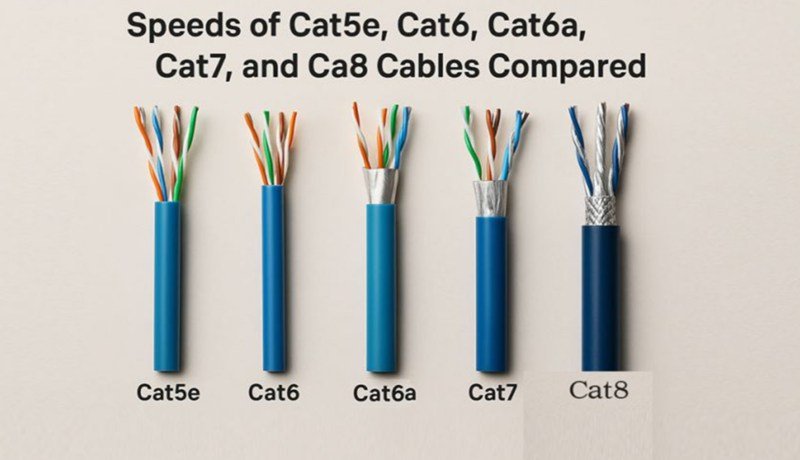
Patch cables are most commonly classified by Ethernet category (such as Cat5e, Cat6, and Cat6A), shielding type (unshielded or shielded), and construction materials. Each type is designed to support specific data rates, electromagnetic environments, and mechanical requirements. Selecting the correct patch cable type ensures stable performance, compliance with network standards, and long-term reliability in real installations.
Which Patch Cables Are Used in Ethernet Networks?
In practice, when people talk about patch cables, they almost always mean Ethernet patch cables. These cables support Ethernet protocols and are defined by standardized performance categories.
The most common categories include:
| Category | Typical Data Rate | Common Use Case |
|---|---|---|
| Cat5e | Up to 1 Gbps | Basic office networks |
| Cat6 | Up to 1 Gbps (10 Gbps short runs) | Enterprise networks |
| Cat6A | Up to 10 Gbps | Data centers, industrial Ethernet |
While higher categories exist, Cat5e, Cat6, and Cat6A account for the vast majority of real-world installations. Choosing between them is less about future-proofing slogans and more about link length, EMI environment, and equipment capability.
For example, Cat6A patch cables are often specified in data centers not because every link runs at 10 Gbps today, but because cable density and electromagnetic noise make shielding and tighter performance margins necessary.
Which Materials and Constructions Define a Patch Cable?
Beyond category, the construction of a patch cable plays a critical role in its behavior.
Key construction elements include:
- Conductor type: stranded copper (for flexibility)
- Shielding: UTP, FTP, STP, or S/FTP
- Jacket material: PVC, LSZH, TPU (industrial use)
- Connector termination: RJ45 with strain relief
Stranded conductors are essential for patch cables. They allow repeated bending without conductor breakage, something solid conductors cannot tolerate over time.
Shielding choice depends heavily on environment:
| Environment | Recommended Shielding |
|---|---|
| Office, low EMI | UTP |
| Dense racks | FTP or STP |
| Industrial machinery | STP / S-FTP |
In high-density or noisy environments, shielding is not optional—it is what keeps error rates low as cable counts increase.
How Is a Patch Cable Used in Real Applications?
Patch cables are used to connect active network equipment—such as switches, routers, servers, and patch panels—over short distances. They provide flexible, replaceable connections that support network changes, maintenance, and troubleshooting without altering permanent cabling. Patch cables remain essential in offices, data centers, and industrial networks because they simplify configuration and reduce downtime.
How Are Patch Cables Used Between Switches and Patch Panels?
In structured cabling systems, permanent cables terminate at patch panels. Patch cables then connect these panels to switches.
This design offers several advantages:
- Network topology can be changed without touching permanent cabling
- Fault isolation is faster and safer
- Equipment replacement is simplified
In practice, most daily network changes happen at the patch cable level. Adding a new device, rerouting traffic, or segmenting a network often involves nothing more than moving or replacing patch cables.
Because of this, patch cables experience more physical stress than any other part of the network. Poor-quality patch cables may pass initial tests but fail months later due to connector wear or internal conductor fatigue.
How Do Patch Cables Function in Data Centers and Offices?
In offices, patch cables are often overlooked until something breaks. In data centers, they are treated as critical components.
Data center patch cables must handle:
- High port density
- Tight bend radii
- Elevated temperatures
- Constant airflow
As speeds increase, even minor imperfections in patch cables can cause packet loss or retransmissions. This is why data centers often standardize patch cable length, color, and category to improve airflow management and troubleshooting efficiency.
In offices, patch cables are shorter and less densely packed, but still critical for day-to-day reliability—especially in environments with frequent desk moves or equipment changes.
Are Patch Cables Still Used in Modern Network Installations?
Yes—absolutely, and in many cases more than ever.
Despite advances in wireless networking and software-defined infrastructure, physical patch cables remain unavoidable at the hardware layer. Every wireless access point, server, and switch still connects via physical ports.
What has changed is how patch cables are used:
- Higher speeds demand better shielding and tighter tolerances
- Cable density requires improved jacket materials and flexibility
- Custom lengths reduce clutter and airflow issues
Patch cables are no longer generic accessories. In modern installations, they are engineered components selected based on application context.
The idea that patch cables are “old technology” usually comes from misunderstanding their role. As long as networks rely on physical interfaces—and they still do—patch cables remain fundamental.
What Specifications Matter When Choosing a Patch Cable?
When choosing a patch cable, the most important specifications include cable category (Cat5e, Cat6, Cat6A), shielding type, length, outer diameter, flexibility, and connector quality. These factors determine signal integrity, resistance to interference, mechanical durability, and long-term reliability in real installations.
What Cable Categories (Cat5e, Cat6, Cat6A) Are Relevant?
Cable category defines the performance envelope, but not the real-world outcome by itself.
| Category | Max Rated Speed | Typical Real Use |
|---|---|---|
| Cat5e | 1 Gbps | Standard office networks |
| Cat6 | 1–10 Gbps (short) | Enterprise IT |
| Cat6A | 10 Gbps | Data centers, industrial |
In practice, many failures blamed on “network speed” are caused by mismatched components—for example, Cat6 switches connected by poorly terminated patch cables.
For patch cables, consistency matters more than headline speed. A well-made Cat6 patch cable often outperforms a poorly made Cat6A cable in real installations.
What Role Do Shielding, Length, and OD Play?
Shielding reduces EMI, but it also affects stiffness, grounding, and termination quality.
- UTP: flexible, low cost, office-friendly
- FTP / STP: better noise immunity, higher termination demands
Length matters more than most buyers expect. Excessively long patch cables create clutter, airflow blockage, and accidental strain.
Outer diameter (OD) influences:
- Bend radius
- Port density
- Cable management efficiency
In dense racks, thinner, flexible cables often perform better overall than thicker ones, even if theoretical shielding is lower.
How Is a Patch Cable Different From Other Network Cables?
Patch cables differ from other network cables in function and construction. They are designed for short, flexible, frequently handled connections, while permanent network cables are installed once and rarely moved. Patch cables typically use stranded conductors and reinforced connectors to withstand repeated use.
How Does a Patch Cable Differ From Horizontal Cabling?
Horizontal cabling is permanent. Patch cables are operational.
| Feature | Patch Cable | Horizontal Cable |
|---|---|---|
| Conductor | Stranded | Solid |
| Flexibility | High | Low |
| Handling | Frequent | Rare |
| Replacement | Easy | Difficult |
Using patch cable as permanent cabling may work short-term but often violates standards and reduces lifespan.
Are Patch Cables Interchangeable With LAN Cables?
This depends on how “LAN cable” is defined.
In casual language, “LAN cable” often means any Ethernet cable. Technically, patch cables are a subset of LAN cables, optimized for specific use cases.
Problems arise when buyers assume all LAN cables behave the same. In reality, conductor type, termination quality, and mechanical design matter just as much as category rating.
When Should Custom Patch Cables Be Considered?
Custom patch cables should be considered when standard off-the-shelf cables cannot meet installation constraints, environmental conditions, performance requirements, or layout efficiency. This includes high-density racks, industrial environments, special connector orientations, exact length needs, or non-standard materials. Customization reduces clutter, improves airflow, enhances reliability, and ensures the cable fits the real application—not just the catalog description.
When Do Standard Patch Cables Fail in Real Installations?
Standard patch cables are designed for average, generic scenarios. In controlled lab tests or simple office setups, they usually perform well. Problems begin when real-world constraints are introduced.
Common situations where standard patch cables fall short include:
- Excess cable length creating loops and congestion
- Connector boots blocking adjacent ports in dense switches
- Inadequate shielding in electrically noisy environments
- Jacket materials degrading due to heat, oil, or UV exposure
- Inconsistent quality between different batches or suppliers
These issues often do not cause immediate failure. Instead, they lead to gradual performance degradation, intermittent link drops, or maintenance complexity. In high-availability networks, even minor inefficiencies accumulate into real operational cost.
| Typical Issue | Resulting Problem |
|---|---|
| Too-long standard lengths | Poor airflow, accidental strain |
| Thick OD cables | Reduced port density |
| Generic PVC jacket | Cracking, aging in harsh environments |
| Fixed connector design | Difficult routing or blocked ports |
When patch cables stop being “plug-and-forget” components, customization becomes a practical necessity.
Which Application Scenarios Require Custom Patch Cables?
Custom patch cables are most commonly required in environments where space, reliability, or operating conditions are non-standard.
Typical scenarios include:
- High-density data centers with strict airflow and cable management rules
- Industrial networks exposed to vibration, oil mist, dust, or temperature extremes
- OEM equipment with fixed internal layouts and limited routing space
- Control cabinets where cable bend radius is restricted
- Medical or laboratory systems requiring specific materials or traceability
In these applications, using generic patch cables often results in compromises: tighter bends than recommended, forced routing paths, or reliance on cable ties to “fix” layout problems. Custom cables eliminate these compromises by being designed around the physical reality of the installation.

How Do Custom Lengths Improve Cable Management and Reliability?
Length is one of the most underestimated variables in patch cable performance.
Standard patch cables are usually available in coarse increments (0.5 m, 1 m, 2 m, etc.). In dense racks, this often means choosing a cable that is slightly too long, then managing the excess.
Custom-length patch cables solve this directly.
| Cable Length Strategy | Practical Impact |
|---|---|
| Standard lengths | Excess slack, clutter |
| Custom exact length | Clean routing, reduced strain |
| Short optimized runs | Better airflow, easier maintenance |
Benefits of custom lengths include:
- Reduced mechanical stress on connectors
- Improved airflow in racks and cabinets
- Faster troubleshooting and port identification
- Lower risk of accidental disconnection
In large installations, even small length optimizations repeated hundreds of times produce measurable improvements in reliability and serviceability.
When Are Custom Materials and Jackets Necessary?
Material selection is another key reason to move beyond standard patch cables.
Most off-the-shelf patch cables use PVC jackets designed for indoor office environments. In many applications, this is insufficient.
Custom patch cables allow selection of jacket and insulation materials based on real conditions:
| Environment | Recommended Jacket Material |
|---|---|
| Office / IT room | PVC or LSZH |
| Data center (hot aisle) | LSZH, higher temp rating |
| Industrial equipment | TPU / PUR |
| Outdoor or UV exposure | UV-resistant compounds |
| Medical / clean environments | Low-outgassing, compliant materials |
Material customization improves:
- Cable lifespan
- Safety compliance
- Mechanical flexibility
- Resistance to chemicals or abrasion
These factors are rarely visible in a product catalog but become critical after months or years of operation.
How Do Custom Connectors and Orientations Solve Layout Problems?
Standard patch cables assume a generic port layout. Real equipment often does not.
Custom patch cables can address issues such as:
- Tight port spacing requiring slim boots
- Side-entry or angled connectors for clearance
- Mixed connector types (e.g., different RJ45 orientations)
- Reduced latch interference in stacked ports
In compact systems or OEM equipment, connector geometry often determines whether a cable can be routed cleanly at all. Custom connector selection and boot design can eliminate forced bends and improve long-term connector integrity.
Is Customization About Performance or Practicality?
In most cases, both.
Custom patch cables are not always about increasing theoretical bandwidth. More often, they improve practical performance:
- Fewer link drops
- Lower maintenance effort
- Cleaner installations
- Longer service life
| Goal | Standard Cable | Custom Patch Cable |
|---|---|---|
| Immediate availability | Yes | No |
| Fit-for-purpose design | Limited | High |
| Long-term reliability | Variable | Consistent |
| Installation efficiency | Moderate | Optimized |
For OEMs, system integrators, and industrial users, these practical gains usually outweigh the small increase in upfront coordination required for customization.
When Custom Patch Cables Make Sense
Custom patch cables should be considered whenever the installation environment, layout, or usage pattern deviates from “generic office networking.” They reduce hidden risks, simplify maintenance, and align the cable with the real system—not an abstract standard.
In professional cable assembly projects, customization is not an exception. It is often the most direct path to reliability.
How Are Patch Cables Manufactured and Tested?
Patch cables are manufactured through controlled conductor preparation, precise connector termination, and systematic testing. Quality manufacturers verify continuity, resistance, and mechanical integrity to ensure consistent performance and compliance with applicable standards.
How Are Connectors Terminated and Verified?
Termination quality defines patch cable lifespan.
Professional manufacturing includes:
- Controlled stripping and pair alignment
- Calibrated crimp force
- Visual and mechanical inspection
Poor termination often looks acceptable but fails after repeated insertions.
How Do Manufacturers Ensure Performance and Compliance?
Reliable suppliers implement:
- Process-level quality checks
- Electrical testing
- Mechanical durability validation
| Test Type | Purpose |
|---|---|
| Continuity | Correct wiring |
| Resistance | Low signal loss |
| Visual inspection | Termination quality |
| Mechanical stress | Durability |
Certifications such as UL, ISO, ROHS, and REACH support—not replace—process discipline.
Patch Cables Are Simple—Until They Aren’t
Patch cables may look interchangeable, but in real networks, they are critical system components. Their role has not diminished with modern technology; it has become more demanding.
For buyers, engineers, and OEMs, the key question is not “Do patch cables still matter?”
It is:
- Are they specified correctly?
- Are they built for the environment?
- Are they manufactured with consistency?
When patch cables are treated as engineered components rather than accessories, network reliability improves—and long-term cost decreases.
If your project involves custom network layouts, high-density installations, industrial conditions, or specific performance requirements, discussing patch cable specifications early can prevent downstream issues.
Sino-Conn supports custom patch cable design, rapid drawings, flexible quantities, and manufacturing-driven recommendations to help ensure the right solution is built from the start.
Related Keywords :patch cable, what is a patch cable, ethernet patch cable, network patch cable, lan patch cord, cat6 patch cable, cat6a patch cable, shielded patch cable, unshielded patch cable, custom patch cable, ethernet cable assembly, network cabling, data center cabling, patch panel cable, rj45 patch cable, industrial ethernet cable, cable assembly manufacturer, custom cable assembly, network cable specifications, patch cable uses

With over 18 years of OEM/ODM cable assemblies industry experience, I would be happy to share with you the valuable knowledge related to cable assemblies products from the perspective of a leading supplier in China.
manufacturer catalogue
Get A Sample Now From Factory→
Get a quote quickly
Here, developing your OEM/ODM custom cable assemblies collection is no longer a challenge—it’s an excellent opportunity to bring your creative vision to life.