Skip to content

Imagine you’re streaming a live 8K video from one side of the globe to the other—and at the same time controlling an automated factory line and performing remote surgery. All these tasks rely on a super-thin strand of glass no wider than a human hair, carrying bursts of light at incredible speed. That’s the power of a fiber optic cable.
a fiber optic cable is a glass (or sometimes plastic) strand sized like a hair, designed to transmit data as pulses of light over long distances with high bandwidth and minimal interference. This technology underpins modern telecom, data-center, industrial automation and many customized cable assembly applications. But beyond that definition lies a fascinating story of precision design, materials science, and highly-tailored manufacturing. At Sino‑Conn we see clients bring us a photo and say: “Can you make exactly this but customised—length, connectors, shield, bend radius, UL/ISO/ROHS certified?” By going deeper into what fiber cables are, how they work, their types, uses and customization possibilities, you’ll not only understand why they matter—but also be well positioned to select or specify one for your next project. Stay with me because by the end you’ll know how to pick the right fiber cable for your application—and how Sino-Conn can help you get it built exactly to spec.
What Is a Fiber Optic Cable?
A fiber optic cable is a slender strand (or multiple strands) of ultra-pure glass or plastic, encased in cladding and protective jacket, which carries data encoded as pulses of light rather than electrical current. It enables high-speed, high-bandwidth data transmission over long distances with low signal loss and strong immunity to electromagnetic interference.
At its core, a fiber optic cable consists of three principal layers: the core (through which light travels), the cladding (which keeps light inside via total internal reflection) and the buffer or jacket (which protects the fragile glass from mechanical damage, moisture and environmental factors).
Unlike copper cables that rely on electrical conduction, fiber cables transmit data as light waves, often generated by lasers or LEDs, making them capable of much higher data‐rates and longer distances before requiring repeaters.
From a manufacturing and specification standpoint—particularly relevant for Sino-Conn’s customers—the parameters matter: core diameter, cladding material, jacket composition, shielding, bent radius, OD (outer diameter), flexibility, EMI/EMC shielding, halogen-free, UV resistance, high-temp rating. These parameters determine how the cable will perform in a given environment (industrial, medical, military, telecom) and whether custom adjustments (connector, pin-out, length) are required.
Critically, for custom cable assembly customers: you may come with a photo or even just an image of a cable. But unless you also specify technical parameters (core size, attenuation, bend radius, jacket material, certification like UL/ISO/RoHS/REACH), you’re only partly specifying what matters. At Sino-Conn we emphasise supplying full specs and CAD drawings before production—so there are no surprises.
In short: a fiber optic cable is more than “just glass in a jacket”—it’s a precision engineered optical transmission medium, tailored via materials, geometry and manufacturing to meet your exact application. Whether you need a standard telecom link or a fully ruggedised, custom fibre assembly for a factory robot arm, understanding what it is forms the foundation of choosing the right cable.
How Does a Fiber Optic Cable Work?
A fiber optic cable works by transmitting data as pulses of light through strands of glass or plastic fibers. Each fiber core guides light using total internal reflection, enabling high-speed data transfer over long distances with minimal signal loss or electromagnetic interference.
1. The Basic Principle: Light as the Data Carrier
At its core, a fiber optic cable replaces traditional electrical signals with light. Instead of electrons moving through a copper wire, photons travel through ultra-pure glass or plastic fibers. This light is usually generated by a laser or LED at one end, modulated to represent digital data (1s and 0s), and received by a photodetector at the other end.

This design allows optical fibers to transmit information at near-light speed, with much less signal degradation compared to electrical conductors. Because light travels in a confined path inside the fiber, it is immune to electromagnetic noise and radio frequency interference—two major issues that plague copper communication cables.
2. Structure of a Fiber Optic Cable
A standard fiber optic cable is composed of several concentric layers, each with a distinct function:
| Layer | Function | Material |
|---|---|---|
| Core | The central part that carries light signals | Ultra-pure glass or plastic |
| Cladding | Surrounds the core and reflects light back into it via total internal reflection | Glass or polymer with lower refractive index |
| Coating/Buffer | Protects the fiber from physical damage and moisture | Soft plastic |
| Strength Members | Add tensile strength and flexibility | Kevlar (Aramid yarn) |
| Outer Jacket | Provides environmental and mechanical protection | PVC, LSZH, or TPU |

These layers work together to preserve signal integrity, ensure mechanical stability, and protect the fragile glass fibers inside.
3. Total Internal Reflection — The Science Behind the Transmission
The fundamental physical principle enabling fiber optics is total internal reflection. When light enters the core at a certain angle (below the “critical angle”), it continuously reflects off the cladding boundary instead of escaping.
This reflection happens millions of times per second as the light travels, guiding the signal through the bends and twists of the cable with minimal loss. The higher the refractive index difference between the core and the cladding, the more effectively the light stays trapped within the core.
4. Types of Fiber Transmission: Single-Mode vs. Multi-Mode
Fiber cables come in two main types, each optimized for different applications:
- Single-Mode Fiber (SMF): Features a small core diameter (≈9 µm). It allows only one light path (mode), minimizing dispersion and enabling transmission distances exceeding 100 km. Used in telecommunication backbones and data centers.
- Multi-Mode Fiber (MMF): Has a larger core (50 µm or 62.5 µm), supporting multiple light paths. While it offers lower cost and easier termination, it suffers from modal dispersion, limiting its range to typically under 2 km. Ideal for local networks, factory automation, or short-range sensor links.
| Type | Core Size | Typical Range | Common Use |
|---|---|---|---|
| Single-Mode | 9 µm | Up to 100 km | Long-distance telecom, FTTH |
| Multi-Mode | 50–62.5 µm | Up to 2 km | LAN, industrial systems |
5. The Transmission Process: Step-by-Step
- Light Generation: A laser diode or LED converts electrical signals into light pulses.
- Injection: Light enters the fiber core at a controlled angle through a connector or splice.
- Propagation: Light travels via internal reflection along the fiber’s length.
- Reception: At the far end, a photodiode or receiver converts light back into electrical signals.
- Decoding: Network devices interpret the electrical output as usable digital data.
This seamless conversion between electrical and optical domains allows modern networks to reach speeds beyond 400 Gbps, supporting everything from streaming and AI servers to industrial automation.
6. Factors Affecting Performance
While fiber optics are highly efficient, several variables can influence signal quality:
- Attenuation: Gradual signal loss due to absorption or scattering within the fiber.
- Dispersion: Widening of light pulses over long distances, causing data overlap.
- Connector and Splice Loss: Imperfect connections or bends leading to reflections or leaks.
- Bend Radius: Sharp bends can break internal reflection paths and increase loss.
- Temperature and Vibration: Environmental conditions that may affect optical alignment or jacket integrity.
Proper cable selection, installation, and quality inspection—often supported by UL, ISO, and ROHS certifications—ensure consistent, long-term signal reliability.
7. Why Understanding the Working Principle Matters
Knowing how fiber optic cables work helps engineers and procurement specialists make smarter choices—matching the correct core size, jacket material, and connector type to their application. For instance, a custom cable designed for outdoor or industrial use may need enhanced UV resistance, flame retardancy, or higher tensile strength.
By understanding these fundamentals, decision-makers can clearly communicate their specifications when consulting suppliers like Sino-conn, ensuring the final cable assembly meets precise optical and environmental requirements.
What Are the Main Types of Fiber Optic Cables?
The main types are single-mode (very small core, long-distance high‐bandwidth) and multi-mode (larger core, shorter distances), and in construction variants like simplex, duplex, breakout, ribbon, indoor/outdoor, each with different jacket, connector and performance profiles.
Single-mode vs. Multi-mode
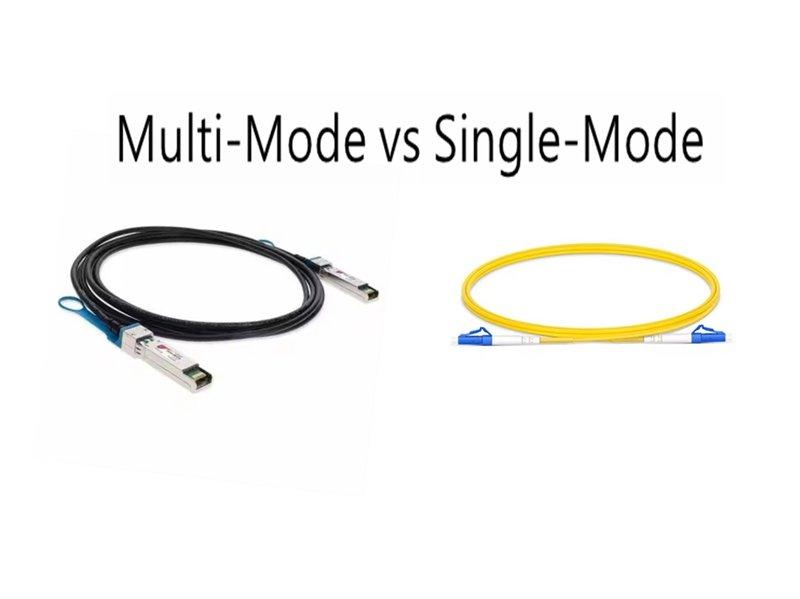
Single-mode fiber typically has a core diameter around 8–10 µm, allows only one propagation mode (light path) and is thus ideal for long distances and high-bandwidth telecom or data center backbone links. Multi-mode fiber has a larger core (50 µm, 62.5 µm etc) enabling multiple light paths, making it more suited to shorter links like within buildings or data centres at lower cost.
| Type | Core Diameter | Typical Use | Distance & Bandwidth |
|---|---|---|---|
| Single-mode | ~8–10 µm | Long-haul telecom, backbone | Tens to hundreds of km |
| Multi-mode | ~50–62.5 µm | LAN, data centre links | Up to a few km |
Construction Variants (Simplex, Duplex, Ribbon etc)
Beyond mode type, fiber cables have many build forms:
- Simplex: single fiber in one jacket, useful for one-way links.
- Duplex: two fibers in a jacket or twin jacket—one transmit, one receive.
- Breakout and distribution versions: multiple fibers grouped for multi-port or multi-device installations.
- Ribbon: flat group of fibers side-by-side, for high-density installations.
- Indoor vs. Outdoor: Outdoor cables may have gel-filled core, armour, UV-resistant jacket; indoor may favour plenum or riser‐rated jacket.
Connectors and Terminology
Connectors matter in custom assemblies: commonly SC, LC, ST, FC and others. The choice affects cost, stock availability, performance (insertion loss, return loss), and suitability for your application (rugged industrial vs. telecom datacom). When you come to Sino-Conn, we ask: Are these “original” (brand new, prem-qualified) “compatible/alternate” connectors? Supply chain, pricing and delivery differ: originals cost more, longer lead-time; compatibles are more flexible for custom, smaller-volume runs.

Which Industries Use Fiber Optic Cables Most?
Fiber optic cables are used widely in telecom and internet backbone, data-centres, industrial automation, medical instruments, military/defence systems, and smart-city/IoT applications—essentially wherever high-speed, long-distance or interference-immune data transmission is critical.
Fiber cables are foundational to many industries. Let’s look at key sectors and what they expect:
Telecom & Data Centres
Widely known: fiber forms the backbone of our global internet, cloud services and inter-data-centre connectivity. It supports high-bandwidth, long-distance transmission, often using single-mode fibers with advanced multiplexing (WDM) to carry multiple channels over one strand.
Industrial Automation & Smart Manufacturing
Factories increasingly use fiber optic cables to connect sensors, actuators and control systems across large sites. Why fibre? Because it is immune to electromagnetic interference (EMI) from heavy machinery, industrial power systems and high-voltage environments. It also allows longer runs than copper, reducing need for repeaters. At Sino-Conn we often customise fiber assemblies with relay‐proof jackets, high flex ratings, oil/UV resistant jackets, and low-bending radii for moving machinery.
Medical / Healthcare Equipment
Machines such as endoscopes, laser surgery units, diagnostic imaging often rely on fiber optics for light delivery or data transmission. Fiber’s small size, immunity to EMI and ability to transmit high-resolution data make it ideal for medical OEMs. Our team supports clients in this sector by offering full traceable certifications (ISO, ROHS, REACH, PFAS) and custom lengths/connectors for tight spaces.
Defense & Aerospace
Military and aerospace applications demand rugged, reliable cabling with low latency, high bandwidth and minimal interference vulnerability. Fiber optic cables serve radar systems, onboard aircraft avionics, satellite communications and secure networks. Surge immunity, non-conductive paths and light weight are advantages. In this scenario, custom cable assemblies with ruggedised connectors, small lot runs, quick sample turnaround (2–3 days) and flexible MOQ (1 pc up) are common.
Smart Cities, IoT and Emerging Applications
As 5G/6G, IoT sensors, smart grids and distributed infrastructure proliferate, fiber becomes the backbone. For example, “Radio-over-Fiber” systems link remote antennas to central hubs via fiber, consolidating multiple radio signals over one link. Also, fiber spans campus networks, building-to-building links, traffic management systems and more.
Customer Perspective – Why it matters
As a buyer or design engineer, you must recognise that each industry has its own priorities:
- Trade-buyers may ask simply “Can you make cable XYZ?” often providing a photo only. Our job is to ask the right questions: environment, bend radius, certifications, cable length, connector type, volume, delivery time.
- R&D engineers will provide specs, drawings, and focus on performance not just price.
- OEM factories often care most about price and large volumes, but still need dependable delivery and quality.
At Sino-Conn we accommodate all three: no MOQ (1 pc sample), sample lead-time as short as 2-3 days, bulk orders in 3-4 weeks (or 2 weeks for rush), full certifications and strict quality control (100 % inspection, three stages). These services align with industry demands across sectors.
In summary: fiber optic cables are not just for telecom—they touch nearly all sectors where data, speed, length, interference immunity and reliability matter. Understanding the expectations of each industry helps you specify the right custom assembly—and that’s where Sino-Conn adds value.
How to Choose the Right Fiber Cable for Your Application
To choose the right fiber cable, consider your application’s distance, environment, data rate, and installation conditions. Select between single-mode or multi-mode fiber, match proper connector types, and choose jacket materials and protection levels based on temperature, flexibility, and exposure to oil, UV, or moisture.
1. Matching Fiber Type to Transmission Distance and Bandwidth
One of the first decisions is whether to use single-mode or multi-mode fiber.
Your choice depends on how far and how fast you need to transmit data.
| Fiber Type | Core Diameter | Max Range | Typical Data Rate | Ideal Use Case |
|---|---|---|---|---|
| Single-Mode (OS1/OS2) | 9 µm | Up to 100 km+ | Up to 400 Gbps | Telecom networks, data centers |
| Multi-Mode (OM1–OM5) | 50–62.5 µm | Up to 2 km | Up to 100 Gbps | Industrial LANs, factory automation, short interconnects |
If your project involves long-distance backbones, single-mode is the clear choice. For shorter, high-density interconnections—like between control cabinets or network switches—multi-mode fiber offers a cost-effective solution with easier termination.
2. Selecting the Proper Connector Type
Connectors determine how easily your fiber cable integrates with existing systems.
Different connectors offer trade-offs in insertion loss, return loss, and mechanical strength.
| Connector Type | Description | Common Applications |
|---|---|---|
| SC (Subscriber Connector) | Snap-in design, low cost, simple to use | Telecom and LAN |
| LC (Lucent Connector) | Compact, high-density | Data centers, switches |
| ST (Straight Tip) | Bayonet-style, durable | Industrial, legacy networks |
| FC (Ferrule Connector) | Threaded for secure fit | Test equipment, precision optics |
| MTP/MPO | Multi-fiber, high-speed backbone | 40G/100G systems, parallel optics |
Choosing the wrong connector can result in high insertion loss or unreliable coupling, so it’s important to confirm connector compatibility early in your design.
3. Understanding Environmental and Mechanical Conditions
Fiber optic cables are used in diverse environments—from clean indoor cabinets to outdoor conduits and industrial machinery. The surrounding environment dictates what jacket and buffer materials are suitable.
| Environment | Recommended Jacket | Key Properties |
|---|---|---|
| Indoor (Plenum / Riser) | PVC or LSZH | Fire-resistant, low smoke emission |
| Outdoor | PE or UV-Resistant LSZH | UV protection, moisture resistance |
| Industrial / Factory | TPU or Nylon | Oil-proof, abrasion-resistant, flexible |
| Harsh / Marine | Stainless armored or PUR | Anti-corrosion, pressure-resistant |
If your fiber will be exposed to vibration, bending, or movement—such as in robotic automation—select a cable with a tight-buffered construction and a smaller bend radius to prevent micro-cracks or attenuation.
4. Considering Installation and Routing Constraints
Routing and installation conditions affect both performance and lifespan.
Here are key considerations:
- Bend Radius: Exceeding the minimum bend radius causes optical loss. Follow manufacturer guidelines (typically 10× the cable OD).
- Pulling Force: Fiber can break if pulled too hard; use strength members such as Kevlar yarn to distribute tension.
- Routing Path: Avoid sharp edges and high-pressure cable ties; maintain proper spacing in ducts or trays.
- Connector Protection: Use dust caps and clean ferrules to prevent signal degradation.
When designing for confined spaces or motion, flexible and small-diameter fibers such as 1.8 mm or 2.0 mm OD options are preferred.
5. Verifying Compliance and Certification
Compliance with recognized standards ensures safety and long-term reliability.
When evaluating suppliers or custom assemblies, look for these certifications:
| Certification | Purpose |
|---|---|
| UL / ISO 9001 | Quality and safety assurance |
| RoHS / REACH | Restriction of hazardous substances |
| IEC 60793 / 60794 | Optical and mechanical performance |
| IP67 / IP68 (for connectors) | Dustproof and waterproof ratings |
These standards are especially important for export projects, where regional regulations (e.g., EU, US, Japan) vary.
6. Determining Fiber Count and Custom Configuration
The number of fibers you need depends on your system architecture.
For instance:
- Duplex fibers (2 cores) for standard bidirectional data links.
- 12-, 24-, or 48-core bundles for dense interconnects or backbone trunks.
- Breakout or fan-out assemblies when connecting multiple devices in parallel.
Sino-conn and similar manufacturers can provide custom pinouts, length definitions, and connector combinations, often supported by CAD drawings and samples before mass production.
This step ensures the assembly fits precisely into your system without additional adapters or modifications.
7. Evaluating Cost, Lead Time, and Flexibility
While performance is critical, practical factors like lead time and MOQ (minimum order quantity) often influence decision-making.
Engineers or procurement teams should balance:
- Urgency: Rapid prototype delivery (2–3 days) vs. regular lead times (2–4 weeks).
- Quantity: Projects needing 1–10 samples can request low-volume production.
- Price-performance ratio: Choosing between original-brand connectors and compatible alternatives.
A well-planned sourcing strategy ensures you receive the best combination of optical performance, durability, and cost efficiency.
8. Why Choosing the Right Fiber Cable Matters

Selecting the wrong cable can cause excessive signal loss, frequent maintenance, or even network downtime.
An optimal choice not only ensures stable transmission but also reduces long-term operational costs by improving durability and minimizing system failures.
Whether it’s for industrial automation, smart factories, or data communication, understanding the trade-offs among fiber types, connectors, and materials helps engineers design systems that remain reliable for years.
Can Fiber Optic Cables Be Customized?
Yes—fiber optic cable assemblies are highly customizable in terms of length, connector type & pin-out, jacket material, structure (simplex, duplex, ribbon, hybrid), modification for flexibility/bend-radius, shielding or armouring, and certifications. At Sino-Conn we facilitate custom builds from 1 piece onward, with full drawings, fast turnaround and flexible pricing.
What Customisation Options Are Available?
When clients come to Sino-Conn, common customisation requests include:
- Length: From 1 piece to mass production, custom lengths allow fit into unique equipment or machine layouts.
- Connector & Pin-Out: Choose standard or customised connectors; define pin-out (especially for hybrid fiber + copper or multi-core assemblies).
- Material & Jacket: Specify high-flex jackets, halogen-free, oil/UV resistant, high‐temperature rating, armour or metal braid for harsh environments.
- Structure: Breakout, ribbon, hybrid cable (fiber + power + sensor wires) are possible.
- Certificates: ROHS, REACH, PFAS, COC, COO. If your industry requires UL/ISO/medical/military ratings – we can support.
- Build & Lead-Time: Sample lead times as short as 2–3 days; bulk lead times 3–4 weeks (rush 2 weeks). No minimum MOQ (1 pc supported).

Original vs Compatible Connectors – What to Consider?
- Original brand connectors: Higher cost, longer lead-time, less flexible for small orders, but trusted and certifiable by big OEMs/trade.
- Compatible/alternate connectors: Lower cost, faster shipping, more flexible for custom runs and small volumes, performance often comparable for many industrial uses. Sino-Conn helps you decide: if you are an end-user looking for “best quality no compromise”, we help source originals; if you are an OEM or need cost-controlled volume, we suggest compatible options.
Drawing Approval & Production Workflow
Our process at Sino-Conn:
- You send photo/spec or requirement; if only photo, we reverse engineer or ask key parameters.
- We generate a CAD drawing (PDF) in ~30 minutes to up to 3 days for complex builds.
- You review and approve the drawing and specifications.
- Sample production (2–3 days possible); you test and approve.
- Bulk production begins (typically 3–4 weeks, rush 2 weeks).
- Full inspection: process check, final check, pre-shipment check (3-stage quality).
The above workflow gives confidence you’ll get exactly what you asked for, with minimal risk.
In short: Yes, fiber optic cable assemblies are very customizable—and for customers with unique machine layouts, harsh environments, low volumes or fast turnaround, working with a supplier such as Sino-Conn who supports full customisation, fast sample delivery, flexible MOQ and full traceable quality certifications makes a big difference.
Why Choose Sino-Conn for Custom Fiber Cable Assemblies
You should choose Sino-Conn because we combine full customisation (length, connector, material, certification), rapid turnaround (samples in 2–3 days, bulk in 3–4 weeks, rush in 2 weeks), flexible MOQ (1 piece), stringent quality control (100% inspection at three stages), global pricing/experience and deep understanding of industrial, medical, telecom, military fiber cable assembly needs.

Customer-Centric Approach
At Sino-Conn we don’t just sell cables—we partner with you. We ask: what environment is the cable in? What movement or bending will it endure? What certifications do you need? Are you trade, R&D or OEM? Based on your profile:
- Trade clients: often send a photo, unclear on specs—We respond in 30 minutes with a drawing & quotation.
- R&D engineers: provide drawing & specs, we collaborate on design & test.
- OEM factories: large volumes, price sensitivity, long account terms (30–90 days) – we accommodate.
Speed, Flexibility & Quality
- Sample lead time: as short as 2–3 days.
- Bulk lead time: 3–4 weeks, rush orders in 2 weeks.
- Flexible MOQ: 1 piece sample runs—ideal for prototypes or low-volume custom builds.
- Pricing: optimized for your segment—brand end-users pay highest, OEM factories lower, trade clients in between.
- Quality process: three-stage full inspection (in‐process + final + pre-shipment); all products 100% full‐inspection.
- Certifications: UL, ISO, RoHS, REACH, PFAS, COC/COO. We help you select and document the right compliance.
Global & Industry Experience
- We serve clients in US, Europe (Italy, Poland, Germany, France), Asia (Japan, Korea, SE-Asia), India, Russia. Understand regional cost variations.
- Industries: Industrial automation, telecom/datacom, medical, military/aerospace, OEM/assemblies. We’ve built thousands of custom fibre cable assemblies.
- Custom specification prowess: lengths, jackets (oil/U V/halogen-free), connectors, hybrid builds. We respond to photos and sketches—if you don’t know the technical spec, we’ll help you define it.
Why Your Project Benefits
Whether you’re specifying a fibre cable for a high-end medical imaging device requiring ultra-clean materials and traceability, or a factory robot harness needing high flex and rugged jacket, Sino-Conn is designed to serve you. With our combination of engineering support, rapid response, customisation, global supply and quality assurance, you have a single partner capable of delivering a tailored fiber optic cable assembly that meets your exact needs.
Ready to Get Started?
If you’re seeking a reliable, fully customizable fiber optic cable assembly—whether a single prototype or a large production run—contact Sino-Conn today. Let us draw your cable, quote your project in 30 minutes, and deliver your sample in days. Start by sending us your photo, sketch, or specification sheet and we’ll take it from there.
We look forward to being your partner in high-performance fiber cable solutions.