Skip to content
Are Solar Panel Connectors Waterproof?
- andy
Solar energy systems live outdoors 24/7, facing rain, humidity, UV radiation, wind, snow, and temperature swings. While solar panels themselves are designed for outdoor weather, many users still ask one critical question: Are the connectors between solar panels truly waterproof? This question matters more than people realize. The waterproof performance of a connector directly affects system efficiency, safety, and longevity. A poorly sealed connector can allow moisture to enter and cause corrosion, overheating, or even fire hazards.
Yes — most solar panel connectors, especially MC4 connectors, are engineered to be waterproof with IP65–IP67 ratings. They withstand rain, humidity, dust, and outdoor weather conditions. However, waterproof performance depends on connector materials, sealing rings, cable OD match, installation quality, and whether the connectors are genuine or high-grade alternatives.
Many failures occur not because the MC4 design is flawed, but because installers use poor-quality substitutes, mismatched cable diameters, or improper crimping. Sino-Conn once received a request from a customer whose MC4 connectors had melted during the rainy season. After analysis, the issue turned out to be a low-grade plastic shell paired with a loose crimp terminal—an easy mistake that caused expensive downtime. Stories like this highlight why understanding waterproof performance is essential before selecting connectors for your PV system.
What Makes a Solar Panel Connector Waterproof?
A solar panel connector is waterproof when it achieves an IP65–IP67 rating, uses sealed housings, rubber O-rings, UV-resistant materials, and proper cable-to-body compression. Waterproofing depends not only on connector design but also on correct cable OD, crimping quality, and installation technique.
Waterproofing begins with the connector’s IP rating, a standardized measure that indicates protection against dust and water. IP65 means the connector can withstand water jets, while IP67 means it can survive temporary immersion. MC4 connectors typically achieve IP67 when unmated and IP65 when mated, giving them robust protection against rain and outdoor exposure.
Can You Leave Solar Panels Out in the Rain?
Yes—solar panels and their connectors are specifically designed to operate in rain. However, failures occur when low-quality connectors are used or when installers mismatch cable diameters. Rain itself is not the problem; poor sealing is. Outdoor conditions such as heavy rainfall, condensation, and humidity cycles test the durability of every connection point. A waterproof connector must be made of UV-resistant plastic, use secure O-rings, and maintain tight mechanical engagement even after years of expansion and contraction.
Weather Resistance Factors
Proper waterproofing also depends on the material used in the connector shell. High-quality MC4 connectors use UV-stabilized PPO or polycarbonate, which resists sunlight. Cheap plastics degrade under UV exposure, causing cracks that allow moisture to enter.
Sino-Conn provides overmolded waterproof solutions for customers who want even stronger protection. Overmolding adds a layer of silicone or PVC around the cable entry, improving both waterproofing and strain relief—ideal for coastal or humid climates.
Which Solar Panel Connectors Are Waterproof?
In modern photovoltaic (PV) systems, several types of connectors are used to link solar panels, extension cables, junction boxes, and inverters. However, not all of them offer the same level of waterproof protection. The waterproof capability depends on connector design, locking mechanism, sealing components, material grade, manufacturing tolerances, and proper installation. Among all connector types, MC4 remains the industry standard due to its strong weatherproof construction and globally recognized IP65–IP67 protection level.
Understanding the waterproof performance of each connector type helps prevent common failures such as moisture ingress, corrosion, intermittent output, and thermal hotspots.
How Waterproof Are MC4 Connectors?
MC4 connectors are the most widely used solar connectors today and are specifically engineered for outdoor durability. Their waterproof performance is based on several structural features:
IP65−IP67 Protection
- Unmated: Typically IP67, meaning they can withstand temporary immersion.
- Mated: Usually IP65, providing resistance against rain, water jets, and dust.
Rubber O-Ring Sealing
A compression O-ring inside the housing prevents moisture from entering the contact chamber, even during humidity cycles or heavy rain.
Double-Locking Mechanism
MC4 uses a snap-in locking system with a secure plastic latch. This ensures uniform pressure on the sealing surface and prevents accidental loosening due to vibration or thermal expansion.
UV-Resistant Materials
Most high-quality MC4 connectors use PPO or polycarbonate reinforced with UV stabilizers. This prevents micro-cracking from long-term sunlight exposure, which is a common failure point in cheaper alternatives.
Tight Dimensional Tolerances
Waterproof performance depends heavily on manufacturing precision. Even slight deviations in plastic mold accuracy or rubber hardness can compromise sealing integrity.

Engineers need to note that not all MC4 connectors are equal. Variants from different factories may look identical but perform very differently in real outdoor environments. The sealing quality, plastic grade, and contact plating determine long-term stability.
MC3 Connectors and Their Water Resistance
MC3 connectors were used before MC4 became the industry standard. While they offer some level of outdoor resistance, their waterproof ability is limited compared to MC4 due to:
- Weaker sealing structure (no integrated O-ring)
- Lower locking force
- Less robust housing design
- Limited support for high-current PV systems
MC3 connectors are increasingly rare in new installations because they cannot consistently maintain waterproof integrity in extreme environments (heavy rain, high humidity, desert UV exposure, etc.).
T-Branch and Y-Branch Connectors
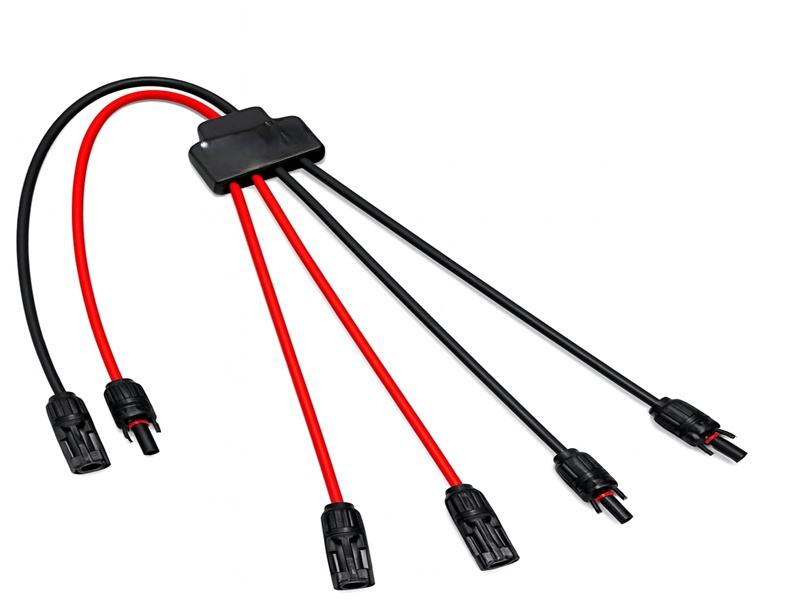
T-branch connectors are used to parallel multiple solar panels. Their waterproof performance varies significantly depending on design:
Overmolded Types
Injected PVC, silicone, or TPE overmold around the cable entry
Offer excellent waterproofing (often IP67 or higher)
Provide good strain relief
These are ideal for long-term outdoor exposure.
Assembled Plastic Housing Types
- Rely on internal gaskets and manual tightening
- Waterproof performance depends on assembly quality
- More susceptible to moisture if not tightened properly
Because T-branch connectors often sit exposed on rooftops, waterproof reliability is crucial for preventing parallel circuit failures.
Solar Extension Cable Connectors
Extension leads often use MC4-compatible connectors on both ends. While the connector itself may be waterproof, the cable-to-connector interface is equally important. Waterproof performance depends on:
- Correct cable OD (outer diameter) matching the connector’s compression range
- Precision crimping of the contact terminal
- Proper strain relief to prevent gaps caused by cable movement
- Quality of the outer jacket material (XLPE or TPE recommended)
Failures usually result from cable diameter mismatch or improper crimping—not from the connector shell itself.
Are “MC4-Compatible” or Third-Party Connectors Waterproof?
Third-party MC4-compatible connectors vary widely in waterproof performance. Some high-quality versions match or exceed the sealing performance of original brands, while low-cost versions may only offer superficial similarity.
Key variables include:
- Rubber hardness (Shore A rating) of O-rings
- Quality of plastic material (PPO vs cheaper blends)
- Contact plating thickness
- Precision of mold tooling
- Fit between male and female housings
In general:
- High-grade alternatives can be fully waterproof and reliable.
- Low-cost, low-precision connectors often fail within months under UV and moisture exposure.
Summary of Waterproof Performance by Connector Type
| Connector Type | Typical Waterproof Level | Pros | Cons |
|---|---|---|---|
| MC4 | IP65–IP67 | Best sealing, UV-resistant, industry standard | Varies by manufacturer quality |
| MC3 | Limited | Simple, used in older systems | Not ideal for modern outdoor PV |
| T-Branch (Overmolded) | Excellent | Strong waterproofing, durable | Slightly higher cost |
| T-Branch (Assembled) | Moderate | Flexible, modular | Waterproofing depends on assembly |
| MC4-Compatible | Highly variable | Affordable, widely available | Quality varies; sealing not guaranteed |
How Waterproof Are Standard Solar PV Cables?
Solar PV cables are waterproof, UV-resistant, and designed for outdoor use. They typically use XLPE insulation and withstand moisture, temperature cycles, and UV exposure. Waterproof performance depends on jacket material, insulation thickness, and cable-to-connector compatibility.
Solar PV cables use cross-linked polyethylene (XLPE) insulation, which resists moisture, heat, and environmental stress. Unlike PVC, which may soften or absorb water, XLPE maintains its integrity in wet conditions and under sunlight. This ensures cables remain waterproof and stable for 20–25 years.
Cable outer diameter (OD) is critical. Each connector requires a specific OD range to clamp properly. If the cable is too thin or too thick, waterproof seals fail. Sino-Conn adjusts cable jacket thickness, OD, and material according to customer needs.
Below is a comparison of common PV cable jacket materials:
| Jacket Material | Waterproof Performance | UV Resistance | Flexibility | Lifespan |
|---|---|---|---|---|
| XLPE | Excellent | Excellent | Medium | 20–25+ years |
| PVC | Moderate | Low | High | 5–10 years |
| TPE | Very good | Good | High | 15–20 years |
Sino-Conn often recommends XLPE or TPE for long-term outdoor use.
Do Waterproof Ratings Affect Solar System Performance and Safety?

Yes. Poor waterproofing leads to corrosion, higher resistance, overheating, and arc faults. Properly waterproof connectors maintain low resistance and protect against moisture intrusion, ensuring stable, safe, long-term PV operation.
Water is one of the biggest threats to solar electrical systems. Even a small amount of moisture entering a connector can corrode the metal contacts. Corrosion increases resistance, causes heat buildup, and can lead to system shutoff or fire hazards.
What Happens When Waterproofing Fails?
Common symptoms include:
- Fluctuating output
- Hot spots in thermal imaging
- Melted plastic
- Visible corrosion inside connectors
- Inverter fault messages
This is why waterproofing is not simply a “nice-to-have” feature—it is essential for safety. DC arcs are harder to extinguish than AC arcs, making connector failure especially dangerous.
Sino-Conn’s three-step inspection process (process, final, shipment) ensures no defective waterproof assemblies reach customers.
How to Choose Waterproof Solar Connectors and Cables
Select connectors with at least IP65–IP67 ratings, UV-resistant materials, proper cable OD matching, certified electrical performance, and reliable sealing structures. Customization is often necessary to achieve long-term waterproof performance.
Choosing the right waterproof connector requires attention to technical details that many buyers overlook. Engineers must evaluate voltage, current, material quality, EMI performance, and temperature ratings.
Key Factors to Consider
| Specification | Importance |
|---|---|
| IP rating | Defines water and dust resistance |
| Cable OD tolerance | Ensures proper sealing |
| Material type | Impacts UV and heat resistance |
| Voltage/current rating | Must match system load |
| Temperature range | Determines outdoor robustness |
| EMI shielding | Enhances electrical stability |
Sino-Conn supports full customization: length, pinout, overmolding, sealing structures, cable materials, and connector brands (genuine or compatible). Engineers appreciate our fast drawing support—30 minutes to 3 days, depending on complexity.
Why Choose Sino-Conn for Waterproof Solar Cable Assemblies?
Sino-Conn offers fully customized waterproof solar cable assemblies with fast lead times, no MOQ, competitive pricing, certified materials, and 100% inspection. We support both genuine and compatible MC4 solutions.
Sino-Conn has deep experience producing waterproof cable assemblies for solar applications. Customers include trading companies, engineers, OEM factories, and end users.
Key Advantages of Sino-Conn
- Fast drawing service: 30 minutes to 3 days
- Fast samples: 2–3 days
- Fast mass production: 2–4 weeks
- No MOQ (1 pc acceptable)
- 100% quality inspection
- UL, ISO, ROHS, REACH, PFAS certifications
- Flexible pricing for different regions and industries
We understand the priorities of customers in different regions—U.S., Europe, Japan, Korea, India—and can provide optimized solutions accordingly.

Ready to Build a Waterproof Solar Cable Assembly?
Waterproofing is essential for stable, long-lasting solar installations. Whether you need MC4 waterproof connectors, IP67 PV cables, custom overmolded solutions, or complete cable harnesses, Sino-Conn can design and manufacture the perfect solution.
Send us your drawing, connector model, or even just a photo—Sino-Conn will help you build a safe, reliable, fully waterproof solar cable assembly.
Related Keywords :solar panel connectors, MC4 waterproof, PV cable assembly, waterproof cable, IP67 connectors, solar wiring, outdoor connectors, PV harness, custom cable assembly, Sino-Conn

With over 18 years of OEM/ODM cable assemblies industry experience, I would be happy to share with you the valuable knowledge related to cable assemblies products from the perspective of a leading supplier in China.
manufacturer catalogue
Get A Sample Now From Factory→
Get a quote quickly
Here, developing your OEM/ODM custom cable assemblies collection is no longer a challenge—it’s an excellent opportunity to bring your creative vision to life.