Skip to content
Medical Cables Manufacturer vs General Electronics Cables Supplier: Which to Choose?
- andy

Choosing the right LVDS cable type is more important than most people think. Whether you’re integrating an LCD module into a medical device, repairing an industrial machine, designing a kiosk, or sourcing cables for an OEM assembly line, the LVDS cable type directly affects signal integrity, EMI performance, display compatibility, and overall system reliability. Yet many engineers and procurement teams discover that LVDS cables are not standardized—different LCD panels, connector brands, and OEM designs use different pinouts, structures, shielding methods, AWG sizes, and even different mechanical forms.
In the middle of this complexity, a simple question keeps appearing in Google searches:
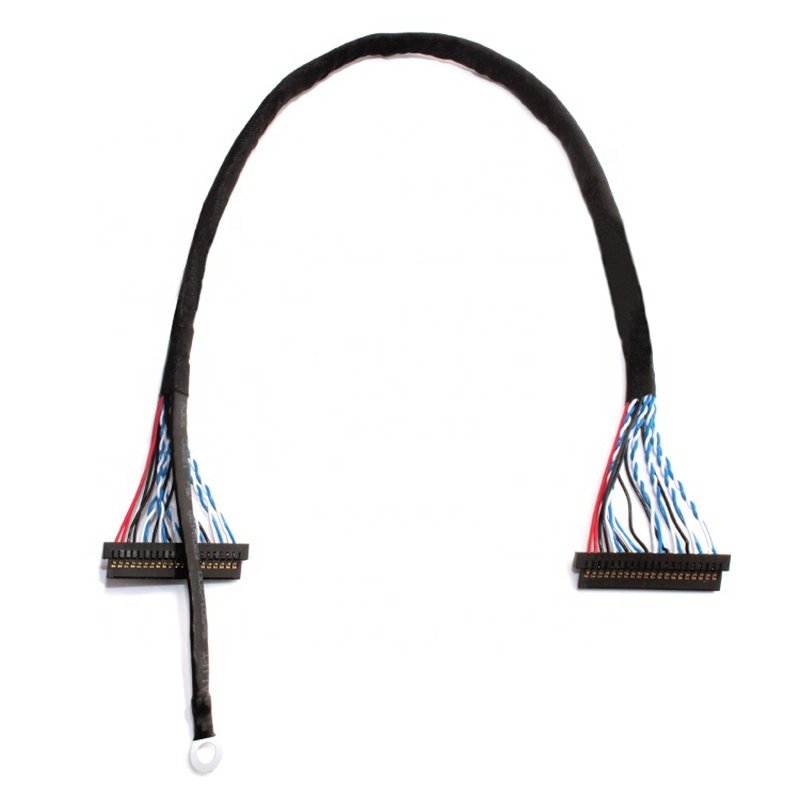
LVDS cables come in several types, including single-channel and dual-channel LVDS, round-wire LVDS harnesses, shielded and unshielded LVDS assemblies, and FFC/FPC-based LVDS cables. They differ in pin count, connector series, impedance control, EMI shielding, and compatibility with specific LCD panels. Choosing the correct type requires matching the connector, pin assignment, signal format, length, and mechanical design of your target display.
What makes this topic especially tricky is that many customers do not have drawings or specifications. They only have a photo, a part number, or the LCD panel model. And sometimes, they only know one thing: “I need an LVDS cable—can you make the same one?”
A Sino-Conn customer once sent us a blurry photo of a broken LVDS cable from a piece of medical diagnostic equipment. No part number. No specifications. No connector reference. Our engineers compared the photo with our connector library, identified the pin count, shield structure, and differential pair layout, and recreated the exact cable in 48 hours—saving the customer a full production delay.
If you want to avoid compatibility mistakes and ensure your next display integration works flawlessly, keep reading.
What Is an LVDS Cable and How Does It Work?
LVDS cables transmit high-speed differential signals between a mainboard and an LCD panel using low-voltage differential signaling. They reduce EMI, support long distances, and use multiple twisted differential pairs to deliver stable image data.
LVDS (Low-Voltage Differential Signaling) is a transmission standard that sends data using pairs of wires carrying opposite electrical signals. This differential design is extremely resistant to noise, making LVDS ideal for industrial environments, automotive electronics, and consumer displays before the rise of eDP.
Modern LCD panels typically use:
- 1–4 differential pairs for RGB data
- A clock pair
- Control signals such as enable, backlight PWM, power, ground
- Optional I²C lines
This explains why LVDS cables vary so much in pin count—from 20-pin to 51-pin connectors.
LVDS is still used extensively today, especially in:
- industrial HMIs
- medical equipment
- ATMs and kiosks
- vehicle displays
- low-cost laptops
- monitors below 1080p or 1080p@60Hz
Even though eDP is replacing LVDS in new consumer laptops, LVDS remains the most repairable and most widely available display signaling method in industrial sectors.
Signal integrity depends heavily on cable quality. Incorrect impedance, poor twisting, or bad shielding immediately causes flickering, color distortion, or horizontal lines. This is why Sino-Conn applies strict EMI shielding, impedance matching, and 100% inspection for every LVDS assembly.
What Are the Main LVDS Cable Types?
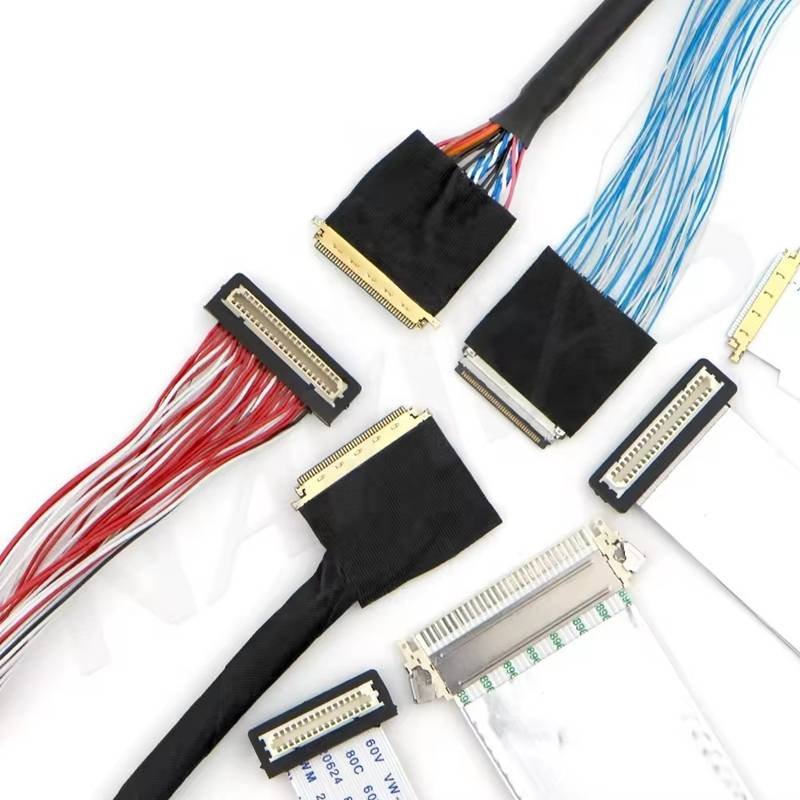
The main LVDS cable types include single-channel LVDS, dual-channel LVDS, shielded and unshielded LVDS, traditional round-wire LVDS harnesses, and FFC/FPC-based LVDS cables. Each type supports different resolutions, mechanical constraints, and EMI requirements.
1. Single-Channel vs Dual-Channel LVDS
- Single-channel LVDS (up to 1366×768)
- Dual-channel LVDS (required for 1080p or higher)
Single-channel uses fewer differential pairs and has lower data bandwidth. Dual-channel splits the data stream across two parallel LVDS paths. If you use the wrong cable type, the display simply won’t show an image.
2. Shielded vs Unshielded LVDS Cables
Shielded cables include:
- Aluminum foil
- Braided copper shielding
- Drain wires
- Ground bonding
These are required for industrial, medical, and automotive devices. Unshielded versions are used in low-cost consumer electronics.
3. Round-Wire LVDS Harnesses vs FFC/FPC LVDS
Round-wire LVDS harness
- Twisted pairs
- Better EMI performance
- More durable
- Flexible routing
FFC/FPC LVDS
- Ultra-thin
- For small spaces
- Used in laptops, tablets
Table : Comparison of Core LVDS Cable Types
| LVDS Cable Type | Best For | Pros | Cons |
|---|---|---|---|
| Single-channel | Small LCDs, 7–10 inch | Lower cost | Lower resolution |
| Dual-channel | 1080p displays | Higher bandwidth | More wires, more cost |
| Shielded | Industrial/medical | Strong EMI protection | Slightly thicker |
| Unshielded | Consumer electronics | Lower cost | Less EMI control |
| Round-wire | OEM equipment | Durable, flexible | Thicker |
| FFC/FPC | Compact devices | Ultra-thin | Lower durability |
Which LVDS Pinouts and Connectors Are Most Common?
LVDS cables commonly use 20-pin, 30-pin, 40-pin, 51-pin, and 60-pin connectors from brands like JAE, Hirose, Molex, and I-PEX. Pinouts are not standardized across LCD manufacturers, so matching the exact pin assignment is critical.
The two biggest variables in LVDS cable compatibility are:
- Connector type and series
- Pin assignment (pinout)
Even if two 30-pin connectors look identical, their pin functions can be completely different.
Common connector families:
- JAE FI-X series (most common for LCD panels)
- JAE FI-S
- Hirose DF14 / DF19
- Molex 52745 / 502250
- I-PEX 20455
Table : Common LVDS Connector Pin Counts
| Pin Count | Typical Use | Notes |
|---|---|---|
| 20-pin | Small LCD modules | Simple signal sets |
| 30-pin | Laptop LCDs | Most widely used |
| 40-pin | Industrial displays | Supports dual-channel |
| 51-pin | Larger displays | More control lines |
| 60-pin | High-function LCDs | Includes power, I²C, LED lines |
Sino-Conn engineers often receive messages like:
“Here is my LCD panel model. I don’t know which LVDS cable I need.”
In most cases, we identify the exact pinout based on the panel datasheet, then design a matching cable within 30 minutes.
How to Identify an LVDS Cable From a Picture or Part Number?
You can identify an LVDS cable by checking connector shape, pin count, latch type, pitch, shielding structure, and wire arrangement. If the panel model is known, its datasheet reveals the exact LVDS pinout and connector type.
Many customers—especially traders and procurement teams—send only photos. They do not know the connector brand, pin count, or signal format. Sino-Conn identifies LVDS cables using:
- Connector pitch measurement (0.5mm, 1.0mm, etc.)
- Housing type (top-lock, side-lock, friction fit)
- Number of differential pairs
- Wire gauge (AWG 28–32)
- Cable OD and shield structure
If the customer provides the LCD panel model (e.g., B133XW01 V.2), our team downloads the datasheet and matches:
- Panel LVDS interface type
- Required pinout
- Required connector series
- Power/ground lines
- Backlight connector type
This process avoids the #1 LVDS mistake: using a cable with the correct connector but the wrong pinout, which can damage the LCD panel or mainboard.
What Technical Specifications Matter When Selecting an LVDS Cable?
Key LVDS cable specifications include impedance (typically 90–100Ω), EMI shielding, conductor size, flexibility, temperature rating, flame resistance, and environmental requirements such as halogen-free or RoHS/REACH compliance.
Here are the most important parameters engineers must evaluate:
1. Impedance Control
LVDS requires consistent impedance (usually 100Ω ±10%). Poor impedance causes:
- ghosting
- flickering
- color shifts
- data loss
Sino-Conn controls impedance through pair twisting, uniform spacing, and shield design.
2. EMI Shielding
Medical and industrial environments demand:
- Braided copper mesh
- Aluminum foil
- Drain wire
- Multi-layer shielding
This prevents interference from motors, power supplies, and RF equipment.
3. Cable OD, Flexibility, and Bend Radius
Important for:
- Tight enclosures
- Hinged displays
- Automotive dashboards
We offer soft PVC, TPE, silicone, and halogen-free materials.
4. Temperature, UV, Oil, Corrosion Resistance
Common requirements:
- 20°C to +80°C for consumer devices
- 40°C to +105°C for industrial equipment
- UV-resistant jackets for outdoor kiosks
5. Certifications
Sino-Conn provides:
- UL
- ISO
- RoHS
- REACH
- PFAS
- COC, COO
These are essential for regulated industries.
How to Customize LVDS Cables for OEM and Engineering Projects?
LVDS cables can be customized in length, pinout definition, wire gauge, shielding structure, connector brand, and material type. Sino-Conn provides drawings, samples, and full engineering support within 1–3 days.
Customization is often required because:
- Different LCD panels use different pinouts
- OEM enclosures require specific routing or length
- Some projects need flame-retardant, halogen-free, or flexible cables
- Engineers need alternative connectors due to availability or price
Customization Options
- Length (any length, no MOQ)
- Pinout (define how each pin connects across both ends)
- Connector brand: original (JAE, Hirose) or compatible alternatives
- Cable jacket: PVC, TPE, silicone, halogen-free
- Shielding: foil, braid, both
- Twisted pairs vs flat wiring
- Strain-relief molding
- Labeling and serialization
Engineering Support
- 30 minutes to create drawings (PDF/CAD)
- 3 days to produce samples
- 2 weeks for mass production
- 100% inspection—process, completion, pre-shipment
This level of support is why OEM factories, medical companies, and engineering teams repeatedly choose Sino-Conn as a long-term LVDS cable supplier.
How Much Do LVDS Cables Cost?
LVDS cable pricing depends on connector brand, shielding level, pin count, customization, order quantity, and the target country or industry. Industrial and medical cables cost more due to higher material and certification requirements.
Key factors affecting price:
- Connector brand: original JAE is much more expensive
- Shielding: braid + foil adds cost
- Pin count: more pins = higher cost
- Length and complexity
- Order volume (OEM vs prototype)
- End-use industry
- Country pricing differences (US, Japan, EU higher; India, SE Asia lower)
OEM factories are price-sensitive but order higher volume. Engineers pay more for prototypes but need high precision. Traders depend on resale margin.
Sino-Conn adapts to all types by offering both premium and cost-effective solutions.

Conclusion:
The LVDS cable world is far from standardized. Choosing the right LVDS cable type means understanding connectors, pinouts, shielding, mechanical constraints, and display interface requirements. Whether you have a full datasheet, only a model number, or simply a photo of your broken cable, Sino-Conn can reverse-engineer, design, customize, and manufacture the exact LVDS cable you need—with no MOQ, fast drawings, 3-day samples, and 100% quality inspection.
If you are ready to customize or source an LVDS cable for your project, device, or OEM production line, contact Sino-Conn for a fast quotation and engineering support.
Related Keywords :LVDS cable, LVDS connector, LCD cable types, display cables, LVDS pinout, custom LVDS assemblies, JAE LVDS, Hirose LVDS, OEM cable assembly, LVDS wiring

With over 18 years of OEM/ODM cable assemblies industry experience, I would be happy to share with you the valuable knowledge related to cable assemblies products from the perspective of a leading supplier in China.
manufacturer catalogue
Get A Sample Now From Factory→
Get a quote quickly
Here, developing your OEM/ODM custom cable assemblies collection is no longer a challenge—it’s an excellent opportunity to bring your creative vision to life.