Skip to content
What Is an OFC Connector Type? A Complete Guide to Optical Fiber Connectors
- andy

In fiber-optic systems, performance is often discussed in terms of bandwidth, distance, and signal loss. Yet one small component quietly determines whether those theoretical advantages actually reach the real world: the connector. Among engineers, purchasers, and system integrators, the term OFC connector type appears frequently in drawings, BOMs, and specifications—but it is also one of the most misunderstood terms in optical connectivity.
Some customers assume OFC connector type refers to a specific brand or proprietary interface. Others treat all fiber connectors as interchangeable as long as the fiber itself matches. In practice, neither assumption is correct. Connector type directly affects insertion loss, return loss, mechanical stability, installation density, and long-term reliability. Choosing the wrong connector type can compromise an otherwise well-designed optical system.
An OFC connector type refers to the specific interface standard used to terminate and connect optical fiber cables, such as SC, LC, FC, or ST. Each OFC connector type differs in size, locking mechanism, performance characteristics, and application suitability. Selecting the correct OFC connector type depends on system requirements, installation environment, and performance expectations rather than fiber type alone.
A network engineer once replaced a damaged fiber jumper with the “same fiber type” but a different connector interface, assuming adapters would solve the issue. The system came online—but signal margins dropped below tolerance. That small connector choice turned a routine maintenance task into a troubleshooting exercise. Understanding OFC connector types early prevents these avoidable problems.
What Is an OFC Connector?
An OFC connector refers to an optical fiber connector used to terminate, align, and connect optical fiber cables within a fiber-optic system. Its primary function is to ensure accurate fiber-to-fiber or fiber-to-equipment alignment so that optical signals can be transmitted with minimal loss and reflection. In most technical documents and industry usage, OFC connector is a functional term rather than a brand name or proprietary interface.
Unlike electrical connectors, which rely on metal-to-metal contact, OFC connectors must precisely align the fiber cores—often within a tolerance of only a few microns. This level of precision is necessary because even slight misalignment can significantly increase insertion loss or return loss, directly affecting system performance and stability.
What does OFC stand for in connectors?
In common industry usage, OFC stands for Optical Fiber Connector. The term is often used as a general descriptor in drawings, BOMs, and specifications to indicate the fiber connector interface used in a system. While different regions or customers may prefer different terminology, OFC connector and optical fiber connector describe the same category of components.
Importantly, OFC does not define a single connector shape or standard. Instead, it refers to a family of standardized connector interfaces—such as SC, LC, FC, and ST—each with its own mechanical structure and application focus.
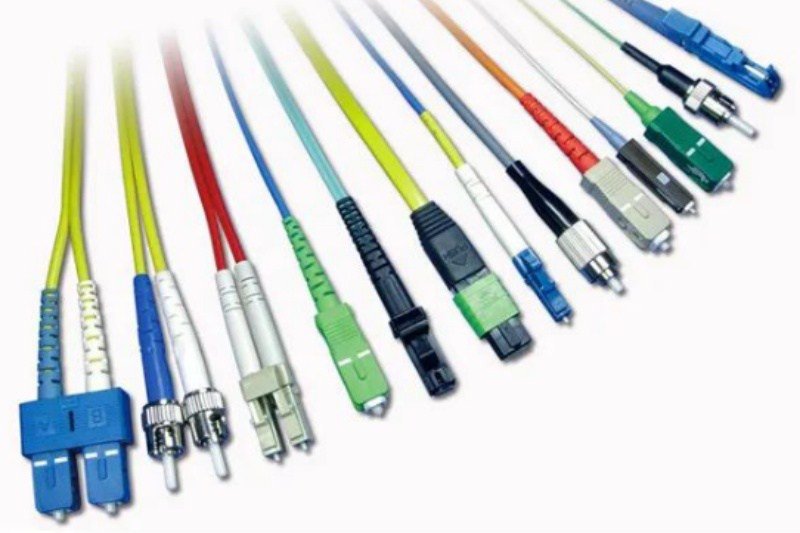
What is the role of an OFC connector in a fiber-optic system?
The role of an OFC connector is to provide a repeatable, detachable connection between optical fibers or between a fiber cable and optical equipment. This enables installation, testing, maintenance, and system reconfiguration without permanent splicing.
In practical terms, an OFC connector must:
- Maintain precise fiber alignment
- Protect the fiber end face from contamination and damage
- Provide sufficient mechanical stability during mating and unmating
- Support consistent optical performance over repeated connections
Because of these requirements, the connector is often one of the most critical points in a fiber-optic link.
Is an OFC connector the same as an optical fiber connector?
Yes, in technical and commercial contexts, an OFC connector is effectively the same as an optical fiber connector. The difference lies mainly in wording preference rather than function. Some customers or documents use “OFC” as shorthand, while others use the full term.
What matters more than the name is the specific connector type, polishing method, and performance grade, as these factors determine compatibility and signal quality far more than terminology alone.
Why understanding OFC connectors matters for selection and sourcing
Understanding what an OFC connector is—and what it is not—helps avoid common mistakes during design and procurement. Treating all fiber connectors as interchangeable can lead to:
- Increased insertion loss
- Unexpected return loss issues
- Mechanical incompatibility
- Reduced long-term reliability
For customers, recognizing the OFC connector as a precision optical interface rather than a generic accessory is the first step toward selecting the right connector type for a given application.
Which Types of OFC Connectors Are Commonly Used?
In fiber-optic systems, OFC connector types are not chosen randomly. Each connector type has been developed to balance mechanical stability, installation density, ease of handling, and optical performance. Among many historical and niche designs, a small number of standardized OFC connector types are widely adopted across telecom, data center, industrial, and professional systems.
The most commonly used OFC connector types today include SC, LC, FC, and ST. These connectors share the same fundamental purpose—accurate fiber alignment and reliable signal transmission—but differ significantly in structure, locking method, size, and typical application environment.
SC Connector: Push-Pull Simplicity
The SC (Subscriber Connector) is one of the most widely used OFC connector types. It features a square housing and a push-pull coupling mechanism, allowing quick installation and removal without tools.
SC connectors are valued for:
- Simple, intuitive operation
- Stable mechanical connection
- Broad compatibility with telecom and network equipment
Because of their balanced performance and ease of use, SC connectors are commonly found in telecommunications infrastructure, fiber distribution frames, and general networking applications where connector density is moderate and reliability is a priority.
LC Connector: High-Density Design
The LC (Lucent Connector) was developed to support higher port density without compromising optical performance. It uses a smaller form factor than SC connectors while maintaining precise fiber alignment.
LC connectors are commonly chosen for:
- High-density patch panels
- Data centers and enterprise networks
- Space-constrained equipment
Their compact size allows more connections per panel, making LC connectors the preferred option in modern systems where space efficiency is critical.
FC Connector: Threaded Stability
The FC (Ferrule Connector) uses a threaded coupling mechanism that provides strong mechanical retention. This design makes FC connectors particularly resistant to vibration and mechanical stress.
Typical use cases include:
- Industrial environments
- Laboratory and test equipment
- Systems exposed to movement or vibration
While FC connectors are less common in high-density installations due to their size and installation time, they remain valuable in applications where mechanical stability is more important than connector density.
ST Connector: Legacy and Industrial Use
The ST (Straight Tip) connector uses a bayonet-style locking mechanism. It was widely used in early fiber-optic systems and is still found in some industrial and legacy installations.
ST connectors are characterized by:
- Simple mechanical design
- Quick connect and disconnect action
- Continued use in certain industrial systems
Although newer connector types have largely replaced ST in modern networks, it remains relevant where existing infrastructure or specific equipment requirements dictate its use.
Common OFC Connector Types at a Glance
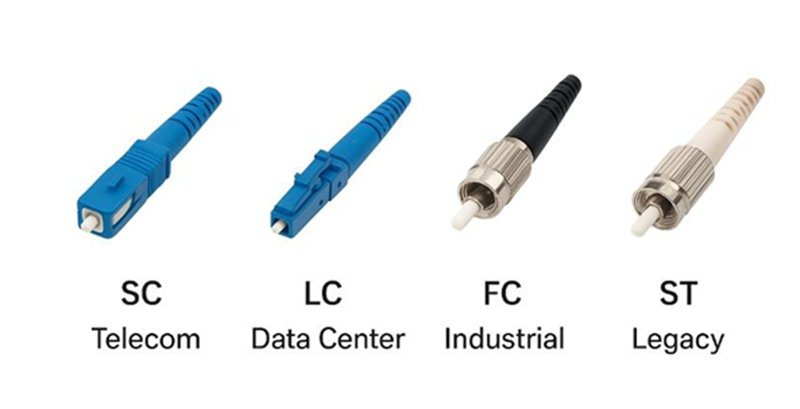
| Connector Type | Locking Method | Size | Typical Applications |
|---|---|---|---|
| SC | Push-pull | Medium | Telecom, general networking |
| LC | Latch | Small | Data centers, high-density systems |
| FC | Threaded | Large | Industrial, vibration-prone systems |
| ST | Bayonet | Medium | Legacy and industrial installations |
Why Connector Type Selection Matters
While all these OFC connector types perform the same basic function, their differences directly affect:
- Installation efficiency
- System layout and density
- Mechanical reliability
- Long-term maintenance convenience
Understanding which OFC connector types are commonly used—and why—helps customers select connectors that align with real-world system requirements rather than relying on assumptions or visual similarity.
How Do OFC Connector Types Differ in Structure and Performance?
OFC connector types differ in mechanical structure, alignment method, and locking design, which directly affect insertion loss, return loss, and long-term stability.
How does connector structure affect optical performance?
Connector structure determines how precisely fibers align at the mating interface. Ferrule material, polishing method, and housing rigidity all influence signal quality.
Poor structural design can introduce:
- Higher insertion loss
- Increased back reflection
- Sensitivity to vibration
Which OFC connectors offer better insertion loss control?
Performance depends more on manufacturing quality than connector type alone. However, LC and SC connectors are commonly optimized for low insertion loss in modern systems.
| Performance Factor | Impact |
|---|---|
| Ferrule concentricity | Signal alignment |
| End-face polish | Return loss |
| Housing rigidity | Long-term stability |
How does connector size affect system design?
Smaller connectors enable higher port density, which is critical in data centers. Larger connectors may offer easier handling and improved durability in industrial environments.
Which Applications Use Different OFC Connector Types?
Different OFC connector types are selected based on application needs such as density, environment, and maintenance requirements.
Which OFC connectors are used in telecom networks?
Telecom systems commonly use SC and LC connectors due to their reliability and compatibility with standardized equipment.
Are OFC connectors used in industrial and medical systems?
Yes. FC connectors are often preferred in vibration-prone environments, while SC connectors are common in controlled medical systems where reliability is critical.
Which connector types are preferred in data centers?
LC connectors dominate data centers because they support high-density patch panels and efficient cable management.
How Are OFC Connector Assemblies Customized in Real Projects?
OFC connector assemblies are customized by selecting connector types, fiber specifications, cable length, structure, and protective features to match specific project requirements.
How is connector type selected for custom fiber assemblies?
Selection begins with system requirements:
- Equipment interface
- Space constraints
- Environmental conditions
Connector choice must align with both electrical-optical performance and mechanical installation realities.
Can OFC connectors be customized by length and structure?
Yes. Customization often includes:
- Cable length
- Jacket material
- Strain relief design
- Overmolding or protective boots
How do drawings and specifications affect OFC assemblies?
Clear drawings reduce ambiguity. Confirmed specifications ensure that assemblies meet expectations before production begins.
What Should You Check Before Choosing an OFC Connector Supplier?
Before choosing an OFC connector supplier, verify technical capability, quality control, documentation support, and flexibility for customization.
What specifications define OFC connector quality?
Key specifications include:
- Insertion loss
- Return loss
- Mechanical durability
Do certifications matter for OFC connectors?
Yes. Certifications indicate controlled manufacturing and compliance with international standards.
How do lead time and MOQ impact OFC connector projects?
Fast samples and flexible MOQ support efficient development, especially during prototyping and low-volume production.
Common Questions About OFC Connector Types
Are OFC connectors interchangeable?
Only when connector types and polishing standards match exactly.
Does connector type affect fiber performance?
Yes. Connector quality and structure directly influence optical performance.
Can one OFC connector type replace another?
Replacement is possible only with compatible interfaces and validated performance.

Final Thoughts: From Connector Type to Reliable Fiber Systems
OFC connector type is not a minor detail—it is a foundational design decision. The right connector ensures stable optical performance, efficient installation, and long-term reliability. The wrong choice introduces hidden risk.
For projects involving custom fiber assemblies, selecting and implementing the correct OFC connector type requires technical understanding, precise documentation, and manufacturing control. Sino-conn supports customers throughout this process—from connector selection and drawings to rapid samples and volume production—helping translate system requirements into dependable optical connectivity solutions.
When fiber performance matters, connector decisions matter just as much.
Related Keywords :ofc connector type, optical fiber connector, fiber connector types, sc lc fc st connector, custom fiber connector, optical connector assembly, fiber optic connector guide, ofc connector selection, fiber connector applications, custom cable assembly

With over 18 years of OEM/ODM cable assemblies industry experience, I would be happy to share with you the valuable knowledge related to cable assemblies products from the perspective of a leading supplier in China.
manufacturer catalogue
Get A Sample Now From Factory→
Get a quote quickly
Here, developing your OEM/ODM custom cable assemblies collection is no longer a challenge—it’s an excellent opportunity to bring your creative vision to life.