Skip to content
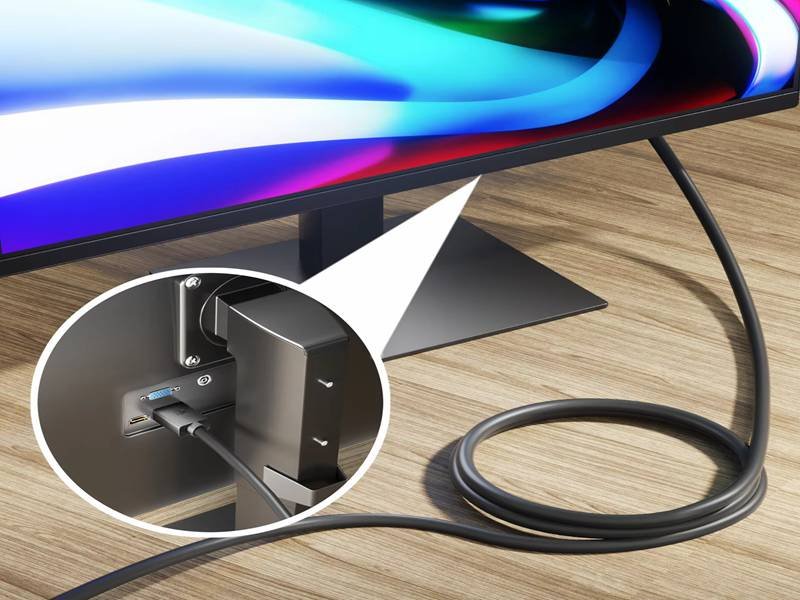
In today’s world of ultra-high definition displays, multi-monitor setups, and increasingly demanding visuals (4K, 8K, high refresh rates), choosing the right display interface isn’t just a trivial matter—it can drastically impact performance, compatibility and future-proofing of your system. Enter DisplayPort: an interface standard designed for high-bandwidth digital video and audio transmission, built by the Video Electronics Standards Association (VESA) to serve both desktop and embedded display markets.
DisplayPort is a digital display interface standard that carries high-bandwidth video and audio from a source (such as a PC, laptop, or GPU) to a display, TV or projector. It supports resolutions up to 8K+, multiple display chains, audio channels and flexible connector types (full-size, Mini, USB-C Alt Mode). With strong support for industry certifications and custom cable assemblies, it is a modern replacement for older interfaces like DVI and VGA.
Imagine you’re setting up a design studio with two 5K monitors, a VR rig and docking station—all running through one port and one cable. The story behind the scenes: Whether you’re a systems integrator or OEM cable builder, you need to know precisely what your cable must handle—length, shielding, impedance, connector type, EMI performance and whether the interface supports the latest version of DisplayPort. Sino-Conn can provide drawings, custom cable lengths, pin-outs, shielding, jacket materials, and full certification to make sure your DisplayPort link works flawlessly in your application. Let’s dig into what DisplayPort is, how it works, and how you should design and choose a cable assembly that truly delivers.
What Is DisplayPort and How Does It Work?

DisplayPort (DP) is a high-speed digital interface standard developed by VESA that carries video, audio, and data between devices. It uses 1–4 differential lanes plus an AUX channel for control, enabling uncompressed or compressed (DSC) video, multi-channel audio, and advanced features like HDR, Adaptive-Sync, and Multi-Stream Transport (MST). DisplayPort supports 8K+ resolutions, high refresh rates, and flexible connectors such as standard DP, Mini DP, and USB-C Alt Mode.
Signal Architecture
DisplayPort transmits data through main link lanes (1, 2, or 4) for high-speed video/audio and an AUX channel for low-speed communication.
During link training, the source and display negotiate bit rates (RBR–UHBR20), voltage swing, and equalization to ensure clean signal transmission.
This intelligent handshake allows cable assemblies to adapt dynamically, but only when their impedance, shielding, and length meet specification.
Transmission Bandwidth
| DP Version | Link Rate (Gbps/lane) | Total Bandwidth (4 lanes) | Encoding | Typical Use |
|---|---|---|---|---|
| DP 1.2 | 5.4 | 21.6 Gbps | 8b/10b | 4K @ 60 Hz |
| DP 1.4 | 8.1 | 32.4 Gbps | 8b/10b | 8K @ 60 Hz (DSC) |
| DP 2.1 (UHBR20) | 20 | 80 Gbps | 128b/132b | 16K @ 60 Hz / 10K @ 120 Hz |
As bandwidth rises, signal loss tolerance tightens. High-speed lanes at 20 Gbps require precise conductor geometry, EMI shielding, and strict impedance control (100 Ω ± 10%). Sino-Conn’s engineering process ensures each DisplayPort assembly passes eye-diagram and insertion-loss tests before shipment.
Packetized Data Flow
Unlike HDMI’s continuous TMDS stream, DisplayPort uses micro-packets.
Each packet contains video, audio, and metadata (like HDR or color depth).
This approach allows advanced features such as:
- Display Stream Compression (DSC): visually lossless compression, up to 3:1.
- Forward Error Correction (FEC): corrects bit errors in ultra-high-speed links.
- Adaptive-Sync: dynamically adjusts refresh rate for smooth motion.
The packet system makes DP flexible and efficient for both single and multiple display outputs.
Multi-Stream Transport (MST)
MST allows one DP output to drive several displays via daisy-chain or hub.
For instance, one port can power two 4K monitors or three 1080p displays using a shared 32.4 Gbps link.
This reduces cabling clutter and costs for workstations, trading setups, or control rooms.
USB-C Alt Mode Integration
DisplayPort signals can also travel through a USB-C connector under Alt Mode.
This configuration carries DisplayPort + USB data + power (PD) over one cable.
However, combining these requires:
- Proper lane mapping for DisplayPort differential pairs.
- E-marker ICs for cable authentication.
- Shielded pair separation to prevent crosstalk.
Sino-Conn specializes in USB-C ↔ DP hybrid assemblies, offering tailored designs for docking stations, laptops, and embedded systems.
Audio, HDR, and Sync Support
DisplayPort transmits multi-channel 24-bit audio, HDR10/HLG metadata, and supports up to 12-bit color depth.
Combined with Adaptive-Sync, it provides tear-free and stutter-free visuals essential for gaming, design, and simulation.
A stable physical layer—proper shielding and grounding—is what keeps these advanced features running smoothly.
Cable Construction and Signal Integrity
To maintain data integrity at high speed, every DP cable must meet strict mechanical and electrical criteria:
| Feature | Specification | Sino-Conn Capability |
|---|---|---|
| Differential Impedance | 100 Ω ± 10% | Precision impedance-controlled design |
| Insertion Loss | ≤ 1.5 dB @ 8 GHz | Verified via VNA/eye diagram |
| Shielding | Foil + Braid, > 85% coverage | Custom EMI isolation for industrial use |
| Bend Radius | ≥ 10 × OD | Flexible LSZH/PUR/FEP jackets |
| Certification | UL, ISO, ROHS, REACH | 100 % inspection + COC/COO |
Which DisplayPort Versions Exist and What Are Their Differences?
DisplayPort has evolved through multiple versions—1.0, 1.1, 1.2, 1.3, 1.4, 2.0, and 2.1—each improving bandwidth, resolution support, color depth, compression technology, and connector compatibility. Early versions (1.x) supported up to 4K, while 2.1 delivers 80 Gbps total bandwidth for 16K or multi-8K setups. Understanding each version’s capabilities helps engineers and OEMs select the right cable assemblies and connectors for performance, cost, and compatibility.
Version Overview
DisplayPort’s progress reflects the rising need for faster data transfer and richer visual experiences. Every major update introduced higher bit rates, new compression formats, and improved synchronization features. Sino-Conn’s cable assemblies are designed to meet these exact technical demands—from HBR2 cables for 4K monitors to UHBR20-rated assemblies for 8K and 16K systems.
DisplayPort 1.0 – The Beginning (2006)
Key Specs:
- Bandwidth: 8.64 Gbps (2.7 Gbps per lane)
- Encoding: 8b/10b (80% efficiency)
- Max Resolution: 2560×1600 @ 60 Hz
- Color Depth: 24-bit RGB
This first release replaced analog VGA/DVI. It introduced the packet-based digital protocol and Main Link + AUX channel design. Though modest by today’s standards, it laid the groundwork for multi-stream packetization—an architecture still used today.
DisplayPort 1.1 / 1.1a – Certification and Compatibility (2007–2008)
Enhancements:
- Bandwidth: same 8.64 Gbps
- Added Features:
- Optional fiber-optic transport for long distances
- HDCP 1.3 and DPCP encryption support
- Mini DisplayPort connector standardized
Engineering Insight:
DP 1.1 ensured interoperability and compliance, making it feasible for consumer PCs and enterprise monitors. It remained backward-compatible with DP 1.0 but began tightening EMI and signal-integrity requirements—critical for cable manufacturers like Sino-Conn.
DisplayPort 1.2 – Mainstream 4K Era (2009)
Key Specs:
| Parameter | Value |
|---|---|
| Bandwidth | 21.6 Gbps (HBR2 = 5.4 Gbps per lane) |
| Max Resolution | 4K @ 60 Hz or 2 × WQHD |
| Features Added | Multi-Stream Transport (MST), Audio Return Channel, 3D Stereo, Full 10-bit color |
DP 1.2 made DisplayPort practical for high-end displays. MST allowed daisy-chaining monitors, and Aux Channel bandwidth increased from 1 Mbps to 720 Mbps—enabling faster EDID and control transfers. For cable design, the new HBR2 rate required better shielding, tighter impedance tolerance, and higher-grade copper to control attenuation.
DisplayPort 1.3 – Bridging to 8K (2014)
Key Specs:
- Bandwidth: 32.4 Gbps (HBR3 = 8.1 Gbps/lane)
- Max Resolution: 5K @ 60 Hz or 8K @ 30 Hz
- Color Depth: Up to 16-bit HDR
- New Additions: Dual-Mode (DP++) for HDMI/DVI conversion; enhanced color spaces (Rec.2020).
Engineering Note:
The jump to HBR3 pushed physical layer demands. Cable length for passive designs dropped to ~2 m at 8K. Active cables with equalizers became standard for workstation and display-wall applications—products that Sino-Conn still builds today under strict loss budgets (< 2 dB @ 8 GHz).
DisplayPort 1.4 / 1.4a – HDR and Compression (2016–2018)
Key Upgrades:
| Feature | Description |
|---|---|
| Bandwidth | Same 32.4 Gbps (HBR3) |
| Compression | Display Stream Compression (DSC 1.2) – visually lossless 3:1 ratio |
| Error Handling | Forward Error Correction (FEC) |
| Audio/Video | 32 audio channels, HDR10 metadata, 10-/12-bit color |
| Transport | Enhanced MST hub support |
Why It Matters:
DP 1.4 was a milestone: it allowed 8K @ 60 Hz over one cable using DSC. It also brought HDR10 and Wide Gamut support for color-critical industries like medical imaging and film production. For assembly houses, it marked the transition to DP8K-certified cables, requiring superior EMI shielding and differential pair uniformity.
DisplayPort 2.0 – The 80 Gbps Revolution (2019)
Core Improvements:
- Bandwidth: 80 Gbps raw (UHBR20 = 20 Gbps/lane)
- Encoding: 128b/132b (97% efficiency)
- Effective Data Rate: 77.4 Gbps
- Resolutions: Up to 16K @ 60 Hz or 3 × 10K @ 60 Hz
- New Standards: DSC 1.2a, FEC enhancements, and USB-C Alt Mode 2.0 alignment.
DP 2.0 re-engineered the physical layer to coexist with USB4 signaling. It introduced three data-rate tiers: UHBR10, UHBR13.5, UHBR20. To support these, cables must maintain < 28 dB total insertion loss and ≤ 100 ps skew at up to 20 GHz. Sino-Conn’s DP 2.x assemblies use precision twisted pairs, low-loss dielectrics, and fully shielded braid/foil constructions validated through vector network analysis (VNA).
DisplayPort 2.1 / 2.1a – Modern Integration (2022–2024)
Key Enhancements:
| Attribute | Update |
|---|---|
| Interoperability | Full alignment with USB4 PHY and Type-C Alt Mode 2.1 |
| Cable Certification | Introduction of DP40 (40 Gbps) and DP80 (80 Gbps) labels |
| Active Cable Spec | DP80LL (“Low Loss”) enables ~3× longer UHBR runs |
| Backwards Compatibility | Auto-negotiates to 1.4/1.2 if needed |
Engineering Benefits:
DP 2.1 simplifies hybrid designs (e.g., USB-C to DP hubs) and ensures uniform performance whether using full-size DP or USB-C connectors. The DP80LL spec, ratified 2023, allows active retimer modules inside the cable—pushing 80 Gbps beyond 2 m. Sino-Conn already integrates such modules for OEM customers developing docking stations and 8K/VR systems.
Comparative Summary
| Version | Year | Raw BW (Gbps) | Max Resolution / Rate | Encoding | Signature Features |
|---|---|---|---|---|---|
| 1.1 | 2007 | 8.64 | 2K @ 60 Hz | 8b/10b | Mini DP, HDCP 1.3 |
| 1.2 | 2009 | 21.6 | 4K @ 60 Hz | 8b/10b | MST, HBR2 |
| 1.3 | 2014 | 32.4 | 5K / 8K @ 30 Hz | 8b/10b | HBR3, DP++ |
| 1.4 | 2016 | 32.4 | 8K @ 60 Hz (DSC) | 8b/10b | DSC, HDR10, FEC |
| 2.0 | 2019 | 80 | 16K @ 60 Hz | 128b/132b | UHBR 10–20 |
| 2.1 / a | 2022+ | 80 | 16K / VR | 128b/132b | USB4 sync, DP80LL |
What Types of DisplayPort Connectors and Cables Are Available?
DisplayPort cables and connectors come in several forms — Standard DisplayPort, Mini DisplayPort, and USB-C with DisplayPort Alt Mode — each designed for different space, device, and bandwidth needs. Cables can be passive or active, full-size or mini, and support speeds from HBR (10.8 Gbps) up to UHBR 20 (80 Gbps). The right choice depends on the required data rate, cable length, shielding, and connector type. Sino-Conn offers customized DP assemblies for OEM, consumer, and industrial applications.
1. Standard DisplayPort Connector
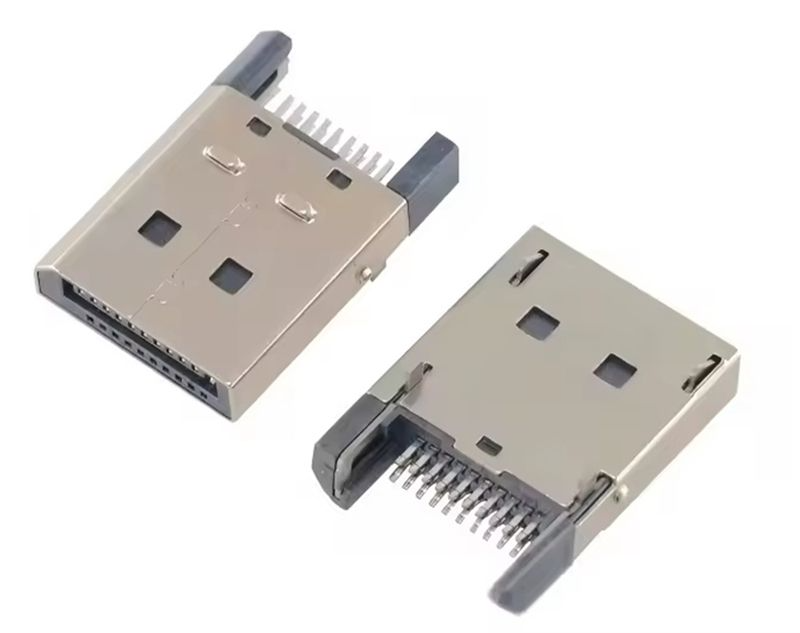
The full-size DisplayPort (DP) connector is the most recognized and widely used version. It features a 20-pin design with a mechanical latch that ensures a secure connection — critical for professional displays and industrial equipment.
Technical details:
- Pin count: 20
- Latching mechanism: integrated lock button (avoids accidental unplugging)
- Bandwidth support: up to UHBR 20 (80 Gbps) under DP 2.1
- Signal type: four main lanes + AUX + power
- Compatibility: backward-compatible with DP 1.1 – 2.1 and DP++ (dual-mode HDMI/DVI)
Applications:
Used in monitors, desktop GPUs, workstations, and industrial PCs, where mechanical stability and high signal integrity are essential.
2. Mini DisplayPort Connector
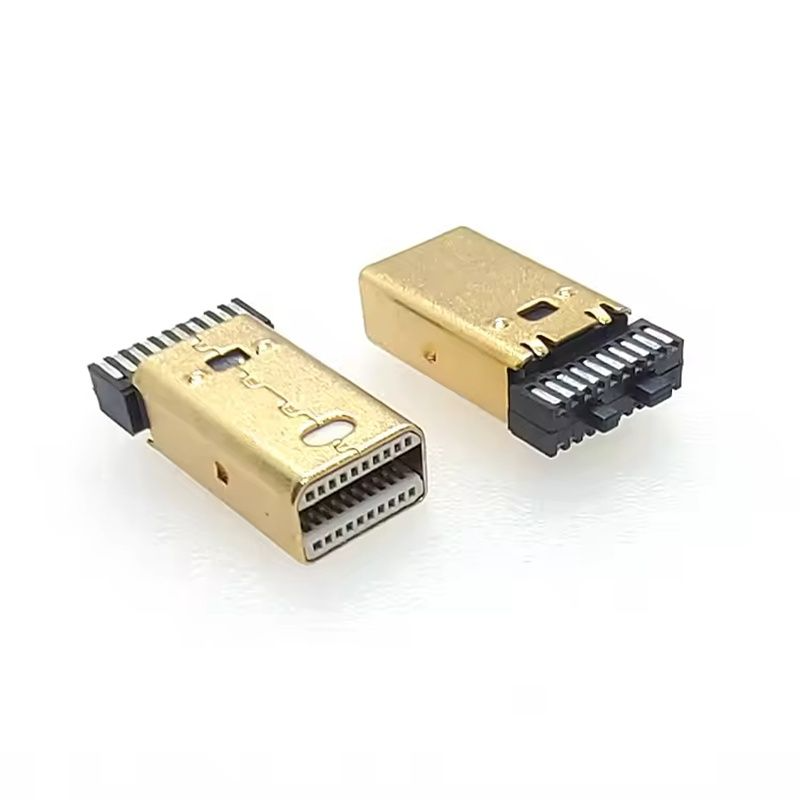
Developed by Apple and later standardized by VESA, Mini DisplayPort (Mini DP) retains full protocol functionality in a smaller 20-pin form. It’s common in laptops, tablets, and compact embedded systems.
Specs & advantages:
| Parameter | Mini DisplayPort |
|---|---|
| Size | 7.5 × 4.6 mm |
| Bandwidth | up to 32.4 Gbps (DP 1.4) |
| Signal type | identical to full-size DP |
| Common length | ≤ 2 m passive; up to 5 m active |
| Use case | Space-constrained devices needing 4K 60 Hz or 5K 30 Hz video |
Engineering note:
Mini DP cables demand tighter tolerances in impedance control and pin alignment. Sino-Conn uses precision-machined contacts and automated crimping to ensure consistent insertion force and signal continuity — vital in high-density electronic enclosures.
3. DisplayPort Dual-Mode (DP++) Cables
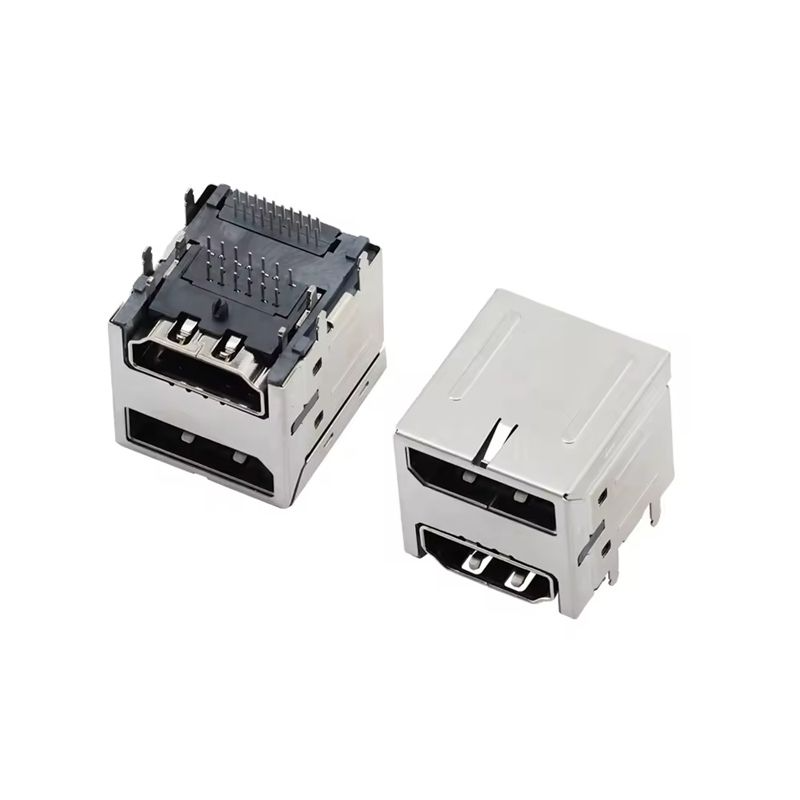
What is DP++?
Dual-Mode DisplayPort (DP++) allows a DisplayPort source to output TMDS signals (like HDMI or DVI) through a passive adapter.
That means you can connect a DisplayPort GPU to an HDMI display without an active converter.
Usage guidance:
- Works only from DP source → HDMI/DVI monitor
- Not bidirectional (HDMI to DP won’t work)
- Bandwidth limits: HDMI 2.0 equivalent (~18 Gbps)
- Ideal for office setups or legacy monitor connections
4. USB-C DisplayPort Alt Mode Cables

DisplayPort Alt Mode allows USB-C ports to carry native DP signals over four differential pairs within the Type-C connector. This design supports video + data + charging in a single cable — essential for docking stations, laptops, and monitors.
Technical breakdown:
| Mode | Lanes | Max Data Rate | Typical Application |
|---|---|---|---|
| 2-lane DP + USB 3.2 | 2 × 10 Gbps | 4K 60 Hz + high-speed data | USB-C hubs |
| 4-lane DP (no USB 3.x) | 4 × 20 Gbps | 8K 60 Hz / 16K 30 Hz | High-res display docks |
| Alt Mode 2.1 | 4 × UHBR 20 (80 Gbps) | DP 2.1 full performance | Next-gen notebooks, VR |
Design challenges:
Since USB-C carries power, high-speed data, and DP video simultaneously, cable design requires independent shielding zones, controlled impedance, and E-Marker chips for negotiation and safety.
5. Passive vs Active DisplayPort Cables
Passive Cables
- Simple point-to-point design; no amplification.
- Typically limited to ≤ 2 m for HBR3 (8.1 Gbps) or ≤ 1.5 m for UHBR 20.
- Cost-effective, ideal for home or office monitors.
Active Cables
- Contain retimers or equalizers that boost signal over longer distances.
- Support up to 5–7 m or more, depending on version.
- Required for 8K and 16K signals in DP 1.4 + 2.1.
| Type | Max Length | Typical Bandwidth | Ideal Use Case |
|---|---|---|---|
| Passive DP 1.4 | ~2 m | 32.4 Gbps | 4K 120 Hz monitors |
| Active DP 2.1 (DP80LL) | 5–10 m | 80 Gbps | 8K 60 Hz / VR setups |
| Optical DP 2.1 | 20 m+ | 80 Gbps | Long-run industrial displays |
6. Specialty DisplayPort Cables

Locking & Panel-Mount DP
Industrial or aerospace equipment often needs vibration-resistant connectors. Sino-Conn offers locking DisplayPort variants with screw locks or friction latches and panel-mount receptacles for rugged integration.
Right-Angle & Low-Profile Assemblies
For compact enclosures or tight cable routing, 90° or 45° angled connectors minimize mechanical stress. These are common in embedded GPU modules and automotive displays.
Mini-to-Full-Size and Adapter Assemblies
Cross-type adapters (Mini DP ↔ DP, USB-C ↔ DP) simplify integration across device generations. Sino-Conn provides custom pin mapping, length, and jacket material options, ensuring proper shielding continuity and mechanical alignment.
7. Cable Material and Shielding Options
Every DisplayPort cable’s reliability depends on construction quality. Sino-Conn tailors materials to meet mechanical and environmental requirements:
| Feature | Standard Material | Enhanced Option | Benefit |
|---|---|---|---|
| Conductor | Tinned copper | Silver-plated copper | Lower attenuation |
| Dielectric | PE / PP | FEP (low-loss) | Higher data rate stability |
| Shielding | Foil + Braid | Dual-foil + 90 % braid | Superior EMI suppression |
| Jacket | PVC | LSZH / PUR / TPE | Fire, oil, UV resistance |
| Testing | Continuity + IL/RL | Eye-diagram + VNA | Guaranteed signal integrity |
How Do DisplayPort Specifications Impact Performance?
DisplayPort performance is dictated by its specifications—including bandwidth, impedance, shielding, insertion loss, EMI resistance, and materials. Higher data rates (like UHBR20 at 80 Gbps) demand stricter signal integrity, shorter lengths, and better shielding. Electrical characteristics such as 100 Ω differential impedance, low skew, and minimal return loss ensure the signal remains stable even under 8K/16K loads. Sino-Conn’s engineering ensures these metrics meet or exceed VESA standards for flawless high-speed transmission.
1. Bandwidth and Data Rate
Every DisplayPort version defines per-lane speeds that scale with performance demands.
More bandwidth allows higher resolution and refresh rates—but it also tightens the signal integrity budget.
| Version | Link Rate per Lane | Total (4 Lanes) | Encoding | Effective Bandwidth | Typical Resolution |
|---|---|---|---|---|---|
| DP 1.2 (HBR2) | 5.4 Gbps | 21.6 Gbps | 8b/10b | ~17.3 Gbps | 4K @ 60 Hz |
| DP 1.4 (HBR3) | 8.1 Gbps | 32.4 Gbps | 8b/10b | ~25.9 Gbps | 8K @ 60 Hz (DSC) |
| DP 2.0 (UHBR 20) | 20 Gbps | 80 Gbps | 128b/132b | ~77.4 Gbps | 16K @ 60 Hz |
At UHBR 20, one bit error can ruin a 16K image frame. Therefore, Sino-Conn applies precision-twisted copper pairs with low-loss dielectric insulation to preserve the signal eye diagram within VESA margins.
2. Impedance and Return Loss
A DisplayPort cable is a 100 Ω differential transmission line. Deviations beyond ±10 % cause reflection, jitter, and visual noise.
- Nominal impedance: 100 Ω ± 10 %
- Return loss target: > 15 dB (up to 8 GHz for HBR3)
- Crosstalk isolation: > 40 dB between lane pairs
3. Insertion Loss and Eye-Diagram Integrity
High-speed signals behave like RF waves; the more attenuation, the worse the eye pattern.
- Insertion loss limit: ≤ 1.5 dB @ 8 GHz (HBR3)
- For UHBR 20: total channel loss < 28 dB across 5 m cable
An open eye pattern indicates minimal distortion. Sino-Conn uses silver-plated conductors and low-dielectric constant FEP insulation to maintain stable waveforms, especially beyond 4K 120 Hz operation.
Eye-pattern testing forms part of Sino-Conn’s 3-stage QC—prototyping, pre-production, and final inspection.
4. Shielding and EMI Control
At multi-gigahertz frequencies, electromagnetic interference (EMI) becomes a major threat. Proper shielding prevents data corruption and compliance failures.
| Shield Type | Construction | Coverage | Typical Use |
|---|---|---|---|
| Single Foil | Aluminum-Mylar | ~ 70 % | Standard consumer |
| Foil + Braid | + Tinned copper braid | 85 – 95 % | High-performance 4K/8K |
| Dual Foil + Braid | Layered aluminum + copper | > 95 % | Industrial / medical |
5. Cable Length and Signal Distance
Performance declines rapidly as cable length increases. Attenuation rises roughly 2 dB per meter at 8 GHz for standard copper.
| Cable Type | Max Length (Passive) | Typical Resolution | Notes |
|---|---|---|---|
| HBR2 Copper | 3 m | 4K 60 Hz | Standard cable |
| HBR3 Copper | 2 m | 4K 120 Hz / 8K 30 Hz | Short run |
| UHBR20 Active Copper | 5 m | 8K 60 Hz | With retimer |
| Optical Hybrid DP | 15 – 30 m | 8K/16K HDR | EMI-immune |
For extended runs, Sino-Conn recommends active or optical DP cables using retimer/equalizer modules integrated into the connector shell, keeping total jitter < 10 ps.
6. Material Quality and Flexibility
The physical composition directly influences performance and longevity.
| Component | Standard Material | Premium Upgrade | Performance Effect |
|---|---|---|---|
| Conductor | Tinned Cu | Silver-plated Cu | Lower resistance & IL |
| Dielectric | PE/PP | FEP/PTFE | Reduced signal delay |
| Jacket | PVC | LSZH/PUR | Flame, oil, UV resistant |
| Shield | Foil + Braid | Dual Foil + 90 % Braid | Better EMI control |
| Flexibility | 20 mm bend radius | ≤ 10 mm | Tight-space install |
For industrial, automotive, or medical systems exposed to heat and oil, Sino-Conn provides PUR or FEP jackets rated to 105 °C and compliant with ROHS / REACH / PFAS-Free standards.
7. Environmental and Thermal Performance
High-temperature or corrosive environments can degrade cable insulation, increasing leakage and impedance drift. Sino-Conn tests under –20 °C to +80 °C, ensuring consistent differential impedance and low dielectric absorption.
Optional halogen-free and flame-retardant designs (UL94 V-0) prevent toxic emissions in confined spaces—vital for medical, military, or data-center use.
8. Electrical Testing and Certification
DisplayPort cables must pass a combination of electrical and mechanical tests to meet VESA’s compliance program. Sino-Conn provides:
- Continuity & Short-circuit testing (100 %)
- Insertion/Return Loss (IL/RL) sweep up to 20 GHz
- Skew & delay balance verification
- VESA DP 8K / DP 80 certification for high-rate models
- UL / ISO / ROHS / REACH / PFAS-Free reports upon request
Such documentation ensures OEMs and distributors can integrate DP assemblies directly into certified product ecosystems.
9. Mechanical Design and Connector Quality
Connector design influences signal reflection and mechanical reliability. Sino-Conn’s DP plugs feature:
- Full-metal shells with EMI springs
- Precision-machined contacts (gold-plated 15–30 µin)
- Strain-relieved over-molds rated to > 5 kg pull force
- Lock-latch mechanisms meeting > 5000 insertions
Consistent connector geometry maintains contact impedance continuity, reducing localized return loss spikes—often the cause of flicker or black-screen issues in poorly made cables.
Where Is DisplayPort Used Across Industries?
DisplayPort’s versatility extends far beyond consumer displays. It’s used in consumer electronics, professional design studios, industrial control systems, medical imaging, automotive infotainment, military and aerospace applications, and data centers. Each industry leverages DisplayPort for its high bandwidth, noise immunity, scalability, and compatibility with modern connectors like USB-C. Sino-Conn provides custom DisplayPort assemblies tailored to the mechanical, electrical, and environmental demands of each field—ensuring reliability even in mission-critical environments.
1. Consumer Electronics and Gaming

In consumer markets, DisplayPort powers monitors, gaming PCs, laptops, and VR headsets. Its superior bandwidth allows 4K/8K resolutions at high refresh rates (120–240 Hz) and Adaptive-Sync technology, ensuring smooth gameplay and realistic visuals. Many premium GPUs now feature DisplayPort 1.4 or 2.1 ports for HDR and wide color gamut displays.
For gaming and content creation brands, Sino-Conn develops DP 8K and DP 80 certified cables with robust latch mechanisms and low-loss conductors—supporting stable frame delivery during intense GPU loads or overclocking.
2. Professional Design, Film, and Broadcast

DisplayPort’s color accuracy and high bit depth (10/12/16-bit) make it indispensable in graphic design, post-production, photography, and broadcast workstations. Studios rely on multi-monitor daisy-chain setups using MST to expand digital workspaces across multiple 4K panels.
In these workflows, a weak cable can mean visible artifacts, so Sino-Conn provides impedance-controlled assemblies verified via eye-pattern testing to maintain pixel-perfect clarity for color grading and real-time rendering. Many OEM workstations integrate Sino-Conn DP harnesses directly into their production systems to eliminate latency and EMI noise during editing.
3. Industrial Automation and Control Systems
Factories and production lines depend on DisplayPort for machine vision, control panels, HMI (Human-Machine Interface), and embedded displays in robotics. Its packetized data protocol and EMI resilience outperform HDMI in electrically noisy environments.
Industrial systems often require PUR or FEP-jacketed DisplayPort cables—resistant to oil, abrasion, vibration, and high temperatures. Sino-Conn’s DP assemblies feature double-shielded pairs and locking or panel-mount connectors, ensuring long-term stability in 24/7 operating environments where downtime is unacceptable.
4. Medical and Healthcare Equipment

In medical imaging and diagnostic systems, DisplayPort is chosen for high-resolution and color fidelity—critical in ultrasound, MRI, CT scanners, and surgical monitors. Its error-free digital transmission and zero latency ensure accurate visualization of patient data.
Sino-Conn supplies halogen-free, sterilization-safe DP assemblies compliant with ISO13485 and ROHS/REACH standards. These cables are engineered to maintain 100 Ω differential impedance under frequent cleaning and disinfection cycles, and support precise reproduction of DICOM-compliant images used in medical diagnostics.
5. Automotive and Transportation Systems

Modern vehicles integrate DisplayPort into digital dashboards, infotainment units, rear-seat entertainment, and HUDs (Head-Up Displays). Its low EMI emissions and high data capacity make it suitable for in-vehicle networking where multiple displays share bandwidth via MST hubs.
Sino-Conn produces automotive-grade DP assemblies with FEP or TPE insulation, temperature range –40 °C to +105 °C, and vibration-proof locking to meet AEC-Q200 and ISO 16750 standards. These rugged harnesses ensure stable performance under shock, heat, and long-term automotive stress conditions.
6. Military, Aerospace, and Defense Systems

DisplayPort’s packetized architecture, secure link protocols, and long-distance fiber versions make it ideal for command consoles, avionics, radar systems, and simulation environments. Compared with HDMI, DP offers better latency control and EMI shielding, which are crucial in defense-grade environments.
Sino-Conn’s military DisplayPort solutions include armored or braided copper assemblies, MIL-grade connectors, and fiber-optic hybrid DP lines for EMI-free performance across aircraft or naval command modules. Each unit undergoes thermal shock, humidity, and vibration testing, ensuring durability in extreme operational conditions.
7. Data Centers and High-Performance Computing (HPC)
In server management, data visualization, and control room environments, DisplayPort connects rack-mounted GPUs to monitoring arrays and KVM systems. With DP 2.1 supporting UHBR20 (80 Gbps), data centers can deploy 8K/16K visualization walls and real-time AI analytics displays.
Sino-Conn provides low-skew, long-distance DP harnesses designed for 24/7 operation, with optional active retimer modules for lossless transmission over extended rack layouts. These cables maintain performance under high ambient temperatures and electromagnetic interference typical in dense computing clusters.
8. Education, Corporate, and Public Displays

DisplayPort’s MST and daisy-chain features are popular in education, conference rooms, and signage systems, where one source drives multiple screens efficiently. DP 1.4 and 2.1 support HDR content, dynamic refresh control, and audio embedding, ideal for interactive boards and presentation displays.
Sino-Conn’s commercial-grade DP cables are designed for long uptime, flexible routing, and LSZH jackets to meet building fire codes, ensuring safe and seamless integration into public installations and digital classrooms.
Are There Future Trends and Upgrades in DisplayPort Technology?
Yes—DisplayPort is evolving fast: version 2.1/2.1a introduces UHBR20 (20 Gbps per lane = 80 Gbps total), better mapping to USB4/USB-C, and upcoming DP80LL cables enabling longer runs. Future trends include 16K resolution, higher refresh rates (240-300 Hz), VR/AR interfaces, and tighter cable specs for low-loss, long-reach high-bandwidth links.
UHBR and DP 2.1a
VESA’s DisplayPort 2.1a spec increases link rates with Ultra-High Bit Rate (UHBR) tiers: UHBR10, UHBR13.5, UHBR20. For example, UHBR20 supports ~80 Gbps raw throughput. This opens the door to future-proof displays: 10K, 12K or even 16K resolution, high refresh, high color depth and HDR. For cable manufacturers, this means tighter spec on cables: lower insertion loss, higher shielding, shorter lengths or active electronics.
Cable Length & Active Cable Technology
One limitation of ultra-high bandwidth is cable length and loss. The upcoming DP 2.1b spec includes DP80LL (“low loss”) active cables which enable UHBR20 link rates over up to 3 m. For OEMs and system integrators, it means more flexible placement of monitors/docks and less compromise on cable siting. Cable assemblies for these systems must be engineered accordingly.
Integration with USB-C & USB4
As USB-C becomes universal, DisplayPort Alt Mode and tunneling through USB4 is increasingly common. DisplayPort 2.1 aligns more tightly with USB4 PHY standards, allowing combined data, video and power over one port. This convergence increases demands on cables (hybrid power + display lines) and requires clear specification and engineering.
Applications Driving Change
Emerging uses—like VR/AR headsets, professional simulation rigs, high-end gaming, professional visualization and immersive displays—are pushing the envelope for resolutions, refresh rates, color depth and latency. Cables and interfaces must support not only higher data rates but also minimal delay and high reliability. As customers push these boundaries, Sino-Conn must anticipate custom cable builds with future-looking specs.
Partner with Sino-Conn for Custom DisplayPort Solutions
In a world where display demands continue to grow—4K, 8K, 10K, ultra-wide monitors, high refresh rates, VR rigs, docking stations and embedded systems—the choice of interface and cable assembly is critical. DisplayPort stands out as a versatile, high-bandwidth, scalable standard. But achieving the performance promised by DisplayPort requires more than plugging in a generic cable: it requires precise specification, engineering, quality manufacturing and rigorous testing.
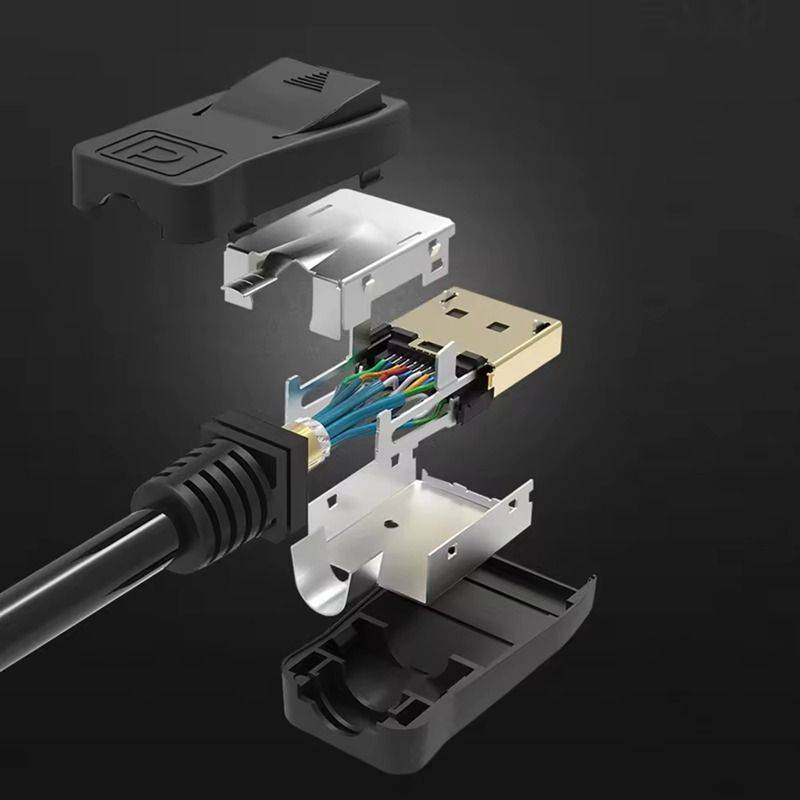
If you are looking to specify a DisplayPort cable assembly—whether it’s a docking station with two 8K monitors, an industrial machine panel, a broadcasting video wall or a VR simulation system—Sino-Conn is your partner for tailoring the right solution. Let’s talk about your requirements: version, bandwidth, length, connector types, shielding, jacket material and environment.
Contact Sino-Conn today for a custom drawing, detailed specification sheet, and fast sample quote. Your visual link is only as good as your cable—make sure it’s built right.