Skip to content
What Is an RCA Connector? Structure, Uses, and Selection Explained
- andy

RCA connectors are often described as “old” or “legacy,” yet they continue to appear in an extraordinary range of products—from consumer audio systems and broadcast equipment to industrial controllers and measurement instruments. This contradiction raises an important question: if RCA connectors are outdated, why do engineers, OEMs, and system integrators still specify them today? The answer lies not in nostalgia, but in engineering practicality.
An RCA connector is simple by design, but simplicity does not equal irrelevance. In fact, many modern systems still rely on analog audio, composite video, or coaxial digital audio signals where bandwidth demands are predictable and reliability matters more than interface complexity. In these environments, RCA connectors offer stable electrical behavior, mechanical robustness, and cost efficiency that newer interfaces do not always provide.
An RCA connector is a common electrical connector used to transmit analog audio, composite video, or digital coaxial audio signals. It works with a single center conductor and an outer ground shield, making it suitable for short to medium signal transmission where simplicity, shielding, and cost control are important. RCA connectors are widely used in audio equipment, video systems, and certain industrial and professional applications.
Despite the rise of HDMI, USB, and optical interfaces, RCA connectors remain relevant because real-world engineering is rarely about using the newest technology—it is about using the right one. To understand when RCA connectors make sense, and when they do not, we need to look beyond appearances and examine how they work, where they are used, and how they are selected and customized in practice.
What Is an RCA Connector?
An RCA connector is a widely used electrical connector designed to transmit analog audio, composite video, or digital coaxial audio signals over short to medium distances. It features a simple yet effective structure: a single center conductor for signal transmission and an outer conductive ring that acts as ground and basic shielding. This design makes RCA connectors easy to use, cost-effective, and highly compatible with coaxial cable constructions.
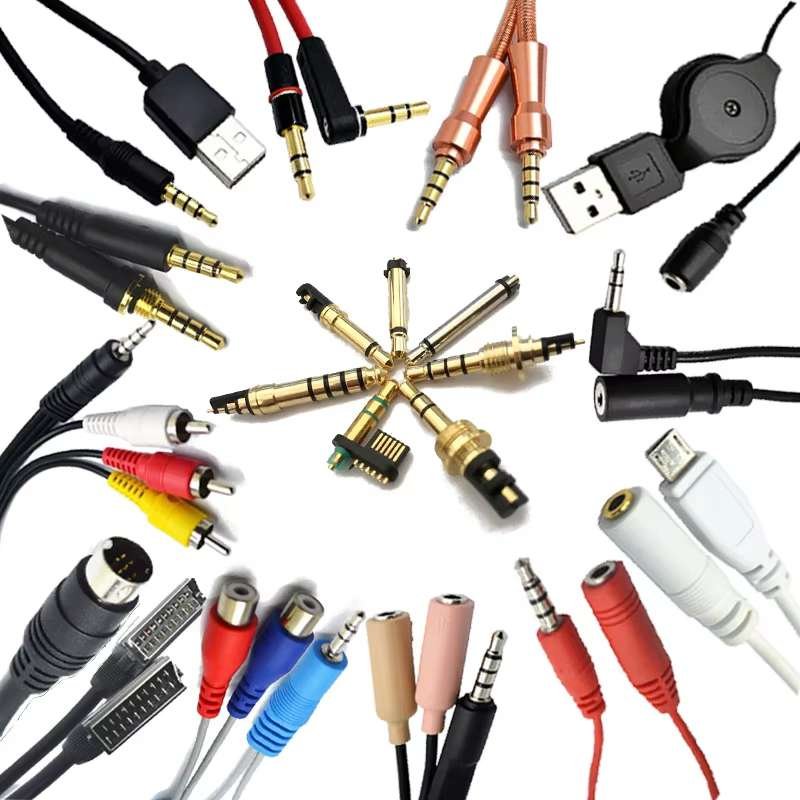
While RCA connectors are often associated with consumer electronics, their continued use is driven by engineering practicality rather than legacy habit. In applications where signal bandwidth is predictable and system simplicity is prioritized, RCA connectors remain a reliable and efficient interface.
What Does RCA Stand For and Where Did It Come From?
The term “RCA” originates from the Radio Corporation of America, which introduced and popularized this connector type in early audio and video equipment. Over time, the connector became so widely adopted that the name transitioned from a brand reference into a generic industry term.
Today, RCA connectors are produced by countless manufacturers worldwide and are standardized in form, though they may vary in materials, plating, and mechanical quality. This widespread adoption is one of the reasons RCA connectors remain compatible across equipment generations, even when devices come from different manufacturers or eras.
How Is an RCA Connector Structured?
From a mechanical and electrical perspective, the RCA connector follows the coaxial transmission principle. This structure allows the signal and ground to share a common axis, helping to maintain signal stability and reduce external interference when used with a coaxial cable.
| Component | Function |
|---|---|
| Center Pin | Carries the signal |
| Insulating Dielectric | Separates signal from ground |
| Outer Ring (Shell) | Ground reference and basic shielding |
| Connector Housing | Provides mechanical support |
This structure is simple but effective, especially for low-to-medium frequency signal transmission.
What Types of Signals Can an RCA Connector Carry?
RCA connectors are not limited to a single signal type. Their versatility comes from the coaxial structure and the ability to pair them with different cable designs.
| Signal Category | Typical Application |
|---|---|
| Analog Audio | Stereo sound systems, amplifiers |
| Composite Video | Video playback and monitoring |
| Digital Audio (SPDIF) | Coaxial digital audio links |
| Low-Frequency Control Signals | Test and diagnostic equipment |
It is important to note that while the connector looks the same, digital audio applications require stricter cable and impedance control than analog audio or video.
What Are the Core Advantages of an RCA Connector?
Despite newer interfaces entering the market, RCA connectors continue to be selected because they solve specific engineering needs efficiently.
| Advantage | Why It Matters |
|---|---|
| Simple Design | Easy installation and termination |
| Broad Compatibility | Works across equipment generations |
| Cost Efficiency | Lower component and assembly cost |
| Adequate Shielding | Reliable performance for intended signals |
These characteristics make RCA connectors particularly suitable for applications where reliability and ease of integration are more important than maximum data rate.
What Is an RCA Connector Not Designed For?
Understanding the limitations of an RCA connector is just as important as knowing its strengths. RCA connectors are not intended for high-bandwidth, multi-channel, or long-distance transmission.
| Limitation | Practical Impact |
|---|---|
| Limited Bandwidth | Not suitable for HD video or data |
| No Positive Locking | Less secure in high-vibration environments |
| Impedance Variability | Not ideal for precision RF systems |
Recognizing these boundaries helps engineers and buyers avoid misapplication and select the right interface from the start.
Why Is the RCA Connector Still Used Today?
RCA connectors remain relevant because engineering decisions are rarely about adopting the newest interface. Instead, they are about matching the interface to the actual system requirements. In audio systems, legacy equipment integration, and certain industrial applications, RCA connectors continue to offer a balanced combination of performance, simplicity, and cost control.
Understanding what an RCA connector **is—and what it is not—**provides a solid foundation for comparing it with newer interfaces and deciding when it is the right choice for a given application.
How Does an RCA Connector Work?
An RCA connector works by transmitting a signal through a central conductor while the outer shell provides a ground reference and basic shielding. This configuration supports stable signal transfer for audio and low-to-medium frequency signals when paired with suitable coaxial cable.
How Is an RCA Connector Structured Internally?
Internally, the RCA connector follows a coaxial principle. The center pin carries the signal, while the surrounding metal shell serves as the ground and return path. When mated, the ground typically connects slightly before the signal pin, which helps reduce transient noise during connection.
Although RCA connectors do not provide impedance locking as precisely as RF connectors, they perform reliably within their intended frequency range. Connector material, plating quality, and mechanical tolerances all influence contact resistance and long-term stability, which is why manufacturing quality matters even for such a simple interface.
How Does Shielding Affect Signal Transmission?
Shielding plays a critical role in RCA cable performance. Because the connector itself offers limited shielding, overall EMI resistance depends heavily on the coaxial cable structure used with it.
| Shielding Type | EMI Resistance | Typical Application |
|---|---|---|
| Single Braid | Moderate | Consumer audio |
| Foil + Braid | High | Digital audio (SPDIF) |
| Double Braid | Very High | Industrial environments |
Poor shielding can result in audible noise, signal dropouts, or interference—especially in electrically noisy environments.
Which Types of RCA Connectors Are Commonly Used?
Common RCA connectors include versions designed for analog audio, composite video, and digital coaxial audio. While mechanically similar, these connectors may differ in impedance requirements, cable selection, and intended signal type.
Which RCA Connectors Are Used for Analog Audio and Video?
Analog RCA connectors are widely used for stereo audio and composite video. These applications prioritize signal continuity and noise suppression rather than high bandwidth. Cable flexibility and connector durability are often more important than strict impedance control.
Which RCA Connectors Are Used for Digital Audio (SPDIF)?
Digital RCA connectors used for SPDIF typically require 75-ohm impedance matching. While the connector itself may look identical to an analog RCA, the cable and termination quality become far more critical to prevent signal reflection and jitter in digital transmission.
Where Are RCA Connectors Commonly Used Today?
RCA connectors are still widely used in audio equipment, broadcast systems, digital audio links, and certain industrial and professional devices where simplicity and compatibility are important.
Which Consumer and Commercial Devices Use RCA Connectors?
RCA connectors remain common in amplifiers, speakers, mixers, and audio distribution equipment. Their ease of use and universal compatibility make them practical in environments where equipment from different generations must interoperate.
Which Industrial or Professional Systems Still Rely on RCA?
In industrial settings, RCA connectors may be used in monitoring systems, diagnostic tools, or legacy control equipment where redesigning the interface offers little benefit compared to maintaining compatibility.
How Do You Choose the Right RCA Connector for Your Application?
Choosing the right RCA connector is less about appearance and more about matching electrical performance, mechanical durability, and real-world operating conditions to your specific application. While many RCA connectors look similar, differences in cable structure, shielding, materials, and termination quality can significantly affect signal stability and long-term reliability.

In practice, selection errors rarely come from misunderstanding what an RCA connector is. They come from underestimating application details—such as signal type, cable length, environment, or integration constraints. A structured selection approach helps avoid noise issues, premature failures, and costly redesigns later in the project.
What Signal Type Are You Transmitting?
The first and most important step is identifying what kind of signal the RCA connector will carry. Different signal types place very different demands on cable impedance, shielding, and termination quality.
| Signal Type | Key Considerations |
|---|---|
| Analog Audio | Noise rejection, flexibility |
| Composite Video | Signal continuity, shielding |
| Digital Audio (SPDIF) | 75-ohm impedance, low jitter |
| Control / Test Signals | Stability, repeatability |
Analog audio applications are generally more tolerant of impedance variation, while digital coaxial audio requires stricter control to prevent signal reflection and data errors. Selecting an RCA connector without understanding the signal type is one of the most common sources of performance issues.
How Do Cable Type and Impedance Affect Performance?
Although the RCA connector itself is standardized, the cable paired with it determines most of the electrical performance. For digital audio, impedance mismatch between the source, cable, and load can cause timing errors and audible artifacts.
| Cable Type | Typical Use | Notes |
|---|---|---|
| Standard Coax (Unspecified) | Analog audio | Cost-effective, flexible |
| 75-Ohm Coax | Digital audio (SPDIF) | Required for signal integrity |
| High-Shield Coax | Industrial / noisy environments | Better EMI resistance |
For short analog runs, cable selection is relatively forgiving. For longer runs or digital signals, cable quality and impedance consistency become critical.
How Does Cable Length Influence RCA Connector Selection?
Cable length directly affects signal attenuation and noise susceptibility. While RCA connectors are commonly used for short to medium distances, pushing them beyond their comfortable range can introduce problems.
| Cable Length | Practical Impact |
|---|---|
| Short (<1 m) | Minimal signal loss |
| Medium (1–5 m) | Shielding becomes important |
| Long (>5 m) | Noise and attenuation risk increases |
As cable length increases, higher-quality shielding and more robust materials are recommended. In some cases, alternative interfaces may be more suitable for very long distances.
What Environmental and Mechanical Factors Matter Most?
Environmental conditions often determine whether a cable assembly succeeds or fails in the field. Temperature, vibration, chemical exposure, and installation constraints all influence connector and cable selection.
| Environment | Recommended Focus |
|---|---|
| Indoor / Consumer | Flexibility, appearance |
| Industrial | Shielding, jacket durability |
| High-Temperature | Heat-resistant materials |
| High-Vibration | Secure termination, strain relief |
Ignoring environmental factors can lead to cracked jackets, loose connections, or intermittent signal issues—even if the electrical design is correct.
How Important Are Connector Materials and Plating?
Connector material and surface plating affect contact resistance, corrosion resistance, and lifespan. While lower-cost connectors may perform adequately in controlled environments, higher-quality materials are often required for demanding applications.
| Material / Plating | Benefit |
|---|---|
| Nickel-Plated Brass | Cost-effective, general use |
| Gold-Plated Contacts | Stable contact, low oxidation |
| Reinforced Housing | Better mechanical durability |
Selecting materials based on actual usage conditions rather than appearance helps balance performance and cost.
When Should You Consider a Custom RCA Cable Assembly?
Standard off-the-shelf RCA cables are suitable for basic applications, but custom assemblies become necessary when requirements extend beyond typical use cases. Customization allows control over cable length, shielding structure, materials, and connector configuration.
| Custom Parameter | Why It Matters |
|---|---|
| Cable Length | Exact fit, reduced signal loss |
| Shielding Design | EMI control |
| Jacket Material | Environmental resistance |
| Connector Options | Compatibility and durability |
Custom RCA cable assemblies are especially valuable in OEM projects, prototyping, and systems with unique routing or performance constraints.
Why Engineering Support Improves RCA Connector Selection
In many real projects, customers may only have a reference model, a photo, or a general application description. Engineering support bridges this gap by translating incomplete inputs into a manufacturable and reliable solution.
This collaborative process often includes specification review, drawing confirmation, and iterative optimization—reducing risk before production begins and ensuring the final assembly performs as intended.
Can RCA Cable Assemblies Be Customized for Different Requirements?
Yes. RCA cable assemblies can be customized in length, cable type, connector materials, shielding, and compliance to meet specific application needs.
What Parts of an RCA Cable Assembly Can Be Customized?
| Custom Option | Purpose |
|---|---|
| Cable Length | Installation fit |
| Cable Type | Signal performance |
| Shielding | EMI control |
| Jacket Material | Environment resistance |
How Are Drawings and Specifications Confirmed Before Production?
Detailed drawings and specification confirmation ensure the final product meets functional and mechanical requirements before mass production.
Are RCA Connectors Still Relevant Compared to Newer Interfaces?
RCA connectors remain relevant where simplicity, cost control, and compatibility outweigh the need for high bandwidth or multi-channel integration.
Which Is Better, RCA or HDMI?
HDMI offers higher bandwidth and integrated audio-video transmission, but RCA remains more practical for analog audio, digital coax audio, and legacy systems. “Better” depends entirely on the application.
When Should RCA Be Replaced by Other Connection Types?
When higher data rates, multi-channel integration, or long-distance transmission are required, newer interfaces may be more suitable.

Ready to Customize Your RCA Cable Assembly?
Whether you have a complete specification, a reference model, or only an image, Sino-conn supports custom RCA cable assemblies with flexible MOQ, fast drawings, and verified compliance. Share your application details and let an experienced engineering team translate your requirements into reliable, manufacturable solutions.
Related Keywords :rca connector, rca cable, rca audio connector, rca digital audio, coaxial rca cable, rca vs hdmi, custom rca cable assembly, audio cable connector, analog audio connector, digital coax audio

With over 18 years of OEM/ODM cable assemblies industry experience, I would be happy to share with you the valuable knowledge related to cable assemblies products from the perspective of a leading supplier in China.
manufacturer catalogue
Get A Sample Now From Factory→
Get a quote quickly
Here, developing your OEM/ODM custom cable assemblies collection is no longer a challenge—it’s an excellent opportunity to bring your creative vision to life.