Skip to content
JST Connector Types: A Complete Guide
- andy

In modern electronics, connectors are often treated as small, interchangeable parts—until something goes wrong. A mismatched connector can delay production, cause intermittent failures, or force costly redesigns late in a project. Among low-profile wire-to-board connectors, JST connectors are some of the most widely used and most frequently misunderstood components.
Engineers appreciate JST connectors for their compact size, reliable mating, and standardized series. Buyers and traders, however, often encounter JST connectors only as part numbers on a BOM or as small white housings attached to a cable. The challenge arises when a connector looks “like JST” but the exact series, pitch, or electrical rating is unclear. In real sourcing situations, customers often provide only a photo or a rough description—without full specifications.
Choosing the correct JST connector type is not just about fit. Pitch size, current rating, locking structure, and wire compatibility all affect performance and safety. Using the wrong series may lead to overheating, loose connections, or assembly issues that only appear after products are shipped.
JST connector types refer to the different connector series produced by JST, such as PH, XH, SH, GH, ZH, and SM. These connectors vary by pitch size, current rating, structure, and application. JST connectors are commonly used in wire-to-board and wire-to-wire connections for consumer electronics, batteries, and industrial equipment. Correct identification requires measuring pitch, housing shape, and wire size rather than relying on appearance alone.
Behind every JST connector is a set of design decisions that balance size, current, and reliability. Understanding those decisions helps engineers, buyers, and OEMs avoid costly mistakes. Let’s start from the basics.
What Are JST Connectors?
JST connectors are electrical connectors manufactured by JST (Japan Solderless Terminal). They are commonly used for wire-to-board and wire-to-wire connections in electronic devices. JST connectors are known for their compact size, standardized series, and reliable locking mechanisms, making them widely used in consumer electronics, battery connections, and industrial applications.
What does JST stand for?
JST is the abbreviation for Japan Solderless Terminal, a Japanese company specializing in connector systems. Over time, “JST connector” has become a generic term used in the electronics industry to describe certain small white plastic connectors, even when they are not manufactured by JST. This naming habit often causes confusion during sourcing and identification.
What are JST connectors used for?
JST connectors are typically used to connect wires to printed circuit boards without soldering. They are widely found in consumer electronics, power supplies, battery packs, sensors, and control boards. Their standardized dimensions and mating structures simplify assembly and replacement.
Are JST connectors wire-to-board or wire-to-wire?
Most JST connectors are wire-to-board, although some series support wire-to-wire connections. The exact function depends on the connector series and housing design.
Which JST Connector Types Are Commonly Used?
The most commonly used JST connector types are defined by their series, each designed around a specific pitch size, electrical capacity, and mechanical structure. Rather than offering one universal connector, JST developed multiple series to address different application needs—from compact consumer electronics to higher-current power and industrial connections. Understanding these commonly used JST connector types helps users quickly narrow down options before moving into detailed specification checks.
At a high level, JST connector series are primarily distinguished by pitch (the distance between adjacent pins). Smaller-pitch series prioritize compact size, while larger-pitch series support thicker wires, higher current, and stronger mechanical retention. Among dozens of JST families, a limited number of series account for the majority of real-world applications.
What are the different JST connectors?
JST connectors are organized into standardized series, each optimized for a particular balance of size, current capacity, and usability. The table below summarizes the most widely used JST connector types encountered in consumer, commercial, and industrial products.
| JST Series | Pitch (mm) | Typical Current Level | Common Applications |
|---|---|---|---|
| SH | 1.0 | Low | Ultra-compact consumer electronics |
| GH | 1.25 | Medium | Industrial control, automation |
| ZH | 1.5 | Low–Medium | Compact electronics, signal lines |
| PH | 2.0 | Medium | Consumer electronics, power & signal |
| XH | 2.5 | Medium–High | Power connections, control boards |
| SM | 2.5 | Medium | Wire-to-wire cable connections |
These series represent the most frequently requested JST connectors in cable assemblies and wire harnesses. While other JST series exist, they are typically application-specific or less common in standard designs.
What are the main JST connector series used in practice?
In practical sourcing and manufacturing scenarios, PH and XH series are the most commonly encountered. PH connectors are widely used where moderate current and compact size are required, such as consumer electronics and small power modules. XH connectors, with their larger pitch, are preferred when higher current or stronger mechanical stability is needed.
Smaller-pitch series like SH and ZH are favored in space-constrained designs, while GH series connectors are often selected for industrial equipment due to improved retention and vibration resistance. SM series, although wire-to-wire rather than wire-to-board, remains popular for simple cable connections and modular wiring.
How are JST connector types classified by pitch?
Pitch is the most important and quickest way to classify JST connector types. It directly affects connector size, terminal design, allowable wire gauge, and current capacity. As pitch decreases, connectors become smaller but more sensitive to crimp quality and wire selection. As pitch increases, connectors support higher current and are generally easier to assemble but require more PCB space.
For many projects, identifying the pitch alone can immediately eliminate several incompatible JST series. Once pitch is confirmed, further identification can focus on housing shape, locking style, and electrical ratings.
Why understanding commonly used JST types matters
Focusing on commonly used JST connector types simplifies both design and sourcing. It reduces the risk of selecting obscure or hard-to-source series, shortens lead times, and improves compatibility with existing terminals, housings, and crimp tooling. For buyers and engineers alike, starting with these widely adopted JST series is the most practical approach before moving into deeper specification or customization decisions.
How Do JST Connector Types Differ by Specification?
JST connector types differ by pitch size, current and voltage rating, locking structure, and supported wire gauge. These specifications determine whether a connector is suitable for low-power signals, battery connections, or industrial environments.
How does pitch size affect selection?
Smaller pitch connectors save space but limit current capacity and wire size. Larger pitch connectors allow thicker wires and higher current but require more PCB space.
How do current and voltage ratings differ?
Each JST series has defined electrical limits. Using a connector beyond its rated current may cause heat buildup and long-term reliability issues.
How do locking mechanisms differ?

Some JST connectors rely on friction fit, while others use positive locking. Locking style affects vibration resistance and assembly reliability.
How does wire gauge compatibility vary?
Wire gauge compatibility is tightly linked to pitch and terminal design. Mismatched wire size can lead to poor crimp quality or unreliable contact.
Which JST Connector Is Best for Different Applications?
The best JST connector depends on application requirements such as size constraints, current demand, and environmental conditions. Compact electronics favor smaller pitch connectors, while battery and industrial applications require larger pitch and higher current ratings.
| Application | Recommended JST Series | Reason |
|---|---|---|
| Consumer electronics | PH / SH | Compact size |
| Battery connections | XH / PH | Higher current |
| Industrial equipment | GH / XH | Strong retention |
| Wire-to-wire | SM | Simple mating |
Application-based selection reduces the risk of over- or under-specifying connectors.
How to Identify JST Connector Types Correctly?
Correctly identifying a JST connector type is often more challenging than expected. In real sourcing situations, many users do not know the exact series name or part number. Instead, they may only have a physical sample, an installed cable, or a few photos. Because different JST connector series can look similar at first glance, accurate identification requires a methodical approach rather than visual guesswork.
The most reliable way to identify JST connector types is by combining physical measurement, structural observation, and wire information. Relying on appearance alone often leads to misidentification, especially between series with similar shapes but different pitch sizes.
How to identify JST connector types by pitch and housing shape?
Pitch measurement is the single most important step in identifying JST connector types. Pitch refers to the center-to-center distance between adjacent pins. Even small differences—such as 2.0 mm versus 2.5 mm—can indicate completely different JST series that are not interchangeable.
Using a digital caliper to measure the pin spacing provides a reliable starting point. Once pitch is known, the connector housing shape can be examined. Key features include:
- Overall housing width and height
- Presence and position of locking tabs
- Whether the housing is shrouded or open
Pitch narrows the possible series dramatically, while housing shape helps confirm the exact family.
What measurements are needed to identify JST connectors accurately?
In addition to pitch, several other measurements help confirm the correct JST connector type. These measurements are especially important when the connector is already installed or partially assembled.
Key measurements include:
- Pin count (number of circuits)
- Housing width and depth
- Terminal insertion direction
- Wire gauge used in the cable
These details help distinguish between series that share similar pitch but differ in structure or terminal design. When available, measuring both the connector housing and the mating board header improves accuracy.
How to identify JST connector types from a photo or sample?
Photos can be useful, but they must be interpreted carefully. A photo without scale or reference often leads to incorrect assumptions. For better identification from images:
- Include a ruler, caliper, or known object for scale
- Provide both front and side views of the connector
- Show the latch or locking feature clearly
Physical samples are more reliable than photos alone. Even when only a cable assembly is available, wire size, crimp style, and strain relief design provide valuable clues for identification.
What information helps suppliers confirm JST connector types?
From a supplier’s perspective, accurate identification becomes much faster when customers provide multiple pieces of information, even if none are complete on their own.
Helpful information includes:
- Clear photos from multiple angles
- Measured pitch value
- Number of pins
- Wire gauge and insulation type
- Application context (signal, power, battery, industrial use)
Combining these details allows experienced suppliers to cross-check possibilities and eliminate incorrect series efficiently.
Why misidentification is common—and how to avoid it
Misidentification often happens because many JST connectors share similar color, material, and overall appearance. Assuming “it looks like PH” without measuring pitch is a common mistake. Another frequent issue is confusing JST connectors with visually similar connectors from other manufacturers.
To avoid errors:
- Always measure pitch instead of estimating
- Avoid relying on connector color or general shape
- Confirm wire size compatibility
- Verify against both housing and terminal characteristics
A structured identification process reduces rework, prevents sourcing delays, and ensures that replacement or custom cable assemblies match the original design exactly.
Identification checklist for JST connectors
| Identification Step | Why It Matters |
|---|---|
| Measure pitch | Primary series identifier |
| Count pins | Confirms circuit configuration |
| Check housing shape | Differentiates similar series |
| Verify wire gauge | Ensures terminal compatibility |
| Review application | Helps validate current rating |
Why correct identification matters before customization
Correct identification is the foundation for any successful JST cable assembly—standard or custom. Before adjusting length, pinout, or materials, the connector type must be confirmed accurately. This prevents mismatches, ensures electrical safety, and avoids costly delays during sampling or production.
For projects involving replacement cables, legacy systems, or undocumented designs, accurate identification is often the most critical step in achieving a reliable solution.
Can JST Connector Cable Assemblies Be Customized?
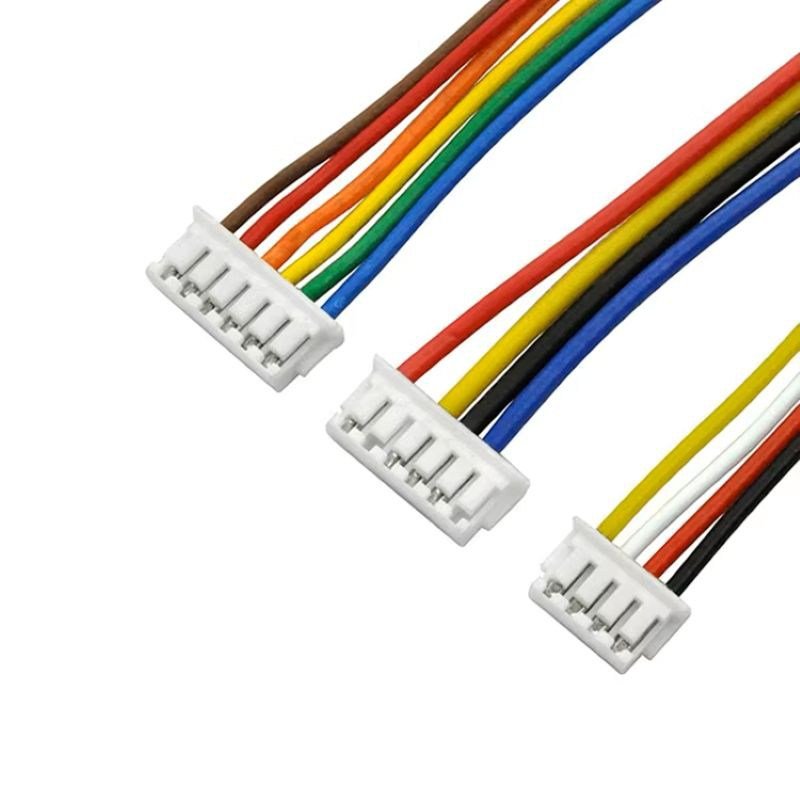
Yes. JST connector cable assemblies can be customized by length, pinout, wire type, materials, and connector choice. Customization is often necessary when standard assemblies do not meet mechanical, electrical, or environmental requirements.
Customization may include:
- Custom cable length
- Defined pin mapping
- Material selection
- Original or compatible connectors
- Compliance with UL, RoHS, REACH, PFAS
Custom assemblies reduce installation errors and improve long-term reliability.
Final Thoughts: From JST Connector Types to Reliable Assemblies
Understanding JST connector types is not about memorizing series names—it is about matching connector design to real application needs. Correct selection and identification prevent failures, delays, and unnecessary redesigns.

At Sino-conn, we support engineers, OEMs, and buyers by translating part numbers, drawings, or even photos into accurate JST connector cable assemblies. From fast drawings and samples to flexible customization and global compliance, we help turn connector knowledge into reliable production solutions.
If you are sourcing JST connectors or need a custom JST cable assembly, contact Sino-conn to discuss your requirements and request a quotation.
Related Keywords :jst connector types, jst connector series, jst ph xh sh, jst connector identification, jst pitch size, jst wire to board, jst cable assembly, custom jst harness, jst connector pinout, jst alternative connectors

With over 18 years of OEM/ODM cable assemblies industry experience, I would be happy to share with you the valuable knowledge related to cable assemblies products from the perspective of a leading supplier in China.
manufacturer catalogue
Get A Sample Now From Factory→
Get a quote quickly
Here, developing your OEM/ODM custom cable assemblies collection is no longer a challenge—it’s an excellent opportunity to bring your creative vision to life.