Skip to content
Cable vs Fiber: What’s the Difference and Which Is Better for Your Network?
- andy

Choosing between cable (Ethernet) and fiber optic connections has become one of the most important decisions for homes, businesses, industrial automation systems, and high-performance data environments. Users today are not just asking about speed—they want to know which option is more reliable, which performs better in harsh conditions, whether fiber works in the rain, and whether the extra cost of fiber is worth it. The truth is, the wrong choice can limit your network for years.
Cable uses electrical signals transmitted through copper, while fiber uses pulses of light through glass strands. Fiber is faster, more stable, immune to electromagnetic interference, and better over long distances. Cable is cheaper, easier to install, and sufficient for everyday networks. The best choice depends on performance needs, environment, and budget: fiber for high-speed, high-reliability applications; cable for cost-efficient general networking.
Many of Sino-Conn’s global customers—including engineers, OEM factories, and distributors—come to us with only a model number or even a photo of a cable, unsure which type they truly need. Some assume cable and fiber are “basically the same.” Others worry that fiber might stop working in the rain. The good news is that once you understand how each technology works—and which one fits your environment—you can make a confident decision and avoid costly redesigns.
What Are Cable and Fiber and How Do They Work?
Cable (Ethernet) transmits data using electrical signals through twisted-pair copper wires. Fiber optic cable transmits data using light pulses through glass or plastic strands. Copper cable is simple, flexible, and cost-effective, while fiber delivers higher speed, lower latency, and immunity to electromagnetic interference. They are not the same and perform differently based on distance, bandwidth, and environmental demands.
Is cable the same as fiber?
Cable and fiber are fundamentally different technologies. Cable relies on electrical signals, which makes it sensitive to EMI, distance loss, and environmental noise. Fiber uses light, meaning it doesn’t suffer from interference and maintains full bandwidth over much longer distances. While both deliver internet or data transmission, their internal structure, materials, and performance characteristics are completely different.
How does Ethernet cable transmit data?
Ethernet cables (Cat5e, Cat6, Cat6A, Cat7, etc.) carry electrical signals through copper pairs. These cables are shielded or unshielded depending on the environment. In industrial or medical applications, customers often request specifications like OD (outer diameter), EMI shielding level, temperature rating, and halogen-free materials to meet UL or RoHS requirements.
How does fiber optic cable transmit data?
Fiber transmits light using either single-mode or multi-mode fiber. Light signals travel faster and farther without degrading. Because the signal is optical—not electrical—fiber is immune to EMI, lightning, and cross-talk, making it ideal for data centers, surgical equipment, military systems, and 5G infrastructure.
What materials and specs define each type?
Fiber uses glass cores, cladding, and protective coatings. Cable uses copper, PVC/PE jackets, foil shields, and braided shields. Sino-Conn often provides detailed spec sheets including impedance, OD, AWG, bending radius, temperature, UV resistance, oil resistance, and flame rating so customers fully understand the cable they are buying.
What Is the Core Difference Between Cable and Fiber?
The core difference is that cable carries electrical signals through copper, while fiber carries light through glass or plastic strands. Because light experiences lower attenuation and zero electromagnetic interference, fiber offers higher bandwidth, longer transmission distance, and more stable performance. Copper cable remains widely used due to its lower cost, easy installation, and compatibility with everyday devices, but it is limited in distance, speed scalability, and EMI-heavy environments. Fiber is better suited for modern high-speed networks, industrial systems, and long-distance links where consistent performance is essential.
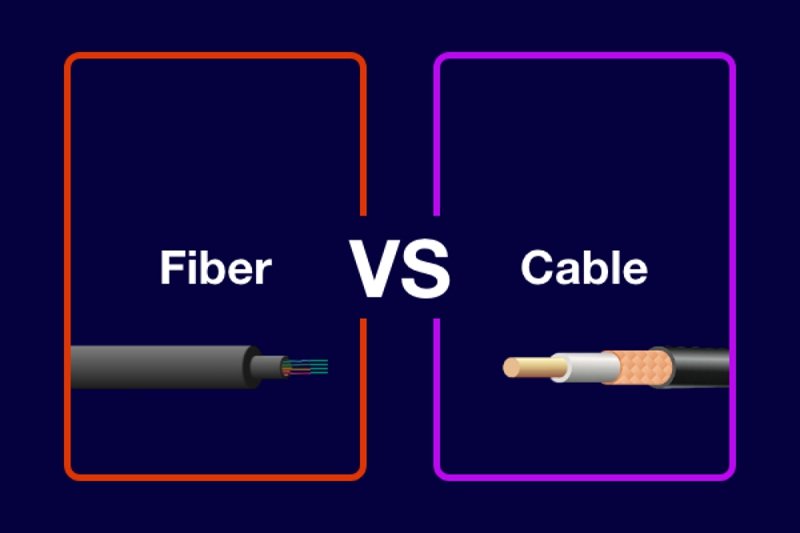
Key Technical Differences at a Glance
| Feature | Cable (Copper) | Fiber Optic |
|---|---|---|
| Transmission Medium | Electrical signals | Light pulses |
| Max Distance (Typical) | ~100 m | Several km to tens of km |
| EMI Resistance | Low | Excellent |
| Bandwidth Scalability | Limited by copper category | Extremely high |
| Signal Degradation | Higher over distance | Very low |
| Physical Material | Metal conductor | Glass/plastic core |
| Weight & Thickness | Heavier, thicker | Lighter, thinner options |
| Upload/Download Speeds | Usually asymmetric | Often symmetric |
Are fiber signals faster and more stable?
Yes. Fiber’s optical signals can carry significantly more data at once and do not weaken quickly over distance. Fiber remains stable even when multiple devices are active, when cables run through multiple floors or buildings, or when placed near electrical machinery. This stability makes fiber ideal for streaming, industrial control, cloud workloads, and latency-sensitive operations.
Do cable networks suffer from EMI and distance loss?
Yes. Copper cables naturally lose signal strength as the distance increases, and most Ethernet standards limit a single cable run to around 100 meters. They are also susceptible to EMI from motors, fluorescent lighting, radio equipment, and high-voltage lines. Even shielded cables cannot eliminate all interference. Fiber avoids these issues entirely because it does not use electricity to carry data.
Is fiber symmetrical in upload/download performance?
Most fiber-based systems and services support symmetrical speeds, meaning that uploads match downloads. This matters for video editing, server hosting, AI training, CAD collaboration, telemedicine, and cloud workflows where large files move in both directions. Cable networks typically reserve more bandwidth for downloads, leading to slower uploads that can limit modern digital tasks.
Which One Is Faster—Cable or Fiber?
Fiber is consistently faster, offering speeds up to 100 Gbps with extremely low latency. Modern cable (Cat6A, Cat8) can achieve high speeds over short distances but cannot match fiber’s long-range bandwidth or stability. Fiber supports demanding applications such as gaming, 8K streaming, cloud computing, and industrial automation with minimal signal loss.
Speed and Latency Comparison Table
| Feature | Cable (Ethernet) | Fiber Optic |
|---|---|---|
| Max Speed | Up to 40 Gbps (Cat8) | 100 Gbps+ |
| Latency | Higher (electrical) | Ultra-low (optical) |
| Distance | <100 m optimal | Up to 40 km+ |
| EMI Resistance | Low | Excellent |
| Upload Speed | Usually asymmetric | Symmetric |
Real-world performance
Even high-grade Cat8 cable cannot match fiber once you exceed short distances. For gaming, remote work, and cloud applications, fiber delivers more consistent latency.
Why demanding workloads prefer fiber
Applications like AI model training, robotic control, industrial PLCs, and medical video systems require stable, low-latency, interference-free connectivity—fiber excels here.
How Do Cost, Installation, and Durability Compare?
Cable is cheaper, easier to install, and more flexible for short-distance networking. Fiber costs more upfront but offers superior durability, resistance to heat, moisture, and EMI, and much better long-distance performance. Fiber is not affected by rain because it uses light, not electricity, making it ideal for outdoor and industrial environments.
Is fiber more expensive?
Yes—but the cost gap is narrowing. Many customers choose fiber because long-term reliability and speed outweigh initial installation cost.
Environmental Durability Table
| Condition | Cable (Copper) | Fiber Optic |
|---|---|---|
| Heat | Good | Excellent |
| Oil/Chemical | Medium | Excellent with proper jacket |
| UV Exposure | Medium | Excellent |
| Corrosion Resistance | Low | Excellent |
| Water/Rain Impact | Possible noise/short | No signal loss |
Does rain affect fiber internet?
No. Fiber signals are immune to moisture because they use light, not electricity. Rain may affect external hardware (like outdoor enclosures), but not the fiber cable itself. This is why fiber is preferred for outdoor telecom, military installations, and harsh-weather regions.
Which industries still rely on copper?
Consumer electronics, office networks, and short-distance OEM systems continue using cable because it is cheaper and easier to assemble. In industrial or medical environments, customers—especially engineers—often shift to fiber to avoid EMI problems.
Do You Need Cable or Fiber for Your Application?
Choose cable for cost-effective, short-distance, everyday networking. Choose fiber for high-speed, low-latency, long-distance, or interference-heavy environments. Homes, small offices, and budget-sensitive OEMs often use cable. Data centers, medical devices, defense systems, and industrial automation benefit significantly from fiber’s performance and durability.

Home and small office
Cable is usually sufficient—affordable, simple, and supports gigabit speeds.
Industrial, medical, military
Fiber performs better where EMI, precision control, and reliability are crucial.
OEM decision factors
Engineers prioritize performance and technical feasibility; OEM factories prioritize price and lead time. Sino-Conn supports both by offering flexible connector options (genuine or alternative), custom lengths, custom pin-outs, material choices, and fast turnaround.
How Sino-Conn Supports Custom Cable and Fiber Solutions
Sino-Conn is known globally for fast engineering response, accurate drawings, and the ability to customize even complex assemblies with no MOQ. Whether customers send a part number, a photo, or a detailed drawing, our team develops a matching or improved solution.
Specification expertise
We provide detailed spec sheets:
- Impedance
- OD & bending radius
- EMI shielding structure
- Jacket materials (PVC, TPE, halogen-free, oil-resistant, UV-resistant)
- Temperature rating
- Current/voltage
- Corrosion & flame resistance
Certifications available: UL, ISO, RoHS, REACH, PFAS, COC, COO.
Fast lead times
- Samples: 2 weeks, or 2–3 days for urgent needs
- Mass production: 3–4 weeks, or ~2 weeks for urgent orders
- Drawings: within 3 days, or 30 minutes for fast cases
Connector options: Genuine vs. alternatives
Some customers need brand-name connectors for compatibility or industry standards. Others choose high-quality alternative connectors for better pricing and faster lead times. We support both based on your project.
Why engineers, OEMs, and traders choose Sino-Conn
- Deep product knowledge—our sales engineers understand construction, materials, shielding, and connector differences
- Responsive service—accurate quotes and drawings in minutes
- Full customization—pin-out definition, length, materials, overmolding
- Strict quality control—100% inspection (in-process + final + pre-shipment)
- Global experience—we understand preferences in US, EU, Japan, Korea, India, and more
Ready to Build Your Custom Cable or Fiber Solution?
Whether you need high-performance fiber, cost-efficient Ethernet, or a hybrid cable assembly, Sino-Conn can design, prototype, certify, and manufacture exactly what your project requires. Our engineering team is ready to review your drawing—or even just a photo—and provide a fast, accurate solution.

If you’re planning a new network, building OEM equipment, or upgrading your system, reach out to Sino-Conn for a detailed quote, drawings, and a customized proposal tailored to your performance needs and budget.
Related Keywords :cable vs fiber, fiber optic cable, ethernet cable, network speed, EMI shielding, custom cable assemblies, industrial networks, OEM engineering, cable durability, Sino-Conn

With over 18 years of OEM/ODM cable assemblies industry experience, I would be happy to share with you the valuable knowledge related to cable assemblies products from the perspective of a leading supplier in China.
manufacturer catalogue
Get A Sample Now From Factory→
Get a quote quickly
Here, developing your OEM/ODM custom cable assemblies collection is no longer a challenge—it’s an excellent opportunity to bring your creative vision to life.