Skip to content
Long-distance signal transmission often depends on one critical but overlooked component: the quality and type of coaxial cable used. Whether you’re deploying satellite TV infrastructure, broadband networks, RF test environments, or commercial video distribution systems, the cable you choose can dramatically affect performance, stability, and reliability. This is where RG11 coaxial cable becomes an essential player—it is thicker, stronger, and engineered to minimize signal loss over extended distances.
RG11 coaxial cable is a 75-ohm, low-loss coax cable designed for long-distance signal transmission in broadband, CATV, satellite, and commercial video applications. Its larger conductor, thicker dielectric, and enhanced shielding allow it to preserve signal integrity better than RG6 across long runs. Because of its low attenuation, RG11 is widely used outdoors, underground, and in high-performance RF networks.
Many engineers first encounter RG11 when troubleshooting persistent signal degradation—pixelation, dropouts, or unstable data rates—despite using standard RG6. Often, the solution appears as soon as RG11 replaces a long cable segment. Some installers recall the first time an ISP demanded RG11 for an entire property upgrade. These experiences spark the key questions this guide answers: What makes RG11 different? When should it be used? How do you choose the right version?
Understanding RG11 Coaxial Cable?
RG11 coaxial cable is a 75-ohm low-loss transmission cable designed specifically for applications that require stable signal performance over long distances. Compared with the more common RG6 coax, RG11 uses a thicker center conductor, a larger outer diameter, and enhanced dielectric insulation, which together significantly reduce signal attenuation as cable length increases. Because of this, RG11 is widely used in broadband internet infrastructure, CATV networks, satellite systems, and commercial video distribution where long cable runs—often exceeding 150 to 300 feet—are unavoidable.
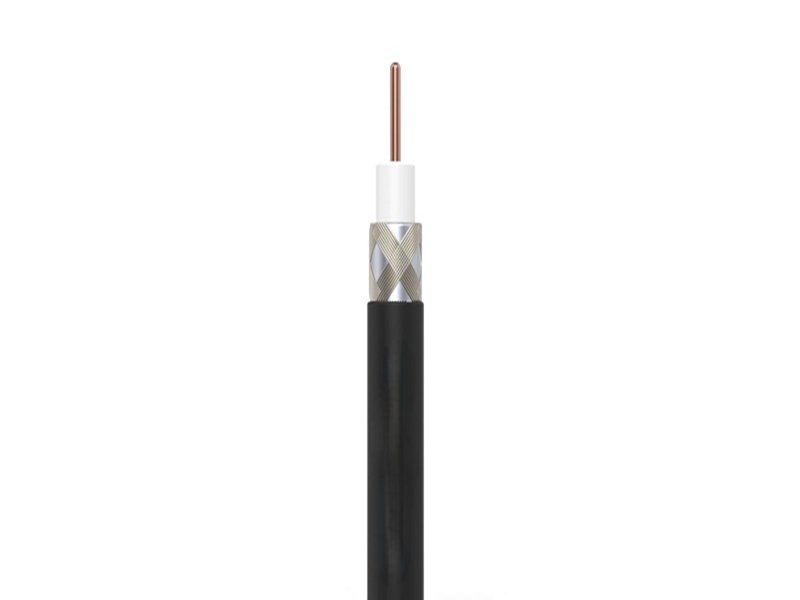
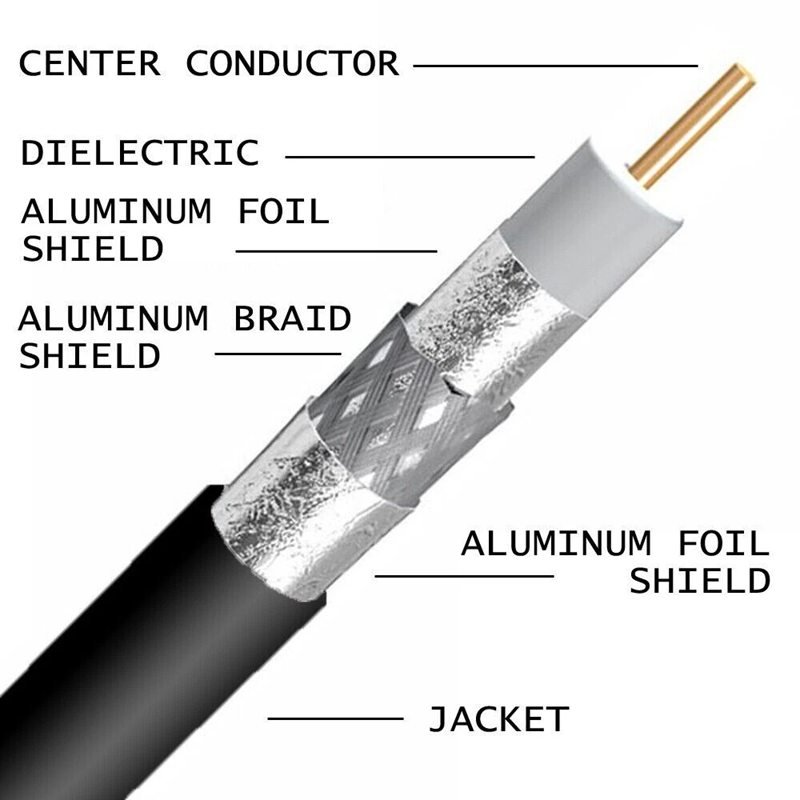
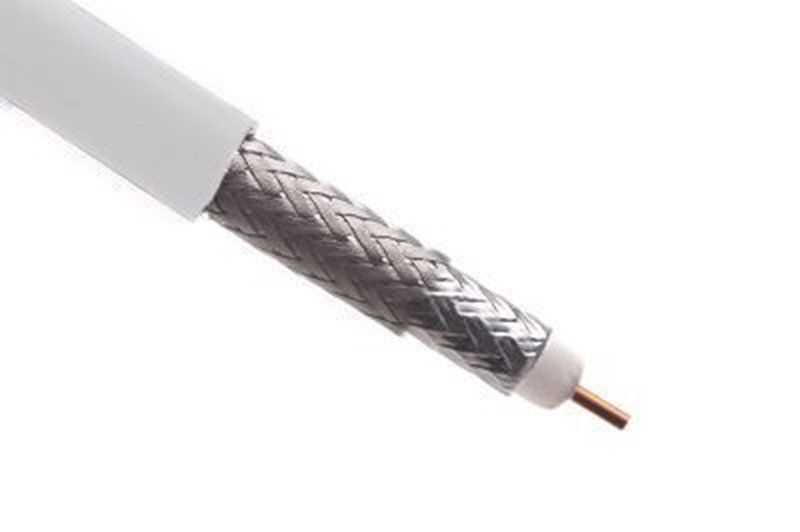
At its core, RG11 is engineered with a multi-layer structure consisting of a center conductor, dielectric, shielding layers, and an outer protective jacket. Each layer plays a role in maintaining impedance stability, reducing interference, and ensuring predictable performance across high-frequency ranges up to 3 GHz or more. This stability makes RG11 particularly effective for modern services such as HD television, high-throughput broadband, and RF control systems that rely on consistent signal strength.
Although RG11 is less flexible and slightly more challenging to install than RG6, its electrical performance makes it the preferred option in scenarios where distance, signal quality, and environmental resistance matter more than ease of routing. It is commonly used as the “backbone” or trunk line in residential, commercial, and industrial networks, while shorter branches or indoor drops may still use RG6.
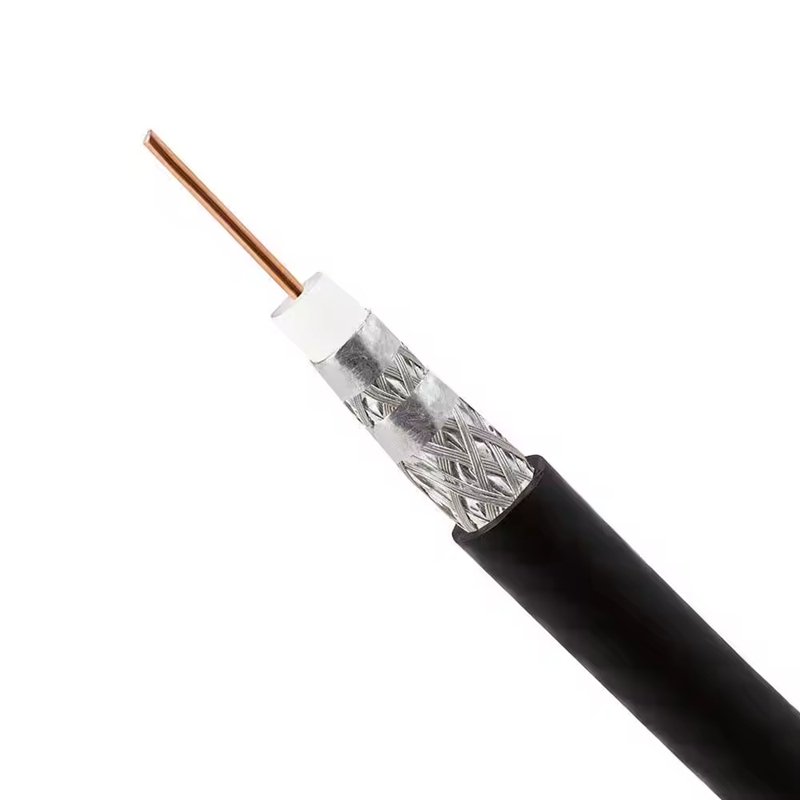
What Does “RG11” Mean?
Historically, “RG” stands for Radio Guide, a designation from early U.S. military cable standards. The numbering (such as 6, 11, 59) has no technical formula but denotes a general category within coax cables. Over decades of industry convergence:
- RG59 became associated with low-frequency analog video
- RG6 became the flexible, general-purpose TV/internet cable
- RG11 became the low-loss, long-distance variant in the 75-ohm family
So, while the name isn’t derived from specific values, the industry widely agrees on the characteristics that define RG11 today.
What Are the Core Specifications?
RG11 is typically defined by these characteristics:
| Parameter | Typical Value | Function / Importance |
|---|---|---|
| Impedance | 75 Ω | Ensures compatibility with TV, satellite, broadband systems |
| Center Conductor | 14 AWG (solid copper or CCS) | Larger size reduces resistance and signal loss |
| Outer Diameter | ~10.3 mm | Improves shielding and dielectric performance |
| Dielectric | Foam Polyethylene (FPE) | Lowers capacitance, increases signal velocity |
| Shielding | Dual / Tri / Quad | Enhances protection from EMI/RFI |
| Frequency Range | Up to 3 GHz+ | Suitable for satellite and broadband signals |
The combination of a thicker conductor and optimized dielectric is what gives RG11 its lower attenuation per 100 feet compared with RG6.
How Is RG11 Different from Standard Coax Types?
RG11 differs from RG6 and RG59 in several meaningful ways:
- Lower Signal Loss RG11 maintains stronger signal over long distances, especially above 1 GHz. RG6 begins to exhibit noticeable attenuation over long runs.
- Larger Diameter & Thicker Dielectric This physical design improves impedance stability but reduces flexibility. Installers often avoid RG11 in tight indoor routing but rely on it for longer trunk lines.
- Higher Frequency Capability RG11 can handle broadband DOCSIS 3.1 and modern satellite frequencies more effectively.
- Longer Maximum Run Length In many specs, RG11 supports runs 50–100% longer than RG6 before needing amplification
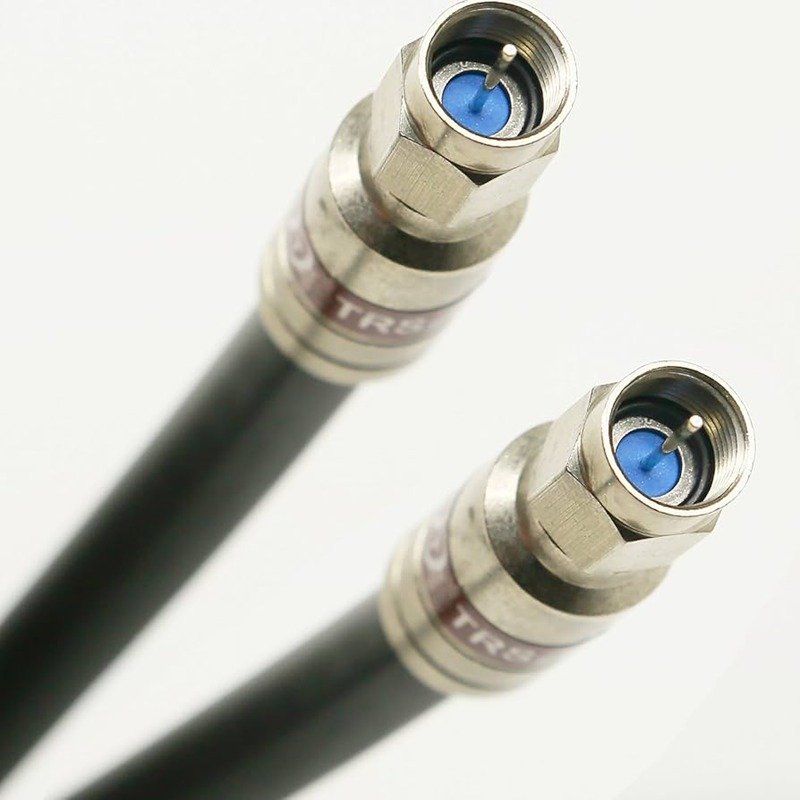
Which Coax Cable Is Better, RG6 or RG11?
The answer depends on the installation environment:
- Use RG6 for short, flexible indoor runs (under 150 feet).
- Use RG11 for long distances, outdoor connections, attic/crawlspace routing, or when the signal source is far from the equipment.
- Use RG11 when system specifications demand low attenuation (e.g., DOCSIS 3.1 modems, satellite LNB feeds).
RG11 isn’t universally “better”—it is simply the right tool for long-distance, low-loss requirements, whereas RG6 is the more practical option for everyday short-distance installations.
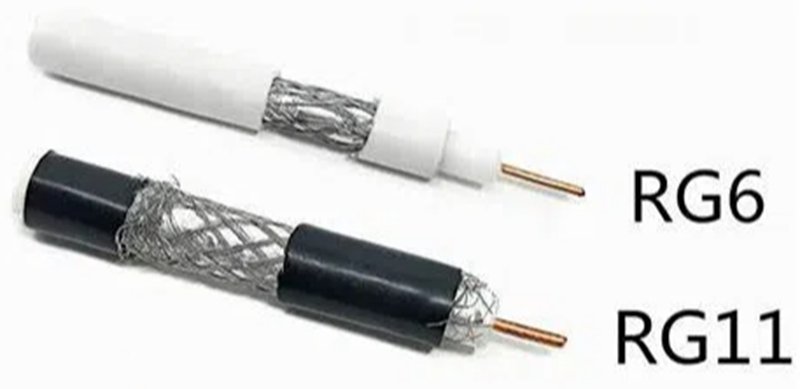
How Is RG11 Cable Constructed?
RG11 cable is constructed with a 14-AWG conductor, foam polyethylene dielectric, aluminum or copper shielding layers, and a durable jacket. This design reduces signal loss and provides strong EMI protection, making it ideal for outdoor or long-distance installations.
What Materials Are Used?
- Center conductor: solid copper or copper-clad steel
- Dielectric: foam polyethylene
- Shielding: aluminum foil, braid, or copper braid
- Jacket: PVC, PE, LSZH
Each material influences frequency response, durability, and signal quality.
Which Jacket Options Apply?
Different environments require appropriate jackets:
- PVC — indoor
- PE — outdoor, UV resistant
- LSZH — fire-safe indoor environments
- Flooded gel — direct burial
What EMI Shielding Options Exist?
| Shield Type | Use Case | EMI Protection |
|---|---|---|
| Dual Shield | Home installs | Medium |
| Tri Shield | Moderate RF environments | High |
| Quad Shield | Industrial or broadcast environments | Very High |
Where Is RG11 Coaxial Cable Used?
RG11 coaxial cable is primarily used in applications where signal must travel long distances with minimal loss, especially at higher frequencies. Because RG11 offers significantly lower attenuation compared with RG6 or RG59, it becomes essential in outdoor, backbone, and infrastructure-level installations within broadband networks, satellite systems, and commercial communication environments. Situations where cable runs exceed 150–300 feet typically require RG11 to maintain signal quality, prevent pixelation, and ensure stable data throughput.
Its mechanical properties—such as a thicker dielectric, larger conductor, and robust shielding—also make RG11 well-suited for environments exposed to weather, electromagnetic interference, or physical routing challenges. As a result, RG11 is commonly found in residential service drops, multi-dwelling unit distributions, campus-level CCTV installations, and telecom networks that require predictable, long-term performance.
What Is RG11 Coax Used For?
RG11 is widely used in the following scenarios:
- Satellite Dish to Receiver Connections Many satellite systems operate above 1 GHz, where attenuation becomes a critical factor. RG11 maintains stronger signal levels from the dish to interior equipment, especially over long exterior wall runs or rooftop-to-ground connections.
- Broadband Internet Infrastructure Cable internet providers often specify RG11 for:
- Pole-to-home drops
- Between buildings in residential complexes
- Outdoor backbone lines feeding distribution amplifiers
- Fiber-to-the-Home (FTTH) Hybrid Installations Even in fiber deployments, coaxial cable is frequently used for the last segment into the residence, particularly in older infrastructure where replacing all coax is impractical.
- Campus-Scale CCTV and Security Systems Large facilities—such as schools, universities, industrial parks, and hospitals—use RG11 as the main trunk cable feeding remote CCTV nodes. The reduced attenuation ensures video clarity over long runs.
- Commercial Video Distribution Systems Hotels, stadiums, casinos, and office buildings often use RG11 in multi-floor MATV/SMATV networks where signals must travel to numerous endpoints.
- Outdoor or Underground Communication Lines RG11 is available in PE jackets, flooded versions, and direct-burial types, making it suitable for:
- Underground conduit runs
- Outdoor wall and roof routing
- Ground-to-building feed lines
In these environments, RG6 typically becomes inefficient due to higher loss, making RG11 the more reliable option.
Is RG11 Better for Long-Distance TV and Satellite Signals?
Yes, particularly when cable lengths exceed roughly 150 feet or when operating with high-frequency satellite signals (950–2150 MHz). Over these distances and frequency ranges:
- RG6 attenuation becomes significant
- Signal-to-noise ratios decline
- Pixelation, dropouts, or loss of lock may occur
RG11’s larger conductor and improved dielectric significantly reduce dB loss per 100 feet, allowing satellite receivers to maintain adequate signal quality without extensive amplification.
Do Broadband and ISPs Still Use RG11?
Yes. Despite advances in fiber technology, RG11 remains common in last-mile or hybrid coaxial infrastructure. Internet service providers employ RG11 for:
- Aerial drop cables from utility poles
- Long-distance modem feed lines
- Distribution points across large residential blocks
- Outdoor segments exposed to temperature extremes
RG11 helps maintain downstream and upstream power levels within operational tolerances, especially in DOCSIS-based systems.
What Industries Prefer RG11?
RG11 appears in multiple industry sectors where long-distance RF or broadband transmission is required:
- Telecommunications — trunk lines, distribution nodes, headend connections
- Broadcasting — high-frequency RF distribution within large facilities
- Security & Surveillance — campus-scale CCTV infrastructure
- Hospitality — large MATV systems in hotels and resorts
- Industrial Automation — communication networks with long cable routing
- Sports & Entertainment Venues — stadium-wide video distribution
In all these cases, the combination of distance, frequency, and reliability makes RG11 the preferred choice over thinner coax types.
RG11 vs RG6 vs RG59 — Which Should You Choose?
Choose RG11 for long-distance and outdoor high-frequency installations, RG6 for general indoor use, and RG59 for low-frequency legacy systems. RG11 provides the lowest attenuation and best signal quality over long runs.
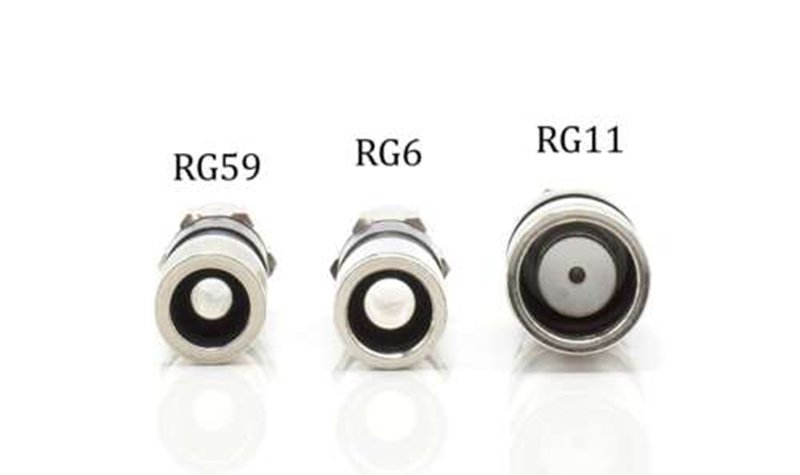
Table: Comparison of Coax Types
| Feature | RG59 | RG6 | RG11 |
|---|---|---|---|
| Impedance | 75Ω | 75Ω | 75Ω |
| Best Use | Legacy CCTV | Home TV | Long-distance broadband |
| Attenuation | High | Medium | Low |
| Flexibility | High | Medium | Low |
| Performance | Low | Medium | High |
What Are the Electrical Differences?
RG11 delivers:
- Lower dB loss
- Greater signal stability
- Higher usable frequency range
- Superior shielding performance
Is RG11 Always Better for Long Runs?
Yes—especially over 150–200 feet. RG6 becomes lossy at long distances.
Which Cable Type Fits HD Video or RF Systems?
- Indoors: RG6
- Outdoors or long runs: RG11
- Legacy analog: RG59
How to Choose the Right RG11 Cable?
Choose RG11 based on shielding type, jacket material, conductor grade, environment rating, and frequency needs. Outdoor runs require PE or direct-burial jackets, while indoor fire-rated spaces may require LSZH or plenum options.
What Specs Matter Most?
- Stable 75-ohm impedance
- Quad-shield for noisy RF environments
- Bend radius tolerance (3–5 inches)
- Frequency rating for your application
Do Outdoor or Burial Installations Require Special Materials?
Yes:
- UV-resistant PE
- Flooded gel
- Armored options
- Moisture-blocking layers
How to Identify Quality vs Low-Quality RG11?
High-quality RG11 has:
- Consistent outer diameter
- Uniform dielectric
- Verified shielding braid count
- Clean jacket extrusion
- Certifications such as UL, RoHS, REACH
Can RG11 Cable Be Customized? (Sino-Conn Guide)
Sino-Conn provides fully customizable RG11 coax cables, including length, connectors, shielding level, materials, pinout, and environmental ratings. Fast drawings, samples, and engineering support are available.
What Customization Options Do We Provide?
- Length and routing
- F, BNC, N, SMA or custom connectors
- Quad-shield configurations
- PVC, PE, LSZH jackets
- Pinout definition
- Overmolded connectors if needed
Do You Need Specs Before Ordering?
Not required. We can work from:
- Customer photos
- Text descriptions
- Old samples
Drawings are delivered in 30 minutes to 3 days.
How Fast Is Our Production?
- Drawings: 30 minutes–3 days
- Samples: 2–14 days
- Bulk: 2–4 weeks
- Urgent orders available
Are Original or Replacement Connectors Offered?
Yes—genuine or cost-effective equivalents.
What Certifications Can Sino-Conn Provide?
UL, ISO, RoHS, REACH, PFAS-free, COC, COO.
How Much Does RG11 Cable Assembly Cost?
RG11 assembly pricing varies by materials, shielding, connectors, environmental rating, order quantity, and application. Industrial and military builds cost more, while large OEM orders receive lower per-unit pricing.
Why Do Prices Vary?
| Factor | Impact |
|---|---|
| Country | US/Japan higher, India/SEA lower |
| Industry | Medical & military highest |
| Connector brand | OEM connectors cost more |
| Quantity | Larger volume = lower unit price |
What Affects Production Cost?
- Shielding complexity
- Jacket material
- RF testing requirements
- Custom assembly steps
- Flexibility or ruggedization needs
Why Engineering Samples and OEM Orders Differ?
Samples require engineering time, prototyping, and adjustments. OEM orders benefit from repetitive consistency and volume savings.
Why Choose Sino-Conn for Custom RG11 Cable Assemblies?
Sino-Conn offers fast engineering support, no minimum order quantities, competitive pricing, and strict 100% inspection for all RG11 cable assemblies. Ideal for engineers, OEMs, and global distributors.
What Are Our Lead Times?
- Samples: 2–14 days
- Bulk orders: 2–4 weeks
- Rush service available
How Does Our Fast Response Help?
- 30-minute quotes
- 30-minute–3 day drawings
- Direct video communication
- Engineering-based consultation
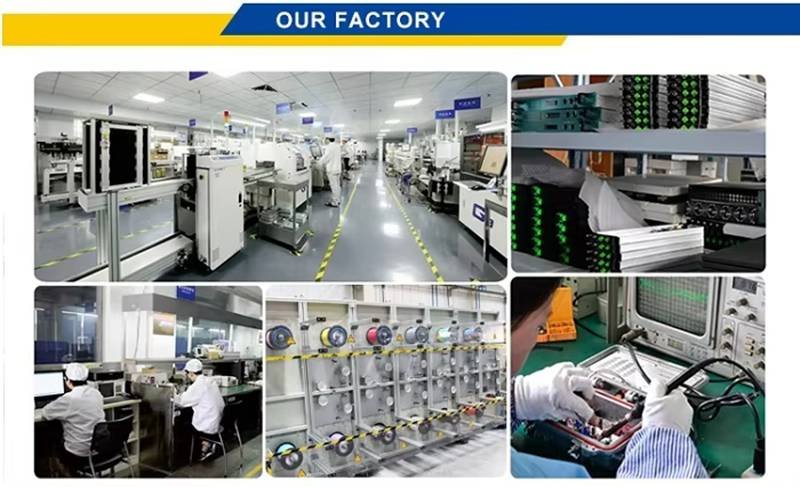
How Do We Guarantee Quality?
3-step full inspection system:
- Process inspection
- Completion inspection
- Pre-shipment inspection
Which Customers Benefit the Most?
- Engineers (customization & precision)
- OEM factories (scale & pricing)
- Traders (fast delivery & flexibility)
Conclusion
RG11 coaxial cable is the ideal solution for long-distance, high-frequency signal transmission in modern communication systems. Selecting the right RG11 cable—and customizing it for your environment—ensures reliable performance and long-term stability.
If you need custom RG11 assemblies, fast drawings, engineering consultation, or certified production:
Contact Sino-Conn and tell us your requirements—we will build the exact cable you need.