Skip to content

When you think about modern connectivity—HDMI, optical, or USB-C might come to mind. Yet one analog hero continues to hold its ground: the RCA cable. Born in the early days of audio broadcasting, RCA cables have quietly adapted to decades of technological change, still found in everything from home theaters to industrial testing equipment. It’s a testament to engineering simplicity that has outlasted generations of digital trends.
An RCA cable is an analog audio or video cable that uses color-coded connectors—typically red, white, and yellow—to transmit signals between devices like amplifiers, TVs, and speakers. Despite newer digital alternatives, RCA cables remain popular due to their reliability, compatibility, and easy customization for professional and industrial use.
And here’s where it gets interesting: while most users see RCA cables as home entertainment accessories, engineers, OEMs, and system integrators still rely on them for custom analog signal pathways, low-latency transmission, and EMI-shielded designs. Let’s explore why this humble connector still defines analog excellence—and how Sino-conn helps bring RCA assemblies into the modern age.
What Is an RCA Cable and How Does It Work?
An RCA cable is an analog connector used to transmit audio or video signals through a central conductor surrounded by a grounding shield. It was developed by the Radio Corporation of America in the 1940s and remains widely used for consumer and industrial applications. RCA cables work by carrying low-frequency electrical signals between devices—such as amplifiers, speakers, and monitors—without digital conversion, preserving signal quality and minimizing interference across short to medium distances.
1. The Origins and Meaning of RCA
The RCA connector—short for Radio Corporation of America—was invented in the late 1930s to simplify internal phonograph connections. At that time, audio systems required bulky screw terminals or proprietary plugs, which were expensive and prone to noise. RCA’s design solved this with a simple coaxial structure:
- a central pin that carried the signal, and
- an outer metal ring that acted as the ground.
This basic but robust design quickly spread beyond record players. By the 1950s, RCA connectors became the universal analog interface for televisions, radios, and early video equipment. Even with the rise of digital standards like HDMI and DisplayPort, RCA’s mechanical simplicity continues to make it useful in legacy systems, testing equipment, and professional audio gear.
2. The Anatomy of an RCA Cable
Understanding how an RCA cable is built helps explain its reliability and versatility. Structurally, it’s a miniature coaxial cable designed for low-frequency signal transmission.
| Component | Description | Common Materials | Engineering Function |
|---|---|---|---|
| Center Conductor | Carries the main audio or video signal | Copper, tinned copper, OFC | Conductivity and signal integrity |
| Dielectric Insulator | Separates the signal from the shield | Polyethylene (PE), Teflon, Foamed PE | Maintains impedance stability |
| Shield/Braid | Surrounds the signal conductor | Aluminum foil, copper braid | Blocks electromagnetic interference |
| Outer Jacket | Protects from mechanical and environmental stress | PVC, TPU, Silicone | Durability and flexibility |

The typical impedance of an RCA cable is 50Ω for audio and 75Ω for video, matching the input and output characteristics of most analog devices. Maintaining this impedance balance is crucial for clean signal transfer, particularly in long cable runs.
3. How Signal Transmission Works
An RCA cable transmits a low-voltage analog signal—usually less than 2 volts peak-to-peak—between two grounded devices.
- The center conductor carries the alternating electrical signal (the actual sound or video information).
- The outer shield connects to the ground, completing the circuit and protecting against electromagnetic noise.
Because RCA uses unbalanced transmission, any external noise picked up along the cable can slightly affect signal purity. However, for short runs (under 5 meters), the degradation is negligible—especially when using quality shielding and tight connector tolerances.
In professional or industrial designs, double-shielded RCA cables (foil + braid) further suppress EMI and crosstalk. This is why RCA remains viable even in complex environments like automotive electronics or control panels.
4. What Is an RCA Cable Used For?
RCA cables are designed for analog audio and video transmission, and their uses vary across applications:

Home and Consumer Electronics
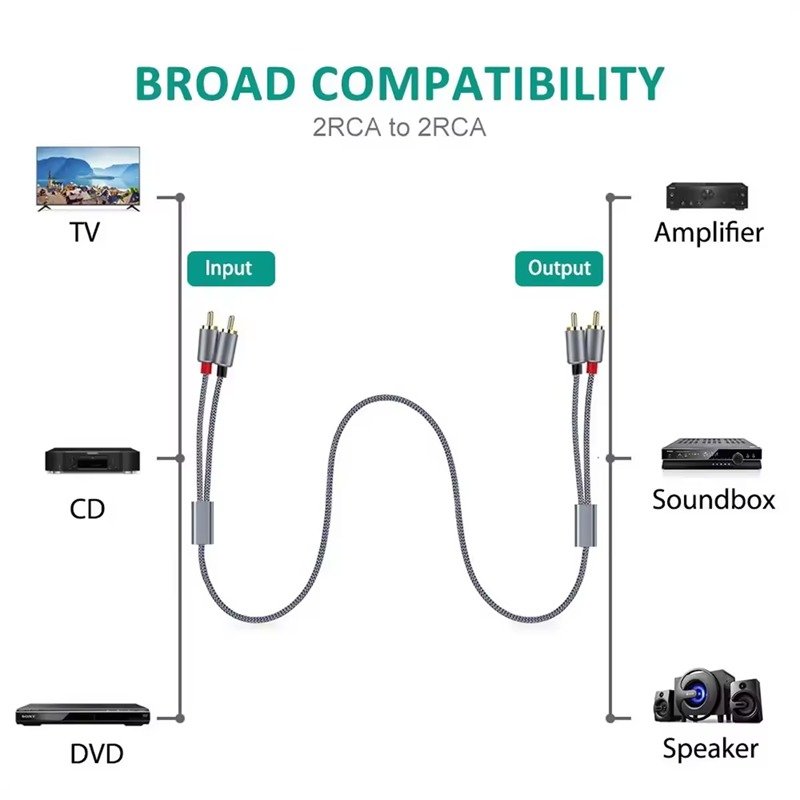
- Stereo audio connections between CD players, amplifiers, and speakers
- Composite video (yellow) for TVs, VCRs, and gaming consoles
- Subwoofer cables for low-frequency sound channels These are typically color-coded: red and white for audio, yellow for video.
Automotive and Industrial Equipment
- In-vehicle entertainment and backup camera systems
- Analog signal transfer between modules in control or diagnostic devices
- Low-voltage measurement systems where EMI resistance is important
Professional and Laboratory Environments
- Audio mixers and signal processors in studios
- Measurement instruments such as oscilloscopes or function generators
- Test benches that still rely on analog waveform accuracy
Despite being considered an older technology, RCA remains relevant because many systems still depend on analog continuity and low-latency communication—qualities not always achievable with digital interfaces.
5. Advantages and Limitations
Every connector technology involves trade-offs. RCA’s strength lies in its simplicity and universality, but it also has boundaries defined by analog physics.
| Advantage | Description |
|---|---|
| Ease of Use | Plug-and-play design requires no configuration or drivers |
| Low Latency | Instant signal transfer without digital encoding delay |
| Broad Compatibility | Works with most legacy and consumer-grade devices |
| Cost-Effective | Affordable materials and simple assembly |
| Analog Purity | No data compression, preserving original waveform integrity |
| Limitation | Description |
|---|---|
| Unbalanced Signal | More susceptible to noise over long distances |
| Limited Bandwidth | Not suitable for HD or digital content transmission |
| No Locking Mechanism | Can loosen under vibration if not molded securely |
| Distance Sensitivity | Ideal performance usually below 5 meters |
For industrial engineers or OEM designers, these characteristics define whether RCA is appropriate for their design—or whether a shielded coaxial or differential system is preferable.
6. Why RCA Still Matters in Modern Engineering
While digital interfaces dominate new consumer products, analog signal paths still exist at the system level. RCA is valuable where signal transparency, low-voltage compatibility, and physical simplicity are prioritized:
- Legacy Integration: Many OEM systems still require backward compatibility with analog ports.
- Testing and Calibration: Analog test setups often need clean baseband signals.
- Low-Cost Prototyping: Engineers can test analog circuits quickly using RCA connections before migrating to digital PCBs.
- Education and Research: RCA remains a teaching standard for demonstrating basic signal theory.
RCA’s longevity proves that a well-designed interface can outlive its era. Its fundamental principles—signal grounding, impedance control, and shielding—remain essential lessons for electrical design.
An RCA cable is more than a nostalgic connector—it’s a practical analog interface still serving engineers, manufacturers, and audio professionals worldwide. By using simple coaxial principles, RCA delivers reliable, low-latency transmission in environments where precision matters more than pixel count or bandwidth.
What Are the Different Types of RCA Cables?
RCA cables come in several forms: audio (red/white), composite video (yellow), component video (red/green/blue), and hybrid RCA-to-digital cables. Each serves unique purposes depending on the signal type, impedance, and device requirements.
Audio RCA Cables (Red & White)
Used for stereo sound transmission, these cables split left and right channels. They remain common in professional mixers, amplifiers, and older audio receivers due to their analog warmth and phase clarity.

Composite Video RCA (Yellow)
The yellow RCA transmits combined video signals—brightness, color, and sync—via one line. Though replaced by HDMI for most consumer applications, composite RCA remains valuable in legacy devices and low-latency industrial monitors.
Component RCA (Red, Green, Blue)
A step up in quality, component RCA separates color information (Y, Pb, Pr) into three cables, reducing interference and supporting up to 1080p resolution for analog displays.
RCA to Digital Audio and Adapter Solutions
As industries transition to hybrid systems, RCA-to-digital (SPDIF or coaxial digital) cables bridge old and new. Sino-conn provides RCA-to-BNC and RCA-to-TOSLINK assemblies that maintain impedance accuracy.
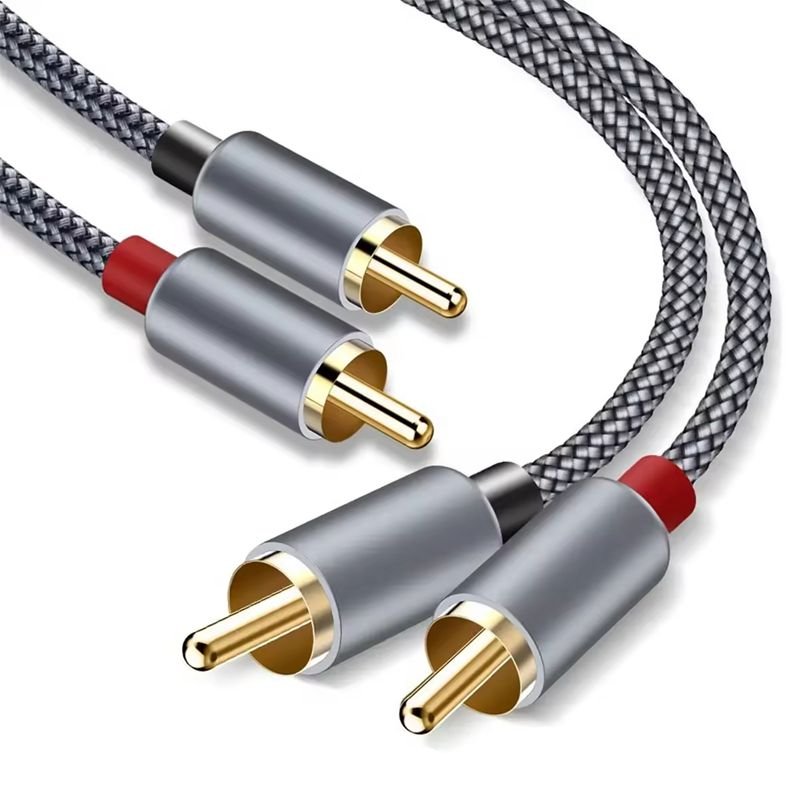
Specialized RCA Variants
For OEMs, Sino-conn manufactures high-flex RCA cables, mini-RCA, and gold-plated connectors to enhance signal stability and corrosion resistance under harsh conditions.
How Does RCA Compare with Coaxial, HDMI, and Optical Cables?
RCA cables transmit analog signals, while coaxial, HDMI, and optical cables carry digital signals. RCA excels in simplicity, low latency, and analog fidelity, but digital cables offer higher bandwidth and noise immunity for long distances.
RCA vs Coaxial Cable
Both use similar internal structures—central conductor and shield—but differ in purpose. RCA handles analog baseband signals, while coaxial often carries modulated RF or digital data. RCA impedance is typically 50–75Ω, while coaxial can go higher.
RCA vs HDMI

HDMI combines audio and video in digital form with HDCP encryption. RCA remains relevant for analog systems requiring zero-latency transmission. It’s also easier to customize in manufacturing—no complex encoding chips required.
RCA vs Optical (TOSLINK)
Optical cables transmit light signals immune to EMI. Yet, RCA’s electrical simplicity makes it ideal for short-run analog signal chains, testing environments, and low-power devices.
Choosing the Right Cable for Your Setup
| Application | Best Option | Reason |
|---|---|---|
| Legacy AV Systems | RCA | Analog compatibility |
| Modern TVs / Consoles | HDMI | Digital audio/video |
| Industrial Signal Testing | RCA | Low-latency analog transfer |
| Long-Distance Audio | Optical | EMI immunity |
Which Industries Still Use RCA Cables Today?
RCA cables remain in use across industries such as consumer electronics, automotive audio, broadcasting, and industrial testing. Their analog stability, customization potential, and wide compatibility ensure ongoing demand.

Consumer Electronics
Despite HDMI’s dominance, RCA remains key in DVD players, turntables, and amplifiers. Vintage enthusiasts still prefer RCA for analog sound reproduction.
Automotive AV Systems
OEM automotive manufacturers use RCA assemblies for backup cameras and infotainment modules. Sino-conn’s RCA cables withstand vibration, temperature fluctuations, and oil exposure.
Broadcast and Studio Applications
Mixing boards and analog monitors continue to rely on RCA for signal chaining. Engineers appreciate RCA’s predictable impedance and grounding.
Industrial Testing Equipment
RCA cables carry low-frequency signals for oscilloscopes, diagnostic instruments, and custom control panels. Sino-conn offers RCA assemblies with flame-retardant and anti-corrosion jackets for such environments.
Why RCA Remains a Standard
Analog equipment longevity and ease of repair keep RCA in circulation. Plus, for developing markets, RCA’s affordability is unmatched.
How Does Sino-conn Customize RCA Cable Assemblies?
Sino-conn customizes RCA cable assemblies by tailoring every specification—length, shielding, conductor material, flexibility, connector type, and environmental protection—to the client’s design and application needs. With in-house engineering, 3D CAD support, UL/ISO-certified production, and no MOQ policy, Sino-conn delivers prototypes within days and mass production within weeks, ensuring precision, performance, and cost efficiency for OEM, industrial, and audio-visual manufacturers worldwide.
Full Customization Options Tailored to Every Application
When it comes to RCA assemblies, “customization” at Sino-conn goes far beyond swapping connector colors. Our engineers start by studying your device’s signal requirements—impedance, voltage, current load, EMI tolerance, and mechanical fit—and then design the cable structure around that data.
Key parameters that can be customized include:
| Parameter | Options | Engineering Purpose |
|---|---|---|
| Length & OD | From 10 cm to 10 m | Adjust voltage drop & flexibility |
| Conductor Material | Bare copper, tinned copper, or CCA | Optimize cost vs conductivity |
| Shielding | Foil, braided, or dual-layer EMI shielding | Reduce noise & interference |
| Insulation & Jacket | PVC, TPE, TPU, Silicone | Enhance flexibility & temperature resistance |
| Connector Type | Straight, right-angle, molded, or overmolded | Adapt to mechanical space |
| Color Coding | Any Pantone or standard RCA color | Simplify assembly identification |
| Environmental Resistance | Flame-retardant, oil-proof, UV-proof, halogen-free | Meet industrial safety standards |
Each RCA cable can be built to audio-grade precision for studio systems or ruggedized for industrial machinery. OEMs in automotive, medical, and testing sectors often request tight impedance tolerance (±5Ω) and anti-vibration strain reliefs, which Sino-conn engineers integrate directly into the connector mold.
Engineering Support: From Concept to CAD in Hours
At Sino-conn, every project begins with data—not guesswork. Once you share your requirements, our technical team prepares a CAD drawing within 30 minutes to 3 days, depending on complexity.
- Clients can submit a photo, diagram, or existing sample.
- We reverse-engineer and propose optimized materials and structures.
- Each drawing is converted to PDF format for cross-department approval before production.
This streamlined process eliminates miscommunication between design, procurement, and manufacturing teams. Engineers appreciate that Sino-conn speaks their language: AWG, impedance, EMI, and bend radius are not sales jargon—they’re design parameters we optimize daily.
Example: A European OEM requested a low-noise RCA assembly for medical imaging. We reduced EMI by 42% through double-shielding and adjusted the conductor pitch without increasing OD, keeping the cable flexible enough for robotic movement.
Quality Control and Global Certifications
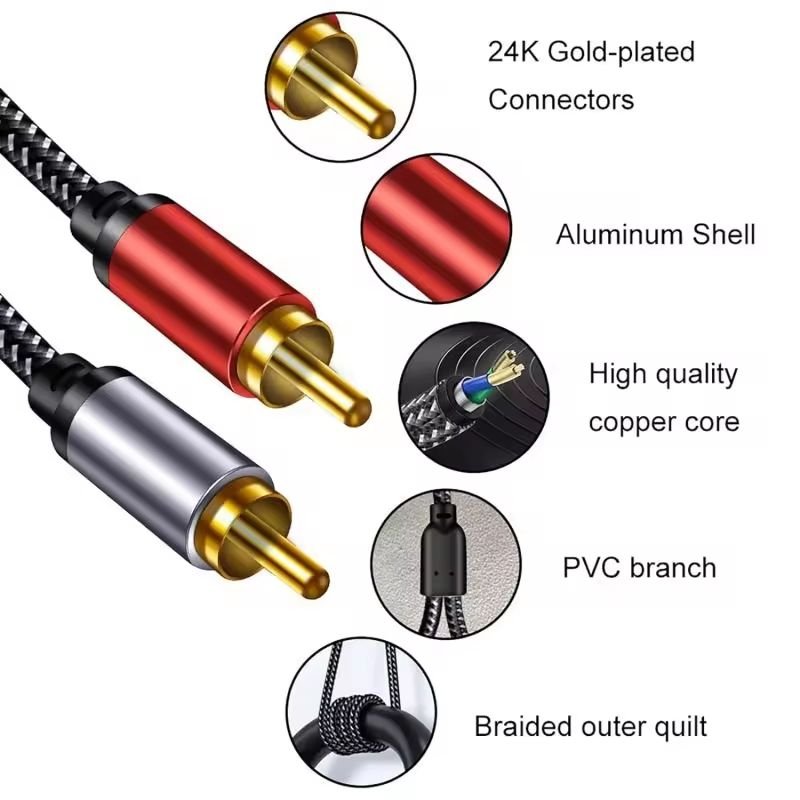
Customization is meaningless without reliability. Sino-conn’s RCA assemblies are backed by a three-stage inspection protocol that ensures every piece meets both mechanical and electrical standards.
| Stage | Process | Purpose |
|---|---|---|
| In-Process Inspection | Visual & continuity checks during production | Detect early assembly defects |
| Final Inspection | 100% test for impedance, polarity, and signal continuity | Ensure functionality |
| Pre-shipment Inspection | Random AQL sampling + visual check | Guarantee packaging & labeling accuracy |
All RCA cable assemblies are certified under:
- UL, ISO9001, RoHS, REACH, PFAS-free, COC, COO
- Testing performed for: dielectric strength, insertion loss, and insulation resistance
- Optional testing for temperature cycling, tensile strength, and vibration endurance for automotive and military clients
Every cable that leaves Sino-conn’s facility is traceable by batch and drawing number, giving OEMs full transparency from design to deployment.
Production Capacity and Lead Time Advantage
Time-to-market matters, especially for OEMs juggling multiple suppliers. Sino-conn’s vertically integrated production allows rapid turnaround—without compromising quality.
| Order Type | Typical Lead Time | Expedited Option |
|---|---|---|
| Prototype / Sample | 1–2 weeks | As fast as 2–3 days |
| Mass Production | 3–4 weeks | 2 weeks (priority orders) |
Other advantages include:
- No MOQ policy — order 1 unit or 10,000; flexibility stays the same.
- Rapid quoting — receive a complete price and drawing within 30 minutes.
- Stocked materials — over 300 conductor and insulation SKUs for instant availability.
For a U.S. automotive client, Sino-conn produced 800 sets of oil-resistant RCA assemblies in under 12 days—cutting project downtime by 30%.
Flexible Pricing and Partnership Models
Different customers have different priorities—price, performance, or delivery speed. Sino-conn’s pricing model reflects this diversity:
| Client Type | Key Focus | Typical Approach |
|---|---|---|
| OEM / Factory Integrator | Volume, reliability, cost-efficiency | Long-term framework pricing |
| R&D Engineer / Project Developer | Design validation, prototype testing | Flexible cost + rapid engineering support |
| Distributor / Trader | Margin & market flexibility | Competitive unit cost for resale |
For engineers and OEMs who value collaboration, Sino-conn offers co-development programs, allowing early access to tooling designs and prototype samples before full production. This approach turns suppliers into technical partners, not just vendors.
Do You Need Custom RCA to Digital Audio or OEM Cable Solutions?
Sino-conn provides RCA-to-digital and OEM-grade RCA assemblies customized for integration into modern devices. From prototypes to production, we offer fast turnaround and full documentation.
When to Choose Custom RCA Over Off-the-Shelf
If your design requires unique impedance, temperature resistance, or connector form, custom RCA assemblies ensure performance consistency. Sino-conn helps clients eliminate mismatched impedance and poor EMI control.
RCA-to-Digital & Hybrid Designs
Bridging analog and digital worlds, Sino-conn builds RCA-to-TOSLINK and RCA-to-BNC conversions for hybrid systems—ideal for engineers upgrading legacy equipment.
Design Validation & Prototyping
R&D engineers can request rapid prototypes with complete drawings and BOM. Sino-conn’s in-house testing simulates real-use conditions to verify durability.
Get Your Custom RCA Cable Today
Have a sample or image? Send it to Sino-conn. Our engineers will analyze and recreate your design to meet exact specifications—with production-ready results in days.
FAQ About RCA Cables
| Question | Short Answer |
|---|---|
| What is the impedance of an RCA cable? | Typically 50–75 ohms depending on use. |
| Can RCA carry digital audio? | Yes, with 75Ω coaxial structure for SPDIF. |
| Are RCA color codes universal? | Generally yes: red/white = audio, yellow = video. |
| How to minimize interference? | Use double-shielded or gold-plated connectors. |
| Are RCA connectors interchangeable? | Yes, with adapter types (BNC, TOSLINK, etc.). |
Conclusion — Why RCA Cables Remain Relevant
In a world rushing toward digital, RCA cables prove that analog craftsmanship still matters. They offer low-latency, high-fidelity signal transfer in applications where reliability counts more than bandwidth. For OEMs and engineers seeking performance, customization, and fast turnaround, Sino-conn bridges classic design with modern precision.
Ready to design your own RCA cable assembly?
Contact Sino-conn today to request your free CAD drawing or quotation—and experience a manufacturer who speaks your engineering language.