Skip to content
Modern electronic systems demand high-speed data transmission, low noise, low power consumption, and stable signal integrity—often all at the same time. Whether you are working on an industrial HMI panel, a medical imaging device, an automotive infotainment screen, or an embedded display system, the way signals travel between processors and displays directly affects performance, reliability, and long-term stability.
This is where LVDS (Low Voltage Differential Signaling) comes in.
LVDS is not a “new” interface, but it remains widely used and highly trusted in applications where robustness matters more than flashy bandwidth numbers. Engineers continue to choose LVDS because it delivers predictable electrical behavior, strong noise immunity, and long-distance transmission capability—especially in electrically noisy environments. At the same time, sourcing or customizing LVDS cable assemblies is often more complex than it looks on paper. Many buyers only have a model number or a reference image, while others come with incomplete specs or unclear pin definitions.
An LVDS interface is a high-speed data transmission technology that uses low-voltage differential signals to transfer data with minimal noise and power consumption. It transmits data as voltage differences between paired conductors, which improves signal integrity, reduces EMI, and enables reliable communication over longer cable distances, especially in display, industrial, medical, and automotive systems.
Behind that simple definition lies a lot of engineering nuance—from impedance control and shielding to connector selection, pinout definition, and cable flexibility. In the sections below, we’ll break down how LVDS really works, where it is still used today, and how manufacturers like Sino-conn help customers turn incomplete requirements into fully validated cable assemblies.
What Is an LVDS Interface?
An LVDS interface is a data transmission method that sends information using low-voltage differential signals instead of single-ended logic levels. By transmitting data as the voltage difference between two conductors, LVDS significantly reduces electromagnetic interference (EMI), improves noise immunity, and enables stable high-speed communication over cables, making it ideal for displays and industrial electronics.
What does LVDS stand for?
LVDS stands for Low Voltage Differential Signaling. The key ideas are “low voltage” and “differential.” Unlike traditional single-ended interfaces (such as TTL), LVDS uses two complementary signals per data line. The receiver does not care about the absolute voltage level; it only measures the difference between the two lines. This approach dramatically improves noise rejection.
From a cable assembly perspective, this means LVDS is inherently more tolerant of electrical noise, ground shifts, and crosstalk—critical in industrial cabinets, medical devices, or automotive environments where motors, power supplies, and RF sources are present.
What problems does LVDS solve in signal transmission?
LVDS was designed to solve three major problems engineers face in high-speed systems:
- Noise sensitivity – Differential signaling cancels common-mode noise picked up along the cable.
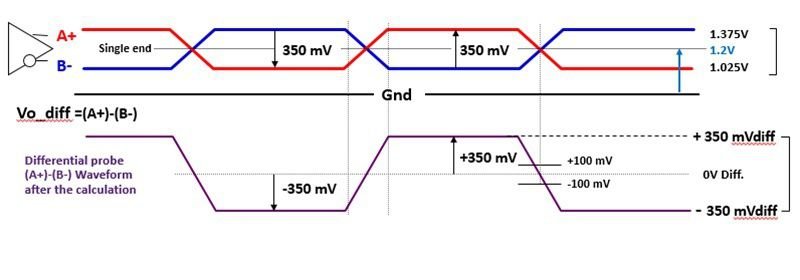
- High power consumption – LVDS operates at very low voltage swing (typically ~350 mV), reducing power draw.
- Signal degradation over distance – Compared to parallel TTL signals, LVDS maintains cleaner eye diagrams over longer cables.
In real-world projects, we often see customers switching to LVDS after encountering random display flicker, unstable images, or EMI compliance failures with older interfaces.
What industries commonly use LVDS?
LVDS is widely used in industries where reliability outweighs marketing trends:
| Industry | Typical LVDS Use |
|---|---|
| Industrial Automation | HMI panels, control displays |
| Medical Devices | Diagnostic monitors, imaging systems |
| Automotive | Infotainment, rear-seat displays |
| Embedded Systems | Single-board computers, FPGA platforms |
| Aerospace & Defense | Ruggedized display links |
At Sino-conn, many LVDS projects come from European and Japanese customers whose engineering teams prioritize electrical stability and documentation over consumer-style interfaces.
How Does LVDS Interface Work?
An LVDS interface works by transmitting data as a small voltage difference between two matched signal lines instead of a single-ended voltage level. A constant current source drives the signal, and the receiver detects logic states based on voltage polarity. This differential, low-voltage method significantly reduces EMI, improves noise immunity, and allows stable high-speed data transmission over longer cable distances.
How does differential signaling work in LVDS systems?
At the core of LVDS is differential signaling, where each data channel consists of two complementary conductors—often referred to as a “positive” and “negative” line.
Instead of sending a logic “1” or “0” as an absolute voltage referenced to ground, LVDS encodes data as the polarity of the voltage difference between the two lines. When one line is slightly higher than the other, the receiver interprets one logic state; when the polarity reverses, it interprets the opposite state.
This approach offers a major advantage: external noise usually affects both lines equally. Because the receiver only measures the difference, common-mode noise is largely canceled. In real industrial environments—near motors, power supplies, or switching devices—this noise rejection is the reason LVDS remains so reliable.
How does low voltage transmission improve signal integrity?
LVDS operates with a very small voltage swing, typically around 300–350 mV, driven by a constant current source. This low-voltage operation brings several practical benefits:
- Lower electromagnetic emissions (EMI) compared to high-voltage logic
- Reduced power consumption, especially important in embedded systems
- Minimal ground bounce, improving timing stability
However, low voltage also means less tolerance for impedance errors. Any mismatch in cable geometry, connector transition, or termination can distort the signal. This is why LVDS cable assemblies must maintain tight differential impedance control, typically around 100 ohms, from connector to connector.
How are LVDS signals transmitted over cables?
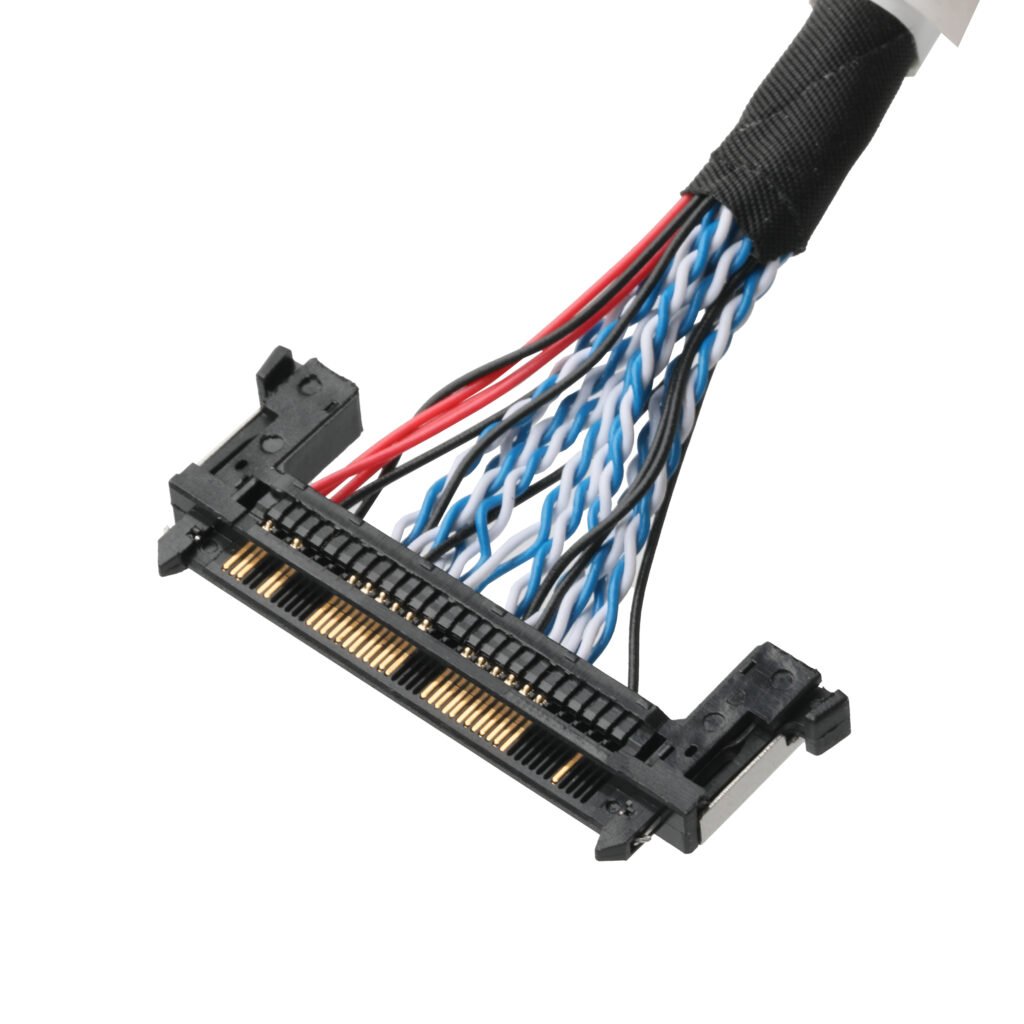
LVDS signals are almost always transmitted over twisted differential pairs. Twisting ensures that both conductors experience the same electromagnetic environment, which further improves noise cancellation.
A typical LVDS cable transmission path includes:
- Differential twisted pairs for each data channel
- One or more clock pairs
- Ground references or drain wires
- Optional shielding layers for EMI control
In longer or noisier installations, shielding becomes critical. Depending on the application, designers may choose:
- Overall foil shielding
- Individual pair shielding
- Braided shields for harsh environments
At Sino-conn, the cable structure is selected based on application, cable length, and EMC requirements, not by default.
How does impedance control affect LVDS performance?
Impedance consistency is one of the most important—and most misunderstood—parts of LVDS design.
LVDS drivers and receivers are designed for a specific differential impedance. If the cable impedance varies due to inconsistent conductor spacing, dielectric material changes, or poor connector transitions, reflections occur. These reflections can cause:
- Eye diagram collapse
- Timing jitter
- Intermittent display artifacts
This is why LVDS cables cannot be treated like generic signal wires. At Sino-conn, impedance targets are defined during the drawing stage, and cable geometry is engineered to stay within tolerance across the entire assembly.
How do termination and receiver circuits work in LVDS?
LVDS receivers typically include a termination resistor (often around 100 ohms) across the differential pair. This termination matches the cable impedance and absorbs the signal energy, preventing reflections at the receiving end.
If termination is incorrect or missing:
- Signal reflections increase
- Noise margins shrink
- System stability degrades
In many real projects, customers experience LVDS issues not because of the chipset—but because termination assumptions do not match the actual cable design. This is one reason Sino-conn reviews signal definitions and pinouts carefully before production.
How does LVDS maintain performance over longer distances?
Compared to single-ended interfaces like TTL, LVDS supports longer transmission distances without significant degradation. Typical LVDS cable lengths range from 30 cm to several meters, depending on data rate, cable quality, and environment.
Key factors that extend LVDS distance include:
- High-quality twisted pairs
- Stable impedance control
- Proper shielding
- Clean connector transitions
In industrial systems, LVDS cables often run inside metal enclosures or across moving assemblies. Proper mechanical design—strain relief, flexibility, and bend radius—becomes just as important as electrical performance.
Which Applications Use LVDS Interfaces Today?
LVDS interfaces are still widely used in industrial displays, medical imaging systems, automotive infotainment platforms, embedded computing devices, and long-lifecycle electronic equipment. Engineers continue to choose LVDS because it delivers stable signal integrity, strong EMI immunity, and predictable performance in harsh electrical environments where reliability and long-term availability matter more than maximum bandwidth.
Which industrial display systems rely on LVDS?
Industrial displays remain the largest and most stable application field for LVDS. Human-machine interfaces (HMIs), factory control panels, CNC machines, test equipment, and automation terminals commonly use LVDS-based LCD panels.
These systems often operate:
- 24/7 in electrically noisy environments
- Inside metal cabinets near motors and power supplies
- Over long product lifecycles (5–15 years)
LVDS is favored because it tolerates long internal cable runs, maintains signal stability, and is supported by a wide range of legacy and current LCD panels. In practice, many Sino-conn customers are not developing new architectures—they are upgrading or sustaining existing platforms, where LVDS compatibility is critical.
Which medical devices still use LVDS interfaces?
Medical equipment places extreme importance on signal reliability, EMI compliance, and certification stability. LVDS is widely used in:
- Patient monitoring displays
- Ultrasound imaging systems
- Diagnostic workstations
- Portable medical devices

Because LVDS operates at low voltage and generates minimal EMI, it helps systems meet strict medical EMC standards without excessive shielding at the system level.
From a cable assembly perspective, medical LVDS projects often require:
- Halogen-free or medical-grade materials
- Precise impedance control
- Documented drawings and traceability
This is why many medical customers involve Sino-conn early—even during the prototype phase.
Which automotive systems still depend on LVDS?
In automotive electronics, LVDS has long been used for:
- Infotainment head units
- Rear-seat entertainment displays
- Camera-to-display links in earlier platforms

While newer vehicles are gradually adopting automotive Ethernet and proprietary high-speed links, LVDS remains common in mid-generation and legacy vehicle platforms, especially where redesign cost is high.
Automotive customers typically prioritize:
- Temperature resistance
- Vibration durability
- Long-term part availability
LVDS cable assemblies with reinforced jackets, proper strain relief, and automotive-grade connectors continue to meet these requirements effectively.
Which embedded and computing platforms use LVDS?
Many embedded systems and single-board computers (SBCs) still provide LVDS output for direct LCD panel connection. Typical examples include:
- Industrial PCs
- ARM-based embedded controllers
- FPGA and SoC development platforms
LVDS is attractive because it allows direct panel interfacing without complex protocol conversion, reducing design complexity and failure points. For developers working on custom enclosures or space-constrained devices, LVDS also enables compact cable routing with predictable electrical behavior.
Which long-lifecycle and legacy systems continue using LVDS?
One often-overlooked reason LVDS remains relevant is product lifecycle length. In aerospace, industrial measurement, and infrastructure equipment, systems are designed to remain in service for 10–20 years.
Redesigning an interface is costly, risky, and often unnecessary. As a result, LVDS continues to be used in:
- Railway control systems
- Industrial inspection equipment
- Defense and aerospace display modules
In these cases, customers value continuity of supply and engineering support more than adopting the newest interface standard.
Why do engineers still choose LVDS instead of newer interfaces?
Although interfaces like eDP, MIPI, and automotive Ethernet offer higher bandwidth, they also introduce:
- Higher cost
- Shorter market availability cycles
- More complex validation requirements
LVDS remains attractive because it is:
- Electrically predictable
- Easier to debug
- Widely supported by panel suppliers
- More forgiving in harsh environments
For many real-world systems, LVDS is not outdated—it is appropriately mature.
What Are the Key Components of an LVDS Cable Assembly?
A typical LVDS cable assembly consists of differential pair cables with controlled impedance, compatible connectors, defined pinouts, and appropriate shielding. Proper material selection, cable geometry, and EMI control are essential to ensure stable LVDS signal performance.
What connectors are used in LVDS assemblies?
LVDS interfaces do not mandate a single connector type. Common options include:
- Board-to-board connectors
- I/O connectors (JST, Molex, Hirose, JAE, etc.)
- Custom or proprietary connectors

One critical question customers often ask is original vs. alternative connectors.
Original-brand connectors offer brand assurance but come with higher cost and longer lead time. High-quality alternatives, when properly qualified, provide similar electrical performance with more flexible supply.
Sino-conn supports both options and clearly explains the trade-offs before production.
What cable structures support LVDS performance?
Cable structure directly affects signal integrity. Typical LVDS cable designs include:
- Twisted differential pairs
- Controlled impedance conductors
- Uniform dielectric materials
Impedance mismatch is one of the most common causes of LVDS instability. This is why we never rely on assumptions—every LVDS cable is designed against impedance targets and validated through drawings before production.
What shielding and EMI control are required?
Not all LVDS cables require heavy shielding, but in industrial or medical environments, shielding is often critical.
Options include:
- Overall foil shield
- Individual pair shielding
- Braided shields for harsh EMI environments
Choosing the wrong shielding approach can increase cost unnecessarily—or worse, fail EMC tests. This is where experienced engineering support makes a real difference.
How Do You Customize an LVDS Cable Assembly?
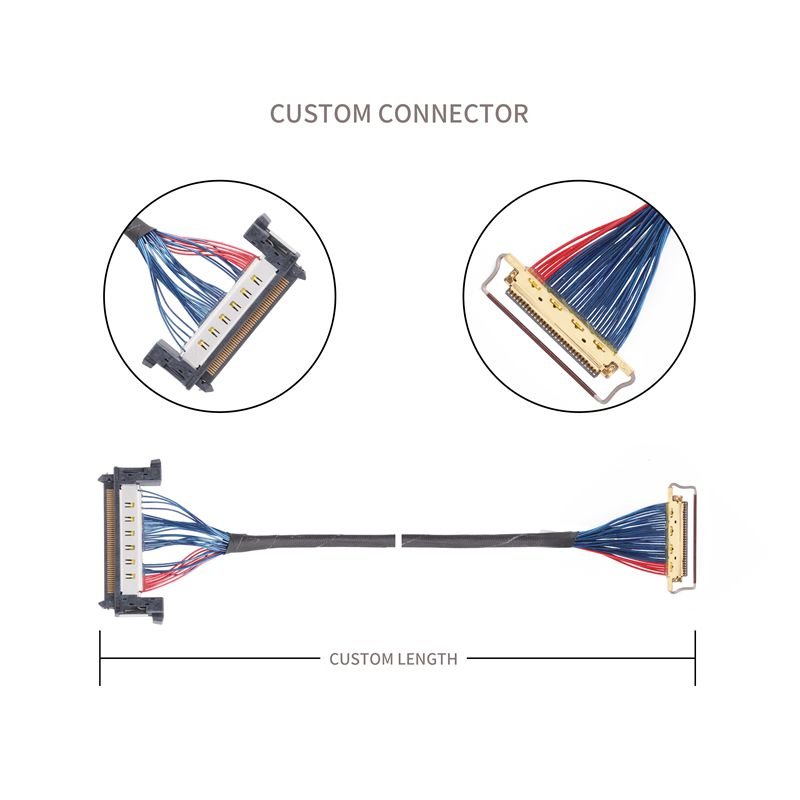
An LVDS cable assembly can be customized by defining the pinout and signal mapping, selecting connector types, adjusting cable length and structure, controlling impedance and shielding, and choosing suitable materials. Accurate drawings and engineering validation before production are essential to ensure signal integrity, compatibility, and long-term reliability in the final application.
How do you define pinout and signal mapping correctly?
Pinout definition is the single most critical step in LVDS cable customization. In practice, many customers do not provide a complete pinout. Some only send:
- A connector model number
- A photo of an existing cable
- A partial schematic from their system
In these cases, engineers must reconstruct the signal definition: which pins form differential pairs, which are clock signals, how grounds and shields are referenced, and how both ends interconnect.
At Sino-conn, every LVDS project starts with pinout clarification and drawing generation. We create a clear end-to-end signal map (from connector A to connector B), convert it into a CAD → PDF drawing, and send it to the customer for confirmation. Production only begins after approval—this step alone eliminates a large percentage of LVDS field failures.
How do connector choices affect LVDS customization?
LVDS does not enforce a fixed connector standard. Common connectors include board-to-board types, micro I/O connectors, and various JST, Hirose, Molex, or JAE series.
Customers often ask whether to use original brand connectors or high-quality alternatives. The answer depends on:
- Budget
- Lead time
- Quantity
- Lifecycle requirements
Original connectors offer brand assurance but usually come with higher cost and longer lead times. Qualified alternatives provide similar electrical performance, faster availability, and more flexibility for customization. Sino-conn supports both options and explains the trade-offs clearly before quoting.
How do cable length and routing influence LVDS performance?
Cable length is not just a mechanical parameter—it directly impacts signal quality. Longer LVDS cables introduce:
- Attenuation
- Skew between differential pairs
- Increased EMI exposure
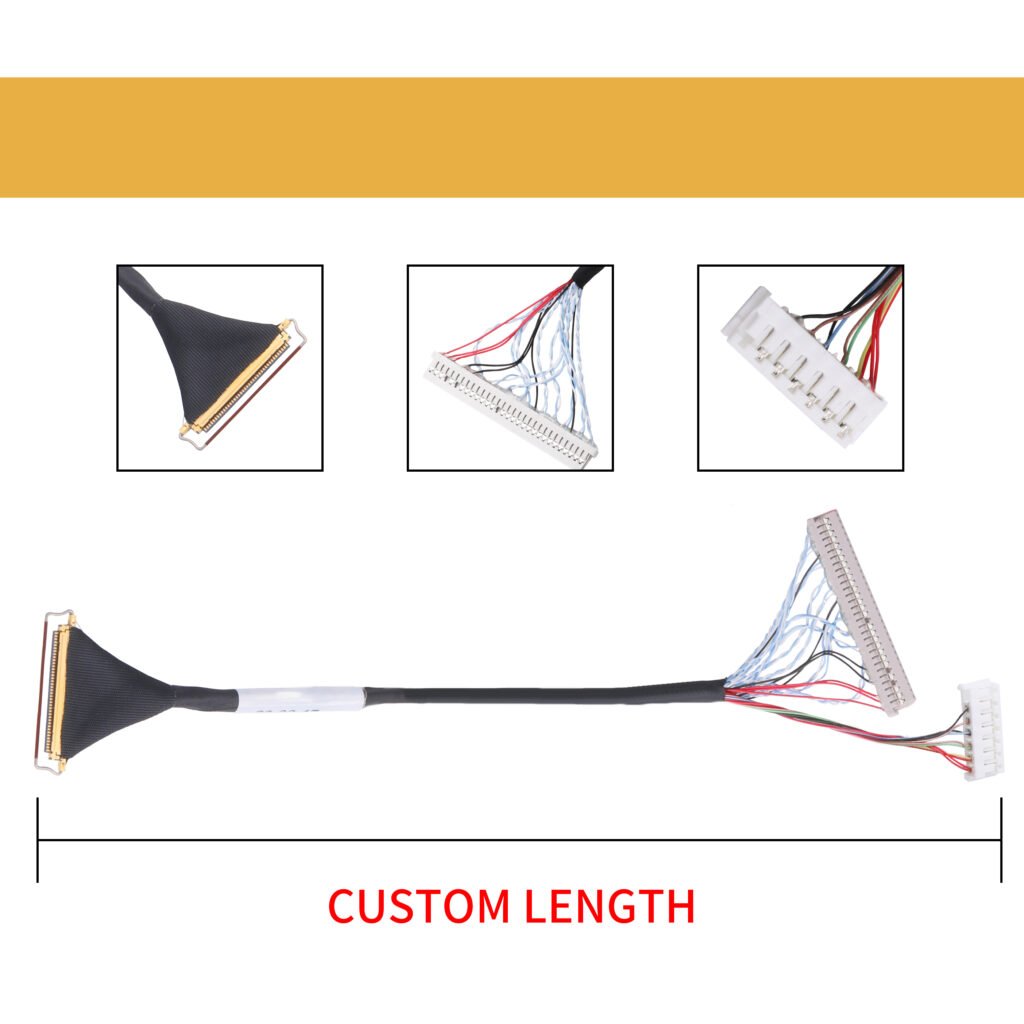
Customization requires balancing required length with signal margins. In compact systems, we often recommend keeping LVDS cables as short as possible. In larger enclosures, impedance control and shielding become more important.
Routing constraints also matter. Tight bends, moving parts, or repetitive flexing demand flexible jackets, optimized strand structures, and proper strain relief. These details are often overlooked until failures appear in the field.
How do cable structure and impedance control get customized?
LVDS requires tight differential impedance control, typically around 100 ohms. Achieving this depends on:
- Conductor size and spacing
- Dielectric material
- Pair twisting geometry
A “generic” cable rarely meets these requirements consistently. At Sino-conn, impedance targets are defined during the design stage, and the cable structure is selected or adjusted accordingly. This is especially important when customers request non-standard OD, thinner cables, or higher flexibility—all of which affect impedance.
How do shielding and EMI requirements change by application?
Not all LVDS applications require the same shielding level. Customization depends heavily on environment:
- Industrial cabinets often require overall shielding
- Medical devices may need enhanced EMI control for compliance
- Automotive systems may combine shielding with mechanical reinforcement
Options include overall foil shields, individual pair shields, braided shields, or combinations thereof. Over-shielding increases cost and stiffness; under-shielding risks EMI failure. The right balance is application-specific.
How are materials customized for different industries?
Material selection is another key customization factor. Depending on the application, LVDS cable assemblies may require:
- High-temperature resistance
- Oil or chemical resistance
- Flame-retardant or halogen-free jackets
- Long-term flexibility
Medical, automotive, and industrial customers often have very different material priorities, even when the electrical interface is the same. This is why Sino-conn treats LVDS cables as engineered products, not catalog items.
How are drawings, samples, and production validated?
Once customization parameters are defined, Sino-conn provides:
- Detailed drawings for customer approval
- Fast samples (as quick as 3 days for urgent cases)
- No MOQ, starting from 1 piece
All LVDS cable assemblies undergo 100% inspection—process inspection, final inspection, and pre-shipment inspection. This ensures that what was approved on paper is exactly what ships.
What Are the Advantages and Limitations of LVDS?
LVDS offers low power consumption, strong noise immunity, and reliable high-speed transmission. However, it has limited bandwidth compared to newer interfaces and requires careful impedance control. LVDS remains ideal for stable, long-life systems rather than cutting-edge consumer electronics.
What advantages does LVDS have over single-ended signals?
Compared to TTL:
- Lower EMI
- Longer transmission distance
- Better noise immunity
- Lower power consumption
These advantages explain why LVDS dominates industrial and medical displays.
What are the limitations of LVDS interfaces?
LVDS does have constraints:
- Limited bandwidth vs. eDP/MIPI
- Parallel data complexity
- Careful routing required
For ultra-high-resolution consumer displays, newer interfaces make sense. For stable systems, LVDS remains practical.
What alternatives are replacing LVDS in some applications?
eDP, MIPI, and automotive Ethernet are growing—but they come with:
- Higher cost
- Shorter lifecycle certainty
- More complex validation
How Do You Choose the Right LVDS Cable Supplier?
Choosing the right LVDS cable supplier depends on engineering expertise, response speed, customization capability, quality control, certifications, and supply flexibility. A reliable supplier should help clarify incomplete requirements, provide accurate drawings and samples quickly, ensure impedance and signal integrity, and support both prototyping and mass production with consistent quality.
How important is engineering capability in an LVDS supplier?
LVDS cable assemblies are engineering-driven products, not standard commodities. A capable supplier must understand:
- Differential signaling behavior
- Impedance control and cable geometry
- Connector transitions and pin mapping
- EMI and shielding strategies
In real projects, many customers do not have a complete specification. They may only provide a model number, a photo, or a partial schematic. A qualified LVDS supplier should be able to analyze, reverse-engineer, and validate the design—not simply ask for more information.
At Sino-conn, our sales team works closely with engineers and can discuss LVDS performance, not just pricing. This engineering-first approach is often what convinces customers to move forward.
How does response speed affect LVDS project success?
Response speed is not just about fast replies—it’s about fast, accurate outputs. Delays in drawings or unclear answers often stall projects during the development phase.
A strong LVDS supplier should be able to:
- Provide drawings within days (or hours for urgent cases)
- Clarify pinouts quickly
- Quote based on real engineering assessment
Sino-conn can deliver drawings and quotations in as fast as 30 minutes for well-defined requests, allowing engineers to keep development moving instead of waiting.
How do drawings and documentation reduce project risk?
Clear documentation is one of the most underrated factors in LVDS projects. A professional supplier should always provide:
- End-to-end pinout drawings
- Cable structure descriptions
- Connector part references
All Sino-conn LVDS orders require customer approval of drawings before production. This process ensures that what is manufactured matches what the system expects—reducing costly rework and field failures.

How do quality control and testing differentiate suppliers?
LVDS issues often do not appear immediately. They show up as:
- Intermittent display noise
- Temperature-related failures
- EMI compliance problems
This makes quality control critical. A reliable LVDS supplier should implement:
- Process inspection during assembly
- 100% final inspection
- Pre-shipment verification
Sino-conn applies three-stage 100% inspection to every LVDS cable assembly, ensuring consistency from prototype to mass production.
How do certifications impact LVDS cable sourcing?
Certifications are not just paperwork—they are often mandatory for market access. Depending on application and destination, LVDS cable assemblies may require:
- UL
- ISO
- RoHS
- REACH
- PFAS compliance
- COC / COO
A supplier without these certifications may be cheaper initially but can delay or block product launches later. Sino-conn maintains a complete certification portfolio to support global shipments.
How does flexibility in MOQ and lead time influence supplier choice?
Many LVDS projects begin with small quantities—sometimes just one or two prototypes. Suppliers that require high MOQs force customers into unnecessary risk.
Sino-conn offers:
- No MOQ (starting from 1 piece)
- Samples in as fast as 3 days
- Mass production in 2–4 weeks, or faster for urgent orders
This flexibility is especially valuable for R&D teams and OEMs validating new designs.
How should pricing be evaluated for LVDS cable assemblies?
LVDS pricing varies based on:
- Connector choice (original vs alternative)
- Cable materials and structure
- Industry requirements (medical, industrial, consumer)
- Order volume and region
A professional supplier explains these variables transparently and offers multiple solution levels, rather than a single fixed quote. Sino-conn supports both cost-optimized and premium solutions, allowing customers to choose what fits their application.
How does communication quality affect long-term cooperation?
LVDS projects often involve iteration—pinout changes, length adjustments, or material upgrades. Clear communication reduces mistakes and builds trust.
Sino-conn supports:
- Direct engineer-to-engineer discussions
- Video meetings for technical alignment
- Clear follow-up documentation
This communication advantage is often why customers continue working with us beyond the first project.
Custom LVDS Cable Assemblies by Sino-conn
If you are working with LVDS interfaces and need:
- Custom pinouts
- Reliable signal integrity
- Fast drawings and samples
- Flexible pricing and lead time
Sino-conn is ready to support your project.

Whether you are an engineer validating a prototype, an OEM factory scaling production, or a buyer working from limited information, our team can turn your requirements into a production-ready LVDS cable assembly.
Send us your model number, drawing, photo, or idea—and we’ll take it from there.