Skip to content

Modern electronic systems rely on data more than ever—but surprisingly, many system failures still originate from something basic: the data cable itself. From consumer electronics and industrial controllers to medical equipment and embedded systems, data cables quietly determine whether signals arrive cleanly, consistently, and on time. Yet in real projects, “data cable” is often treated as a vague or generic term, leading to mismatched specifications, unstable performance, and late-stage redesigns.
Many buyers assume a data cable is simply “anything that transfers data.” In practice, that assumption hides critical differences. A cable that works in a lab prototype may fail in mass production. A cable suitable for short digital bursts may struggle under continuous high-speed transmission. And a cable that looks identical from the outside may behave completely differently internally—depending on impedance control, shielding structure, materials, and termination quality.
A data cable is a cable assembly designed to transmit digital or analog information between devices or system components. Unlike power cables, data cables prioritize signal integrity, impedance control, EMI shielding, and precise specifications. They are used in device communication, internal signal routing, and high-speed data transmission across industries such as electronics, medical devices, industrial automation, and networking. Most real-world applications require customized data cable designs.
In real manufacturing practice, confusion around data cables rarely comes from lack of intelligence—it comes from incomplete information. Customers often provide only photos, partial model numbers, or short descriptions, without fully understanding what the cable must actually do. This is where definition meets reality. To understand what a data cable truly is, and what it is used for, we need to look beyond the name and examine its function, structure, and application context.
What Is a Data Cable?
A data cable is a cable assembly used to transmit information signals—digital, analog, or mixed—between electronic components or devices. Its primary function is reliable data transfer, not power delivery, and it is defined by signal type, electrical characteristics, mechanical structure, and application-specific requirements.
What does “data cable” mean in real applications?
In real-world systems, a data cable is not defined by its name or connector alone. It is defined by what kind of information it carries and how sensitive that information is to distortion. Data cables may transmit simple low-speed control signals or extremely high-speed differential data streams. The requirements change dramatically depending on the use case.
For example, a data cable inside an industrial controller may only carry basic digital signals, while a data cable in a medical imaging system must maintain strict impedance and shielding to prevent noise interference. Treating both as “just data cables” leads to design shortcuts—and eventual problems.
What is a data cable used for in electronic systems?
A data cable is used to enable communication. This includes:
- Device-to-device data exchange
- Board-to-board or module-to-module communication
- Sensor signal transmission
- Display and interface data routing
Unlike power cables, which focus on current delivery, data cables focus on accuracy, timing, and stability. A small error in signal transmission may not cause immediate failure but can degrade system performance over time.

Is a data cable different from a power cable?
Yes—and confusing the two is a common mistake. Power cables are designed to deliver energy, prioritizing current capacity and thermal performance. Data cables are designed to deliver information, prioritizing signal integrity, impedance stability, and noise resistance.
In many systems, both coexist in close proximity. Without proper shielding and separation, power noise can corrupt data signals. This is why data cables often require more complex structures than they appear to.
What signals are typically carried by data cables?
Data cables may carry:
- Digital signals (low-speed or high-speed)
- Differential signals
- Mixed data and control signals
- Low-voltage analog signals
Each signal type imposes different constraints on cable design, which must be reflected in the specifications.
Which Types of Data Cables Are Commonly Used?
Common data cable types include USB cables, Ethernet cables, LVDS cables, ribbon cables, micro coaxial cables, and other signal-focused cable assemblies. The type used depends on transmission distance, data rate, environment, and whether the connection is internal or external.
Which data cables are used for device-to-device communication?
Device-to-device communication often relies on standardized interfaces such as USB or Ethernet. These data cables must follow defined electrical standards, but real-world applications still introduce variability in length, routing, and environment.
For OEM projects, even “standard” interfaces often require custom assemblies to fit mechanical layouts or environmental constraints.
Which data cables are used for short-distance transmission?
Short-distance data transmission inside devices commonly uses ribbon cables, flat cables, or board-to-board signal assemblies. These cables prioritize compact routing and consistent pin definition over long-distance shielding.
However, even short distances can be sensitive to noise when data rates increase. This is where shielding and controlled impedance become relevant—even for cables only a few centimeters long.
Which data cables support high-speed or high-frequency data?
High-speed data cables, such as LVDS or micro coaxial assemblies, are designed for applications where signal timing and integrity are critical. These cables often require:
- Controlled impedance
- Differential pair consistency
- Tight manufacturing tolerances
They are commonly used in displays, imaging systems, and high-performance embedded electronics.
Which data cables are used inside devices vs external connections?
Internal data cables focus on routing, flexibility, and integration. External data cables must also consider durability, handling, and environmental exposure. The same signal may require very different cable constructions depending on where it is used.
Are USB, Ethernet, LVDS, and ribbon cables all data cables?
Yes—but they are not interchangeable. Each serves a different communication role, and choosing the wrong type often leads to subtle failures rather than immediate errors.
Table : Common Data Cable Types and Typical Uses
| Data Cable Type | Typical Use Case | Key Design Focus |
|---|---|---|
| USB Cable | Device communication | Signal integrity, standard compliance |
| Ethernet Cable | Networking | Differential balance, shielding |
| LVDS Cable | Display / imaging | Impedance control |
| Ribbon Cable | Internal connections | Compact routing |
| Micro Coax Cable | High-speed signals | EMI control, consistency |
What Specifications Define a Data Cable?
In real projects, data cable problems rarely come from choosing the “wrong type” of cable.
They almost always come from specifications that were never clearly defined at the beginning.
Many customers start with statements like:
“This is a data cable.”
“It’s similar to the one we used before.”
“The connector is the same, so it should work.”
From a manufacturing and engineering perspective, none of these statements are specifications.
A data cable is defined by measurable electrical, mechanical, and material parameters.
If these parameters are unclear or assumed, signal instability, EMI issues, and late-stage redesigns are very common.
Below are the core specification areas that actually define a data cable in real use, not in theory.
Electrical Specifications That Define Data Performance
Electrical parameters determine whether data can be transmitted correctly at all.
They are also the area where small deviations cause the biggest problems.
The most commonly required electrical specifications include:
- Signal type (single-ended, differential, mixed signal)
- Data rate or frequency range
- Characteristic impedance (fixed value or controlled tolerance)
- Crosstalk limits
- Grounding and return path design
For low-speed control signals, electrical tolerance can be relatively wide.
For high-speed data, even small impedance mismatches can cause reflection, jitter, or data loss.
One important reality:
many electrical failures do not appear immediately.
Systems may pass initial testing but fail later due to temperature changes, cable movement, or system integration.
Table : Typical Electrical Parameters for Data Cables
| Parameter | Typical Range | Why It Matters |
|---|---|---|
| Signal type | Single-ended / Differential | Determines cable structure |
| Data rate | kbps → multi-Gbps | Defines bandwidth requirement |
| Impedance | Fixed or controlled | Prevents reflection |
| Crosstalk | Defined limit | Signal isolation |
| Ground reference | Defined / floating | Signal stability |
Mechanical Specifications That Affect Long-Term Reliability
Mechanical parameters are often underestimated, but they directly affect how electrical performance changes over time.
In real use, data cables are bent, routed, fixed, and sometimes moved repeatedly.
If mechanical limits are not defined, electrical problems appear later—even if the cable initially works.
Key mechanical specifications include:
- Outer diameter (OD)
- Minimum bend radius
- Cable geometry (round, flat, multi-core)
- Expected flex life
- Strain relief structure
A cable bent repeatedly beyond its design limit may slowly change impedance, crack shielding, or stress conductor connections.
These failures are common in handheld devices, movable arms, and compact enclosures.
Mechanical specifications should reflect actual installation and usage, not ideal lab conditions.
Table : Mechanical Parameters Commonly Confirmed in Projects
| Parameter | Typical Question from Customers |
|---|---|
| OD | Will it fit the routing space? |
| Bend radius | Can it bend this tight without damage? |
| Flex life | Is it static or moving? |
| Cable shape | Round or flat for layout? |
| Strain relief | How is stress handled at connectors? |
Shielding and EMI Control Requirements
EMI is one of the most common causes of unstable data transmission, especially when data cables run close to power lines, motors, or wireless modules.
Shielding is not a yes-or-no decision.
It is a structural choice.
Common shielding options include:
- Foil shielding
- Braided shielding
- Spiral shielding
- Combined foil + braid

Each option behaves differently under:
- Frequency changes
- Cable movement
- Grounding conditions
Improper shielding termination can even make interference worse by turning the shield into an antenna.
For this reason, shielding design and termination method should always be confirmed—not assumed.
Table : Common Shielding Structures and Use Cases
| Shielding Type | Typical Use Case |
|---|---|
| Foil | Compact, static environments |
| Braid | Mechanical durability |
| Spiral | Flexing applications |
| Foil + Braid | High EMI environments |
Material Specifications and Environmental Requirements
Material selection affects both reliability and compliance, especially in industrial and medical environments.
Common material requirements include:
- Heat resistance
- Flame retardancy
- Oil or chemical resistance
- UV resistance
- Halogen-free or fluorine-free materials
Material choices often involve trade-offs.
A jacket material that performs well electrically may not be flexible enough, while a very flexible material may limit temperature range.
The correct choice depends on where and how the cable is used, not on generic preferences.
Connector Compatibility and Termination Details
A data cable is not just the cable—it is the cable + connector + termination quality.
Key connector-related specifications include:
- Connector type and pitch
- Original brand vs compatible alternative
- Mating cycle requirement
- Mechanical locking method
- Shield termination method
Using a different connector with similar appearance but different internal structure can change signal behavior significantly.
Connector choice should therefore be treated as part of the electrical and mechanical design, not as a purchasing shortcut.
Why Datasheets and Drawings Are Not Optional
A data cable is only as reliable as its documentation.
Complete datasheets and controlled drawings allow:
- Engineering verification
- Performance prediction
- Manufacturing consistency
- Easier troubleshooting later
When customers provide only a connector part number without cable details—or only cable details without connector data—engineers must fill in gaps.
Each gap increases risk, cost, and development time.
Table : Documentation Typically Required for Data Cables
| Document | Purpose |
|---|---|
| Cable datasheet | Electrical & material reference |
| Connector datasheet | Mechanical & mating details |
| Assembly drawing | Pinout and structure confirmation |
| Approved PDF | Production baseline |
What Really Defines a Data Cable
In real manufacturing, a data cable is defined by:
- Electrical behavior
- Mechanical limits
- Shielding structure
- Material selection
- Connector compatibility
- Complete documentation
If any of these areas are undefined, problems usually appear later—when fixing them is more expensive.
For this reason, experienced suppliers focus less on what the cable looks like and more on what the cable must do in real use.
How Are Data Cables Designed and Customized?
In real projects, data cable design rarely starts with a complete specification.
More often, it starts with partial information: a photo, a sample cable, a connector model, or a short description of what the cable is supposed to do.
Designing and customizing a data cable is not about guessing.
It is about systematically turning unclear input into a manufacturable, repeatable definition.
Below is how data cables are actually designed and customized in real manufacturing environments.
How Data Cable Projects Usually Start
Most data cable inquiries fall into one of these situations:
- A photo of an existing cable
- A connector part number without cable details
- A sample cable with no documentation
- A drawing that lacks electrical or material information
From a customer’s point of view, this is normal.
From an engineering point of view, this means key parameters are missing and must be clarified before production.
The goal at this stage is not to quote immediately, but to identify what is known and what is unknown.
Table : Common Starting Inputs from Customers
| Customer Input | Typical Missing Information |
|---|---|
| Cable photos | Signal type, impedance, materials |
| Connector model only | Cable structure, shielding |
| Physical sample | Electrical limits, tolerances |
| Old drawing | Updated usage conditions |
How Cable Usage Is Clarified Before Design
Before any drawing or quotation, the first step is to understand how the cable is actually used.
Key clarification points usually include:
- What signals are carried (data rate, type)
- Where the cable is installed (internal / external)
- Whether the cable is static or moving
- Environmental exposure (heat, oil, vibration)
These questions often reveal constraints that were not obvious at first.
For example, a cable that looks simple may run next to a power module, making shielding critical.
Usage clarification prevents over-design and under-design at the same time.
How Pinout and Interconnection Are Defined
Pin definition is one of the most critical—and most frequently overlooked—steps in data cable design.
Even with the correct connectors, incorrect pin mapping will result in a non-functional assembly.
For data cables, engineers must confirm:
- End-to-end pin mapping
- Differential pair grouping
- Ground and shield connections
- Signal direction (if applicable)
Pinout confirmation is always documented in drawings, not left as verbal agreement.
Table : Pinout Details Typically Confirmed
| Item | Why It Matters |
|---|---|
| Pin mapping | Functional correctness |
| Differential pairs | Signal integrity |
| Ground reference | Noise control |
| Shield termination | EMI performance |
How Cable Length and Structure Are Customized
Cable length is not just a mechanical dimension.
It affects signal attenuation, routing feasibility, and mechanical stress.
Customization usually includes:
- Nominal length
- Length tolerance
- Cable geometry (round / flat)
- Internal structure (twisted pairs, coaxial cores)
In high-speed applications, even small length changes can affect timing or EMI behavior.
For this reason, length and structure are defined together—not separately.
How Connector Selection Affects Customization
Connector choice has a direct impact on cost, lead time, and flexibility.
Customers may choose between:
- Original-brand connectors
- Compatible alternatives
Original connectors may be required for consistency or customer standards, but often involve longer lead times and limited flexibility.
Alternative connectors can offer faster delivery and easier customization, especially at low or medium volumes.
The functional difference is usually minimal when properly validated.
Table :Connector Options and Practical Impact
| Option | Lead Time | Cost | Custom Flexibility |
|---|---|---|---|
| Original brand | Longer | Higher | Limited |
| Compatible type | Shorter | Lower | Higher |
How CAD-to-PDF Drawings Support Accurate Customization
Once key parameters are defined, a controlled drawing is created.
This drawing typically includes:
- Connector orientation
- Cable length and tolerance
- Pinout definition
- Structural layout
- Shield termination details
Drawings are converted from CAD to PDF and sent for customer confirmation before production.
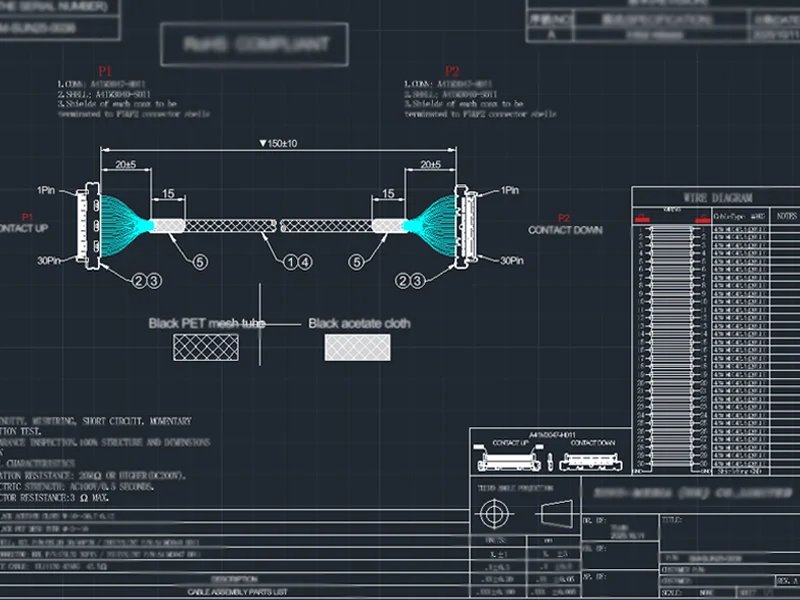
This step prevents misunderstandings and acts as a technical baseline for manufacturing.
Table : Information Typically Shown in Data Cable Drawings
| Drawing Element | Purpose |
|---|---|
| Connector view | Orientation confirmation |
| Length callout | Fit and routing |
| Pinout table | Electrical correctness |
| Notes | Special requirements |
Which Parameters Are Most Commonly Customized
Across different industries and projects, the most frequently customized parameters are:
- Cable length and tolerance
- Pin definition
- Connector type
- Shielding structure
- Jacket material
Customization is not about making something “special.”
It is about making the cable work correctly in its actual environment.
How Customization Impacts Lead Time and Production
Customization does not necessarily mean long lead times.
In most projects:
- Drawings can be prepared within days (or faster for simple designs)
- Samples are produced after drawing approval
- Mass production follows confirmed specifications
Clear customization early reduces rework later, saving both time and cost.
What Custom Data Cable Design Really Means
Designing and customizing a data cable means:
- Clarifying real usage
- Defining missing parameters
- Documenting details in drawings
- Confirming before production
- Manufacturing consistently
When these steps are followed, data cables move from “similar to the old one” to reliable, repeatable components.
How Do Different Customers Choose Data Cables?
Different customers choose data cables based on their role. R&D engineers focus on feasibility and signal reliability, OEM factories prioritize cost, quality, and scalability, traders value speed and clarity, while procurement teams balance price, lead time, and risk. Understanding these perspectives is critical for selecting the right data cable solution.
In theory, a data cable is a technical component.
In practice, it is a decision point shaped by who is buying it.
The same cable can be evaluated very differently by an engineer, an OEM factory, or a trader. Misunderstanding this often leads to mismatched expectations, pricing disputes, or stalled projects.
How R&D engineers define data cable usage during design
Engineers usually come with intent, not just a part number. They care about:
- Whether the signal can be transmitted reliably
- Whether the design can tolerate real-world conditions
- Whether trade-offs are clearly explained
Price is rarely their first concern. Engineers value suppliers who ask the right questions, challenge unclear assumptions, and can quickly translate requirements into drawings.
In many cases, engineers approach suppliers precisely because existing vendors cannot meet their technical needs. Once a design is validated at the engineering level, supplier continuity is very high.
How OEM factories evaluate data cable usage at scale
OEM factories view data cables through a production lens. Their priorities typically include:
- Stable quality over large volumes
- Consistent electrical performance
- Predictable lead times
- Competitive pricing
For OEMs, even small design ambiguities can cause large-scale issues during assembly. They often require suppliers to demonstrate process discipline, inspection capability, and the ability to scale without changing core parameters.
Payment terms and long-term supply stability also matter significantly at this level.
How traders describe data cable usage with limited technical input
Traders often operate between end customers and manufacturers. They may provide:
- A model number
- A photo
- A short description
Their goal is speed and clarity. They rely heavily on suppliers to identify missing details and translate vague input into manufacturable designs.
Successful cooperation here depends on clear communication, fast response, and realistic explanations of what can and cannot be done.
How buyers prioritize usage, cost, and lead time differently
Not all buyers weigh the same factors equally. For some, speed matters more than price. For others, cost dominates once the design is fixed.
Understanding these priorities helps prevent friction and enables realistic quotations from the start.
Table : Data Cable Priorities by Customer Type
| Customer Type | Primary Focus | Typical Concerns |
|---|---|---|
| R&D Engineer | Feasibility | Signal integrity, design support |
| OEM Factory | Scale & Cost | Price, consistency, QC |
| Trader | Speed | Confirmation, documentation |
| Procurement | Risk Balance | Lead time, compliance |
Do Data Cables Usually Require Custom Manufacturing?
Most data cables used in real products require custom manufacturing because standard cables rarely match exact electrical, mechanical, and environmental requirements. While off-the-shelf cables may support early testing, custom data cables are typically necessary for validation, production, and long-term reliability.
The idea of using a standard data cable is appealing—but often unrealistic.
Do standard data cables meet real usage requirements?
Standard data cables are designed for general use. They assume average conditions, fixed lengths, and standardized environments.
Real systems rarely fit that model. Routing constraints, mixed signals, mechanical stress, and EMI exposure all introduce variables that standard products are not designed to handle.
As a result, standard cables often fail quietly—through intermittent errors, signal instability, or reduced lifespan.
When data cable usage makes custom design necessary
Custom manufacturing becomes necessary when:
- Cable length affects signal quality
- Routing requires specific flexibility or geometry
- EMI environment is complex
- Connector availability is constrained
- Documentation and traceability are required
These factors are common—not exceptional—in professional products.
How application environment affects data cable manufacturing
Environment shapes design. Temperature, oil exposure, UV light, vibration, and repeated movement all influence material selection and structure.
Ignoring environment early often leads to redesign later—at much higher cost.
Why custom cable assemblies are common for data transmission
Custom assemblies align design intent with physical reality. They ensure that what is approved is what is produced, every time.
For most serious projects, custom data cables are not an upgrade—they are a requirement.
Table : Standard vs Custom Data Cables
| Aspect | Standard Cable | Custom Data Cable |
|---|---|---|
| Fit | Generic | Application-specific |
| Signal control | Limited | Defined and tested |
| Flexibility | Fixed | Designed for use case |
| Documentation | Minimal | Complete |
| Scalability | Uncertain | Predictable |
How to Describe Data Cable Usage Before Requesting a Quote
Before requesting a quote, clarity saves time and cost.
Suppliers typically need to understand:
- What the cable is used for
- What signals it carries
- Where it is installed
- How it is routed and handled
- What constraints exist on length and materials
When this information is incomplete, engineering effort increases—and so does risk.
Clear usage descriptions allow suppliers to propose accurate solutions, realistic lead times, and appropriate cost options from the start.
Final Thoughts: From Understanding Data Cables to Making the Right Choice
Understanding what a data cable is used for goes far beyond definitions. It requires understanding how signals behave, how environments affect performance, and how manufacturing decisions shape reliability.
If you are working with photos, partial specifications, or an early-stage concept, the most effective step is a technical discussion—not a guess.
Sino-Conn supports data cable projects from single-piece samples to scaled production, offering fast drawings, flexible customization, and realistic manufacturing timelines. If your project requires a data cable that actually works in real conditions, a clear inquiry is the right place to begin.