Skip to content

Coaxial cables are everywhere—inside medical devices, 5G modules, radars, autonomous robots, even the TV on your wall. Yet most people, including many purchasing managers and OEM sourcing teams, only know them as “coax cables” without truly understanding how they work, why different types exist, or how critical cable selection is to signal accuracy, RF stability, and long-term reliability. Engineers know that even a 1 mm change in OD or a mismatched connector can shift impedance enough to break an entire design. That is why companies that rely on performance—medical, military, RF labs, telecom, and precision electronics—care deeply about coaxial structure, shielding, materials, and assembly quality.
A coaxial cable is a specialized electrical cable designed with a center conductor, dielectric, shielding layers, and an outer jacket arranged concentrically to transmit high-frequency or low-loss signals. It works by keeping electromagnetic fields contained within the cable through controlled impedance and shielding. This design makes coax cables ideal for applications like RF communication, video, antennas, radar, sensors, and broadband connectivity.
Understanding these fundamentals is essential whether you’re an engineer specifying a new RF module, a trader sourcing high-mix coax assemblies, or an OEM balancing cost, performance, and lead time. And behind every cable is a real story—like the medical customer who sent Sino-Conn only a blurry photo of a micro-coax assembly and needed samples within three days to keep their prototype alive. We solved it. This article teaches you the same level of clarity and confidence.
What Is Coaxial Cable?
A coaxial cable is a multi-layer electrical cable built with a central conductor, insulating dielectric, metallic shielding, and an outer jacket arranged precisely along the same axis. This concentric structure is what allows a coax cable to maintain stable impedance and protect the signal from noise, making it fundamentally different from ordinary multi-core wires or twisted pairs. Because the electromagnetic field is confined between the conductor and the shield, coax cables provide low-loss, interference-resistant transmission even at high frequencies. They are widely used in RF communication, GPS, video, sensors, antennas, and other performance-critical electronics.
Coaxial cables are engineered for controlled impedance (most commonly 50Ω or 75Ω) so that high-frequency waves can travel without reflections or distortion. When the geometry or materials change—even slightly—the electrical behavior changes as well. For this reason, coax designs vary in conductor type (solid or stranded), dielectric materials (PTFE, PE, foam), shielding structures (foil, braid, double braid), and jacket compounds depending on the application’s mechanical and environmental needs.
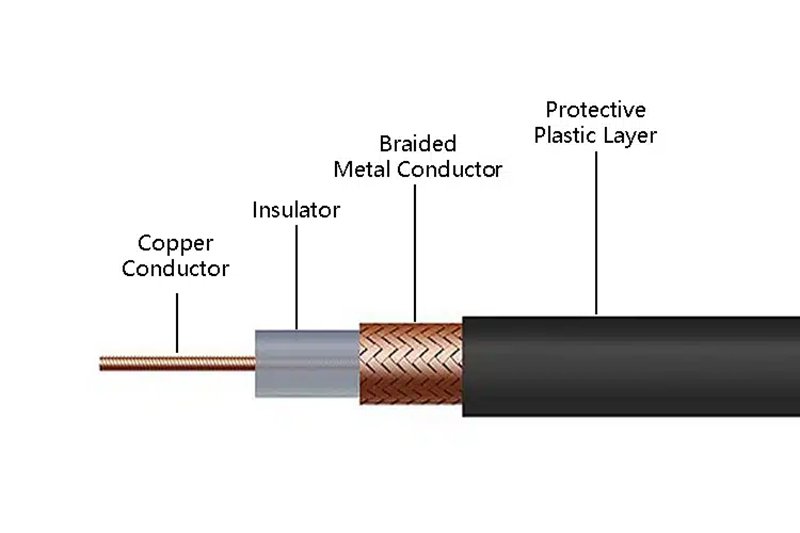
To help illustrate the differences, here is a simple structural breakdown:
Table: Typical Layer Structure of a Coaxial Cable
| Layer | Function | Common Material Options |
|---|---|---|
| Center Conductor | Carries the signal | Copper, tinned copper, silver-plated copper |
| Dielectric | Controls impedance, maintains spacing | PTFE, PE, foam PE |
| Shielding | Blocks EMI, provides return path | Aluminum foil, copper braid, double shield |
| Outer Jacket | Mechanical & environmental protection | PVC, TPU, FEP, LSZH |
Although many coax cables look similar externally, their performance can differ significantly due to variations in dielectric constant, shielding coverage, OD tolerances, and conductor plating. This is why a cable intended for a 5G antenna behaves very differently from one used for CCTV, even if they appear almost identical.
In short, a coaxial cable is defined not just by its appearance, but by the precise combination of structure, materials, and electrical characteristics that work together to preserve signal integrity across demanding environments.
How Is a Coaxial Cable Structured?
A coaxial cable consists of four major components: a center conductor (copper or tinned copper), a dielectric layer that defines impedance, a shielding structure to block EMI, and an outer jacket for protection. Each layer has a functional purpose—mechanical, electrical, or environmental. The geometric alignment of these layers is what keeps electromagnetic fields stable and signals clean, even in high-frequency environments.
What Materials Are Used in Coax Cables?
Materials vary by performance goals. Dielectrics may include PTFE, PE, foam PE, or LSZH depending on temperature and flexibility needs. Shields often use aluminum foil, copper braid, or double braid structures. Jackets can be PVC, TPU, FEP, or high-temperature halogen-free compounds. Sino-Conn frequently supports customers who require UV-resistant, oil-resistant, flame-retardant, or halogen-free custom jackets.
What Are the Key Electrical Characteristics?
Impedance (typically 50Ω or 75Ω), insertion loss, and shielding effectiveness are the most critical values. OD tolerance also matters because even small dimensional changes can impact performance. Sino-Conn provides exact electrical and mechanical specifications in all drawings and spec sheets for engineers and procurement teams.
Is a Coax Cable the Same as a TV Cable?
Not exactly. TV cables are usually 75Ω coax cables optimized for video and broadband. However, the coax category includes many other types—50Ω RF cables for antennas, micro-coax for devices, and semi-rigid coax for microwave applications. All TV cables are coax, but not all coax cables are for TV.
How Does a Coaxial Cable Work?
A coaxial cable works by confining the electromagnetic field between the center conductor and the shield. The dielectric maintains a constant impedance, while the shield blocks noise. This ensures clean, low-loss signal transmission for RF, data, and video applications, even over long distances.
The operation of coaxial cable is grounded in electromagnetic field theory. When a signal travels through the center conductor, an electromagnetic field forms between the conductor and the inner surface of the shield. The dielectric keeps this field stable and determines impedance. If impedance is inconsistent, reflections occur—resulting in distortion or signal loss.
At high frequencies, shielding quality is crucial. Double-braid or foil-braid structures reduce leakage and improve overall shielding effectiveness. Systems like 5G, radar, and GPS rely heavily on precise coax behavior; any deviation can lead to faulty measurements or weak reception.
Another significant factor is attenuation. Thicker cables typically have lower loss but are less flexible. Micro-coax cables, such as 1.13 mm assemblies, prioritize flexibility and compact size but introduce higher attenuation. Engineers must balance space, performance, temperature, and durability.
Environmental factors also influence performance. Heat, vibration, moisture, oil, and UV exposure degrade standard materials. Sino-Conn therefore offers halogen-free, high-temperature, flame-retardant, UV-resistant, and oil-resistant options depending on the application. Each project begins with a customized specification process to ensure the cable functions reliably in real-world conditions.
How Does EMI Shielding Maintain Signal Integrity?
Shielding prevents external noise from entering and stops internal fields from radiating outward. Foil shields block high-frequency interference, while braided shields block lower-frequency noise. In high-EMI environments, Sino-Conn typically recommends double shielding for stability.
Why Does Impedance Matching Matter? (50Ω vs 75Ω)
Impedance determines how signals propagate. 50Ω is standard for RF communication and antennas, while 75Ω is common for video and broadcast. Using the wrong impedance causes signal reflections, distortion, and loss. Sino-Conn matches impedance precisely to maintain system performance.
What Types of Coaxial Cables Are Commonly Used?
Coaxial cables come in many forms, including flexible coax, semi-rigid coax, micro-coax, and RF coax types such as RG series, 1.13 mm, and 1.37 mm cables. Choosing the right type depends on frequency, flexibility, durability, and connector requirements.
Coax types vary widely depending on electrical behavior and mechanical needs. Flexible coax like RG-174 or RG-316 offers good flexibility for general RF use. Semi-rigid coax, built with copper tubing, provides excellent shielding and stability for microwave frequencies. Micro-coax such as 1.13 mm or 1.37 mm is used in compact devices like drones, cameras, IoT modules, and wearable medical devices.
Connector choice is equally important. SMA and RP-SMA are widely used for antennas. MMCX and U.FL connectors fit small PCBs. BNC connectors remain popular for test equipment and video systems. Engineers rely heavily on proper cable-connector matching, especially when designing RF chains.
Sino-Conn supports original and equivalent connectors. Many customers prefer equivalents to reduce price and shorten lead time. With urgent projects, Sino-Conn delivers drawings and samples within 2–3 days and mass production in 2 weeks.
Which Coax Cable Types Fit RF and Microwave Applications?

Cables like RG-316, RG-402 semi-rigid, and low-loss 50Ω coax are common in RF modules, microwave systems, and antennas. Stability, low attenuation, and shielding effectiveness are key requirements.
What Is Semi-Rigid vs. Flexible Coax?
Semi-rigid coax uses a copper tube for the outer conductor, providing excellent shielding and minimal phase change. Flexible coax uses braided shielding and is easier to route in assemblies.
What Are Micro Coax and Ultra-Miniature Coax?
Micro-coax cables such as 1.13 mm or 1.37 mm are designed for small electronics. They balance flexibility, size, and adequate shielding. Sino-Conn frequently builds custom micro-coax assemblies for drones, wearables, sensors, and handheld devices.
Which Connectors Pair with Coax Cables?
Common connectors include SMA, RP-SMA, SMB, MMCX, U.FL, IPEX, BNC, and N-type. The connector must match impedance, frequency, and mechanical requirements.

Where Are Coaxial Cables Used Today?
Coaxial cables are used in RF communication, medical devices, aerospace systems, military equipment, antennas, GPS, video, broadband, drones, robotics, and test instruments. They provide stable, interference-resistant signal transmission.
Coax cables enable communication and sensing technologies across nearly every modern industry. In medical applications, micro-coax assemblies connect imaging sensors, ECG systems, and diagnostic devices requiring extremely low noise. In aerospace and defense, ruggedized coax supports radar, telemetry, and secure communication systems.
OEM factories use coax in wireless modules, routers, cameras, automotive ADAS systems, and industrial automation. Each industry requires specialized materials—high-temperature resistance for automotive, halogen-free materials for medical, and EMI-optimized shielding for aerospace.
Sino-Conn has worked with customers across these fields, delivering drawings, specifications, and prototypes rapidly. With no MOQ and flexible pricing across regions (higher in the US/Japan, lower in Korea/India/Eastern Europe), Sino-Conn helps customers win cost-competitive markets while maintaining engineering-grade performance.

What Industries Rely on Precision Coax Assemblies?
Medical, RF communication, aerospace, automotive, robotics, security, and industrial automation rely heavily on coax assemblies for noise-free signal transmission.
What Is a Coaxial Cable Used For?
Coax cables transmit radio signals, video signals, sensor data, antenna signals, and high-frequency communication signals. They are essential in systems where stable, low-loss transmission is required.
How Do Engineers Specify Coax in New Designs?
Engineers consider impedance, frequency, losses, connectors, routing flexibility, and environmental conditions. Sino-Conn helps refine specifications and provides exact drawings.
Why Do OEM Factories Prefer Custom Assemblies?
Custom assemblies reduce installation time, prevent mismatch issues, and ensure consistent performance. OEMs also benefit from Sino-Conn’s fast lead times and engineering support.
How to Choose the Right Coaxial Cable Assembly?
Choosing a coax assembly requires analyzing impedance, frequency, shielding, materials, connectors, and environmental requirements. The right combination ensures performance, durability, and compliance.
Selecting coax cables is often more complex than choosing simple wires. The key is balancing electrical performance, mechanical flexibility, and environmental requirements. Engineers typically evaluate impedance first—whether 50Ω RF or 75Ω video. Then they assess shielding, attenuation, temperature ratings, and bending radius.
Buyers also need to consider compliance. Medical products may require halogen-free jackets; outdoor equipment may need UV-resistant coatings; industrial devices may need oil-resistant or flame-retardant materials. Sino-Conn provides UL, ISO, RoHS, REACH, PFAS, COC, and COO documentation upon request.
Connector choice significantly impacts cost and lead time. Original connectors have long lead times and higher prices. Equivalent connectors offer faster delivery and similar performance. Traders and OEMs often choose equivalents for cost-sensitive projects.
Below is a sample comparison table for common requirements:
Table: Common Coax Requirements Overview
| Requirement | 50Ω RF Coax | 75Ω Video Coax | Micro-Coax (1.13 mm) |
|---|---|---|---|
| Frequency Range | High (GHz) | Medium | Medium–High |
| Flexibility | Medium | Low | Very High |
| Shielding | High | Medium | Moderate |
| Typical Applications | Antennas, RF modules | TV, CCTV | Drones, IoT, wearables |
| Custom Assembly? | Yes | Yes | Yes |
What Key Specs Should Engineers Evaluate?
Voltage, current, impedance, attenuation, shielding, OD tolerance, and temperature range are essential for ensuring the cable fits the system requirements.
Which Environmental Ratings Matter?
High-temperature, flame-retardant, UV-resistant, oil-resistant, and halogen-free ratings matter depending on the environment. Sino-Conn provides customized material options.
Do You Need Original or Equivalent Connectors?
Original connectors are expensive and slow to source. Equivalent connectors provide cost savings and fast lead time with similar functionality.
How Do Certifications Affect Compliance?
UL, ISO, RoHS, REACH, PFAS, and other certifications are often required by OEMs and regulatory standards. Sino-Conn supplies full documentation for every order.
How Are Custom Coaxial Cable Assemblies Manufactured?
Custom coax assemblies require precise engineering drawings, sample approval, connector matching, shielding integrity checks, and 100% inspection. Sino-Conn delivers samples in as fast as 2–3 days.
The manufacturing process begins with engineering. Customers submit specifications, photos, or drawings. Sino-Conn prepares detailed CAD drawings for approval—often within 30 minutes for urgent cases. Once confirmed, materials are sourced and cable cutting, stripping, crimping, soldering, shielding, and over-molding processes begin.
Quality control is critical. Sino-Conn conducts three levels of inspection: in-process checking, final assembly checking, and pre-shipment checking. Every cable is tested for continuity, resistance, impedance, and appearance quality.
Lead times vary depending on connector availability. If using original branded connectors, lead times may extend. Equivalent connectors dramatically improve speed and cost. Samples usually take 2 weeks, but urgent orders can be delivered in 2–3 days. Mass production generally takes 2–4 weeks.
Why Do Drawings and Pin-Out Definitions Matter?
Accurate drawings ensure that the engineering intent matches the final product. Pin-out definitions prevent assembly errors and guarantee system compatibility.
How Fast Can Custom Samples Be Made?
Urgent samples can be produced within 2–3 days. Standard samples take around 2 weeks. Sino-Conn maintains flexible scheduling for urgent engineering projects.
How Does 100% Quality Inspection Ensure Reliability?
Every assembly undergoes complete electrical and visual testing—during production, after assembly, and before shipping. This prevents faults and ensures consistency.
What Is the Typical Lead Time for Samples and Mass Production?
Samples: 2 weeks (2–3 days for urgent). Mass production: 2–4 weeks. Lead time depends on materials, connectors, and project complexity.
Why Work With Sino-Conn for Custom Coaxial Cable Assemblies?

Sino-Conn provides fast lead times, no MOQ, full certifications, custom engineering support, drawings in 30 minutes, and flexible pricing. Ideal for engineers, OEMs, and traders.
Sino-Conn stands out because we combine professional engineering support with manufacturing speed and flexibility. Many customers lack full technical information—they only know the model, or they have only a picture. Sino-Conn turns incomplete information into complete solutions by preparing drawings and specification sheets immediately.
Engineers appreciate Sino-Conn because they care about performance, impedance control, shielding, and reliability. Traders appreciate flexible pricing. OEMs appreciate volume capability and long-term supply stability. Our no-MOQ policy allows customers to prototype easily, while our fast production helps them launch products quickly.
We also understand global pricing differences. US and Japan markets have higher price expectations; Korea, India, Southeast Asia, Poland, and Italy often require more competitive pricing. Sino-Conn supports all of them with adaptable cost structures.
For certifications, Sino-Conn provides UL, ISO, RoHS, REACH, PFAS, COC, and COO. Quality is protected through 100% inspection. No cable ships without passing full testing.
What Customization Options Do We Offer?
Customers can customize length, pin-out, connectors, jacket material, EMI shielding, OD, and environmental protections.
How Do We Support Customers Who Only Provide Photos?
Sino-Conn reverse-engineers the cable, provides drawings, and confirms materials and specifications before production.
Why Is Our Pricing Flexible Across Countries & Industries?
Different countries have different cost expectations. Medical and military industries require higher specifications; consumer products require lower pricing. Sino-Conn adjusts accordingly.
How Do We Help Engineers, Purchasers, OEMs, and Traders Differently?
Engineers get deep technical support. Purchasers get fast replies and clear documentation. OEMs get stable mass production. Traders get competitive pricing and flexible supply.
Conclusion:
Choosing the right coax cable assembly requires understanding structure, materials, shielding, connectors, and performance requirements. Sino-Conn simplifies the entire process—no matter your technical level. Whether you are an engineer designing RF systems or a buyer sourcing specialized cables, Sino-Conn delivers drawings fast, samples quickly, and high-quality assembly with 100% inspection.
If you need custom coaxial cable assemblies—micro-coax, RF coax, semi-rigid, or any other type—contact Sino-Conn to begin your custom design or quotation today.