Skip to content
Most people never think about RF cables—until something stops working.
A wireless signal drops unexpectedly. A medical imaging device shows noise where clarity is critical. A communication module passes lab tests but fails in the field. In many of these cases, the root cause is not the chip, the antenna, or the software—it’s the RF cable in between.
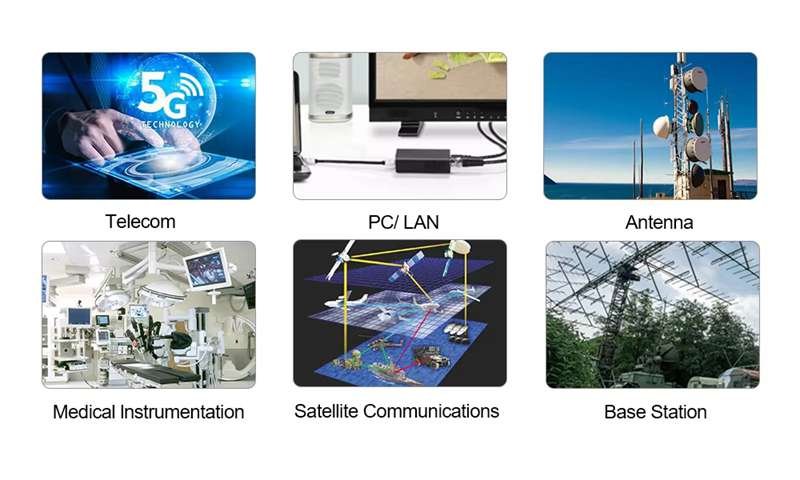
RF cables quietly sit at the center of modern connectivity. They carry radio-frequency signals that enable wireless communication, high-speed data transfer, precision sensing, and real-time imaging. From 5G base stations and satellite systems to medical diagnostics, automotive radar, industrial IoT, and consumer electronics, RF cables are the physical pathway that determines whether signals arrive cleanly, consistently, and without interference.
Yet despite their importance, RF cables are often misunderstood. Engineers, buyers, and sourcing teams frequently ask the same questions: What exactly is an RF cable? Is it the same as a coaxial cable? How is it different from RCA cables? What materials and structures actually matter? And how do you choose the right RF cable for your application—without overengineering or overspending? An RF cable is a specialized cable designed to transmit radio-frequency signals with minimal loss, interference, and impedance mismatch. Most RF cables use a coaxial structure—center conductor, dielectric insulation, shielding, and outer jacket—to ensure signal integrity at high frequencies. They are widely used in wireless communication, medical equipment, automotive radar, aerospace systems, and industrial electronics.
Understanding RF cables is no longer optional. As frequencies rise, device sizes shrink, and performance margins tighten, the cable itself becomes an engineered component—not a commodity. In this guide, we break down how RF cables work, how they differ from other signal cables, where they are used, and how OEMs can design or source the right RF cable assemblies with confidence.
What Is an RF Cable and How Does It Work?
An RF cable is a specialized transmission cable designed to carry radio frequency (RF) signals—typically ranging from several kHz up to GHz frequencies—with minimal signal loss and interference. It works by guiding electromagnetic waves through a controlled impedance structure, using a central conductor, dielectric insulation, and shielding to maintain signal integrity, reduce EMI, and ensure stable performance in wireless communication, broadcasting, medical imaging, aerospace, and RF instrumentation systems.
Understanding RF Cables at a Technical Level
RF cables play a foundational role in modern electronics, especially in systems where signal accuracy, frequency stability, and electromagnetic compatibility are critical. Unlike low-frequency power or data cables, RF cables are engineered to transmit high-frequency alternating signals that behave as electromagnetic waves rather than simple electrical currents. This fundamental difference explains why RF cables require precise construction, impedance control, and shielding.
At their core, RF cables are transmission lines. Their purpose is not just to connect two devices, but to preserve the original signal waveform as it travels from a transmitter to a receiver. Even small imperfections—such as impedance mismatch, poor shielding, or inconsistent dielectric materials—can lead to reflection, attenuation, phase distortion, or noise coupling.
What Does “RF” Mean in RF Cable?
RF stands for Radio Frequency, which generally refers to electromagnetic signals in the frequency range of 3 kHz to 300 GHz. These frequencies are commonly used for:
- Wireless communication (Wi-Fi, cellular, Bluetooth)
- Radio and television broadcasting
- Radar and navigation systems
- Medical imaging and diagnostics
- Aerospace and defense electronics
- RF test and measurement equipment
At these frequencies, signals no longer behave like simple DC or low-frequency AC currents. Instead, they propagate as electromagnetic waves, making cable geometry and material selection critically important.
How Does an RF Cable Transmit Signals?
RF cables transmit signals by guiding electromagnetic waves along the cable’s length. The signal energy travels in the dielectric space between the center conductor and the shield, not inside the copper itself.
Key working principles include:
- Controlled Impedance Most RF cables are designed for 50 ohms or 75 ohms impedance. Maintaining constant impedance prevents signal reflection and standing waves.
- Low Signal Attenuation High-quality conductors and low-loss dielectrics reduce signal loss over distance.
- Electromagnetic Shielding The shield blocks external interference and ensures signal stability even in electrically noisy environments.
- Velocity of Propagation (VoP) RF signals travel at a predictable speed based on dielectric material, which is crucial for timing-sensitive systems.
Why Are RF Cables Different from Ordinary Cables?
Ordinary electrical cables are optimized for current delivery, not signal fidelity. RF cables, by contrast, are optimized for:
- Frequency stability
- Phase accuracy
- EMI suppression
- Reflection control
- Signal integrity across distance
For example, a standard power wire may work at 50/60 Hz, while an RF cable must reliably carry signals at hundreds of MHz or several GHz without distortion.
This is why RF cables require:
- Tighter manufacturing tolerances
- Higher material purity
- Specialized testing (VSWR, return loss, insertion loss)
Where Are RF Cables Commonly Used?
RF cables are essential in applications such as:
- Cellular base stations and antennas
- Wi-Fi routers and access points
- GPS and GNSS modules
- Medical imaging equipment (MRI, ultrasound probes)
- RF test instruments and spectrum analyzers
- Aerospace communication and radar systems
- Automotive ADAS and telematics modules
In many of these systems, custom RF cable assemblies are required to meet exact length, connector, shielding, and compliance requirements—an area where Sino-conn provides OEM-level solutions.
Why Is It Called a Coaxial Cable—and Is RF the Same as Coaxial?
A coaxial cable is named for its “co-axial” design, where the inner conductor and outer shield share the same central axis. RF is not the same as coaxial—RF describes the signal type, while coaxial describes the cable structure. Most RF cables are coaxial, but not all coaxial cables are designed for RF performance.
RF vs Coaxial vs RCA Explained
Why the Term “Coaxial” Matters
The word coaxial literally means “sharing the same axis.” This structure ensures uniform impedance along the cable length, which is critical for RF signal stability. Without this geometry, reflections and losses increase dramatically at high frequencies.
RF Cable vs Coaxial Cable — What’s the Difference?
| Aspect | RF Cable | Coaxial Cable |
|---|---|---|
| Definition | Signal-based (RF signals) | Structure-based |
| Frequency Range | MHz to GHz | Depends on design |
| Shielding | Mandatory | Optional |
| Impedance Control | Critical | Not always required |
In practice, RF cables are a subset of coaxial cables built to much stricter electrical standards.
Is RF the Same as RCA?
No. RCA refers to a connector type, not a signal or cable category. While RCA cables can carry low-frequency RF signals in consumer AV systems, they are not suitable for modern high-frequency RF applications due to poor shielding and impedance control.
How Is an RF Cable Structured and How Does It Transmit Signals?
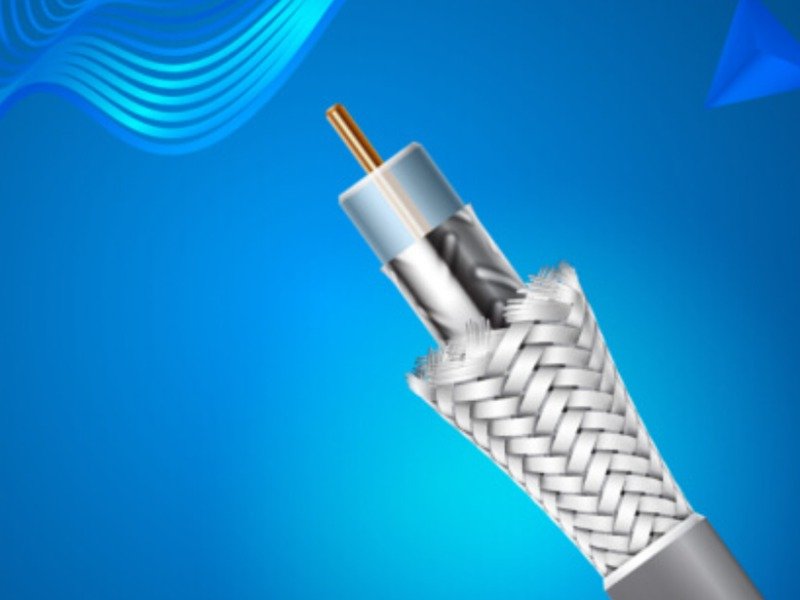
An RF cable is structured as a controlled-impedance transmission line consisting of a center conductor, dielectric insulation, metallic shielding, and an outer jacket. This concentric design allows RF signals to travel as electromagnetic waves between the conductor and shield with minimal loss, interference, and signal reflection. Proper material selection and dimensional accuracy ensure stable impedance, low attenuation, and reliable RF signal transmission across a wide frequency range.

What Are the Main Structural Layers of an RF Cable?
An RF cable typically consists of four concentric layers, each serving a critical electrical and mechanical function.
1. Center Conductor — The Signal Carrier
The center conductor carries the RF signal and is usually made of:
- Solid copper
- Stranded copper
- Silver-plated copper (for high-frequency performance)
- Copper-clad steel (for long-distance RF applications)
At RF frequencies, most current flows along the surface of the conductor due to the skin effect. This is why plating quality and surface smoothness matter more than bulk conductor thickness in RF cable design.
2. Dielectric Insulation — Controls Impedance
Surrounding the center conductor is a dielectric material such as:
- Solid PE (Polyethylene)
- Foam PE (lower loss, lighter weight)
- PTFE / FEP (high-temperature, low loss)
The dielectric does not simply insulate—it defines the characteristic impedance of the cable (commonly 50Ω or 75Ω). Even microscopic changes in dielectric thickness or density can cause impedance mismatch, leading to signal reflection, insertion loss, and return loss degradation.
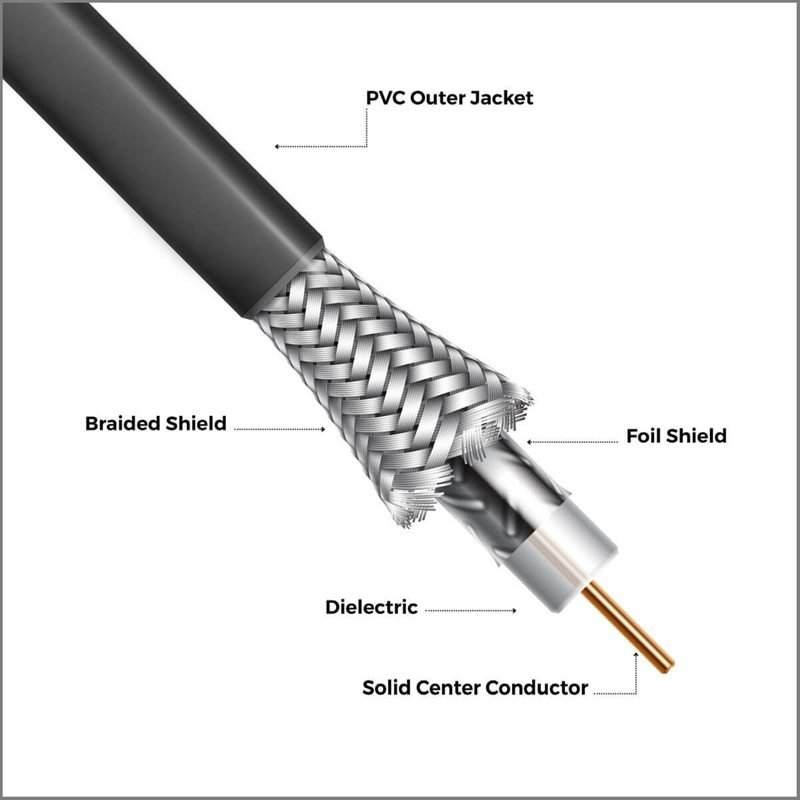
3. Shielding Layer — EMI Protection and Return Path
The shield serves two purposes:
- Acts as the return path for the RF signal
- Protects the signal from external electromagnetic interference (EMI)
Common shield constructions include:
- Aluminum foil (100% coverage, high-frequency shielding)
- Braided copper shield (low-frequency noise suppression)
- Dual or quad shielding (foil + braid combinations)
High-performance RF cables often use multiple shielding layers to maintain signal integrity in EMI-heavy environments such as base stations, medical imaging systems, and automotive electronics.
4. Outer Jacket — Mechanical & Environmental Protection
The outer jacket protects the internal structure from physical and environmental damage.
Typical materials include:
- PVC (general purpose)
- PE (outdoor and RF stability)
- TPU (flexible, abrasion-resistant)
- FEP / PTFE (chemical resistance, high temperature)
While electrically passive, the jacket affects flex life, durability, flame resistance, UV resistance, and compliance with industry standards.
How Does an RF Cable Actually Transmit Signals?
Unlike DC or low-frequency cables, RF cables transmit signals as guided electromagnetic waves, not simple electron flow.
Key Transmission Principles
- The RF signal propagates in the dielectric space between the center conductor and shield
- The electric field exists radially between conductor and shield
- The magnetic field circles the conductor concentrically
- Energy travels down the cable at a velocity determined by the dielectric constant
This structure allows RF cables to behave as predictable transmission lines, which is essential for high-frequency systems.
Why Is Controlled Impedance So Important in RF Cables?
Controlled impedance ensures that:
- Signal power is transferred efficiently
- Reflections are minimized
- Standing waves (VSWR) are reduced
- Signal distortion is avoided
If impedance is not controlled precisely:
- Reflections occur at connectors or transitions
- High-frequency data becomes unstable
- System performance degrades significantly
This is why RF cables must be manufactured with tight tolerance control over conductor diameter, dielectric thickness, and concentricity.
How Do RF Cables Minimize Signal Loss and Interference?
RF signal loss occurs mainly through:
- Conductor loss (skin effect)
- Dielectric loss (material absorption)
- Radiation loss (poor shielding)
High-quality RF cables reduce loss by:
- Using silver-plated conductors
- Selecting low-loss dielectric materials
- Employing high-coverage shielding
- Maintaining smooth impedance transitions at connectors
Sino-conn engineers focus on material matching, connector compatibility, and precise termination to ensure low insertion loss and stable performance.
Why Does RF Cable Quality Matter More at Higher Frequencies?
As frequency increases:
- Wavelength becomes shorter
- Tolerances become tighter
- Small defects cause larger performance drops
At frequencies above 1 GHz, even minor imperfections—such as uneven braid coverage or inconsistent dielectric density—can lead to measurable signal degradation.
How Are RF Cables Manufactured and Tested?
RF cables are manufactured through precision-controlled processes including conductor drawing, dielectric extrusion, concentric shielding, impedance tuning, jacket extrusion, and connector termination. They are tested using electrical, mechanical, and environmental methods such as VSWR, insertion loss, TDR impedance testing, shielding effectiveness, flex cycling, and temperature aging. These steps ensure stable high-frequency signal transmission in wireless, telecom, medical, automotive, and aerospace applications.
Unlike ordinary electrical cables, RF cables are transmission-line components, not just conductors. Their manufacturing and testing processes are tightly linked to signal integrity, impedance stability, and EMI control, especially at high frequencies ranging from MHz to tens of GHz.
A small deviation in conductor centering, dielectric density, or shield coverage can significantly degrade RF performance. For this reason, RF cable production is both a materials science challenge and a precision manufacturing discipline.
Below is a step-by-step breakdown of how professional RF cables are made and validated for real-world OEM use.
Step 1 — Precision Conductor Drawing and Surface Treatment
RF cable performance starts with the center conductor. Manufacturers typically use:
- Bare copper
- Silver-plated copper (SPC)
- Copper-clad steel (CCS)
- High-frequency alloys (for rigidity or loss control)
The conductor is drawn to tight diameter tolerances (±0.001–0.003 mm) because conductor size directly affects:
- Characteristic impedance (50Ω / 75Ω)
- Skin effect behavior at high frequencies
- Insertion loss
Surface smoothness is especially critical at GHz frequencies, where current flows primarily on the conductor’s outer surface. Silver plating is often used to reduce RF resistance and improve signal efficiency.
Step 2 — Dielectric Extrusion and Impedance Control
The dielectric layer electrically isolates the conductor and defines impedance.
Common dielectric materials include:
- Solid PE – standard RF applications
- Foamed PE – lower dielectric constant, lower signal loss
- PTFE / FEP – high temperature, aerospace, medical RF
- Low-loss fluoropolymers – mmWave & 5G
During extrusion, manufacturers must ensure:
- Perfect concentricity between conductor and dielectric
- Uniform dielectric density
- Stable wall thickness
Even slight eccentricity can cause impedance ripple, leading to reflection, return loss, and signal distortion. High-end RF lines use inline laser diameter monitoring to maintain real-time control.
Step 3 — Shielding Construction for EMI Suppression
Shielding is what separates RF cables from ordinary wires.
Typical shielding structures:
- Aluminum/Mylar foil – 100% coverage, high-frequency noise control
- Braided copper shield – low-frequency EMI protection, grounding
- Double or triple shields – used in telecom, CATV, medical imaging
Shield parameters that matter:
- Braid coverage percentage (typically 85–95%)
- Braid angle and wire diameter
- Shield continuity across connector interfaces
Poor shielding results in:
- Signal leakage
- Crosstalk
- Regulatory EMI failures
For sensitive RF systems (ADAS radar, MRI, antennas), shield effectiveness is as important as impedance.
Step 4 — Outer Jacket Extrusion and Environmental Protection
The outer jacket protects RF cables from mechanical and environmental stress.
Common jacket materials:
| Material | Key Properties | Typical Use |
|---|---|---|
| PVC | Cost-effective, flexible | Consumer RF |
| PE | UV & moisture resistant | Outdoor telecom |
| TPU | High abrasion resistance | Automotive, robotics |
| FEP/PTFE | High temp, low friction | Medical, aerospace |
| LSZH | Flame retardant, low smoke | Public infrastructure |
Jacket choice affects:
- Flex life
- Temperature rating
- Chemical resistance
- Compliance (RoHS, REACH, halogen-free)
Step 5 — RF Connector Termination and Assembly
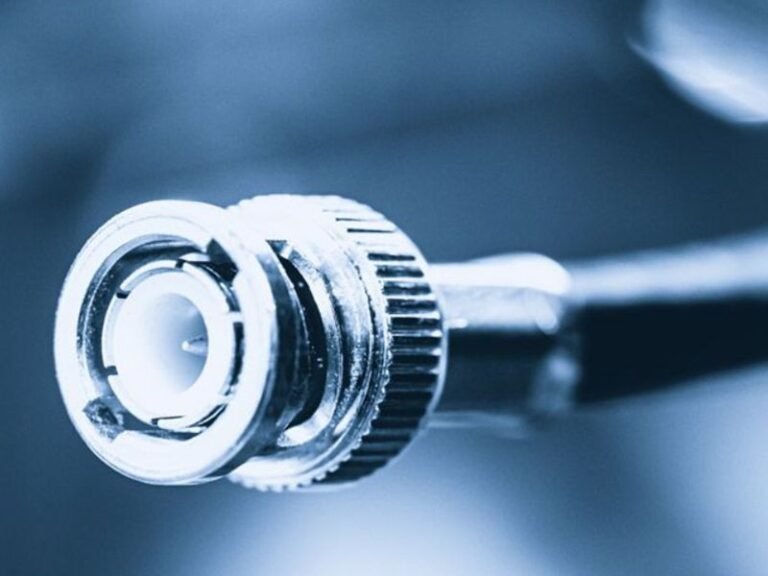
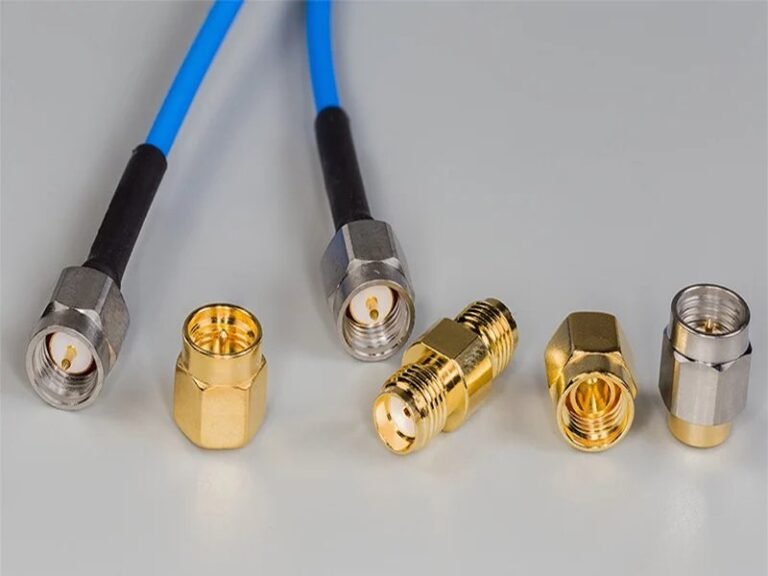
RF connectors (SMA, SMB, MMCX, FAKRA, N, BNC, U.FL, etc.) must be installed with geometry accuracy, not just mechanical strength.

Critical termination factors:
- Pin depth and alignment
- Shield 360° contact
- Controlled solder volume
- Crimp compression consistency
Improper termination is the #1 cause of RF assembly failure, even when the cable itself is perfect.
Sino-conn provides:
- Original and equivalent RF connectors
- Crimp, solder, or hybrid termination
- Drawing-based pin-out confirmation before production
How Are RF Cables Tested for Performance and Reliability?
RF testing verifies that manufacturing precision translates into real signal performance.

Electrical RF Tests
| Test | What It Measures | Why It Matters |
|---|---|---|
| VSWR / Return Loss | Signal reflection | Antenna & RF efficiency |
| Insertion Loss | Signal attenuation | Range & data integrity |
| TDR | Impedance uniformity | Reflection control |
| Shielding Effectiveness | EMI suppression | Regulatory compliance |
| Phase Stability | Signal timing | Radar, phased arrays |
These tests are performed across frequency bands relevant to the application (e.g. 0–6 GHz, 18 GHz, 40 GHz).
Mechanical & Environmental Tests
- Flex and bend cycling
- Pull force & retention
- Vibration & shock
- Temperature aging (-40°C to +125°C or higher)
- Humidity & salt spray (automotive / outdoor use)
RF cables must maintain electrical stability even after mechanical stress.
Compliance & Documentation
Professional RF assemblies are delivered with:
- Electrical test reports
- Material certifications (RoHS, REACH, PFAS-free)
- Dimensional drawings (CAD → PDF)
- Batch traceability (COC / COO)
What Devices and Industries Depend on RF Cables?
RF cables are essential in industries that rely on high-frequency signal transmission, including telecommunications, medical devices, aerospace, automotive, defense, broadcasting, IoT, and industrial automation. Devices such as antennas, base stations, imaging systems, radar modules, wireless sensors, and test equipment depend on RF cables to deliver low-loss, impedance-controlled, and EMI-shielded signal connections across short and long distances.
RF cables play a foundational role in modern electronic systems wherever radio frequency signals must be transmitted accurately, reliably, and with minimal loss. Unlike low-frequency power or data cables, RF cables operate in frequency ranges where signal integrity is highly sensitive to impedance mismatch, attenuation, shielding quality, and mechanical consistency.
As a result, RF cables are not limited to one sector—they are deeply embedded across telecommunications, healthcare, automotive, aerospace, industrial control, defense, and emerging wireless technologies. Below is a detailed guide of the key industries and the specific devices that depend on RF cable assemblies.
Telecommunications & Wireless Infrastructure
The telecommunications industry is the largest consumer of RF cables globally. RF cables are critical in building and maintaining wireless communication networks.

Typical Devices
- Cellular base stations (2G / 3G / 4G / 5G)
- Small cells and distributed antenna systems (DAS)
- Remote radio heads (RRH / RRU)
- Microwave backhaul systems
- Antenna feeders and jumper cables
Why RF Cables Matter Here
- Maintain 50Ω impedance consistency
- Minimize insertion loss over distance
- Provide strong EMI and RFI shielding
- Support wide frequency ranges (MHz → GHz)
With 5G and upcoming 6G technologies, RF cables must support higher frequencies, tighter tolerances, and lower loss, making custom RF assemblies increasingly necessary.
Medical Devices & Healthcare Equipment
In the medical industry, RF cables are used where high-frequency signals interact with sensitive electronics or human tissue. Reliability and safety are critical.

Medical Applications
- MRI and CT imaging systems
- Ultrasound probes
- RF ablation and electrosurgical devices
- Patient monitoring equipment
- Wireless medical sensors and telemetry
Key Requirements
- Stable impedance and signal integrity
- Low noise and minimal crosstalk
- Biocompatible and sterilization-resistant materials
- Compliance with medical standards (RoHS, REACH, PFAS-free)
Medical RF cables often require custom lengths, micro-coax structures, and specialized connectors, which standard off-the-shelf cables cannot provide.
Aerospace, Aviation & Defense Systems
Aerospace and defense applications rely heavily on RF cables for mission-critical communication, navigation, and sensing systems.

Common RF-Dependent Systems
- Radar and surveillance systems
- Avionics communication modules
- Satellite payloads
- Electronic warfare equipment
- Secure military communications
Why RF Cables Are Essential
- Precise signal timing and integrity
- Resistance to vibration, shock, and temperature extremes
- Low outgassing and flame-retardant materials
- Long-term reliability in harsh environments
Automotive & EV Applications
Modern vehicles—especially electric vehicles (EVs)—are increasingly dependent on RF cables due to the explosion of sensors, connectivity, and advanced driver-assistance systems (ADAS).

Automotive RF Cable Uses
- GPS navigation antennas
- Vehicle-to-everything (V2X) communication
- ADAS radar and camera modules
- Infotainment systems
- Keyless entry and wireless charging
Technical Challenges
- High EMI environments
- Tight installation spaces
- Constant vibration and thermal cycling
- Long service life expectations
Automotive RF cable assemblies often require custom routing, reinforced jackets, and automotive-grade connectors to meet reliability standards.
Broadcasting, Audio & Video Systems
RF cables are indispensable in professional broadcasting and A/V transmission.

Typical Equipment
- Television and radio transmitters
- Satellite TV receivers
- RF modulators and demodulators
- Studio monitoring systems
Why RF Cables Are Preferred
- Stable high-frequency transmission
- Low signal distortion
- Reliable long-distance connectivity
Even small impedance mismatches can degrade broadcast quality, making precision RF cable assemblies essential.
Industrial Automation & IoT Systems
Industrial environments increasingly rely on RF cables to support wireless sensing, monitoring, and control systems.

Applications
- Wireless sensors and gateways
- Smart factory communication nodes
- Industrial RF test systems
- PLC and automation controllers
Key Considerations
- Resistance to oil, chemicals, and dust
- Strong shielding against industrial EMI
- Long-term durability
As Industry 4.0 evolves, RF cables act as the physical backbone of wireless industrial systems.
Test, Measurement & R&D Equipment
RF cables are essential in laboratories and production lines where signal accuracy must be measured and validated.

Typical Devices
- Spectrum analyzers
- Network analyzers
- Signal generators
- RF calibration equipment
Why Precision Matters
- Measurement accuracy depends directly on cable performance
- Impedance errors skew test results
- Consistent cable quality ensures repeatability
These applications often require short, low-loss, highly stable RF cable assemblies, frequently customized for specific test setups.
Consumer Electronics & IoT Devices
Although often invisible to users, RF cables are embedded inside countless consumer products.

Examples
- Smartphones and tablets
- Wi-Fi routers
- Smart home devices
- Wearables and AR/VR equipment
- Drones and remote-control devices
Miniaturization trends push RF cables toward micro-coax and ultra-fine constructions, increasing the need for precision manufacturing.
Conclusion
Designing and sourcing RF cable assemblies is never just about choosing a cable. It is about signal integrity, impedance control, EMI performance, mechanical reliability, compliance, and manufacturability at scale. A small mismatch in impedance, shielding, connector termination, or material selection can lead to signal loss, interference, certification failures, or costly redesigns.
Ready to Build or Optimize Your RF Cable Assembly?
If you are working on:
- Custom RF cable assemblies
- Antenna feed cables
- Wireless module interconnects
- High-frequency coaxial solutions
- Medical or automotive RF wiring
- Compact RF designs with tight bend radius
- Cost-optimized RF solutions without performance loss
Contact Sino-conn today with your drawing, model number, or even just a photo. Our engineers will review your requirements, propose the right RF cable structure, and deliver a fast, accurate quotation.
From prototype to production — Sino-conn is your RF cable assembly partner.