Skip to content

Local networks power everything—from home routers to industrial automation lines—and at the center of these systems lies a simple piece of hardware most people barely think about: the LAN cable. In a world obsessed with “wireless,” the truth is that nearly every high-reliability system still depends on physical cabling to move data accurately, quickly, and securely. Whether it’s a smart manufacturing cell, a medical imaging device, or a test bench in an R&D lab, LAN cables remain the silent backbone of modern connectivity.
A LAN cable is a physical data cable used to connect devices within a Local Area Network for fast, stable, and secure communication. Often called an Ethernet cable, it contains twisted copper pairs and an RJ45 connector. LAN cables support speeds from 100Mbps to 40Gbps depending on category (Cat5e–Cat8). They ensure low latency, minimal signal loss, and reliable data transfer for home networks, industrial equipment, servers, and custom-built systems.
Most people encounter LAN cables only when they plug in a router or restart an office computer. But engineers, OEMs, and system integrators know these cables are far more complex—they involve electrical design, EMI control, impedance matching, shielding choices, custom pinouts, material decisions, and strict compliance requirements. At Sino-Conn, we see another side of the story: buyers sending only a photo, engineers needing exact bend radii, OEMs requiring thousands of units, and global companies struggling to source stable, compliant, custom LAN assemblies with tight deadlines.
In this guide, we’ll break down LAN cables from the ground up—what they are, how they work, how to choose one, and why custom assemblies matter—while sharing the technical insights and real-world challenges we solve daily. Let’s dive in.
What Is a LAN Cable?
A LAN cable is a physical Ethernet cable used to connect devices within a Local Area Network for fast, stable, and secure data transmission. It contains twisted copper pairs, insulation, shielding, and typically an RJ45 connector. LAN cables reduce interference, maintain low latency, and support speeds from 100Mbps up to 40Gbps depending on category. They are commonly used in homes, offices, servers, industrial equipment, and custom-built systems requiring reliable wired connectivity.

Understanding LAN Cables in Modern Networking
LAN cables are the quiet infrastructure behind fast networks. While wireless gets attention, wired connections handle the real workload—servers, industrial controllers, medical devices, and high-precision systems. What makes LAN cables valuable isn’t only speed; it’s consistency, low noise, predictable performance, and immunity to wireless congestion. For this reason, engineers, integrators, and OEMs continue to rely on LAN cables in mission-critical environments.
Sino-Conn often receives inquiries from customers who send just a part number—or even a blurry product photo—asking, “Can you make this?” The answer is usually yes, because LAN cables, despite looking simple, follow well-defined electrical and mechanical standards. But the real complexity lies in the details: shielding selection, jacket material, pair twist rate, impedance, pinouts, and connector compatibility. That’s where custom assembly expertise becomes essential.
What Does “LAN” Mean and What Does the Cable Do?
LAN stands for Local Area Network—a network that connects nearby devices such as computers, switches, printers, servers, and industrial machines. The LAN cable is the medium that carries electrical signals between them. Through twisted pairs, it transmits data using differential signaling to reduce noise. Unlike Wi-Fi, wired LAN communication avoids wireless interference, providing lower latency and higher stability, which is crucial for automation, robotics, and medical equipment.
Is a LAN Cable the Same as an Ethernet Cable?
Yes—“LAN cable” and “Ethernet cable” refer to the same type of cable used in wired networks. Technically, “Ethernet” describes the communication standard, while “LAN cable” describes the environment where it’s used. In practice, the terms are interchangeable. Industry professionals may specify by category (Cat5e, Cat6, Cat7, etc.) or by connector type (RJ45). All are forms of twisted-pair copper cables supporting standardized Ethernet protocols.

What Signals Does a LAN Cable Transmit?
LAN cables transmit differential electrical signals—pairs of opposing voltages that help cancel out noise. Higher-category cables have stricter controls on impedance (typically 100Ω), crosstalk, and pair twist ratios to ensure high-frequency stability. These signals can support bandwidths from 100MHz (Cat5e) to 2000MHz (Cat8). This stable electrical environment is why Ethernet cables remain essential for industrial-grade automation, real-time control systems, and data-heavy equipment.
How Does a LAN Cable Differ from Coaxial, Fiber, and USB Cables?
- Coaxial: Single conductor + shield; used for RF, CCTV, or broadband—incompatible with Ethernet.
- Fiber optic: Uses glass fiber instead of copper; supports long distances and ultra-high speeds.
- USB cables: Designed for peripherals and charging, not network infrastructure.
LAN cables sit in the middle—cost-efficient, durable, and perfect for distances up to 100 meters with no signal repeaters needed.
Which Types of LAN Cables Are Most Common?
The most common LAN cable types are Cat5e, Cat6, Cat6A, Cat7, and Cat8. These categories define speed, bandwidth, shielding, and performance. Cat5e supports 1Gbps; Cat6 supports 1–10Gbps; Cat6A reaches 10Gbps at 100 meters; Cat7 and Cat8 offer higher frequencies for data centers and servers. LAN cables may be UTP (unshielded), FTP (foiled), or SFTP (braided + foiled) depending on EMI requirements.
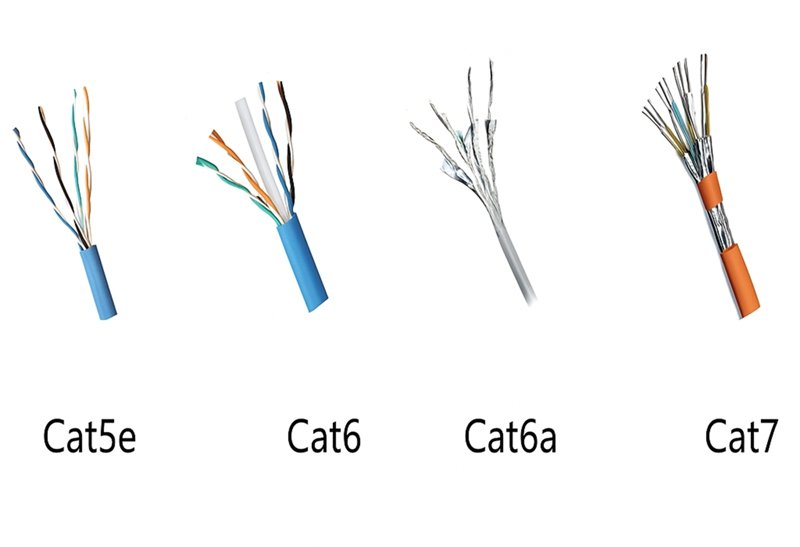
Cable Categories, Shielding, and Real-World Use Cases
Network categories evolve with the demands of modern systems. For example, factories adopting Industry 4.0 require better shielding and higher bandwidth because of motors, VFDs, and EMI-generating machinery. Medical devices need minimal packet loss and predictable latency. Data centers depend on stable 10–40Gbps connections. The cable category you choose directly impacts speed and reliability.
LAN cables also differ by shielding type. In office spaces, UTP is common because EMI is low. But in factories or automotive plants, FTP or SFTP becomes essential. Sino-Conn customers often request specific shielding combinations depending on their environment, connector selection, and required flexibility.
To help buyers and engineers compare specifications easily, here’s a practical reference:
Common LAN Cable Categories & Performance
| Category | Max Speed | Bandwidth | Typical Use Case | Max Distance | Notes |
|---|---|---|---|---|---|
| Cat5e | 1Gbps | 100MHz | Home & office LAN | 100m | Cost-effective |
| Cat6 | 1–10Gbps | 250MHz | SMEs, light industrial | 55–100m | Less crosstalk |
| Cat6A | 10Gbps | 500MHz | Data centers, hospitals | 100m | Heavier shielding |
| Cat7 | 10Gbps+ | 600MHz | Industrial automation | 100m | Fully shielded |
| Cat8 | 25–40Gbps | 2000MHz | Servers & racks | 30m | Best for short, high-speed links |
What Are Cat5e, Cat6, Cat6A, Cat7, and Cat8?
Each category increases the cable’s ability to handle higher frequencies. For instance, Cat6 reduces crosstalk with tighter pair twists, while Cat6A and Cat7 add more shielding and thicker jackets. Cat8 pushes performance to the limit with extremely high frequencies but short distances. Sino-Conn builds all categories and often customizes OD, color, and flexibility for specific installations.
What Is the Difference Between UTP, FTP, and SFTP LAN Cables?
- UTP: Unshielded; flexible; low cost; good for clean environments.
- FTP: Foil shield; good EMI protection; ideal for factories.
- SFTP: Foil + braided shield; maximum noise protection.
Sino-Conn helps buyers choose based on machine proximity, voltage sources, and sensitivity to interference.
Which Connectors Are Used for LAN Cables?
Most LAN cables use RJ45 connectors—either unshielded or shielded. Higher categories may require shielded, metal-shell RJ45 plugs. Some industrial installations use M12-X connectors. As a custom cable manufacturer, Sino-Conn offers original-brand connectors or cost-effective alternatives based on customer budget and application.

How Is a LAN Cable Structured?
A LAN cable is built from four twisted copper pairs, insulation, optional shielding, filler materials, and an outer jacket. Twisting reduces crosstalk, while shielding protects against EMI. Electrical properties like impedance (100Ω), conductor gauge (24–28 AWG), and jacket materials (PVC, LSZH, TPU) determine performance and durability. The structure ensures stable high-speed data transmission across up to 100 meters.
Internal Construction and Material Selection
The internal structure of a LAN cable determines how well it performs in real environments. While everyday consumers only see a colored outer jacket, engineers care about what’s inside: conductor type, insulation material, pair twist rate, shielding layers, separator cores, and jacket formulation. Each variable influences noise immunity, flexibility, bend radius, and heat resistance.

At Sino-Conn, many customers require cable assemblies for non-standard situations: outdoor exposure, oil-rich factory floors, high-temperature machines, or confined robotic arms. For each case, we tailor materials such as PE, LSZH, PVC, or TPU to balance durability and performance.
Table: Common LAN Cable Material Options
| Component | Material Options | Benefits |
|---|---|---|
| Conductor | Bare copper, tinned copper | High conductivity, corrosion resistance |
| Insulation | HDPE, FRPE | Low loss, stable dielectric properties |
| Jacket | PVC, LSZH, TPU, PUR | Flexibility, flame resistance, oil/UV protection |
| Shielding | Foil, braid, foil + braid | EMI suppression |
| Fillers | Nylon yarn, cross separator | Shape stability & crosstalk reduction |
What Are Twisted Pairs and Why Do They Reduce EMI?
Each data signal travels through a pair of conductors carrying opposite voltages. Twisting the pair ensures external noise affects both wires equally, canceling interference. Higher categories increase twist tightness to handle higher frequencies. Sino-Conn ensures each twisted pair is manufactured to precise tolerances to maintain consistent electrical performance.
What Materials Are Used for Conductors, Insulation, and Jackets?
- Conductors: Solid or stranded copper depending on flexibility needs.
- Insulation: HDPE or FRPE for stable electrical properties.
- Jackets: PVC for general use; LSZH for safety environments; TPU/PUR for industrial robotics.
Material decisions often depend on temperature range, chemical exposure, and installation space.
What Electrical Parameters Matter (Impedance, AWG, OD, Bend Radius)?
LAN cables must maintain 100Ω impedance to prevent signal reflection. Conductor size (AWG) affects resistance and flexibility. Outer diameter (OD) determines bend radius, which is crucial in tight installations. Sino-Conn customizes all these parameters based on customer drawings or performance needs.
Are LAN Cables Resistant to Oil, UV, Heat, Flame, or Chemicals?
Standard PVC jackets are not enough for harsh environments. Instead:
- TPU/PUR: Oil-resistant, abrasion-resistant
- LSZH: Flame-retardant, low smoke
- PE: UV-resistant for outdoor use
This is especially important for OEMs in automation, automotive production, and outdoor systems.
How Do You Choose the Right LAN Cable?
Choosing the right LAN cable depends on several practical factors—network speed, installation distance, EMI conditions, cable materials, and connector compatibility. A well-matched cable avoids signal loss, improves stability, and ensures long-term reliability. To make the selection easier, the key considerations can be viewed across a few essential dimensions.

1. Network speed and category.
The first step is determining your required data rate. Cat5e handles 1Gbps for typical office work, while Cat6 improves performance and reduces crosstalk. For full 10Gbps over 100 meters, Cat6A is the most reliable option. Higher categories such as Cat7 or Cat8 are designed for very high frequency applications like server rooms or data centers. If your project involves future expansion, choosing a slightly higher category provides more bandwidth headroom.
2. Shielding level and EMI environment.
Your installation environment greatly influences whether you need UTP, FTP, or SFTP. In homes or general office areas, UTP performs well with minimal interference. However, near motors, transformers, HVAC systems, or industrial machinery, EMI can disrupt data signals. In these cases, FTP or SFTP—both of which add foil or braided shielding—significantly improves transmission stability and prevents packet loss.
3. Cable length and signal distance.
Standard Ethernet supports up to 100 meters, but not all categories maintain their maximum speed over that distance. Cat6, for example, supports 10Gbps only up to around 55 meters. Short-range high-speed links, such as Cat8, are typically limited to 30 meters. Understanding your exact routing distance helps avoid speed drops or unexpected network bottlenecks.
4. Jacket materials and installation conditions.
Cable jackets determine how well the cable withstands its physical environment. PVC suits indoor applications, while LSZH is often required in public buildings, hospitals, and enclosed spaces due to low-smoke, non-halogen properties. For industrial settings—especially areas exposed to oil, abrasion, flexing, or outdoor sunlight—TPU, PUR, or PE jackets offer better mechanical and environmental durability.
5. Connector type and compatibility.
Most LAN cables use RJ45 connectors, but not all RJ45s are the same. Shielded cables require shielded (metal-shell) RJ45 plugs to maintain grounding. In industrial networks, vibration-resistant or sealed connectors such as M12-X may be required. Ensuring the connector matches the cable category and shielding type prevents mismatch issues that could degrade signal quality.
6. Certifications and regulatory requirements.
Depending on where the cable will be used or sold, certain certifications may be mandatory. UL ensures electrical safety; RoHS and REACH regulate hazardous substances; some medical or European applications require PFAS-free materials. Using certified cables avoids compliance issues during audits or product approvals.
Overall, choosing the right LAN cable involves evaluating both the electrical requirements of the network and the environmental demands of the installation. By considering speed, shielding, distance, materials, connector compatibility, and compliance, you can confidently select a cable that delivers stable performance and meets the specific needs of your project.
What Is a Custom LAN Cable Assembly?
A custom LAN cable assembly is an Ethernet cable that has been specifically designed, configured, or manufactured to meet unique technical or environmental requirements. Unlike off-the-shelf cables, custom assemblies can vary in length, shielding structure, connector type, pinout definition, jacket material, flexibility, and environmental resistance. Customization ensures that the cable integrates correctly with the equipment it connects, performs reliably under real operating conditions, and meets any regulatory or mechanical constraints required by the application.
Custom LAN cable assemblies are commonly used in situations where standard Ethernet cables are unsuitable—such as industrial automation, medical devices, robotics, outdoor communications, or equipment with limited installation space. In these scenarios, factors like precise bend radius, EMI protection, high durability, or non-standard connector wiring become critical. By adjusting materials, geometry, and construction, a custom cable can solve challenges that commercial stock cables cannot address.
To understand what “custom” means in practical terms, the following aspects are typically modified based on project requirements:
1. Custom Length and Routing Requirements
Standard cable lengths rarely match the exact layout of a machine or network cabinet. Custom assemblies allow engineers to specify the precise length needed, reducing cable slack, minimizing signal degradation, and improving installation neatness. In systems with tight spaces or moving parts—robotic arms, automated lines, test benches—exact length becomes essential for safety and stability.
2. Pinout Definition and Wiring Configuration
Not all RJ45 cables use straight-through wiring. Some equipment relies on crossover wiring, custom-defined pinouts, or integration with non-Ethernet connectors. A custom assembly ensures the internal connections match the equipment’s electrical requirements. This is especially important in proprietary systems, PLC controllers, or devices that combine power and data through modified RJ45 configurations.
3. Material Selection for Specialized Environments
Environmental exposure significantly influences cable performance and lifespan. Depending on the application, jackets may need to be:
- LSZH for public buildings or medical facilities
- TPU/PUR for abrasion-resistant or oil-resistant industrial environments
- PE for outdoor, UV-exposed installations
- PVC for general indoor use
Similarly, conductor types (solid vs. stranded), shielding layers (foil, braid, or both), and filler materials are chosen to meet the environmental and mechanical demands.
4. Shielding and Noise Protection Requirements
In environments with motors, drives, or RF equipment, EMI can cause unstable communication. Custom assemblies can incorporate:
- Foil shielding for moderate EMI
- Braided shielding for mechanical strength
- Combined shielding (SFTP) for maximum noise suppression
These decisions ensure consistent data transmission even in harsh industrial zones.
5. Connector Type, Orientation, and Mechanical Structure
Beyond standard RJ45 plugs, some systems require alternative connector types or special mechanical features:

- Right-angle RJ45 for tight or low-clearance spaces
- Shielded metal RJ45 for noise-sensitive networks
- M12-X coded connectors for industrial and vibration-heavy environments
- Custom-molded connectors for durability or ingress protection
- Original-brand vs. compatible connectors depending on specification or cost constraints
The connector choice directly affects reliability, grounding integrity, and mechanical performance.
6. Assembly Tolerances and Reliability Requirements
Applications such as medical devices, aerospace systems, and automated production equipment may require:
- precise impedance control
- low contact resistance
- improved strain relief
- verified conductor twist integrity
- resistance to repetitive bending or flex cycles
Custom cable assemblies allow these characteristics to be controlled and verified during manufacturing, ensuring consistent performance.
7. Documentation, Drawings, and Compliance Needs
Custom assemblies often require technical documentation such as wiring diagrams, CAD drawings, material specifications, or compliance certificates (UL, RoHS, REACH, PFAS-free, etc.). Proper documentation ensures compatibility, simplifies quality audits, and accelerates integration into the final product.
Why Custom Assemblies Are Necessary
Standard LAN cables work well for general networking, but many engineered systems require specific electrical and mechanical characteristics that off-the-shelf cables cannot provide. Custom LAN cable assemblies ensure:
- proper fit within the equipment
- compliance with engineering requirements
- durability under specific environmental conditions
- predictable electrical performance
- compatibility with unique connector interfaces
In short, custom assemblies bridge the gap between generic networking hardware and the precise needs of specialized equipment.
Why Custom LAN Cable Assemblies Matter
Standard LAN cables work for everyday networking—but engineering projects, OEM machines, and industrial systems almost always require customization. This may mean a unique length, tighter bend radius, overmolded connectors, flame-resistant jackets, or matching the pinout of specialized equipment. Custom assemblies ensure compatibility, safety, mechanical reliability, and regulatory adherence.
Sino-Conn specializes in high-mix, low-volume, and highly technical custom LAN cable assemblies. Whether a customer sends a part number, a sample cable, or only a smartphone photo, our engineering team can reverse-engineer and generate full CAD drawings within 30 minutes to 3 days. Every order includes a drawing confirmation stage before production, protecting the customer from costly mistakes.
Below are the key customization areas.
When Do You Need a Custom Length, Pinout, or Material?
Custom length reduces clutter and improves signal stability. Pinout customization is common in automation, medical devices, and control systems where the RJ45 is wired differently. Material customization is essential for high heat, chemical exposure, or abrasion-heavy environments. Sino-Conn matches materials to each use case.
How Do We Help When Customers Send Only a Photo or Part Number?
This is extremely common. Buyers often lack full technical documents. Sino-Conn evaluates the connector family, shielding type, OD, jacket color, and crimp method. We then build the specification sheet, define materials, and recommend alternatives if the exact part is unavailable.
Original vs. Alternative Connectors — Which Should You Choose?
- Original (Brand-Name) Connectors: Higher cost, longer lead time, preferred by European and American customers.
- Alternative (Compatible) Connectors: Lower cost, flexible supply, excellent for OEMs.
Both options are fully functional. Sino-Conn maintains a large inventory of compatible connectors for fast delivery.
How Do Drawings, Samples, and Production Work?
- Quotation: 30 minutes–24 hours
- Drawing (CAD → PDF): 30 minutes–3 days
- Samples:
- Standard: 2 weeks
- Urgent: 2–3 days
- Mass Production:
- Standard: 3–4 weeks
- Urgent: 2 weeks
Everything is confirmed through customer-approved drawings before production.
Why OEMs, Engineers, and Traders Choose Sino-Conn
- MOQ = 1 pc
- True engineering support
- Fastest drawings in the industry
- Flexible supply chain: premium or budget-friendly solutions
- 100% full inspection: in-process + final + pre-shipment
- Wide certification coverage
Sino-Conn reliably supports both large-scale OEM production and custom low-volume orders.
How Much Do LAN Cables Cost?
LAN cable cost depends on cable category, shielding, jacket materials, connector brand, customization needs, and order quantity. Prices also vary by country and industry requirements. Higher categories (Cat6A–Cat8) and shielded cables cost more, while OEM-grade cables are cheaper in volume. Sino-Conn provides flexible pricing, offering both premium original connectors and cost-effective compatible alternatives.
Price Factors and Market Variability
LAN cable pricing is not universal—it fluctuates by region, industry, material cost, connector selection, and demand cycles. For instance, medical and military industries require strict compliance and traceability, pushing prices upward. In contrast, consumer products or simple office networks prioritize cost efficiency.
Sino-Conn’s pricing model is transparent and customizable. We evaluate the customer’s needs, then present multiple solution tiers: brand-name connectors, high-performance equivalents, or cost-optimized assemblies.
Table: Typical LAN Cable Price Drivers
| Factor | Influence on Cost | Notes |
|---|---|---|
| Category | Cat8 > Cat6A > Cat6 > Cat5e | Higher frequency = higher cost |
| Shielding | SFTP > FTP > UTP | More material + labor |
| Connectors | Original > Alternative | Lead time differs |
| Jacket Material | TPU/PUR > LSZH > PVC | Industrial materials cost more |
| Region | US/EU > Japan > Korea > India/SEA | Market expectations vary |
| Industry | Medical/Military > Industrial > Consumer | Compliance drives cost |
| Volume | Low qty > High qty | OEM orders reduce unit cost |
Why Prices Differ Between Regions
- United States & Germany: Higher compliance, higher labor cost, higher expectations
- Japan: Quality-focused but slightly lower pricing
- Korea, India, Southeast Asia: Cost-sensitive markets aimed at OEM volume
Sino-Conn adjusts quotations based on your region’s common pricing norms and expectations.
How Pricing Varies by Industry
- Medical & Military: Highest pricing due to strict documentation
- Industrial: Mid-range, performance-focused
- Consumer Electronics: Lowest pricing, high-volume batches
We deliver pricing optimized to each industry’s technical and compliance requirements.
Why Premium Connectors Cost More
Original-brand connectors have longer lead times and limited flexibility. Alternative connectors offer nearly identical performance at a fraction of the cost. Sino-Conn provides both, allowing buyers to choose based on budget and urgency.
Conclusion:

LAN cables may appear simple, but behind every reliable network, industrial machine, medical device, or automation system lies careful engineering: shielding selection, impedance control, jacket design, connector compatibility, and manufacturing precision. Understanding how LAN cables work—and how to choose the right one—helps ensure stable, safe, and high-performance operation.
Sino-Conn is a trusted partner for engineers, OEM factories, traders, and procurement teams worldwide. Whether you have a complete drawing, a detailed specification sheet, or only a product photo, we can design, prototype, and produce your custom LAN cable assembly with unmatched speed, flexibility, and quality.
If you’re ready to develop a custom cable or need expert guidance on your next project, reach out to Sino-Conn for a tailored quote and technical consultation. We’re here to build exactly what your application needs—fast, reliably, and with no minimum order quantity.