Skip to content
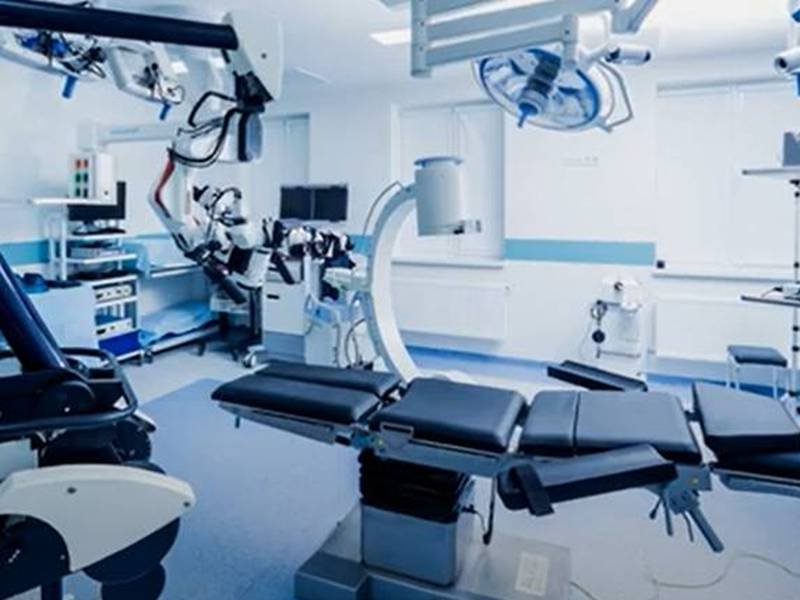
Medical devices are often judged by what patients see: screens, probes, sensors, or sleek housings. But behind every reliable diagnostic image, stable monitoring signal, or life-support system is something far less visible—and far more critical: the cable assembly.
Medical grade cables are not simply “better quality wires.” They are engineered to operate safely and reliably in environments where signal failure, electrical noise, or material degradation can directly impact diagnosis, treatment, or patient safety. Unlike consumer or industrial cables, medical grade cables must perform consistently under repeated sterilization, constant movement, tight bending radii, and strict regulatory oversight.
What makes this topic even more complex is that “medical grade” is not a single specification. It is a combination of material selection, electrical performance, mechanical durability, biocompatibility, and regulatory compliance—all aligned to the specific medical application. A cable suitable for an ultrasound probe may be completely inappropriate for a patient monitoring system or surgical device.
This is also where many OEM projects encounter delays. Engineers may understand their device well but underestimate cable requirements, while procurement teams may focus on cost without fully understanding regulatory or performance risks. The result is redesigns, re-testing, or approval bottlenecks.
Understanding what medical grade cables truly are—and how they differ from standard cable assemblies—is the first step to building safer, more reliable medical devices.
Medical grade cables are specialized cable assemblies designed for use in medical devices, where safety, reliability, and regulatory compliance are critical. They use biocompatible, halogen-free materials, provide stable electrical performance with low EMI, and meet standards such as UL, ISO, RoHS, and REACH. Medical grade cables are engineered to withstand repeated use, cleaning, and demanding clinical environments.
What Are Medical Grade Cables?
Medical grade cables are specialized cable assemblies engineered for medical devices where patient safety, signal accuracy, and regulatory compliance are critical. They combine certified materials, controlled electrical performance, enhanced EMI shielding, and high mechanical durability to ensure reliable operation in clinical, diagnostic, and therapeutic environments. Unlike standard cables, medical grade cables are designed and tested according to medical-specific usage risks and standards.
The term medical grade is often used loosely, but in professional medical device development it has a very specific meaning. A medical grade cable is not defined by appearance or price—it is defined by how it behaves under risk.
In simple terms, medical grade cables are cable assemblies designed to minimize clinical, electrical, and regulatory risk throughout the entire life of a medical device.

What makes a cable “medical grade”?
A cable is considered medical grade when it satisfies four core dimensions at the same time:
- Electrical safety – stable insulation, controlled leakage, reliable signal transmission
- Material compliance – certified, traceable materials that meet medical and environmental regulations
- Mechanical reliability – durability under repeated bending, handling, and cleaning
- Process control – consistent manufacturing, testing, and documentation
If any one of these dimensions is missing, the cable may function electrically—but it does not qualify as medical grade in a true engineering sense.
How are medical grade cables different from standard cables?
The difference is not just quality level, but design intent.
Standard cables are typically designed to:
- Meet general electrical specifications
- Optimize cost or mass production
- Perform acceptably in predictable environments
Medical grade cables, by contrast, are designed to:
- Perform reliably in unpredictable clinical conditions
- Protect patients and operators from electrical or signal-related risk
- Withstand repeated use, disinfection, and mechanical stress
- Pass regulatory review and audits
A standard cable might work “most of the time.”
A medical grade cable is designed to work every time, under defined risk constraints.
Are all cables used in hospitals medical grade?
No—and this is a common misconception.
Hospitals use many types of cables, including:
- Commercial power cords
- Industrial communication cables
- Consumer-grade peripherals
Medical grade cables are typically reserved for device-critical connections, such as:
- Signal paths connected to patients
- Diagnostic and imaging systems
- Monitoring and therapeutic equipment
Using non-medical-grade cables in these paths increases the risk of EMI interference, signal instability, and regulatory non-compliance—even if the cable appears to function initially.

Is “medical grade” a single standard?
There is no single global standard called “medical grade cable.”
Instead, medical grade status is established through a combination of standards, test methods, and documented controls, which may include:
- Electrical safety requirements
- Material regulations (RoHS, REACH, PFAS)
- Quality system standards (ISO)
- Application-specific testing
This is why medical cable design is always application-driven. A cable suitable for a wearable monitor may not be suitable for a surgical device, even if both are technically “medical.”
Why medical grade cables are usually custom-designed
Because medical devices vary so widely, off-the-shelf solutions rarely meet all requirements.
Medical grade cables are often customized to:
- Match specific connector systems
- Achieve required flexibility and OD
- Control EMI for sensitive signals
- Comply with regional regulations
Customization is not a luxury—it is often the only practical way to ensure safety, performance, and compliance at the same time.
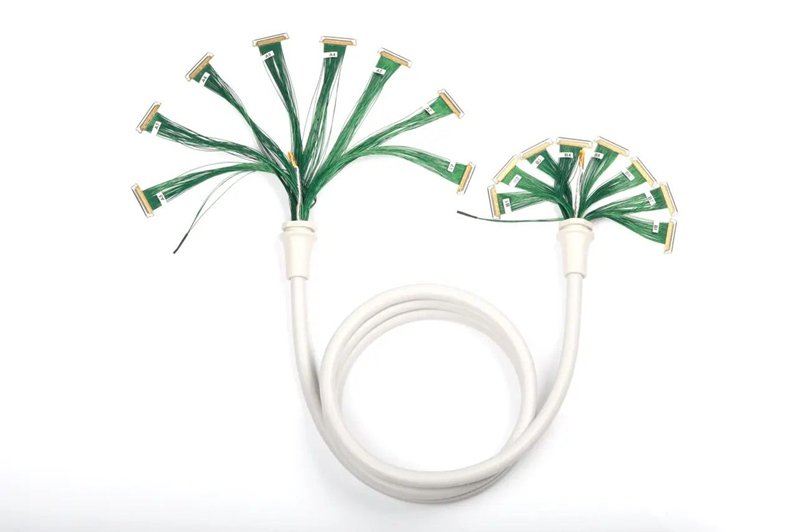
Which Materials Are Used in Medical Grade Cables?
Medical grade cables use carefully selected insulation and jacket materials such as medical-grade PVC, TPU, TPE, and silicone. These materials are chosen for their flexibility, durability, biocompatibility, chemical resistance, and compliance with medical and environmental regulations. Material selection directly affects safety, usability, sterilization compatibility, and long-term reliability in medical devices.
In medical devices, cable materials are not selected simply for cost or availability.
They are selected to manage clinical risk, regulatory risk, and long-term reliability risk at the same time.
A material that performs well electrically but degrades after cleaning—or releases restricted substances—can turn into a compliance or safety issue long after the device ships. This is why material selection is one of the most critical engineering decisions in medical grade cable design.
Medical-grade PVC
Medical-grade PVC remains one of the most widely used materials in medical cables.
Its advantages include:
- Stable electrical insulation
- Good flexibility at reasonable cost
- Proven performance in medical environments
- Broad regulatory acceptance
Medical-grade PVC is carefully formulated to avoid restricted substances and to maintain flexibility over time. It is commonly used in patient monitoring cables, diagnostic equipment, and general-purpose medical devices.
However, PVC formulations must be tightly controlled—industrial PVC does not automatically qualify as medical grade.

TPU (thermoplastic polyurethane)
TPU is often chosen when mechanical durability and abrasion resistance are critical.
Key benefits include:
- Excellent wear resistance
- High tensile strength
- Good flexibility with thin wall thickness
- Resistance to oils and cleaning agents
TPU is frequently used in cables that experience frequent movement, dragging, or contact with equipment surfaces. In medical applications, it balances durability with a clean, professional feel.

TPE (thermoplastic elastomer)
TPE materials are valued for their soft touch and high flexibility, making them suitable for user-facing medical devices.
Common reasons to choose TPE include:
- Comfortable handling
- Low surface friction
- Good resistance to repeated bending
TPE is often used in cables connected directly to patients or wearable medical devices, where comfort and ease of movement are just as important as electrical performance.
Silicone rubber
Silicone is typically selected for high-temperature resistance and sterilization compatibility.
Its strengths include:
- Excellent flexibility over a wide temperature range
- Resistance to heat and aging
- Compatibility with repeated sterilization processes
Silicone cables are common in surgical environments and devices that undergo frequent high-temperature cleaning. The trade-off is higher material cost and lower abrasion resistance compared to TPU.
Halogen-free and low-toxicity compounds
Many medical OEMs require halogen-free materials to reduce toxic gas release in case of fire.
These materials:
- Improve safety in enclosed clinical spaces
- Support hospital fire safety policies
- Align with global environmental regulations
Halogen-free requirements often go beyond regulation and reflect institutional risk management decisions by hospitals and healthcare providers.
Biocompatibility considerations
While not all medical cables require direct skin contact, material safety is always considered.
Material selection accounts for:
- Skin contact duration
- Cleaning and disinfection exposure
- Potential allergic reactions
Even for non-invasive devices, perceived safety and cleanliness influence clinical acceptance and user confidence.
Shielding and conductor materials
In addition to jackets and insulation, internal materials matter.
Medical grade cables often use:
- High-purity copper conductors
- Tinned or silver-plated copper for corrosion resistance
- Carefully designed shielding layers for EMI control
These materials support signal integrity and reduce interference in noise-sensitive medical environments.
Medical Grade Cable Material Comparison Table
| Material | Flexibility | Durability / Abrasion | Sterilization Resistance | Chemical / Oil Resistance | Biocompatibility | Typical Medical Applications | Relative Cost |
|---|---|---|---|---|---|---|---|
| Medical-Grade PVC | Good | Medium | Limited (not for high-temp sterilization) | Good | Good (formulation-dependent) | Patient monitoring cables, general diagnostic devices, hospital equipment | ★★ |
| TPU (Thermoplastic Polyurethane) | Very Good | Excellent | Moderate | Excellent | Good | Mobile medical equipment, handheld devices, cables exposed to movement and wear | ★★★ |
| TPE (Thermoplastic Elastomer) | Excellent | Medium | Limited to moderate | Moderate | Very Good | Wearable medical devices, patient-connected cables, comfort-focused applications | ★★★ |
| Silicone Rubber | Excellent (wide temp range) | Medium–Low | Excellent | Good | Excellent | Surgical equipment, high-temp environments, frequently sterilized devices | ★★★★ |
| Halogen-Free Compounds | Good–Very Good | Medium | Application-dependent | Good | Good | Devices with strict fire safety or environmental requirements | ★★★ |
| Fluoropolymer (PTFE / FEP) | Medium | Excellent | Excellent | Excellent | Excellent | High-frequency diagnostic cables, harsh chemical or temperature environments | ★★★★ |
Material Choice vs Application Requirements
| Application Factor | Material Impact |
|---|---|
| Repeated bending | TPU, TPE |
| Sterilization | Silicone |
| Wear resistance | TPU |
| User comfort | TPE, Silicone |
| Cost sensitivity | Medical-grade PVC |
| Regulatory focus | Halogen-free compounds |
What Performance Requirements Must Medical Grade Cables Meet?
Medical grade cables must deliver stable electrical performance, strong EMI shielding, and long-term mechanical reliability while meeting strict safety and regulatory expectations. They are designed to maintain signal integrity, withstand repeated bending and cleaning, minimize electrical risk to patients, and perform consistently throughout the medical device’s service life.
In medical devices, cable performance is not defined by how well it works once, but by how reliably it continues to work under stress, repetition, and regulatory scrutiny.
A medical grade cable must control multiple risk factors at the same time:
- Electrical risk to patients
- Signal instability affecting diagnosis or treatment
- Mechanical failure during use
- Long-term degradation due to cleaning or handling
This is why performance requirements for medical cables go far beyond basic conductivity or voltage ratings.
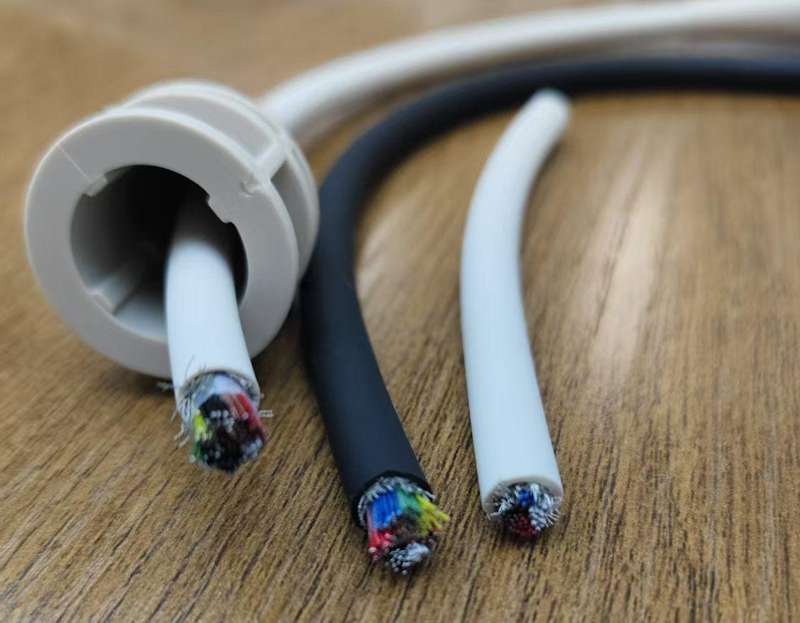
Electrical stability
Electrical stability is the foundation of medical cable performance.
Medical grade cables are designed to:
- Maintain consistent resistance and insulation
- Prevent leakage currents
- Deliver predictable signal transmission
In monitoring and diagnostic devices, even small fluctuations in electrical behavior can lead to inaccurate readings. Medical grade cables therefore prioritize consistency over peak performance, ensuring that electrical characteristics remain stable over time and across production batches.
Signal integrity
Signal integrity is especially critical in low-voltage, low-noise medical systems.
Medical grade cables must:
- Minimize signal loss
- Reduce reflections and distortion
- Preserve waveform accuracy
This is vital for ECG, EEG, imaging, and sensor-based systems where signal degradation can directly affect clinical decisions. Unlike consumer electronics, medical devices cannot tolerate intermittent or ambiguous signals.
EMI shielding
Hospitals and clinical environments are electrically noisy.
Medical grade cables require effective EMI shielding to:
- Block interference from nearby equipment
- Prevent internal signals from radiating outward
- Maintain compliance with electromagnetic compatibility requirements
Poor EMI performance can cause unstable readings, false alarms, or device malfunction—problems that are difficult to diagnose once the device is deployed.
Mechanical durability
Medical cables are handled constantly.
They must withstand:
- Repeated bending and flexing
- Pulling and twisting during use
- Long-term mechanical fatigue
Durability is not only about avoiding breakage. Mechanical degradation often leads to intermittent electrical faults, which are among the most dangerous failure modes in medical devices because they are unpredictable.
Flexibility and ergonomics
Flexibility affects both device usability and cable lifespan.
Medical grade cables are engineered to:
- Bend easily without stressing conductors
- Feel comfortable in clinicians’ hands
- Avoid kinking or memory effects
In wearable or patient-connected devices, poor flexibility can reduce patient comfort and increase strain on connectors, accelerating failure.
Resistance to cleaning and disinfection
Medical cables are exposed to frequent cleaning.
They must resist:
- Alcohol-based disinfectants
- Chemical cleaning agents
- Moisture and humidity
Performance requirements include maintaining insulation integrity, flexibility, and surface quality after repeated cleaning cycles. Material degradation here can compromise both safety and hygiene.
Long-term reliability
Medical devices are expected to operate reliably for years.
Medical grade cables must:
- Retain electrical and mechanical properties over time
- Resist aging, cracking, and embrittlement
- Perform consistently across temperature variations
Long-term reliability reduces maintenance costs, device downtime, and clinical risk—key concerns for hospitals and OEMs alike.
Medical Cable Performance vs Failure Risk
| Performance Requirement | Risk if Not Met |
|---|---|
| Electrical stability | Inaccurate readings, patient safety risk |
| Signal integrity | Diagnostic errors, data loss |
| EMI shielding | False alarms, unstable operation |
| Mechanical durability | Intermittent or sudden failures |
| Flexibility | Reduced usability, early fatigue |
| Cleaning resistance | Material breakdown, hygiene risk |
| Long-term reliability | High maintenance and recall risk |
Which Standards and Certifications Apply to Medical Grade Cables?
Medical grade cables must comply with a combination of electrical safety, material compliance, and quality system standards, including UL, ISO, RoHS, REACH, and increasingly PFAS-related requirements. These standards ensure patient safety, regulatory approval, and consistent performance throughout the medical device lifecycle.
In medical device projects, standards are often viewed as a checklist. In reality, they are a shared technical language between OEMs, regulators, hospitals, and suppliers. Choosing cables that align with the right standards reduces approval risk, accelerates market entry, and avoids costly redesigns.
UL and electrical safety
UL standards focus on electrical safety and fire behavior, particularly for devices connected to power sources or used near patients.
For medical cables, UL-related testing may involve:
- Dielectric strength
- Insulation resistance
- Flame resistance
- Temperature ratings
UL compliance is especially important for products entering the US market, where inspections and certifications are closely scrutinized. From a buyer’s perspective, UL alignment simplifies downstream approval and hospital acceptance.
ISO and quality systems
ISO standards, particularly ISO 9001 and ISO 13485, govern how medical products are designed, manufactured, and controlled.
While ISO standards do not define cable performance directly, they ensure:
- Process consistency
- Traceability of materials
- Controlled change management
For medical OEMs, working with an ISO-certified cable supplier reduces the risk of variability between batches—an often underestimated source of long-term device issues.
RoHS and REACH compliance
RoHS and REACH focus on material safety and environmental impact.
Medical grade cables must restrict hazardous substances in:
- Insulation compounds
- Jackets
- Connector materials
Compliance is increasingly required not only by regulators, but also by hospital procurement teams and multinational OEMs seeking global consistency.
PFAS and emerging material rules
PFAS restrictions are becoming more common, especially in Europe and parts of Asia.
While not always mandatory today, forward-looking medical OEMs already require:
- PFAS-free materials
- Full material declarations
- Supplier transparency
Planning for these requirements early helps avoid future redesigns when regulations tighten.
Documentation and audit readiness
Beyond testing, buyers expect clear documentation, including:
- Certificates of Conformity (COC)
- Country of Origin (COO)
- Test reports
- Material declarations
Suppliers who cannot provide these documents often become bottlenecks during audits or regulatory reviews.
At Sino-conn, documentation is prepared alongside production—not after problems arise.
What Are Medical Grade Cables Used For?
Medical grade cables are used in diagnostic, monitoring, imaging, therapeutic, and wearable medical devices where safety, signal accuracy, and durability are critical. Applications range from patient monitors and ultrasound systems to portable and home-care equipment.
The term “medical device” covers a wide spectrum of applications, and cable requirements vary dramatically depending on how and where the device is used.
Diagnostic equipment
Diagnostic devices rely heavily on signal accuracy and stability.
Examples include:
- Ultrasound systems
- ECG and EEG equipment
- Imaging peripherals
In these devices, cables must provide excellent EMI shielding and stable electrical characteristics. Even small amounts of noise or signal drift can affect diagnostic results.

Patient monitoring systems
Patient monitors operate continuously, often for long periods.
Cable requirements include:
- High flexibility
- Long-term durability
- Resistance to repeated movement
Reliability is critical because failures may occur while the device is actively monitoring vital signs.

Therapeutic devices
Therapeutic devices such as surgical or treatment equipment may involve:
- Higher currents
- Elevated temperatures
- Strict safety controls
Cables used here must balance electrical performance with mechanical robustness and insulation reliability.

Portable and wearable devices
Portable and wearable medical devices place strong emphasis on:
- Lightweight construction
- Small OD (outer diameter)
- User comfort
In these applications, flexibility and material feel are just as important as electrical performance, especially when devices are worn for extended periods.
Home and consumer-facing medical equipment
As healthcare moves closer to the patient, many medical-grade cables are now used outside hospitals.
Home-use devices require:
- Simplified designs
- High reliability with minimal maintenance
- Compliance with both medical and consumer regulations
This crossover increases the importance of careful cable design and material selection.
Can Medical Grade Cables Be Customized for OEM Projects?
Yes. Medical grade cables are commonly customized to meet specific OEM requirements, including length, pinout, connector type, materials, shielding, and mechanical design. Customization allows medical devices to meet performance, safety, and regulatory needs more effectively than off-the-shelf cables.
In medical device development, standard cables rarely fit perfectly. Custom cable assemblies allow OEMs to optimize performance, usability, and compliance.

Common customization parameters
Medical OEMs frequently customize:
- Cable length and routing
- Connector type and orientation
- Pin definitions and interconnections
- Jacket and insulation materials
- Shielding structures
These adjustments improve device integration and reduce installation or handling risks.
Drawings and engineering support
Clear drawings are critical in medical projects.
At Sino-conn, drawings are:
- Provided before production
- Confirmed with customers
- Updated with any design changes
Fast drawing turnaround (sometimes within hours) helps OEM teams move quickly from concept to validation.
Original vs alternative connectors
Medical OEMs often face trade-offs between:
- Original branded connectors
- Qualified alternative connectors
Original connectors may offer brand confidence but longer lead times and higher cost. Qualified alternatives provide flexibility, faster delivery, and comparable performance when properly validated.
Lead time and MOQ flexibility
Medical projects often start with:
- Small prototype quantities
- Engineering samples
Sino-conn supports 1-piece MOQ, fast sampling, and scalable production—allowing OEMs to validate designs before committing to volume.
Quality control and inspection
For medical grade cables, quality control is non-negotiable.
Sino-conn applies:
- In-process inspection
- Final inspection
- Pre-shipment inspection
This three-stage approach ensures consistency and reduces field failure risk.
Start Your Medical Cable Project with Sino-conn
Medical grade cables are not components you want to “fix later.”
They influence safety, compliance, and long-term device reliability from the very beginning.
Whether you are:
- Developing a new medical device
- Replacing an existing cable design
- Scaling from prototype to production
Sino-conn supports your project with fast engineering feedback, flexible customization, comprehensive testing, and full documentation.
Share your drawing, specification, or reference sample with us.
We’ll help you turn your medical cable requirements into a reliable, compliant cable assembly—ready for real clinical use.