Skip to content
In today’s hyper-connected world, the speed of communication often depends on something as small as a fingernail — the fiber connector. Whether in 5G infrastructure, cloud data centers, or precision medical equipment, these tiny connectors ensure light signals travel efficiently and accurately through networks. Yet for many engineers and buyers, choosing the right connector type is still confusing — given the acronyms, form factors, and technical differences.
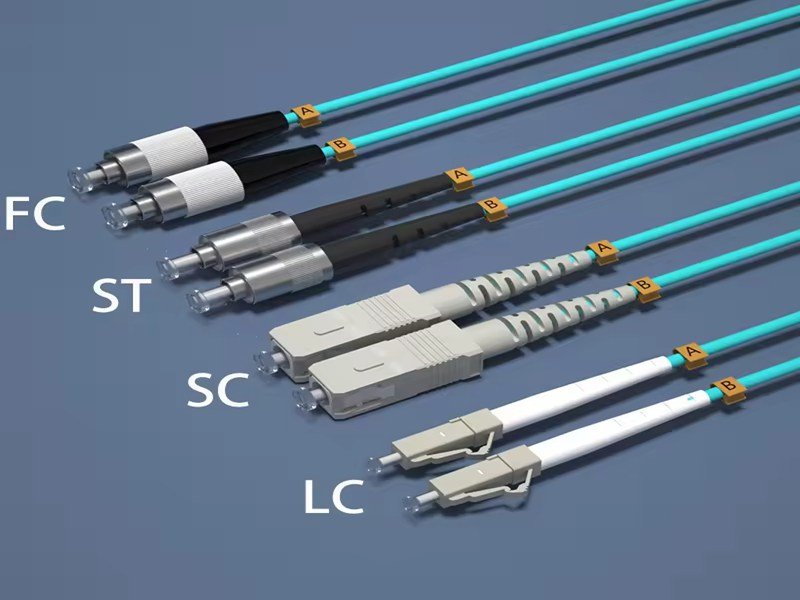
A fiber connector is a mechanical device that joins and aligns optical fibers to transmit light signals with minimal loss. Common types include SC, LC, FC, ST, and MPO connectors, each designed for specific performance, density, and application needs.
Selecting the correct connector isn’t just a technical detail — it determines system performance, installation efficiency, and long-term reliability. Let’s explore each major connector type, understand their standards, and learn how engineers, OEMs, and system integrators can choose wisely. By the end, you’ll not only recognize every connector by sight but also understand when and why to use it.
Imagine setting up a high-speed fiber network — the wrong connector could mean signal loss, downtime, and costly rework. Let’s make sure that doesn’t happen.
What Is a Fiber Optic Connector and How Does It Work?
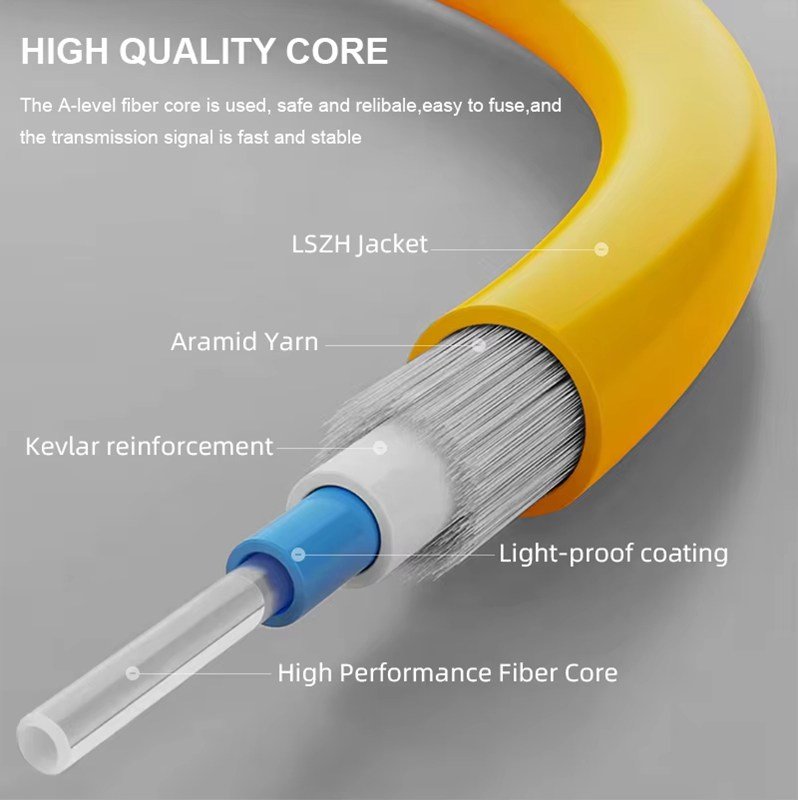
A fiber optic connector precisely aligns two optical fibers so that light can pass with minimal reflection or loss. It contains a ferrule, housing, boot, and alignment sleeve, ensuring the fiber cores meet accurately. The connector type and polish (UPC or APC) determine signal quality and performance in both single-mode and multimode applications.
Fiber connectors are the unsung heroes of modern communication systems. Their main job is to make fiber cables detachable without performance degradation. A well-designed connector maintains core alignment within microns — a feat of optical engineering.
Each connector contains four main parts:
- Ferrule: Holds the fiber in place (usually ceramic or metal).
- Housing: Provides structure and mechanical coupling.
- Boot: Offers strain relief and bend protection.
- Alignment sleeve: Ensures precision when two connectors mate.
There are two major categories of fiber:
| Type | Description | Typical Use | Connector Compatibility |
|---|---|---|---|
| Single-Mode (OS1, OS2) | Small 9 µm core, long-distance transmission | Telecom, WAN | LC, SC, FC |
| Multimode (OM1–OM4) | Larger 50–62.5 µm core, shorter range | LAN, Data Centers | LC, SC, ST, MPO |
What Does OS1, OS2, OM1, OM2, OM3, and OM4 Mean?
These terms define fiber classification standards.
- OS1/OS2 refer to single-mode fibers: OS1 for indoor (tight-buffered), OS2 for outdoor (loose-tube) long-range cables.
- OM1–OM4 are multimode types: OM1 uses 62.5 µm cores, while OM4 supports 10–100 Gbps speeds up to 550 m.
Understanding these standards helps match the right connector polish and material for desired bandwidth and attenuation levels.
What Are the Main Types of Fiber Connectors?
Fiber connectors come in many designs, but only a few have become international standards due to their reliability, optical performance, and ease of use. Each connector type serves specific environments — from dense data centers to rugged industrial installations — and differs by its size, coupling mechanism, ferrule dimension, and mode compatibility.
In summary:
The most common fiber connectors are SC, LC, FC, ST, and MPO/MTP. Each offers unique advantages depending on density requirements, durability needs, and network architecture.
1. SC Connector (Subscriber Connector)
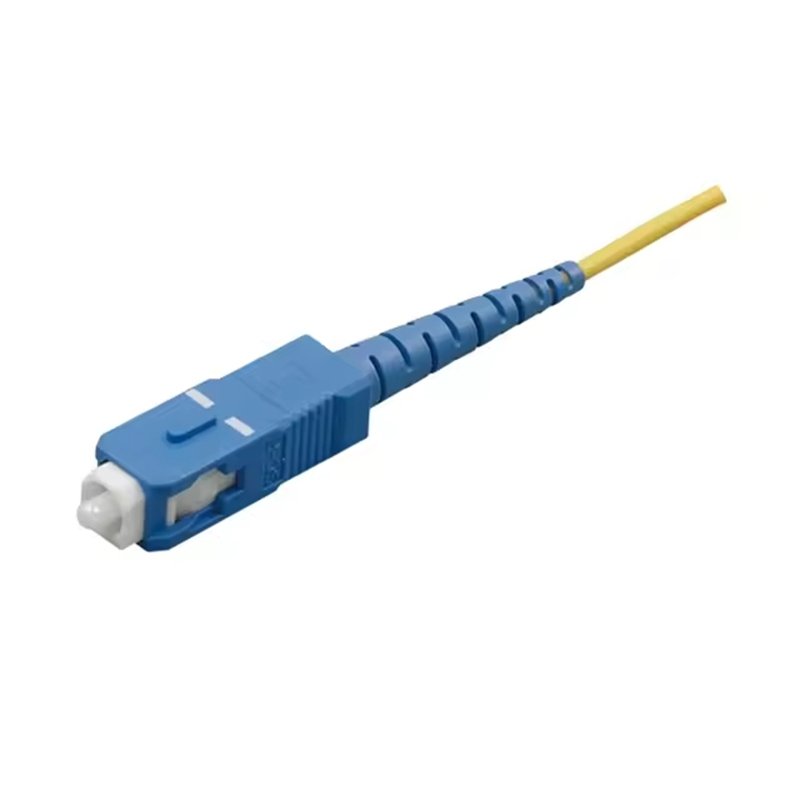
The SC connector is one of the earliest and most recognized designs in optical communication. It uses a square, push-pull coupling mechanism that provides secure and repeatable connections without twisting or threading.
Key Features:
- Ferrule size: 2.5 mm ceramic ferrule
- Connection type: Push-pull latch for quick insertion/removal
- Typical fiber: Single-mode and multimode
- Insertion loss: Typically 0.20–0.35 dB
Because of its simple design and low cost, the SC connector became the global default in telecom and CATV systems during the 1990s and remains widely used in patch panels, media converters, and distribution frames. Its click-on mechanism ensures reliable alignment even after hundreds of mating cycles.
Use Case:
SC connectors are ideal for fixed installations such as central offices or data center racks where connections are not frequently changed but must remain stable over time.
2. LC Connector (Lucent Connector)
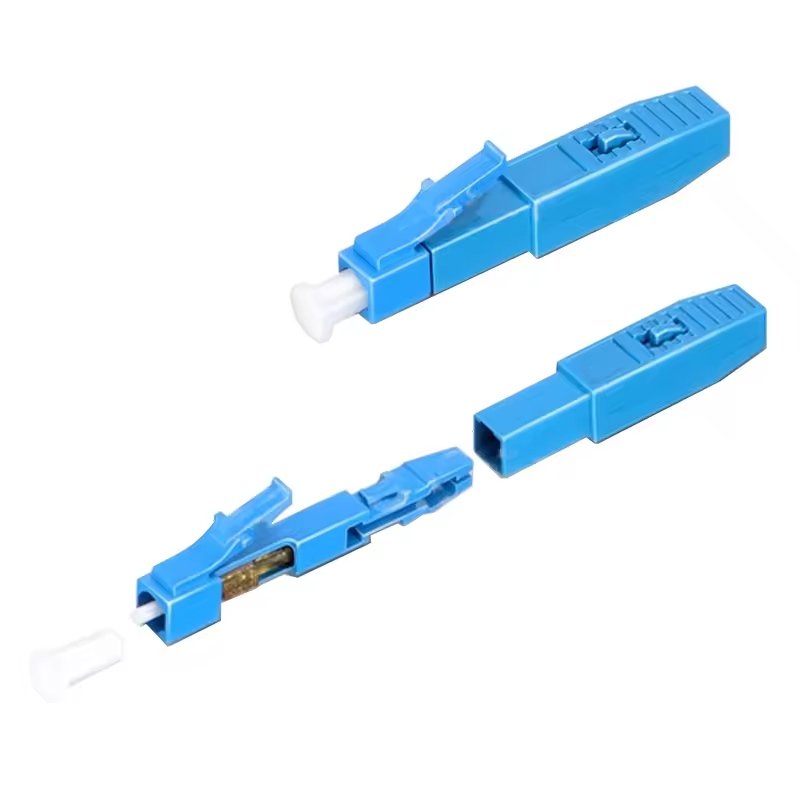
The LC connector was developed by Lucent Technologies to address the growing need for higher port density. Its design is similar to the SC but scaled down by 50%, using a 1.25 mm ferrule instead of 2.5 mm.
Key Features:
- Compact form factor: Doubles port density compared with SC
- Latch mechanism: Small clip-style latch provides secure retention
- Insertion loss: Around 0.10–0.30 dB
- Common polish types: UPC or APC for different reflection control
The LC connector quickly became the de facto standard for modern networking hardware — including transceivers (SFP, SFP+, QSFP modules), servers, and switches — because it enables smaller patch panels and more efficient cable management.
Use Case:
LC connectors are preferred in data centers, enterprise LANs, and high-density telecom environments where space is limited but optical precision is critical.
3. What Do LC and SC Stand For?
- LC: Lucent Connector — named after its developer, Lucent Technologies.
- SC: Subscriber Connector — originally defined by NTT (Japan).
Though their functions overlap, their physical sizes and coupling mechanisms differ. LC offers space savings and better density, while SC remains valued for its ruggedness and simplicity. Both share similar optical performance levels when properly terminated.
4. FC Connector (Ferrule Connector)

The FC connector is designed for environments where vibration resistance and mechanical stability are crucial. It uses a screw-on threaded coupling, ensuring that once connected, it remains tightly secured.
Key Features:
- Ferrule: 2.5 mm zirconia ceramic
- Coupling: Threaded metal housing
- Insertion loss: 0.25–0.40 dB
- Durability: Excellent resistance to vibration and mechanical stress
While FC connectors are less common in high-density systems today, they are still used in test and measurement equipment, industrial automation, and long-haul single-mode networks. Their robust design makes them suitable for field applications where connectors might face movement or temperature variations.
5. ST Connector (Straight Tip)
The ST connector is one of the oldest types, recognizable by its bayonet-style coupling (similar to a BNC connector). It was popular in the early days of LAN and campus networks using multimode fiber.
Key Features:
- Ferrule: 2.5 mm
- Coupling: Twist-lock bayonet design
- Insertion loss: 0.25–0.50 dB
- Use case: Multimode networks and educational setups
While ST connectors are now considered legacy, they’re still found in older installations, labs, and training environments because of their simplicity and durability.
6. MTP/MPO Connectors (Multi-Fiber Push-On)

The MTP/MPO connector represents the evolution of optical interconnects for parallel transmission systems. Instead of carrying a single fiber, each connector can handle 12, 16, or even 24 fibers in one rectangular ferrule, dramatically increasing data throughput per connection.
Key Features:
- Fiber count: 8–24 fibers (or more for custom versions)
- Application: 40G/100G/400G Ethernet and backbone cabling
- Insertion loss: 0.35–0.75 dB
- Alignment: Guide pins ensure precise multi-fiber positioning
MTP is an enhanced version of the MPO standard — featuring tighter mechanical tolerances, improved spring design, and better performance consistency. These connectors are essential for hyperscale data centers, cloud infrastructure, and high-bandwidth cross-connect systems.
7. E2000, MU, and Other Specialized Connectors
While the mainstream market revolves around SC, LC, FC, and MPO, certain specialized connectors are tailored for niche applications:
- E2000: Features an automatic spring-loaded shutter to protect against dust and laser exposure. Common in telecom and medical systems.
- MU: Miniaturized version of the SC connector (1.25 mm ferrule), often used in high-density optical modules.
- DIN and SMA: Rugged designs for military, industrial, or sensing environments requiring metal housings and precise optical interfaces.
These connectors demonstrate how the fiber optic industry adapts to unique requirements — whether cleanliness in hospitals, reliability in military communication, or compactness in aerospace.
8. What Are Three Common Fiber Optic Connector Types?
While dozens of designs exist, three connector types dominate modern fiber installations:
- SC – reliable and easy to handle, widely used in telecom and FTTH systems.
- LC – compact, space-saving, and the top choice for modern networking gear.
- ST – older but still relevant in legacy multimode networks.
Together, these three account for over 90% of field-deployed connectors worldwide.
Summary Table – Comparison of Main Fiber Connectors
| Connector Type | Ferrule Size | Coupling Method | Typical Use | Fiber Type | Insertion Loss (dB) |
|---|---|---|---|---|---|
| SC | 2.5 mm | Push-pull latch | Telecom, Data centers | SM/MM | 0.20–0.35 |
| LC | 1.25 mm | Latch clip | High-density data racks | SM/MM | 0.10–0.30 |
| FC | 2.5 mm | Threaded | Industrial, long-haul | SM | 0.25–0.40 |
| ST | 2.5 mm | Bayonet twist | Legacy LANs | MM | 0.25–0.50 |
| MTP/MPO | Multi-fiber | Push-on | High-speed parallel links | SM/MM | 0.35–0.75 |
| E2000/MU | 1.25 mm | Snap or shutter | Medical, telecom | SM/MM | 0.20–0.40 |
Key Takeaway
Each connector type evolved to balance performance, durability, and density. SC and LC remain the workhorses of the industry, FC excels in stability, ST serves older systems, and MPO drives the next generation of multi-lane, high-speed communication. Understanding their characteristics allows engineers and buyers to specify the right connector for every fiber network — ensuring reliability and future scalability without unnecessary complexity.
Which Fiber Connector Type Is Best for Your Application?
Choosing the “best” fiber connector isn’t about picking a single superior design — it’s about matching the connector’s characteristics with the functional, environmental, and mechanical demands of your specific application.
Each connector type has strengths and trade-offs related to insertion loss, durability, size, and cost. Understanding these factors ensures your network performs reliably and is easy to maintain over time.
In short:
The best connector depends on your application’s fiber mode, environment, space limitations, and required performance. LC connectors suit high-density systems, SC for general purpose, FC for vibration-prone environments, and MPO for high-speed data transmission.
1. Factors That Determine the “Best” Connector
Before comparing connector types, it’s important to define the key decision factors:
| Factor | Why It Matters | Examples |
|---|---|---|
| Fiber Type | Determines connector size and polish (single-mode vs. multimode). | OS2 = LC/APC; OM3 = LC/UPC |
| Space & Density | High-density racks require smaller connectors. | LC or MU preferred |
| Insertion/Return Loss | Affects signal integrity, especially in long-distance systems. | LC/APC for ≤0.3 dB |
| Mechanical Durability | Important in environments with movement or vibration. | FC or ruggedized SC |
| Ease of Maintenance | Push-pull connectors simplify frequent patching. | SC or LC |
| Budget | High-performance connectors cost more but reduce downtime. | MPO higher upfront cost, higher data density |
2. LC Connectors – Best for High-Density and Modern Networks

The LC connector is often the default choice in modern optical systems due to its compact design and high precision.
Because of its 1.25 mm ferrule, LC allows twice the port density of SC connectors, a critical advantage in server rooms, telecom racks, and hyperscale data centers.
Best for:
- High-density environments (data centers, enterprise switches)
- Short- to medium-distance single- or multimode fiber
- Applications where space and airflow are limited
Advantages:
- Small form factor saves panel space
- Excellent optical performance (≤0.3 dB insertion loss)
- Easy latch release for quick maintenance
Limitations:
- Smaller components may be delicate in rugged environments
- Requires careful cleaning due to small contact area
Verdict:
For modern 10G/40G/100G networks, LC connectors are typically the most efficient and future-ready choice.
3. SC Connectors – Reliable and Easy to Handle

The SC connector remains a trusted standard across industries thanks to its simple push-pull coupling and proven reliability. It’s widely used in telecom, CATV, and general network infrastructure where stability outweighs size constraints.
Best for:
- Telecommunication and broadband distribution
- Patch panels or static installations
- Environments requiring consistent connections over time
Advantages:
- Robust structure, easy to handle even with gloves
- Low-cost and widely available
- Durable ferrule design ensures consistent alignment
Limitations:
- Larger footprint reduces density per panel
- Less suited for ultra-compact or mobile systems
Verdict:
A dependable all-rounder for general-purpose single-mode networks, especially when installation space is not critical.
4. FC Connectors – Ideal for Industrial and Vibration-Prone Environments

The FC connector uses a screw-thread coupling mechanism that prevents loosening from vibration or mechanical stress.
It’s common in test instruments, manufacturing systems, and outdoor installations where stability and precision are vital.
Best for:
- Industrial automation or machine vision
- Test and measurement setups
- Long-haul single-mode systems
Advantages:
- High mechanical strength
- Maintains connection integrity under vibration
- Excellent long-term stability
Limitations:
- Slower to connect and disconnect due to threading
- Not suitable for dense patch panels
Verdict:
When vibration or mechanical reliability is more important than speed of access, FC is the superior choice.
5. ST Connectors – Practical for Legacy and Educational Networks

Though now considered legacy, the ST connector remains relevant in older LANs, training facilities, and educational labs that still use multimode fiber.
Best for:
- Existing multimode fiber systems
- Training environments and lab setups
- Low-cost educational projects
Advantages:
- Simple design and low cost
- Easy to connect and disconnect
- Widely available replacement parts
Limitations:
- Larger ferrule limits density
- Less secure than threaded or latched designs
- Not optimized for high-speed or modern data rates
Verdict:
A solid, inexpensive option for legacy or short-run multimode networks, but less suitable for new installations.
6. MPO/MTP Connectors – For High-Speed, Multi-Fiber Systems

The MPO (Multi-Fiber Push-On) and MTP (Mechanical Transfer Push-On) connectors are designed for parallel optical communication, where multiple fibers transmit data simultaneously.
They are the foundation of 40G, 100G, and 400G Ethernet systems and are critical in modern cloud and enterprise data centers.
Best for:
- Data center backbone or cross-connects
- Parallel transmission systems (12, 16, or 24 fibers)
- Scalable, modular cabling architectures
Advantages:
- Handles high data capacity in compact format
- Simplifies mass deployment
- Available in male/female and key-up/key-down variants
Limitations:
- Higher insertion loss than single-fiber connectors
- Requires precise cleaning and alignment
- More complex polarity management
Verdict:
Essential for high-bandwidth, modular systems — particularly where scalability and speed are more critical than single-connection precision.
7. Specialized Connectors (E2000, MU, and More)
For environments with stringent performance or safety requirements, specialized connectors fill the gap where standard types are inadequate.
| Connector | Distinguishing Feature | Common Use |
|---|---|---|
| E2000 | Spring-loaded shutter protects against dust and laser light | Medical, telecom |
| MU | Micro version of SC, 1.25 mm ferrule | High-density optical modules |
| DIN / SMA | Metal housings, high durability | Military, sensing, research |
Verdict:
These connectors prioritize safety, miniaturization, or environmental resilience, and are often selected in specialized or regulated industries rather than general networking.
8. Comparative Overview – Selecting by Application
| Application | Recommended Connector | Key Benefits |
|---|---|---|
| Data Center / Cloud | LC, MPO/MTP | High density, fast deployment |
| Telecom / FTTH | SC, LC (APC) | Reliable, low reflection |
| Industrial / Manufacturing | FC | Rugged, vibration-resistant |
| Medical / Cleanroom | E2000 | Protected, sterile connection |
| Legacy LAN / Labs | ST | Economical, simple setup |
This overview shows that no connector is “best” in every case — rather, each excels in a different operational context.
Key Takeaways
- LC connectors dominate modern compact systems.
- SC connectors remain the most universally compatible.
- FC connectors are unmatched in mechanical robustness.
- MPO connectors drive parallel, high-speed infrastructure.
- Specialized connectors serve niche or regulated markets.
Choosing the right type is less about brand or trend and more about ensuring alignment between optical performance and real-world operating conditions.
By evaluating your fiber type, system design, and maintenance needs early, you’ll ensure every connection in your network performs consistently over its lifecycle.
How to Choose the Right Fiber Connector for Your Project
Selecting the correct fiber connector is one of the most critical steps in designing or upgrading an optical network. The right choice ensures minimal signal loss, long-term reliability, and ease of installation — while the wrong one can cause compatibility issues, maintenance challenges, or costly rework.
In summary:
To choose the right fiber connector, you must match your fiber type (single-mode or multimode), environment (indoor or outdoor), connector polish (UPC or APC), and density requirements. These parameters determine optical performance, durability, and system compatibility.
1. Identify Your Fiber Type (Single-Mode vs. Multimode)
The first step is understanding the type of fiber cable used in your system. Each connector type is optimized for specific core sizes and transmission distances.
| Fiber Category | Core Size | Typical Range | Common Connectors | Notes |
|---|---|---|---|---|
| OS1/OS2 (Single-Mode) | 9 µm | Up to 40 km or more | LC, SC, FC | Used for telecom, long-distance, and high-precision systems |
| OM1–OM4 (Multimode) | 50–62.5 µm | 300–550 m | LC, SC, ST, MPO | Common in LANs, data centers, and short links |
- Single-mode fibers (OS1, OS2): Smaller cores (9 µm) that carry light over long distances. Typically paired with LC or SC connectors and used in telecom, FTTH, and backbone networks.
- Multimode fibers (OM1–OM4): Larger cores (50/62.5 µm) supporting multiple light paths for short-range, high-throughput applications — such as data centers and enterprise networks.
Tip: Using a connector not matched to the fiber type can lead to poor alignment, higher insertion loss, or complete signal failure.
2. Consider the Operating Environment
The physical conditions where your network operates greatly influence connector choice.
Ask these questions:
- Will the installation be indoors or outdoors?
- Is the area exposed to vibration, moisture, or dust?
- Will connectors be frequently connected and disconnected?
General guidance:
- Indoor, controlled environments: LC or SC connectors with standard boots are sufficient.
- Outdoor or harsh environments: Consider connectors with metal housings, waterproof boots, or strain relief (e.g., FC or ruggedized SC).
- High-vibration or mobile systems: Threaded connectors like FC prevent loosening.
In industrial automation or military applications, connectors may also require UV resistance, fire retardancy, or oil-proof jackets. In cleanroom or medical settings, dust-protected connectors (e.g., E2000) are preferable.
3. Choose the Correct Connector Polish Type
Connector polishing is a critical yet often overlooked detail. The end-face geometry of the fiber determines reflection loss and return signal performance.
| Polish Type | Geometry | Return Loss | Common Use | Notes |
|---|---|---|---|---|
| PC (Physical Contact) | Slightly curved | ≥–40 dB | Legacy systems | Basic polish, low-cost |
| UPC (Ultra Physical Contact) | More refined curve | ≥–50 dB | LANs, test gear | Low insertion loss, common today |
| APC (Angled Physical Contact) | 8° angled end-face | ≥–60 dB | FTTH, high-precision telecom | Minimizes reflection, ideal for single-mode |
Key insight:
- UPC connectors are ideal for most short- to medium-distance systems (LANs, data centers).
- APC connectors are critical in high-precision single-mode networks where reflected light can interfere with lasers or cause signal instability.
- APC connectors are usually green, while UPC connectors are blue — an easy visual identifier in mixed environments.
4. Evaluate Space, Density, and Accessibility
Physical layout matters just as much as optical design. The number of connections per rack or panel determines which connector type will be most efficient.
| Environment | Space Constraint | Recommended Connector |
|---|---|---|
| Data Center Patch Panels | High | LC duplex or MPO |
| Telecom Rooms | Moderate | SC or LC |
| Industrial Cabinets | Low | FC or ruggedized SC |
| Portable Test Systems | Varies | FC, ST, or hybrid |
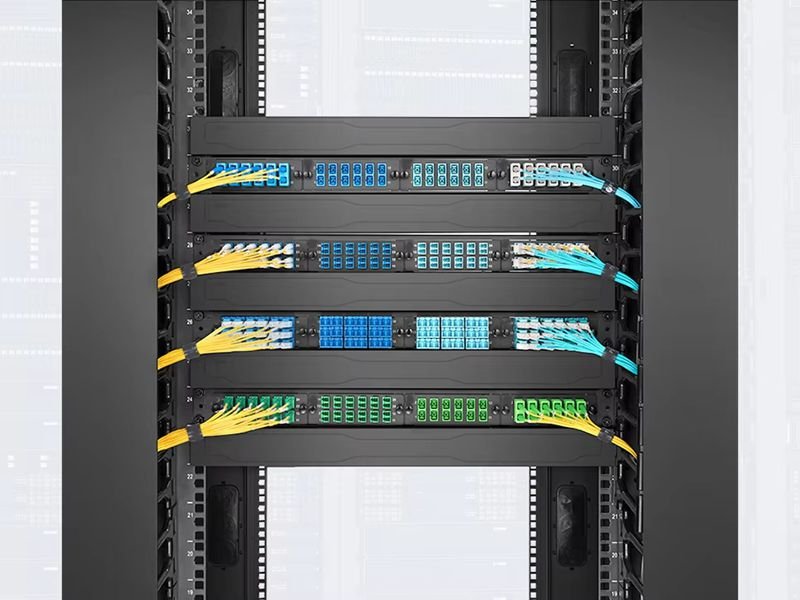
- High-density environments such as data centers benefit from LC or MPO connectors, which minimize footprint while maximizing connectivity.
- General installations with moderate space can use SC connectors for easier handling.
- In environments with limited access or frequent reconfiguration, choose connectors with push-pull designs for faster maintenance.
5. Assess Performance and Budget Trade-offs
While performance metrics like insertion loss (IL) and return loss (RL) are standardized, connector quality and manufacturing precision can vary across suppliers.
Typical performance ranges:
| Connector Type | Insertion Loss (dB) | Return Loss (dB) | Notes |
|---|---|---|---|
| LC / SC UPC | 0.1–0.3 | –50 | Standard high-quality connectors |
| LC / SC APC | 0.2–0.3 | –60 | Superior for long-distance links |
| MPO / MTP | 0.35–0.75 | –40 | Multi-fiber connectors with higher loss tolerance |
For most commercial and enterprise networks, an insertion loss under 0.35 dB is acceptable. Mission-critical links (e.g., telecom, broadcast, medical imaging) demand 0.2 dB or less.
Balancing budget and precision is crucial. High-performance connectors are more expensive but can reduce maintenance costs, downtime, and signal degradation over time.
6. Plan for Maintenance and Future Scalability
Fiber systems evolve. Choosing a connector type that aligns with future upgrades can save time and cost.
Consider:
- Ease of cleaning: Smaller connectors (like LC) require more precision cleaning tools.
- Upgrade potential: MPO connectors allow modular scaling from 12 to 24 fibers for future bandwidth increases.
- Field termination options: If field installation is needed, connectors with pre-polished ferrules or mechanical splicing features simplify setup.
A connector system that can scale with increasing speed demands (from 1G to 400G) ensures longevity of your infrastructure.
7. Common Decision Flow – Quick Selection Guide
Below is a simplified decision framework engineers often use:
- Determine Fiber Type → Single-mode (LC/APC, SC/APC) or Multimode (LC/UPC, SC/UPC, MPO).
- Assess Space → Limited? Choose LC or MPO. Spacious? SC or FC.
- Environment → Industrial? Use FC or armored SC.
- Performance Needs → Long distance or precision? Choose APC polish.
- Scalability → Expect upgrades? MPO provides future-proofing.
8. Example Scenarios
- Scenario 1 – Data Center Backbone: LC/UPC duplex or MPO trunk cables for compact, high-bandwidth racks. Reason: Minimal space, need for modular scalability.
- Scenario 2 – Telecom Fiber Distribution: SC/APC connectors for low-reflection, stable single-mode connections. Reason: Long-distance, outdoor cabling, and high laser performance.
- Scenario 3 – Industrial Monitoring System: FC connectors for screw-on stability and vibration resistance. Reason: Machinery and mobile components require secure coupling.
- Scenario 4 – Medical Imaging Equipment: E2000 connectors with automatic dust shutters. Reason: Cleanroom environments with frequent disconnection.
9. Summary Table – Connector Selection Overview
| Application Type | Recommended Connector | Polish | Reason |
|---|---|---|---|
| High-Density Data Center | LC Duplex / MPO | UPC | Compact, fast connection |
| Long-Distance Telecom | SC / LC | APC | Low reflection, long reach |
| Industrial / Harsh | FC / Armored SC | UPC | Mechanical strength |
| Medical / Cleanroom | E2000 | APC | Safety and cleanliness |
| Legacy Networks | ST | PC | Cost-effective and simple |
10. Key Takeaways
- There is no universal “best” connector — only the most suitable one for your conditions.
- LC and SC dominate general applications; FC fits rugged systems; MPO powers parallel optics.
- Always align fiber type, polish, and environment to achieve optimal performance.
- Considering future scalability early prevents costly redesigns later.
Choosing wisely at the design stage ensures your fiber infrastructure remains efficient, maintainable, and adaptable — no matter how technology evolves.
Do Fiber Connectors Affect Performance and Reliability?
Yes. Connector precision directly impacts insertion and return loss, which affect overall link stability. Poor-quality connectors can cause up to 3 dB of loss, while well-polished, high-precision connectors keep it below 0.3 dB.
A misaligned ferrule can cause optical back reflection, signal distortion, and even equipment damage. That’s why fiber connector manufacturing requires micron-level accuracy.
Performance Metrics to Monitor:
| Metric | Typical Value | Impact |
|---|---|---|
| Insertion Loss | ≤0.3 dB | Affects transmission strength |
| Return Loss | ≥–50 dB (UPC) / ≥–60 dB (APC) | Determines reflection quality |
| Durability | >500 matings | Affects lifecycle cost |
Material and Polishing Quality Matter:
Connectors made from high-grade zirconia ceramics and precisely polished end-faces show far superior repeatability.
Testing and Quality Control:
Professional manufacturers such as Sino-conn conduct 100% inspection: in-process, final, and pre-shipment checks, ensuring every connector meets spec before leaving the facility.

Why Choose Sino-conn as Your Custom Fiber Cable Partner
Sino-conn provides engineering-driven, customized fiber cable assemblies — from connector design and drawing approval to full production. Certified with UL, ISO, ROHS, and REACH, they deliver globally with competitive pricing and no MOQ.
While understanding connector types is essential, selecting the right manufacturing partner is what ensures long-term success.
Why global OEMs trust Sino-conn:
- Fast Engineering Response: CAD drawings within 30 minutes to 3 days.
- Flexible MOQ: From 1 pc prototype to full production.
- Certified Quality: UL, ISO, ROHS, REACH, PFAS compliant.
- Rapid Lead Time: Samples in 2–3 days; mass production within 2–4 weeks.
- Expert Support: Engineers who understand both technical specs and application context.
Sino-conn supports customization in:
- Connector type and pin definition
- Cable length and jacket material
- EMI shielding and environmental protection (UV, oil, fire)
Each order passes through three quality gates: process inspection, finished inspection, and pre-shipment validation — guaranteeing reliability across every application.

Are Fiber Connectors Interchangeable Across Systems?
Not always. Different connectors may vary in ferrule size, polish angle, and coupling design, making interchangeability limited. Matching fiber type and polish is crucial for optimal performance and safety.
While SC and LC may look similar, their ferrules differ in diameter. Likewise, an APC-polished connector cannot properly mate with a UPC port without severe signal loss. Always ensure mechanical and optical compatibility.
For complex systems, professional suppliers like Sino-conn can assist in compatibility analysis, connector matching, and even design modifications to meet specific interface standards.
Conclusion:
Fiber connectors are the small details that make large networks function seamlessly. Whether you’re designing a 5G backbone, a factory automation line, or a medical imaging system, selecting the correct connector is critical — but so is choosing a capable partner who understands every technical nuance.
Sino-conn provides custom fiber cable assemblies tailored to your requirements — from LC and SC patch cords to MPO/MTP backbone solutions — with professional drawings, flexible MOQ, and guaranteed quality.
Ready to start your project?
Contact Sino-conn’s engineering team today to discuss your custom fiber connector or cable assembly needs and experience the precision of a true manufacturing partner.