Skip to content

In electrical design, one seemingly small decision—choosing stranded or solid wire—can have a massive impact on system performance, flexibility, and cost. From robotics to residential wiring, the type of conductor you choose affects everything from signal reliability to maintenance cycles.
Solid wire is a single, rigid conductor ideal for permanent, low-vibration installations. Stranded wire is made of multiple fine strands twisted together, providing superior flexibility for dynamic or portable applications.
While both serve the same basic purpose—conducting electricity—they differ in structure, behavior, and cost. Understanding these distinctions ensures your project runs smoothly and efficiently. A factory automation engineer once told Sino-conn, “We lost 30% of production uptime before realizing our fixed-line cables were breaking under vibration.” The solution? Switching to stranded wires designed for motion.
What Is Solid Wire and How Does It Work?
Solid wire is a single-core conductor made from copper or aluminum, designed for permanent, low-movement electrical installations. Its uniform structure delivers excellent conductivity, low resistance, and high durability in fixed systems such as building wiring, control panels, and power distribution. Solid wires are easy to terminate, inexpensive to produce, and ideal for applications that demand stable electrical performance without frequent flexing or vibration.

Understanding the Structure of Solid Wire
A solid wire consists of one continuous piece of conductive metal—most commonly copper (Cu) or aluminum (Al)—encased in an insulating layer such as PVC, XLPE, or PTFE.
Unlike stranded wire, which uses many thin filaments twisted together, solid wire is monolithic, meaning there are no internal air gaps.

This uniform structure provides two immediate electrical advantages:
- Lower electrical resistance, which minimizes power loss over distance.
- Consistent conductivity, ensuring predictable voltage and current behavior across the entire circuit.
Because electrons travel more efficiently through a single, unbroken path, solid wire is widely used in fixed installations where movement is minimal and long-term reliability is critical.
Core Physical Properties and Electrical Characteristics
| Property | Solid Wire | Typical Value / Performance |
|---|---|---|
| Conductor Type | Single solid copper/aluminum core | 1 strand |
| Common Sizes | 10–24 AWG | Medium to large gauge |
| Resistance (Ohms/km) | Lower than stranded | High conductivity |
| Flexibility | Low (rigid) | Holds form during installation |
| Current Capacity | Slightly higher than stranded (same gauge) | Excellent |
| Cost Efficiency | More affordable to produce | Economical choice |
Solid wires also demonstrate superior surface stability—the absence of multiple strand interfaces reduces oxidation and corrosion inside the conductor.
When paired with high-temperature insulation (such as XLPE or silicone), they can tolerate continuous operation in up to 125°C environments without deformation or cracking.
Why Solid Wire Offers Strong Electrical Performance
- Low Resistance Path The uninterrupted conductor allows electrons to move freely, reducing resistive heat generation and voltage drop. This makes solid wire ideal for longer cable runs or high-current circuits such as power distribution boards.
- Predictable Impedance The uniform geometry minimizes impedance variation—important in industrial controls and communication systems that rely on signal integrity.
- Enhanced Durability With no internal strands to separate or fatigue, solid wire can maintain electrical stability for decades when installed properly.
- Stable Mechanical Form Solid wire retains its shape once bent, which helps electricians neatly route and anchor wiring in conduits, junction boxes, or PCB terminals.
Advantages of Solid Wire in Engineering Applications
- Consistent Conductivity: Lower resistance translates to less voltage loss and greater energy efficiency—especially in large commercial buildings or factory networks.
- Simplified Termination: Because of its rigidity, solid wire easily fits into screw terminals, clamp connectors, and solder joints, reducing installation time.
- Long-Term Reliability: Ideal for permanent circuits—outlets, switches, lighting, and grounding—where frequent rework isn’t required.
- Cost Advantage: Solid wire requires less manufacturing effort and less copper overall, typically 10–15% cheaper than stranded equivalents of the same gauge.
Where Solid Wire Is Most Commonly Used
Solid wire is prevalent in environments with minimal motion, vibration, or mechanical stress, including:
- Residential Wiring (Romex Cables): Wall outlets, lighting systems, circuit panels.
- Building Infrastructure: Conduits, switchgear, HVAC systems, and ceiling wiring.
- Industrial Control Panels: Power buses and internal connections in cabinets.
- Grounding and Bonding Applications: Direct earth connections that require high current capacity and corrosion resistance.
Is Romex Wire Solid or Stranded?
Romex, a trademarked brand for non-metallic (NM) electrical cable, typically contains solid copper conductors for 14 AWG, 12 AWG, and 10 AWG sizes—the most common gauges in household wiring.
This makes it easier to connect to screw-type terminals found in wall outlets and switches.
However, for larger gauges (8 AWG and above) or circuits requiring increased flexibility—like service feeders or heavy equipment wiring—Romex and similar cables may use stranded conductors instead.
When to Use Solid vs Stranded Wire
Choosing between solid and stranded wire depends primarily on whether the installation will remain static or mobile.

Use solid wire when:
- The wiring is permanently installed within walls, conduits, or enclosures.
- Flexibility is unnecessary or undesirable.
- Low cost and minimal resistance are priorities.
Use stranded wire when:
- The wire must bend, move, or flex during normal operation.
- The environment experiences vibration, heat cycling, or motion.
| Installation Type | Recommended Wire | Reason |
|---|---|---|
| Permanent residential wiring | Solid wire | Stable, affordable, long-lasting |
| Industrial robotics | Stranded wire | Flexible, vibration-resistant |
| Control cabinets (fixed) | Solid wire | Easy termination |
| Machinery power cords | Stranded wire | High bending endurance |
What Is Stranded Wire?
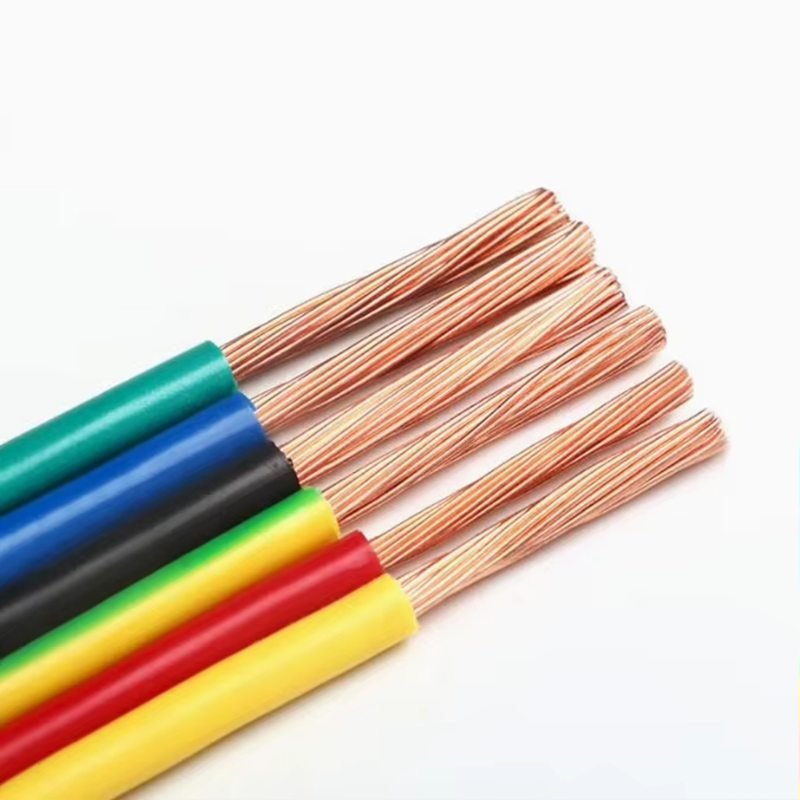
Stranded wire is made up of multiple thin metal strands twisted together to form a single flexible conductor. This structure gives stranded wire superior bending capability, vibration resistance, and durability compared to solid wire. It’s ideal for dynamic or mobile applications—such as robotics, automotive, and industrial machinery—where movement, vibration, and temperature variation demand resilience without sacrificing conductivity.
Understanding the Structure of Stranded Wire
Unlike solid wire, which consists of one continuous conductor, stranded wire is composed of many small-gauge filaments—typically 7, 19, 37, or even 127 strands—woven together to form a single core. Each strand is made of copper (bare, tinned, or silver-plated) or aluminum, and the entire bundle is insulated by a protective layer such as PVC, silicone, XLPE, FEP, or PTFE.
This design is based on a simple mechanical principle:
Multiple thinner conductors bend more easily than one thick conductor of the same diameter.
By distributing stress across several strands, stranded wire can flex, twist, and vibrate repeatedly without cracking or losing conductivity. That’s why it’s used in flexible power cords, electronic leads, automotive harnesses, and industrial robots—where reliability under movement is non-negotiable.

Key Electrical and Mechanical Characteristics
| Property | Stranded Wire | Typical Range / Value |
|---|---|---|
| Construction | Multiple fine strands twisted together | 7–127 strands |
| Flexibility | Very high | Ideal for dynamic motion |
| Resistance (Ohms/km) | Slightly higher than solid | +1–3% depending on strand count |
| Durability under Bending | Excellent | Up to 10 million bend cycles |
| Current Capacity | Slightly lower | Depends on strand configuration |
| Termination Needs | Requires ferrules or crimping | Prevents fraying or weak contact |
The more strands a wire has, the more flexible it becomes—but it also increases manufacturing complexity and cost.
To balance this, manufacturers select a strand count and diameter based on the application’s motion cycle, voltage level, and space constraint.
Why Stranded Wire Offers Superior Flexibility
Each strand in a stranded wire can move independently within the bundle, reducing internal friction and distributing mechanical stress evenly during bending.
This flexibility provides four major benefits:
- Extended Lifespan in Motion: Stranded wires resist metal fatigue, allowing them to perform millions of bend cycles without failure—critical for robotics and motion control cables.
- Improved Vibration Resistance: Equipment like motors or vehicles generate continuous vibration. Stranded conductors absorb that energy, preventing breakage and signal loss.
- Easier Routing in Tight Spaces: The flexible core bends around corners or inside compact housings without kinking or damaging insulation.
- Enhanced Durability Under Repeated Handling: Portable tools, chargers, and test equipment often flex during daily use; stranded wire ensures lasting conductivity and user safety.
Surface Treatments and Conductive Coatings
Sino-conn uses various coatings to improve stranded wire performance:
- Tinned Copper: Resists corrosion and improves solderability.
- Nickel-Plated Copper: Withstands high temperatures and oxidation.
- Silver-Plated Copper: Offers superior conductivity for aerospace and defense applications.
These surface finishes not only extend cable lifespan but also ensure low contact resistance and stable performance under thermal and environmental stress.
Applications Where Stranded Wire Excels
Stranded wire is indispensable in systems where flexibility, motion, and vibration resistance are key performance indicators.
Typical use cases include:
- Automotive Wiring Harnesses: Used in dashboards, doors, and engine bays to tolerate vibration and temperature extremes.
- Industrial Automation: Power and signal transmission in robotic arms, CNC machines, and assembly lines.
- Aerospace & Defense: Lightweight and flexible wiring for aircraft avionics and onboard systems.
- Consumer Electronics: Headphone cables, chargers, and power cords where frequent bending occurs.
- Marine & Renewable Energy: UV- and moisture-resistant stranded wires ensure safety in harsh, outdoor conditions.
What Are the Disadvantages of Stranded Wire?
While stranded wire offers many advantages, it also comes with trade-offs that must be considered during design and installation:
- Higher Manufacturing Cost: Stranding increases production complexity and material use, raising cost compared to solid wire.
- Slightly Higher Resistance: The small air gaps between strands reduce current-carrying efficiency slightly, which may impact long-distance power runs.
- Trickier Termination: The flexible strands can fray during termination; hence, crimping ferrules or tinned ends are often necessary for consistent connection quality.
- Moisture Entrapment Risk: In humid environments, gaps between strands can trap moisture, increasing the risk of corrosion unless sealed properly with insulation or heat-shrink tubing.
- Less Form Stability: Unlike solid wire, stranded wire doesn’t hold its shape after bending, which can make routing inside panels or conduits slightly more difficult.
Despite these drawbacks, stranded wire’s operational flexibility and long service life far outweigh the disadvantages in dynamic environments.
Which Key Differences Matter Most Between Stranded and Solid Wire?
The main differences between stranded and solid wire come down to flexibility, conductivity, durability, and cost.
Solid wire offers lower resistance and higher conductivity, making it ideal for stable, long-term installations.
Stranded wire provides superior flexibility and vibration resistance, suited for environments involving motion or repeated bending.
The choice depends on whether your system needs maximum conductivity (solid) or mechanical resilience and flexibility (stranded).
1. Electrical Conductivity and Resistance
At the electrical core, solid wire wins on raw conductivity. Because it is a single, unbroken conductor, electrons flow through it with minimal resistance and fewer junction points where energy can be lost as heat.
By contrast, stranded wire contains microscopic air gaps between strands and slightly longer total conduction paths (due to twist geometry), creating 1–3 % more resistance for the same cross-sectional area.
| Parameter | Solid Wire | Stranded Wire |
|---|---|---|
| DC Resistance (Ω/km) | Lower | Slightly higher |
| Voltage Drop | Minimal | Slightly higher over long runs |
| Current-Carrying Efficiency | Excellent | Very good |
| Energy Loss | Low | Slightly higher under load |
For long cable runs—such as building power feeds or solar string wiring—solid wire ensures consistent voltage delivery.
However, in short or flexible runs, the added resistance of stranded wire is negligible compared with the mechanical benefits it provides.
2. Flexibility and Bend Radius
The single greatest distinction between the two is mechanical flexibility.
- Solid wire is rigid. It holds its shape when bent but cannot withstand repeated flexing. After only a few bends, the metal may harden and crack.
- Stranded wire, composed of many filaments, behaves almost like woven fabric—it bends repeatedly without fatigue.
| Property | Solid Wire | Stranded Wire |
|---|---|---|
| Bend Radius | Larger (stiffer) | Smaller (highly flexible) |
| Cycle Life | < 500 bends typical | > 10 million bends (Class 6) |
| Form Stability | Excellent | Poor (does not hold shape) |
For applications such as robotic arms, automotive harnesses, or portable tools, stranded wire’s flexibility prevents internal fractures and connector stress.
In contrast, solid wire is perfect when the routing is fixed—inside walls, conduits, or cabinets—where cables will not move once installed.
3. Durability Under Motion and Vibration
Flexibility directly impacts fatigue life. Solid conductors experience micro-cracking at the grain boundaries of copper when flexed, leading to open circuits over time.
Stranded conductors distribute mechanical strain across dozens of filaments, drastically extending lifespan.
Real-world performance tests (per IEC 60228) show:
- Solid (1 Class) conductors survive < 1 000 bend cycles.
- Stranded (Class 5) survive ≈ 100 000 cycles.
- Extra-fine (Class 6) exceed 10 million cycles.
This makes stranded wire the clear winner in high-vibration sectors—automotive, rail, marine, and factory automation—where reliability under movement is paramount.
4. Ease of Termination and Installation
Solid wire simplifies installation in fixed-terminal systems because it fits neatly under screw clamps, into push-in connectors, or onto solder pads without fraying.
However, when multiple connections or frequent re-wiring are needed, stranded wire can be more challenging unless properly prepared.
Common practices for stranded wire:
- Crimp ferrules or terminals to prevent strand breakage.
- Tin the conductor ends for soldering applications.
- Use strain-relief boots to prevent wire pull-out.
| Installation Aspect | Solid Wire | Stranded Wire |
|---|---|---|
| Connector Type | Screw / Clamp | Crimp / Ferrule |
| Ease of Soldering | Very easy | Requires tinned ends |
| Pull Strength | High (rigid) | Moderate (needs strain relief) |
| Re-termination | Limited | Excellent flexibility |
Professional installers often prefer stranded wire in confined spaces or equipment assemblies because it can be routed easily and reduces labor time when pulling through conduits or around corners.
5. Cost and Manufacturing Efficiency
From a production standpoint, solid wire is cheaper.
It requires a single-drawn conductor and simple extrusion for insulation. Stranded wire adds multiple stages—fine-wire drawing, bunching, twisting, and sometimes compaction—raising both labor and copper usage.
| Cost Component | Solid Wire | Stranded Wire |
|---|---|---|
| Copper Usage | Standard | Slightly higher |
| Manufacturing Steps | Simple | Complex (multi-stage) |
| Average Cost per km | Lower | +10 – 25 % higher |
| Maintenance Cost | Low (static) | Lower over time (motion applications) |
That said, stranded wire’s longer mechanical life can yield lower total cost of ownership in dynamic systems by reducing downtime and replacement cycles.
6. Environmental and Application Suitability
Different environments favor different wire types:
| Environment / Application | Recommended Type | Rationale |
|---|---|---|
| Indoor fixed wiring (buildings) | Solid | Low movement, cost-efficient |
| Control panels / switchboards | Solid or fine-stranded | Short, semi-flexible runs |
| Automotive / Robotics / Drones | Stranded | Continuous motion and vibration |
| Marine / Outdoor / Renewable energy | Stranded (tinned) | Moisture & corrosion resistance |
| Data / Signal cabling | Depends on impedance needs | Solid for stable signals, stranded for flexible patch cords |
In Ethernet cabling, for instance:
- Solid Cat 6 cables maintain precise impedance for long, fixed runs.
- Stranded patch cords are used for short, flexible connections between devices.
7. Electrical Noise and Shielding Compatibility
Another subtle difference is how each conductor behaves in electromagnetic environments.
- Solid wires have uniform geometry, maintaining predictable impedance—beneficial for signal integrity in high-frequency circuits.
- Stranded wires, with multiple interfaces, may experience slightly higher skin-effect losses at very high frequencies (> 10 MHz).
However, stranded conductors pair exceptionally well with braided or foil shields, which absorb vibration and mechanical stress without breaking—ideal for industrial sensor cables or audio leads.
Comparing Key Differences
| Feature | Solid Wire | Stranded Wire |
|---|---|---|
| Conductivity / Resistance | Lower resistance, better current flow | Slightly higher resistance |
| Flexibility | Rigid, shape-holding | Highly flexible, bendable |
| Vibration Resistance | Poor | Excellent |
| Ease of Termination | Simple screw/solder | Requires ferrules or crimping |
| Cost | Lower initial | Slightly higher, longer life |
| Typical Uses | Building wiring, grounding, panels | Robotics, automotive, portable tools |
How Do Stranded and Solid Wires Perform Across Applications?
Stranded wires outperform solid wires in flexible, high-vibration, or mobile systems, while solid wires excel in fixed, low-movement electrical installations.

The difference in performance depends on factors such as motion, vibration, current load, and environmental stress.
Solid wire delivers stable conductivity and easy termination for permanent circuits, whereas stranded wire ensures durability, flexibility, and longevity where bending or motion occur—such as robotics, vehicles, or industrial machinery.
1. Building and Residential Wiring
Solid wire dominates the construction industry for permanent electrical circuits such as wall outlets, switches, and ceiling lights. Its stiffness allows easy routing through conduits and junction boxes, maintaining neat, code-compliant installations.
| Factor | Solid Wire | Stranded Wire |
|---|---|---|
| Flexibility | Low | Moderate (only for short runs) |
| Installation Efficiency | Excellent | Acceptable but more time-consuming |
| Durability (Static Use) | Outstanding | Equal if fixed properly |
| Voltage Drop | Very low | Slightly higher |
Residential and commercial electricians prefer solid wire because of its stable shape and consistent diameter—perfect for screw terminals and push-in connectors.
Moreover, electrical codes (e.g., NEC, IEC 60228) favor single-conductor wiring for predictable impedance and grounding performance.
However, stranded wire appears in temporary setups, such as generator connections or flexible conduit feeds, where some motion or vibration may occur.
In North America, Romex-type NM cables (used in most homes) are almost entirely solid copper conductors for gauges 14–10 AWG.
2. Industrial Machinery and Automation Systems
Industrial systems expose cables to constant vibration, bending, and temperature changes, making stranded wire the preferred choice for reliability and longevity.
| Property | Solid Wire | Stranded Wire |
|---|---|---|
| Vibration Resistance | Poor | Excellent |
| Bend Life (Cycles) | < 1,000 | > 1,000,000 (fine-stranded) |
| Maintenance Frequency | High | Low |
| Cost per Lifecycle | Higher | Lower over time |
In manufacturing environments—such as CNC machines, packaging robots, or conveyor systems—Class 5 and Class 6 stranded conductors (IEC rating) are standard.

They allow repetitive movement without fatigue, ensuring consistent current delivery even after millions of flex cycles.
Solid wires, on the other hand, can crack internally, causing hidden open circuits or short failures under motion.
Sino-conn often recommends silicone-insulated fine-stranded wire for dynamic applications due to its exceptional temperature tolerance (-60 °C to +200 °C) and soft-bend properties.
3. Automotive and Transportation Systems
The automotive and rail industries require conductors that survive constant vibration, tight routing, and heat cycling. Stranded wire is the universal standard here.
| Factor | Solid Wire | Stranded Wire |
|---|---|---|
| Flexibility in Harness Design | Very low | Excellent |
| Resistance to Vibration | Poor | Outstanding |
| Corrosion Protection (Tinned) | Moderate | Excellent |
| Weight Efficiency | Higher weight | Lighter, optimized for bundles |
Automotive harnesses may include hundreds of individual circuits, often bundled into tight conduits that weave through dashboards and engine compartments.
Here, stranded wire provides the necessary bend radius and vibration resilience, preventing metal fatigue.
Tinned copper or silver-plated stranded wire enhances corrosion resistance under high humidity or chemical exposure, such as in marine or EV battery environments.
Sino-conn supplies ISO-certified automotive-grade stranded wires meeting SAE J1128 and UL 62 standards—engineered for both conventional and electric vehicle systems.
4. Data, Communication, and Signal Systems
Data transmission quality depends on signal integrity, impedance stability, and electromagnetic noise control—areas where both wire types serve distinct roles.
| Application | Recommended Type | Reason |
|---|---|---|
| Permanent Ethernet installation (Cat 6/6A) | Solid | Maintains consistent impedance |
| Patch cords or device cables | Stranded | Flexible, easy to move |
| Audio/Video equipment | Stranded | Better handling, less fatigue |
| RF or instrumentation circuits | Solid (core) | Predictable signal propagation |
Solid conductors provide stable electrical geometry, which reduces attenuation and crosstalk over long runs.
That’s why structured cabling systems use solid copper twisted pairs inside walls or server racks.
In contrast, stranded patch cables are used between devices, routers, and switches—where movement and flexibility matter more than slight signal loss.
Sino-conn manufactures both solid and stranded variants of Cat 6/Cat 8 Ethernet, coaxial, and shielded control cables, optimizing impedance uniformity and shielding coverage.
5. Power Distribution and Renewable Energy Systems
Power systems prioritize low resistance and mechanical robustness. Solid wire is ideal for short, static bus connections, while stranded wire excels in renewable setups involving movement or thermal cycling.
| System Type | Solid Wire | Stranded Wire |
|---|---|---|
| Indoor power panels | Preferred | Acceptable |
| Solar panel arrays / Wind turbines | Not recommended | Highly recommended |
| Grounding / bonding conductors | Standard | Used for flexible terminations |
| Portable power systems | Unsuitable | Essential for mobility |
Solar and wind energy installations require cables exposed to outdoor conditions—UV radiation, moisture, and daily temperature swings.
Flexible, tinned stranded copper wires are favored because they accommodate expansion and contraction while maintaining conductivity.
In stationary power distribution, solid copper remains the go-to solution for its simplicity and long-term stability, especially in breaker panels and grounding grids.
6. Consumer Electronics and Appliances
Everyday electronics rely heavily on stranded wire because users constantly move, bend, or unplug devices.
| Device Type | Typical Wire Type | Reason |
|---|---|---|
| Headphones / chargers | Stranded | Continuous motion |
| Desktop appliances | Mixed | Short internal runs = solid; external cords = stranded |
| Medical or laboratory devices | Stranded (fine) | Reliability and safety under movement |
Appliance manufacturers choose stranded wire for durability and flexibility, especially in portable or handheld products.
Fine-stranded silicone or TPE insulation improves flexibility and user safety, resisting fatigue and overheating from repeated coiling or twisting.
Sino-conn’s Class 6 ultra-flex cables are particularly popular among OEMs of smart devices, handheld scanners, and portable testing instruments.
7. Environmental and Safety Considerations
Beyond mechanical or electrical performance, wire selection also affects fire resistance, chemical durability, and safety certification.
- Solid wire handles heat well but can become brittle in cold environments.
- Stranded wire, especially with silicone or PTFE insulation, withstands vibration, chemical exposure, and rapid temperature changes.
- In high-risk environments—oil rigs, marine decks, or defense electronics—engineers typically specify tinned fine-stranded conductors for both performance and corrosion resistance.
How to Choose Between Stranded and Solid Wire for Your Project
Choosing between stranded and solid wire depends on your application’s movement, environment, and electrical needs.
Use solid wire for stationary, cost-efficient, and low-maintenance installations where rigidity and conductivity matter most.
Choose stranded wire for flexible, vibration-prone, or high-motion environments.
For best results, evaluate factors like bend radius, current load, connection type, and insulation—then match them with Sino-conn’s custom-engineered solutions.
1. Start by Defining Your Application Environment
Before comparing wire types, the first step is to clarify how the wire will function in your system. Ask yourself these key questions:
- Will the wire move or stay fixed once installed?
- Is the environment static (indoor) or dynamic (vibrating, mobile, or outdoor)?
- What is the required current capacity and operating temperature range?
- How often will the wire be bent, flexed, or serviced?
In simple terms:
Solid wire performs best in stable environments.
Stranded wire thrives in motion and vibration.
Example:
A data center’s internal power feed (fixed) uses solid copper conductors, while robotic assembly arms use multi-stranded silicone-insulated wire for flexibility.
2. Match Wire Type to Mechanical Requirements
Mechanical flexibility and bend life are the most decisive criteria.
| Requirement | Recommended Type | Reason |
|---|---|---|
| Fixed routing or permanent installation | Solid | Rigid, shape-holding |
| Frequent motion, bending, or vibration | Stranded | Survives millions of flex cycles |
| Tight-space routing | Stranded | Smaller bend radius, easier handling |
| Form-holding or structural wiring | Solid | Retains shape after bending |
Solid wire’s rigidity allows precise form control—it stays in place once bent, ideal for control panels and junction boxes.
By contrast, stranded wire’s flexibility prevents metal fatigue and conductor breakage under motion, especially when integrated with robotic cable carriers or automotive harness systems.
For systems with continuous movement or heat cycling, Sino-conn engineers typically recommend Class 6 fine-stranded copper with high-temperature silicone or PTFE insulation, offering >10 million bend cycles.
3. Consider Electrical Load and Performance
Electrical performance differences between stranded and solid wire are subtle but measurable.
| Property | Solid Wire | Stranded Wire |
|---|---|---|
| Conductivity | Slightly higher (less resistance) | Slightly lower (more resistance) |
| Voltage Drop (long runs) | Lower | Higher (by 1–3%) |
| Skin Effect (AC at high frequency) | More stable | Slightly increased |
| Power Loss | Minimal | Negligible at short runs |
For low-frequency AC power or DC circuits, both wire types perform similarly.
However, in long-distance transmission (e.g., solar or building wiring), solid wire’s lower resistance minimizes voltage drop.
On the other hand, in short, flexible, or mobile assemblies, the added resistance of stranded wire is insignificant compared to the mechanical advantage it brings.
Tip: Sino-conn offers both Class 2 solid and Class 5/6 stranded copper wires, enabling precise resistance matching according to circuit length and current load.
4. Evaluate Environmental Exposure and Safety Needs
The operating environment heavily influences your selection—especially for temperature, moisture, chemicals, and outdoor use.
| Environment | Ideal Choice | Why |
|---|---|---|
| Indoor (dry, fixed) | Solid | Stable, cost-effective |
| Outdoor (UV, moisture) | Tinned stranded | Corrosion resistance |
| High-vibration (vehicle, marine) | Stranded | Withstands shock and motion |
| High-temperature (machinery) | Stranded (silicone/PTFE) | Maintains flexibility and insulation |
| Underground / panel wiring | Solid | Easier terminations, no fray risk |
Solid wire is structurally consistent but can become brittle in cold or vibration-heavy environments.
Stranded wire, especially tinned or nickel-plated copper, endures oxidation, moisture, and repeated stress.
Sino-conn’s tinned fine-stranded conductors are widely used in marine, EV charging, and renewable energy sectors for their exceptional corrosion and fatigue resistance.
5. Identify Termination and Connector Compatibility
The choice of connectors can dictate the wire type.
| Connection Type | Recommended Wire | Notes |
|---|---|---|
| Screw / clamp terminal blocks | Solid | Inserts cleanly, holds tight |
| Crimped terminals / ferrules | Stranded | Prevents strand spread |
| Solder joints (PCB / sensor wires) | Solid or tinned stranded | Tinned stranded gives stronger joint |
| Plug-in / quick connectors | Stranded | Easier flexibility, no fracture risk |
Solid wire fits tightly into terminal blocks and screw clamps with little risk of deformation.
However, when frequent maintenance or re-termination is required, stranded wire is preferable—it withstands repeated insertions without breaking.
Sino-conn provides both pre-crimped and ferrule-fitted stranded assemblies, ensuring clean, vibration-proof connections for industrial control, medical devices, and automotive electronics.
6. Factor in Cost and Lifecycle Economics
Initial cost and lifecycle value often differ by design and usage pattern.
| Cost Consideration | Solid Wire | Stranded Wire |
|---|---|---|
| Material Cost (per km) | Lower | +10–25% higher |
| Installation Labor | Slightly faster | Slightly longer |
| Service Life in Motion | Shorter | Up to 10× longer |
| Replacement Frequency | Low (static) | Very low (dynamic) |
| Overall Lifecycle Cost | Lowest in static use | Lowest in dynamic use |
Solid wire minimizes initial expense for fixed wiring, while stranded wire reduces maintenance and downtime costs in flexible systems.
A good example:
- A stationary control cabinet may run efficiently for years on solid wire.
- But a robotic production arm using solid wire could fail within weeks due to fatigue—making stranded wire cheaper long-term.
7. Use a Practical Selection Framework

Decision Matrix for Wire Selection:
| Project Factor | Recommended Wire Type |
|---|---|
| Fixed structure, indoor power | Solid |
| Dynamic machinery, robotics | Stranded |
| Long transmission distance | Solid |
| High vibration or mobile use | Stranded |
| Space-limited routing | Stranded |
| Cost-sensitive installations | Solid |
| Frequent bending / service cycles | Stranded |
| Signal integrity priority | Solid |
| Outdoor / marine exposure | Tinned stranded |
Conclusion
Modern wiring isn’t just about copper and coatings — it’s about precision, reliability, and purpose-built engineering.
Whether you’re wiring a static control cabinet, an automotive harness, or a robotic arm, the difference between stranded and solid conductors defines how efficiently power, data, and signals move through your system.
Sino-conn specializes in turning those specifications into reality:custom solid, stranded, or hybrid assemblies engineered for the way you actually build, test, and deploy your products.
Talk to Our Engineers Today
If you’re developing a new product, improving existing wire performance, or simply unsure which conductor fits best —let Sino-conn help you design it right the first time.