Skip to content
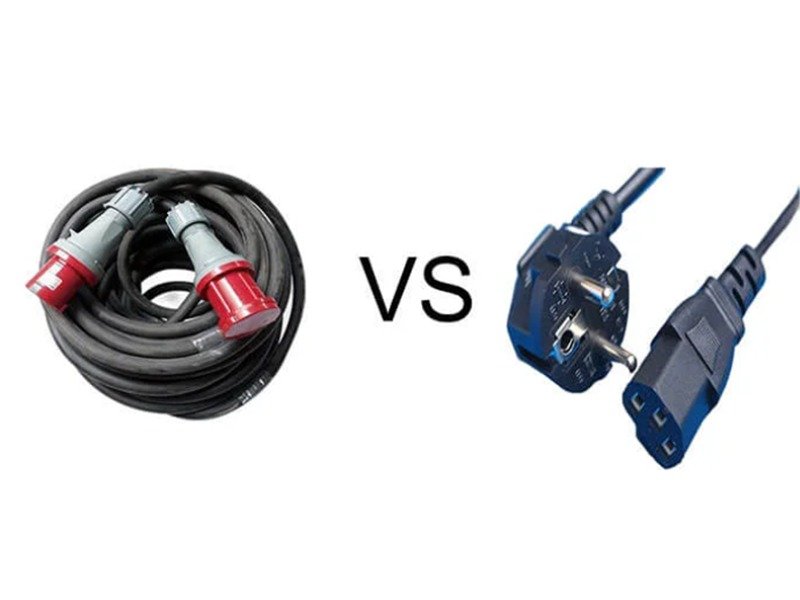
Many customers assume “power cord” and “power cable” mean the same thing. In casual conversation this might not cause confusion, but in engineering projects, medical devices, industrial automation, and electronic appliances, the difference directly affects safety, performance, and compliance. Sino-Conn receives hundreds of inquiries every month, and more than one-third contain misunderstandings between these two terms—especially when customers send only a photo without voltage, current, or connector details.
A power cord is an AC connection product with molded plugs designed to link equipment to wall outlets, while a power cable is a general electrical cable used to carry power inside devices, control panels, or wiring harnesses. Power cords include plugs and must follow regional certifications; power cables usually do not. Their structure, durability, voltage levels, and safety requirements differ clearly.
Why does this matter? Because choosing the wrong type can lead to failed UL tests, overheating, signal noise, early cable fatigue, connector mismatch, or even equipment damage. Sino-Conn has seen cases where a customer planned to use a low-temperature PVC internal cable as an external power cord—this would have failed flame tests immediately. Correcting this early saved the customer two months of rework and prevented a costly recall.
The goal of this article is to give you practical clarity—the kind of clarity that prevents redesigns, reduces cost, and speeds up certification. Everything below comes from real engineering work Sino-Conn handles daily across North America, Europe, and Asia.
What Is a Power Cord?
A power cord is a flexible AC cable with molded connectors that allows appliances, electronics, and industrial devices to plug into a wall outlet. It includes a plug, insulation, jacket, and often an IEC connector on the device end. Power cords follow strict national and regional standards such as UL, VDE, BS, and PSE.

Power Cord Structure and Performance Requirements
Below is a Sino-Conn standard structure overview:
| Component | Purpose | Typical Sino-Conn Specification |
|---|---|---|
| AC Plug | Connects to outlet | NEMA, Schuko, BS1363, PSE, SAA |
| Device Connector | Connects to equipment | IEC C13/C14, C19/C20, C5/C6 |
| Conductors | Carry AC current | 16–22 AWG copper or tinned copper |
| Insulation | Electrical safety | PVC or TPE rated 60–105°C |
| Outer Jacket | Protects from wear | SJT/SVT, oil/UV/flame-resistant |
| Strain Relief | Prevents bending damage | Molded to withstand 10,000+ flex cycles |
Key Characteristics
1. Voltage and Current Ratings
- North America: 125V / 10–15A
- Europe: 250V / 10–16A
- Japan: 100V / 7–12A
- Industrial cords: Up to 20A+ depending on IEC type
Sino-Conn verifies conductor resistance and jacket thickness according to UL62, UL817, and IEC standards.
2. Mandatory Certifications for Power Cords
Power cords legally require certification marks:
| Region | Certification | Notes |
|---|---|---|
| USA | UL / ETL | Mark must appear on plug + cable |
| Europe | VDE / ENEC | Required for appliances sold in EU |
| UK | BS | Fuse inside plug is mandatory |
| Japan | PSE | Separate plug and cable approval |
| Australia | SAA | Heat-resistant rubber types often required |
Sino-Conn offers fully certified plug-end molds with serialized tracking for compliance audits.
3. Features That Matter in Real-World Use
- Withstands repeated plugging/unplugging
- Resistant to abrasion from floors or equipment edges
- Proper strain relief to avoid conductor breakage
- Flame retardancy (VW-1, FT2)
- Optional ferrite core to reduce interference
- Durable over years of bending and torsion
Some customers focus only on voltage but overlook mechanical durability—yet 70% of cord failures come from repeated bending at the strain relief.
What Is a Power Cable?
A power cable is any insulated conductor assembly used to carry electrical power inside equipment, vehicles, wiring harnesses, or building systems. Unlike power cords, power cables normally do not include plugs and can be designed for AC or DC transmission. Their structure varies widely depending on voltage level, environment, and mechanical requirements.

How Power Cables Differ in Structure and Use
| Layer | Function | Sino-Conn Capability |
|---|---|---|
| Conductor | Carries power | Copper/tinned copper, 7–133 strands |
| Insulation | Electrical isolation | PVC, XLPE, TPE, silicone |
| Shielding | Reduces noise | Foil, 65–95% braid, dual shield |
| Fillers | Maintain shape | PP yarn, cotton |
| Armor | Heavy protection | Steel or aluminum braiding |
| Jacket | Environmental durability | UV-resistant, oil-resistant, halogen-free |
Power Cable Application Areas
1. Internal Wiring of Appliances
Air conditioners, refrigerators, washing machines, etc.
2. Industrial Equipment and Control Cabinets
- Motor power lines
- Sensor power feeds
- DC power distribution cables
3. Automotive and EV Industries
- 12V/24V power harnesses
- Battery cables
- High-temperature cables up to 200°C

4. Robotics and Automation
Flexible cables tested for 5,000–20,000 bend cycles.
5. Renewable Energy Equipment
- Solar inverters
- Battery management systems
- DC high-current lines
Sino-Conn frequently customizes internal power cables with ±5% OD tolerance, chemical-resistant jackets, and precise strand counts to match customer power load requirements.
How Are Power Cords and Power Cables Built Differently?
Power cords are built as finished, safety-certified products designed for external use and frequent handling, while power cables are built as functional electrical components intended for internal routing or fixed installation. Their differences appear in structure, materials, termination methods, mechanical reinforcement, and compliance requirements.
Power Cord Construction
A power cord is engineered as a complete end-use product, not just a cable with plugs added later. At Sino-Conn, power cord design always starts from regulatory and mechanical risk, not just electrical load.
Core construction features of power cords:
Integrated molded plugs
- One-shot or two-shot injection molding
- Copper conductors mechanically locked inside the plug
- Mold geometry designed to pass pull force tests (typically ≥35–50 lbs)

Standardized cordage types
- Common structures: SJT, SVT, H05VV-F, H05RR-F
- Fixed conductor counts (2C / 3C)
- Tight outer diameter tolerance (often ±0.2–0.3 mm)
Reinforced strain relief
- Extra rubber or PVC thickness at plug exit
- Designed to survive 10,000–20,000 bending cycles
- Prevents copper breakage at the highest-stress point
Safety-focused insulation and jacket
- Flame-retardant PVC or rubber
- Typical temperature rating: 60°C–105°C
- Designed to resist casual abrasion, foot traffic, and twisting
Mandatory markings
- Voltage, current, certification marks printed on jacket
- Traceability required for audits
In Sino-Conn production, power cords are tested not only electrically, but also mechanically. Many failures in the field come from strain relief fatigue—not conductor size.
Power Cable Construction
Power cables are engineered as system components, optimized for electrical performance, routing efficiency, and long-term stability rather than user handling.
Typical power cable structure at Sino-Conn:
Flexible conductor design
- Bare copper or tinned copper
- Strand counts adjusted for flexibility (e.g. 19 / 37 / 65+ strands)
- Current capacity calculated based on continuous load
Application-specific insulation
- PVC for general use
- XLPE for higher voltage and temperature
- Silicone for 150–200°C environments
- Thickness adjusted based on dielectric requirement, not appearance
Optional shielding layers
- Aluminum foil for EMI control
- Braided copper shield (65–95% coverage)
- Used when power lines run near signal cables or motors
Custom outer jackets
- Oil-resistant, UV-resistant, or halogen-free
- OD optimized for tight routing or cable trays
- No cosmetic requirements
Termination flexibility
- Crimp terminals
- Ring lugs
- Board-mounted connectors
- Direct soldering

Power cables are rarely standardized. At Sino-Conn, more than 80% of power cables are customized for length, material, or jacket performance.
Structural Comparison at a Glance
| Feature | Power Cord | Power Cable |
|---|---|---|
| Designed as | Finished consumer product | Internal electrical component |
| Plug included | Yes (mandatory) | No |
| Strain relief | Heavy, molded | Minimal or none |
| Flex cycle design | Very high | Depends on application |
| Jacket thickness | Fixed by standard | Adjustable |
| Shielding | Rare | Common |
| Certification focus | End-product safety | Material & construction |
| Typical OD | Larger | Optimized / smaller |
This table alone explains why swapping one for the other often causes problems.
Common Build-Related Mistakes Sino-Conn Corrects
From real customer projects, these issues appear frequently:
- Using power cable as an external power cord → fails flame or pull tests
- Using power cord inside equipment → bulky, poor heat dissipation, higher BOM cost
- Assuming thicker cable = safer → often incorrect without proper insulation rating
- Ignoring bending stress near connectors → early conductor fatigue
In multiple projects, Sino-Conn redesigned the structure early and helped customers avoid 2–3 months of certification delays.
Why Build Differences Matter in Real Projects
Choosing the wrong structure affects:
- Certification approval
- Heat buildup inside enclosures
- Long-term reliability
- Assembly efficiency
- Total landed cost
From Sino-Conn’s experience, structure errors cost more than material upgrades. Fixing them early is always cheaper than redesigning later.
Where Are Power Cords vs Power Cables Used?
Power cords are used where equipment must be connected and disconnected from external power sources. Power cables are used inside systems, machines, or infrastructure where power routing is permanent or semi-permanent. The installation environment largely determines which one is appropriate.
How are power cords used in appliances and electronics?
Power cords dominate end-user interaction zones.
Common applications:
- Home appliances (TVs, microwaves, air conditioners)
- Office equipment (printers, monitors, servers)
- Medical devices (patient monitors, lab analyzers)
- Portable industrial tools
Design priorities in these scenarios:
- User safety
- Frequent bending and handling
- Plug compatibility by region
- Clear certification markings
A failed power cord does not just stop equipment—it can expose users to electrical risk. That is why regulators focus heavily on cords.
How are power cables used in industrial or fixed wiring?
Power cables operate behind the scenes.
Typical uses:
- Internal wiring of machines
- Control panels and cabinets
- Robotics and automation arms
- Battery packs and DC power buses

Engineering priorities shift to:
- Long-term thermal stability
- Resistance to oil, coolant, or UV
- Tight bend radius
- Consistent electrical characteristics
In these cases, appearance is irrelevant. Performance over time is everything.
Do voltage and current needs influence the choice?
Absolutely—and this is one of the most misunderstood points.
| Factor | Power Cord | Power Cable |
|---|---|---|
| Typical Voltage | 100–250V AC | 12V–1000V AC/DC |
| Current Range | 7–20A | From milliamps to hundreds of amps |
| Load Stability | Intermittent | Continuous |
| Heat Dissipation | Limited by jacket | Designed into cable |
Using a power cord inside equipment often results in:
- Excess bulk
- Poor heat dissipation
- Higher cost
- Compliance conflicts
Conversely, using a power cable as an external cord can lead to failed safety tests.
Do Power Cords and Power Cables Follow Different Standards?
Yes. Power cords are governed by product safety standards, while power cables follow component and material standards. Mixing these requirements is one of the most common causes of certification failure and shipment delays.
What safety rules apply to power cords?
Power cords must meet national safety regulations, including:
- Mechanical pull tests
- Flexing and torsion tests
- Flame propagation tests
- Plug temperature rise limits
- Marking and traceability rules
Each region enforces its own rules. A cord approved in the US may not be legal in Europe or Japan without redesign.
What certifications apply to power cables?
Power cables are usually certified at the material or construction level, such as:
- UL AWM styles
- IEC wire classifications
- Flame ratings (VW-1, FT1)
- Environmental compliance (RoHS, REACH, PFAS)
They are approved as components—not finished consumer products.
Are durability and temperature ratings different?
Yes, significantly.
Power cords:
- Typically rated 60–105°C
- Designed for room-temperature environments
Power cables:
- Can reach 125°C, 150°C, or 200°C
- Designed for enclosed or harsh environments
At Sino-Conn, we frequently redesign customer projects after discovering that their “cord” must survive 90°C inside a sealed enclosure—this alone changes material choice and cost.
How Do You Choose Between a Power Cord and a Power Cable?
The choice depends on where the power line is used, how it is handled, and which safety rules apply. If the cable connects equipment to a wall outlet and can be touched by users, it must be a power cord. If the cable routes power inside equipment or fixed systems, it is a power cable. Choosing incorrectly often leads to compliance failure or unnecessary cost.
Installation Location
The single most important factor is where the cable will be installed.
Use a power cord when:
- The cable is outside the equipment housing
- Users can touch or move it
- The product must plug into a wall outlet
- The equipment may be unplugged during normal use
Use a power cable when:
- The cable is fully inside an enclosure
- The routing is fixed or semi-permanent
- The cable is installed during assembly
- The cable will not be handled by end users
At Sino-Conn, over 40% of incorrect RFQs come from ignoring installation location.
Electrical Load and Heat
Electrical load determines conductor size, insulation type, and long-term reliability.
Key questions Sino-Conn engineers always ask:
- What is the continuous current, not just peak?
- Is the load intermittent or constant?
- Will heat build up inside an enclosure?
| Scenario | Recommended Choice |
|---|---|
| AC appliance under 15A | Power cord |
| DC power inside control panel | Power cable |
| High-current continuous load | Power cable |
| Portable device with plug | Power cord |
Power cords are not designed for high-temperature enclosed environments, even if conductor size seems sufficient.
Movement and Bending
Mechanical stress causes more failures than electrical overload.
Choose power cords if:
- Frequent bending or twisting is expected
- The cable is unplugged regularly
- The cord may be pulled or stepped on
Choose power cables if:
- The cable remains mostly stationary
- Bending radius is controlled
- Movement cycles are predictable (robotics, automation)
Sino-Conn flex-tests many power cables to 5,000–20,000 cycles, but power cords are designed for uncontrolled user movement.
Compliance and Market Destination
Regulatory requirements often make the decision for you.
Power cords:
- Must comply with regional safety rules
- Require plug-specific approvals
- Must carry printed certification marks
Power cables:
- Usually certified as materials or components
- Follow UL AWM, IEC, or internal standards
- Do not require country-specific plug approvals
| Market | Power Cord Complexity |
|---|---|
| USA | UL + NEMA |
| EU | VDE / ENEC |
| UK | BS + fuse |
| Japan | PSE |
| Australia | SAA |
Choosing a power cable where a power cord is required will fail audits immediately.
Cost vs Total Risk
Unit price alone is misleading.
Power cords cost more per piece due to:
- Plug molding
- Certification
- Additional testing
Power cables appear cheaper but may increase:
- Certification risk
- Redesign cost
- Assembly time
From Sino-Conn projects:
- Wrong choice often increases total project cost by 3–5×
- Early correction reduces cost and lead time significantly
Correct selection is a risk-reduction decision, not just a price decision.
Customization Needs
Customization is often the final deciding factor.
Choose custom power cords when:
- Length must be precise
- Plug orientation matters
- Market-specific plugs are required
Choose custom power cables when:
- OD must fit tight routing
- Jacket must resist oil, UV, or heat
- Shielding is required
- Pinout or termination is special
Sino-Conn supports 1-piece customization, allowing validation before mass production.
Sino-Conn’s Internal Selection Checklist
Before quoting, Sino-Conn confirms:
- Installation location
- Voltage and current
- Market destination
- Environment (heat, oil, UV)
- Movement expectations
- Certification scope
If any item is unclear, we stop and clarify—this prevents redesign later.
Do Power Cords and Power Cables Cost the Same?
No. Power cords are usually more expensive per unit than power cables because they include molded plugs, strain relief, certification fees, and regulatory testing. Power cables cost less per meter but can become expensive when custom materials, shielding, or high-temperature ratings are required. The total project cost depends on how correctly the product is specified.
Where does the cost difference come from?
Many customers compare prices by length alone, which leads to incorrect conclusions. The real cost drivers are very different.
| Cost Factor | Power Cord | Power Cable |
|---|---|---|
| Plug & molding | Required | Not required |
| Certification | Mandatory per region | Often material-level only |
| Tooling | Plug molds | Usually none |
| Labor | Plug termination + testing | Cutting, stripping, crimping |
| Compliance risk | High if incorrect | Moderate |
In Sino-Conn projects, a 1.8 m power cord may cost 2–4× more than the same length of internal power cable—even if the copper content is identical.
Why “cheaper” choices often become expensive later
Common real-world mistakes we see:
- Using a power cable externally → fails safety audit
- Using a power cord internally → bulk, heat buildup, higher BOM
- Selecting certified cord for internal use → unnecessary cost
- Ignoring temperature rise → early insulation failure
In several OEM cases, redesign costs exceeded the original cable cost by 5–10× due to delayed certification or failed inspections.
Correct classification at the beginning is one of the easiest ways to control total cost.
Do Regional Markets Change the Definition or Cost?
Yes. Regional standards affect structure, certification, materials, lead time, and price. A power cord or cable that works in one country may be illegal or impractical in another. Regional differences are one of the most overlooked cost factors in global projects.
How regional standards affect power cords
Power cords are heavily localized products.
| Region | Key Differences |
|---|---|
| USA | NEMA plugs, UL marking, thicker jackets |
| Europe | VDE/ENEC, higher voltage rating (250V) |
| UK | Fused plug, larger plug size |
| Japan | Smaller plugs, lower voltage (100V) |
| Australia | Heat resistance, SAA approval |
Each variation affects:
- Plug tooling
- Lead time
- Minimum order quantities
- Testing cost
Sino-Conn maintains pre-approved plug tooling for most major regions to avoid repeated certification delays.
How regional factors affect power cables
Power cables are less visible but still impacted by region:
- EU customers often request halogen-free (LSZH) jackets
- North America emphasizes UL AWM styles
- Japan prioritizes compact OD and flexibility
- Industrial EU projects focus on oil and chemical resistance
Ignoring these expectations often results in rejection during customer qualification—even if the cable is electrically correct.
How Do OEM and Application Types Influence the Choice?
OEMs, engineers, and end-product brands evaluate power cords and power cables differently. Engineers focus on performance and feasibility, while OEM factories focus on cost and delivery. Understanding these perspectives helps avoid mismatched designs and pricing conflicts.
Engineer-driven projects
In engineer-led projects, Sino-Conn usually sees:
- Clear electrical parameters
- Defined installation environment
- Less sensitivity to unit price
- Higher customization needs
These projects often favor properly designed power cables internally and certified power cords externally—each used exactly where needed.
OEM factory-driven projects
OEM factories typically prioritize:
- Unit cost
- Stable supply
- Simple assembly
- Predictable lead times
Here, Sino-Conn often:
- Simplifies structures without sacrificing safety
- Recommends substitute materials where allowed
- Adjusts jacket thickness to reduce cost
- Balances certification scope carefully
Consumer vs industrial use cases
| Application | Preferred Choice |
|---|---|
| Consumer electronics | Power cord |
| Medical equipment | Certified power cord + internal cable |
| Industrial machinery | Power cable |
| Automation systems | Power cable |
| Portable tools | Heavy-duty power cord |
Matching the product to the real use case avoids over-engineering and under-compliance.

How Does Sino-Conn Help You Choose Correctly?
Sino-Conn helps customers avoid mistakes by combining engineering review, fast drawings, flexible sourcing, and strict inspection. We do not simply quote what is requested—we verify whether the request is technically and commercially correct.
Engineering-first communication
What Sino-Conn typically requests at the start:
- Voltage and current
- Installation location
- Target market
- Temperature exposure
- Photos or sketches (if no drawing)
Even if a customer only provides a photo, Sino-Conn engineers can reverse-analyze the structure and propose a compliant solution.
Fast drawings and confirmation
- CAD or PDF drawings provided within 30 minutes–3 days
- All pinouts, dimensions, and materials clearly marked
- No production without customer approval
- Reduces miscommunication and rework
This step alone has prevented countless costly errors in past projects.

Flexible sourcing and cost control
Sino-Conn supports:
- Original-brand connectors or qualified alternatives
- Multiple insulation and jacket options
- Different conductor constructions
- No MOQ (1 piece supported)
This flexibility allows customers to balance cost, lead time, and performance rather than being locked into a single option.
Quality control that matches real risk
Every Sino-Conn power cord or cable goes through:
- Process inspection
- Final inspection
- Pre-shipment inspection
For power cords, additional checks include:
- Pull force testing
- Visual mold integrity
- Continuity and polarity verification
This is how we reduce field failures—not by paperwork, but by control.
Work With Sino-Conn
If you are unsure whether your project needs a power cord or a power cable, or if you are facing certification pressure, cost constraints, or unclear drawings, Sino-Conn can help before problems appear.
We support:
- One-piece samples
- Fast engineering feedback
- Global compliance awareness
- Custom solutions without MOQ pressure
- Short lead times for urgent projects
Send us your drawing, photo, or even just a description.
Our engineers will help you choose the right solution the first time.