Skip to content

Medical cable assemblies rarely attract attention—until something goes wrong. A signal dropout during patient monitoring, a cracked jacket after repeated sterilization, or an unexpected compliance failure can delay an entire medical device launch. In reality, cable assemblies are the nervous system of medical equipment. They carry power, data, and signals that clinicians rely on every second, often in life-critical environments.
What makes medical cable assembly manufacturing especially challenging is not just technical complexity, but uncertainty. Many buyers approach suppliers with incomplete drawings, legacy part numbers, or even just photos. Others know exactly what they want—but struggle to find a manufacturer that can respond fast, document everything, and still remain flexible. Add regulatory pressure, tight timelines, and global sourcing risks, and cable selection becomes far more than a simple purchasing decision.
Medical cable assembly manufacturing is the process of designing, producing, and validating cable assemblies used in medical devices under strict electrical, mechanical, and regulatory requirements. It involves material selection, connector integration, custom wiring, quality control, and compliance with standards such as ISO 13485, RoHS, and REACH. Choosing the right supplier requires evaluating engineering support, manufacturing capability, responsiveness, and traceability—not just price.
Behind every reliable medical device is a series of quiet decisions—about materials, pinouts, drawings, and partners. Understanding how those decisions are made is what separates smooth production from costly redesigns. Let’s break it down.
What Is Medical Cable Assembly Manufacturing?
Medical cable assembly manufacturing refers to the custom design and production of cable assemblies specifically for medical devices. These assemblies must meet strict requirements for safety, reliability, biocompatibility, electrical performance, and regulatory compliance. Unlike standard industrial cables, medical cable assemblies are often customized in length, materials, connectors, and wiring definitions to support specific clinical applications.
What defines a medical cable assembly?
A medical cable assembly is not defined by a single cable type or connector. It is defined by use case and risk profile. If a cable is used inside or alongside a medical device—especially one that interacts with patients—it falls into a different category of responsibility.
Key characteristics include controlled materials, predictable electrical behavior, repeatable manufacturing processes, and documented traceability. Even when two cables look identical externally, the medical version often uses different insulation compounds, tighter tolerances, and additional testing.

Where are medical cable assemblies used?
Medical cable assemblies appear in a wide range of equipment:
- Patient monitoring and diagnostic systems
- Imaging equipment such as ultrasound and endoscopy
- Surgical tools and robotic systems
- Therapy and rehabilitation devices
In many cases, the cable assembly is a single point of failure, which is why medical OEMs rarely accept off-the-shelf solutions without validation.
Which Standards and Certifications Are Required?
Medical cable assembly manufacturing typically requires compliance with ISO 13485 quality systems, along with product-level certifications such as UL, RoHS, and REACH. Depending on the market, additional documentation like COC and COO may be required. These standards ensure traceability, material safety, and consistent manufacturing control.
Why ISO 13485 matters more than people expect
ISO 13485 is not just a certificate—it defines how a manufacturer thinks. It governs document control, process validation, change management, and traceability. For medical cable assemblies, this means every drawing revision, material change, and production batch can be tracked and reviewed.

Manufacturers without this system may still produce working cables, but scaling production or passing audits becomes risky.
Common certifications and what they mean
| Certification | Purpose | Why It Matters |
|---|---|---|
| ISO 13485 | Medical quality system | Process control & traceability |
| UL | Safety & flammability | Electrical and fire safety |
| RoHS / REACH | Material compliance | Restricted substances |
| COC / COO | Trade documentation | Customs and compliance |
For buyers, certificates are not checkboxes—they are risk controls.
How Are Medical Cable Assemblies Designed and Produced?
Designing and producing medical cable assemblies is a structured engineering process rather than a simple assembly task. Because these products are used in regulated medical environments, every step—from early design input to final inspection—must be controlled, documented, and repeatable. The goal is not only to make the cable function electrically, but to ensure long-term reliability, safety, and consistency across production batches.
In practice, the process usually begins long before any cable is cut or any connector is crimped.
Design and Requirement Clarification
Medical cable projects often start with incomplete or uneven information. Some customers provide full specifications and drawings, while others may only have a legacy part number, a sample cable, or a set of product photos. In these cases, the first design task is to clarify functional intent rather than blindly copying appearance.
Key parameters are confirmed early, including voltage and current ratings, signal type, shielding requirements, mechanical flexibility, operating temperature, and environmental exposure. Connector selection is also evaluated at this stage, including whether original-brand connectors are required or whether compatible alternatives can be used without affecting performance or compliance.
Based on this information, an engineering drawing is created. This drawing defines cable length, wire gauge, pin assignments, connector orientation, shielding structure, and mechanical details. Production does not proceed until the drawing is reviewed and approved, as this document becomes the reference point for manufacturing, quality control, and traceability.
Material and Component Selection
Once the design is defined, suitable materials are selected to match both performance and regulatory requirements. Cable jackets, insulation compounds, shielding layers, and strain relief materials are chosen based on flexibility, durability, chemical resistance, and temperature tolerance.
For medical applications, material consistency is critical. Even small changes in insulation or jacket material can affect bend life, sterilization resistance, or regulatory compliance. For this reason, material selection is treated as part of the design process rather than a purchasing decision.
Connectors are evaluated not only for electrical compatibility, but also for mating cycles, mechanical retention, and long-term availability. In some projects, supply chain stability becomes just as important as technical performance.
Assembly and Manufacturing Process
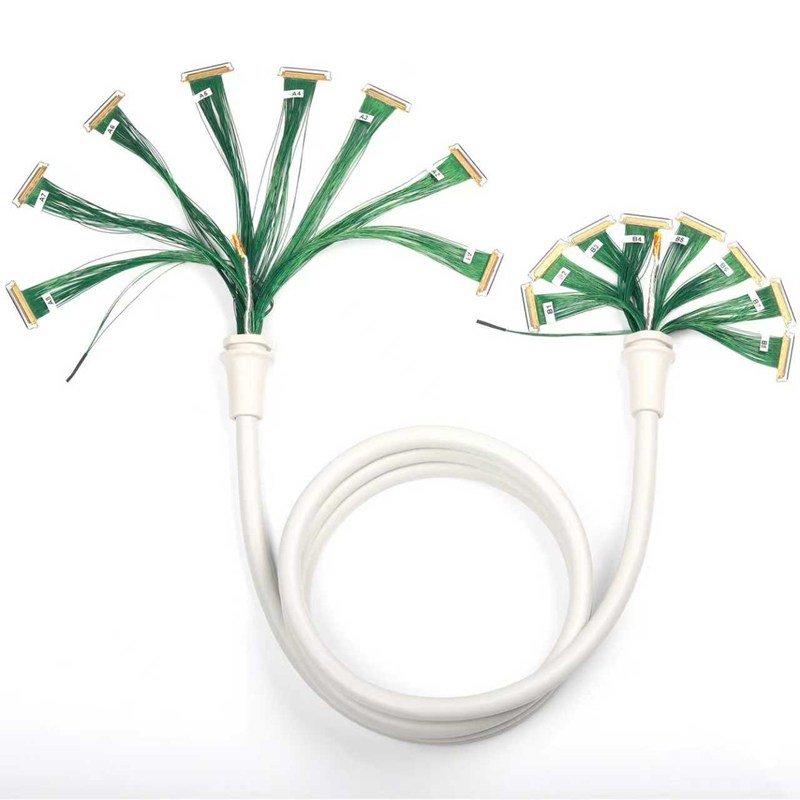
After materials and components are finalized, the cable assembly moves into production. Standard steps include cable cutting, stripping, conductor preparation, and termination by crimping or soldering, depending on the connector design. Shielding termination is handled carefully to maintain EMI performance and signal integrity.
For assemblies requiring additional mechanical protection, overmolding or strain relief is applied to reduce stress at connection points. These features are especially important for cables subjected to repeated bending, movement, or handling during clinical use.
Throughout the assembly process, workmanship consistency is closely monitored. Medical cable assemblies demand tighter control than many industrial products because small defects—such as damaged insulation or uneven shielding—may not cause immediate failure but can lead to reliability issues over time.
Testing, Inspection, and Production Control
Testing and inspection are integral parts of medical cable assembly production. Electrical tests typically verify continuity, insulation resistance, and correct wiring configuration. Mechanical checks ensure proper assembly, connector retention, and dimensional accuracy.
Rather than relying solely on final inspection, many manufacturers apply in-process checks to catch issues early. This approach reduces variability and ensures that each assembly conforms to the approved drawing and specification.
Only after passing all required inspections are cable assemblies approved for shipment. This disciplined approach helps ensure that the product delivered to the customer matches the design intent and performs consistently in its intended medical application.
Which Materials and Technical Parameters Matter Most?
Material selection and electrical parameters directly impact safety and performance in medical cable assemblies. Key factors include insulation material, EMI shielding, voltage and current ratings, outer diameter, bend radius, and resistance to heat, chemicals, and sterilization.
Common cable materials in medical applications
Medical cables often prioritize flexibility, durability, and safety. Common choices include TPU, TPE, and medical-grade PVC. Halogen-free and fluorine-free options are increasingly requested for environmental and safety reasons.
Technical parameters engineers care about
| Parameter | Why It Matters |
|---|---|
| Voltage / Current | Prevents overheating |
| EMI Shielding | Signal integrity |
| OD & Bend Radius | Device ergonomics |
| Flex Life | Repeated movement |
| Temperature Rating | Sterilization tolerance |
Ignoring any of these can shorten device lifespan or cause intermittent failures.
How Can Medical Cable Assemblies Be Customized?
Medical cable assemblies can be customized in length, wiring definition, connector type, materials, and mechanical structure. Customization allows manufacturers to match exact device requirements while balancing cost, lead time, and regulatory constraints.
What customization usually involves
Customization is not only about shape. It often includes pin-to-pin definitions, mixed connector types, and tailored strain relief. Some customers require original brand connectors; others prefer high-quality equivalents for flexibility and faster delivery.
Speed, MOQ, and flexibility
Medical R&D projects often start with very small quantities. Manufacturers that support no MOQ, fast prototyping, and rapid drawing turnaround can significantly accelerate development timelines—sometimes by weeks.

How Do You Choose the Right Medical Cable Assembly Supplier?
Choosing a medical cable assembly supplier is less about finding the lowest quote and more about managing technical, regulatory, and supply-chain risk. Medical cable assemblies are often tightly integrated into device designs, which means a supplier change can trigger revalidation, redesign, or even regulatory review. For this reason, supplier selection is typically a long-term decision rather than a transactional purchase.
A suitable supplier must be able to support the entire product lifecycle—from early development and prototyping to stable mass production—while maintaining consistent quality and documentation.
Evaluate Engineering Capability and Communication
One of the most important factors is the supplier’s engineering capability. Medical cable projects frequently involve custom requirements, non-standard pin definitions, or application-specific mechanical constraints. A capable supplier should be able to review incomplete information, ask relevant technical questions, and translate functional requirements into clear drawings and specifications.
Communication quality is closely tied to engineering strength. Clear, structured communication reduces misunderstandings and shortens development cycles. Suppliers that can quickly provide drawings, technical feedback, and clarification help prevent design errors from reaching production.
Assess Manufacturing Control and Quality Systems
Medical cable assemblies demand a higher level of manufacturing control than many commercial products. When evaluating suppliers, it is important to understand how production processes are documented, controlled, and audited.
Quality systems such as ISO 13485 indicate that the supplier follows standardized procedures for document control, process validation, and traceability. However, buyers should also look beyond certificates and understand how inspection, testing, and change management are actually implemented on the production floor.
Consider Responsiveness and Lead Time Flexibility
Responsiveness is often underestimated until a project encounters delays. In medical device development, schedules can change quickly due to testing results, regulatory feedback, or design revisions. A supplier’s ability to respond quickly—whether by updating drawings, adjusting production plans, or supporting urgent prototypes—can significantly affect overall project timelines.
Flexible lead times, especially during the prototyping phase, are particularly valuable. Short sample lead times allow engineering teams to validate designs early and reduce downstream risk.
Balance Cost with Long-Term Reliability
Cost is always a factor, but in medical applications it should be evaluated in context. A lower initial price may not reflect the true cost if it leads to inconsistent quality, limited documentation, or supply interruptions.
Pricing differences often reflect differences in materials, connector sourcing, inspection intensity, and quality control. Understanding what is included in a quote helps buyers compare suppliers on a more meaningful basis rather than on unit price alone.
Review Supply Chain Stability and Component Strategy
Medical devices often remain in production for many years. A supplier’s ability to support long-term availability of cables and connectors is therefore critical. This includes evaluating how connectors are sourced, whether alternative components are qualified, and how material changes are managed.
Suppliers with a clear component strategy can reduce the risk of obsolescence and unexpected redesigns. This is especially important for devices sold into multiple regions with varying regulatory and trade requirements.
Understand the Supplier’s Customer Profile and Experience
Finally, it is useful to consider the types of customers a supplier typically serves. Suppliers experienced in medical, OEM, or regulated industries are more likely to understand documentation expectations, audit requirements, and communication standards.
A supplier familiar with working directly with engineers, OEM manufacturers, and professional procurement teams is better positioned to support complex projects where technical accuracy and reliability are essential.
Are Quality Control and Testing Truly Critical?
Yes. Medical cable assemblies require rigorous quality control, including in-process inspection, final inspection, and pre-shipment testing. Full inspection ensures electrical performance, mechanical reliability, and compliance with documented specifications.
Why 100% inspection is common in medical projects
Unlike consumer products, medical devices cannot tolerate intermittent failures. Multiple inspection stages—during production, after completion, and before shipment—reduce risk and increase confidence.
Final Thoughts: From Design to Reliable Supply
Medical cable assembly manufacturing goes far beyond assembling wires and connectors. It requires the ability to interpret incomplete requirements, manage regulatory and supply-chain risk, and translate design intent into a stable, repeatable production process. In medical applications, reliability is not achieved by chance—it is built through engineering discipline, documentation, and controlled manufacturing.

At Sino-Conn, we support medical cable projects from early concept through mass production. Our team works directly with engineers and procurement teams to review specifications, clarify technical details, and generate production-ready drawings before manufacturing begins. We regularly support projects that start with limited information—such as legacy part numbers, samples, or photos—and turn them into clearly defined, manufacturable cable assemblies.
Whether you are developing a new medical device, qualifying an alternative supplier, or optimizing an existing cable design for cost, lead time, or reliability, our flexible production model allows you to start with prototypes and scale to volume without rigid MOQ constraints. With fast response times, controlled processes, and full inspection at every stage, we help ensure that your cable assemblies perform consistently throughout the product lifecycle.
If you have a medical cable assembly requirement to discuss—early-stage or production-ready—we welcome the opportunity to review your project and provide a practical, engineering-driven solution.