Skip to content
AC vs MC Cable: A Complete Guide to Differences, Applications, and Selection
- andy
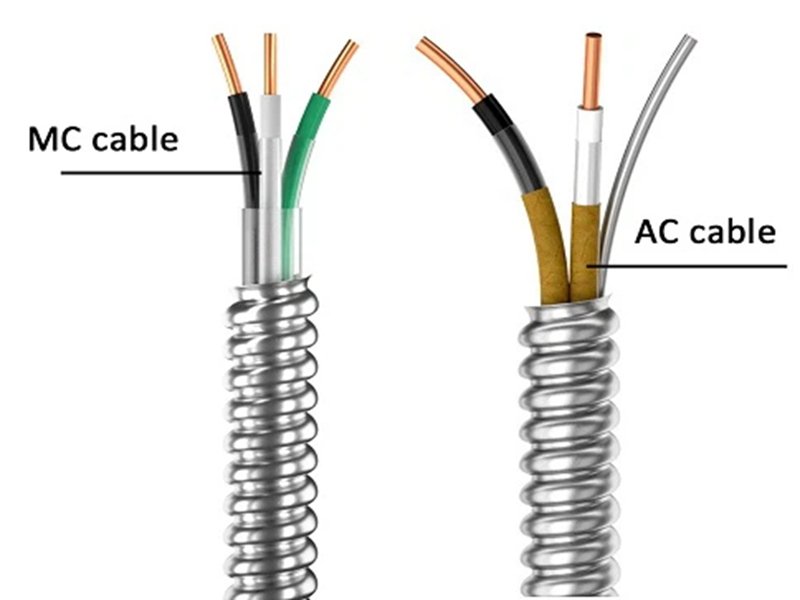
Choosing between AC and MC cable is often treated as a code-driven or checklist-based decision—but in real projects, the consequences of that choice go far beyond compliance. Engineers, OEMs, and industrial buyers regularly encounter unexpected issues such as grounding failures, mechanical damage, inspection rejections, or long-term reliability problems that trace back to an early assumption: “AC and MC cable are basically the same.” They are not.
At a glance, AC and MC cables may appear similar. Both use metallic armor. Both are used in commercial and industrial installations. Both are widely accepted by electrical inspectors when installed correctly. Yet beneath that surface similarity lies a fundamental difference in construction philosophy, protection strategy, and risk tolerance. These differences directly affect how the cable behaves under vibration, mechanical stress, heat, moisture, and long-term operation.
AC and MC cables differ primarily in construction, grounding method, and conductor protection. AC cable relies on its armor and bonding strip for grounding, while MC cable uses fully insulated conductors and a dedicated grounding path, offering higher mechanical and electrical protection. MC cable is generally preferred in industrial, harsh, or critical environments, while AC cable is often used in lighter commercial installations where flexibility and cost are priorities.
Behind the simple question—“What is the difference between MC and AC?”—is a layered engineering decision involving safety margins, lifecycle cost, and manufacturability. This guide breaks down AC vs MC cable from a technical, application, and OEM decision-making perspective, helping you choose with confidence instead of habit.
What Is AC Cable?
AC cable (Armored Cable) is a type of electrical cable that uses flexible metallic armor as mechanical protection and grounding, combined with insulated conductors and a bonding strip. It is commonly used in commercial buildings and light industrial environments where moderate protection is sufficient and flexibility is valued.

What does AC cable stand for?
AC cable stands for Armored Cable. The term describes a cable where mechanical protection is provided by a flexible metal armor, typically aluminum or steel. Historically, AC cable was designed to replace rigid conduit in many commercial installations, offering faster installation and reduced labor.
How is AC cable constructed?
An AC cable typically contains:
- Individually insulated conductors
- A thin bonding strip
- Interlocked metallic armor that serves both as protection and grounding path
The armor itself is part of the electrical safety system. This dual-purpose design keeps AC cable relatively lightweight and flexible, but it also means the armor plays a critical role in fault current return.
What protection does AC cable provide compared to MC cable?
AC cable provides moderate mechanical protection suitable for indoor environments. However, because the grounding relies on the armor and bonding strip, any damage, deformation, or improper termination can reduce grounding effectiveness. Compared to MC cable, AC offers less redundancy in safety design.
Where is AC cable commonly used?
AC cable is widely used in:
- Commercial buildings
- Office spaces
- Retail installations
- Light industrial environments
These applications typically have controlled conditions and lower mechanical risk.
What are the limitations of AC cable?
AC cable is less suitable for:
- High-vibration environments
- Areas exposed to moisture or corrosive agents
- Heavy industrial machinery
- Applications requiring enhanced fault tolerance
In these cases, the reliance on armor-based grounding becomes a liability rather than an advantage.
What Is MC Cable?
MC cable (Metal-Clad Cable) is an armored electrical cable where all conductors are fully insulated and grounding is provided by a dedicated grounding conductor or metallic sheath. It offers higher mechanical protection, improved grounding reliability, and broader application flexibility than AC cable.

What does MC cable stand for?
MC stands for Metal-Clad. Unlike AC cable, MC cable emphasizes conductor insulation and grounding separation, rather than relying on armor alone for safety functions.
How is MC cable constructed differently from AC cable?
MC cable construction typically includes:
- Fully insulated conductors
- A separate grounding conductor (or integrated grounding path)
- Metallic armor used primarily for mechanical protection
This separation of functions improves reliability and reduces dependency on armor integrity.
How does MC cable improve grounding and conductor protection?
Because MC cable does not rely solely on the armor for grounding, it maintains electrical safety even if the armor is damaged. This makes it better suited for environments with vibration, impact risk, or long service life requirements.
Which environments require MC cable instead of AC cable?
MC cable is commonly required or preferred in:
- Industrial facilities
- Manufacturing plants
- Data centers
- Healthcare and critical infrastructure
These environments demand higher fault tolerance and mechanical robustness.
Why is MC cable preferred in industrial installations?
Industrial systems prioritize predictability and redundancy. MC cable provides both by isolating grounding, insulation, and mechanical protection into separate design elements.
How Do AC and MC Cables Differ in Construction and Protection?
At first glance, AC cable and MC cable appear nearly identical. Both use metallic armor, both are flexible alternatives to rigid conduit, and both are commonly approved in commercial and industrial installations. However, their internal construction and protection philosophy differ fundamentally, and these differences directly affect grounding reliability, mechanical resilience, and long-term safety.
The distinction between AC and MC cable is not cosmetic—it reflects two different engineering approaches to risk management. Understanding how each cable is built explains why they behave differently in real-world installations.
Grounding Strategy: Shared vs Dedicated Protection
The most critical structural difference lies in how grounding is achieved.
AC cable relies on its metallic armor combined with a bonding strip to provide the equipment grounding path. In this design, the armor is not only mechanical protection but also an active part of the electrical safety system. If the armor is compromised—through deformation, improper termination, or corrosion—the grounding path can be weakened.
MC cable, by contrast, uses a dedicated grounding conductor or integrated grounding path, separate from the armor. The metallic sheath is primarily mechanical protection, not the sole grounding return. This separation adds redundancy and reduces dependency on armor integrity for electrical safety.
From an engineering standpoint, MC cable offers higher fault tolerance, especially in environments where mechanical stress or vibration is expected.
Conductor Insulation and Electrical Isolation
Another key difference is how conductors are insulated.
In AC cable, conductors are insulated, but the system relies more heavily on the armor and bonding strip to maintain safe fault paths. This means conductor protection is partially tied to overall armor condition.
MC cable uses fully insulated conductors throughout, with grounding handled independently. This reduces the likelihood that mechanical damage to the armor will expose or affect live conductors. As a result, MC cable provides a higher degree of electrical isolation and is better suited for installations where accidental impact, abrasion, or movement may occur.
Mechanical Protection Philosophy
Both AC and MC cables use interlocked metal armor, but they treat that armor differently.
- In AC cable, armor serves a dual role: protection and grounding.
- In MC cable, armor is purely mechanical protection.
This distinction matters over time. When armor is expected to flex, vibrate, or endure incidental impact, separating mechanical and electrical functions—as MC cable does—reduces cumulative risk.
Fire Resistance and Environmental Adaptability
Because MC cable does not depend on the armor for grounding, it allows greater flexibility in insulation materials and fire-resistant designs. MC cable is often available with enhanced fire ratings, moisture-resistant jackets, or specialized insulation for industrial and critical environments.
AC cable options are more limited in this regard, as changes to armor or bonding design can directly affect grounding performance.
Side-by-Side Construction Comparison
| Feature | AC Cable | MC Cable |
|---|---|---|
| Grounding method | Armor + bonding strip | Dedicated grounding conductor |
| Armor function | Protection + grounding | Mechanical protection only |
| Conductor insulation | Standard insulation | Fully insulated conductors |
| Fault tolerance | Moderate | High |
| Suitability for harsh environments | Limited | Strong |
Why These Construction Differences Matter in Practice
In controlled commercial environments, AC cable construction is often sufficient and cost-effective. However, in installations involving vibration, machinery movement, moisture exposure, or long service life expectations, MC cable’s construction offers a measurable safety and reliability advantage.
The difference is not about code compliance alone—it is about how much protection margin the system has when conditions deviate from ideal.
Key Takeaway
AC and MC cables are built around different assumptions. AC cable assumes stable conditions and relies on armor-based grounding. MC cable assumes variability and separates grounding, insulation, and mechanical protection to reduce dependency on any single component. For engineers and OEMs, recognizing this difference is essential to making informed, application-driven cable decisions rather than relying on surface similarity.
Which Applications Use AC Cable vs MC Cable Most Often?
AC cable is most common in commercial and light industrial settings, while MC cable dominates industrial, manufacturing, and critical infrastructure applications due to its higher protection level.
AC cable suits controlled environments. MC cable suits unpredictable ones. The difference is not code—it is risk tolerance.

Which Is Better: AC or MC Cable for Industrial Projects?
For industrial projects, the question is rarely whether AC cable can be used—it is whether AC cable can provide sufficient safety margin and long-term reliability under real operating conditions. In most industrial environments, MC cable is generally the better choice, not because AC cable is “wrong,” but because industrial conditions tend to expose the limits of AC cable’s design philosophy.
The difference between AC and MC cable becomes most visible when systems are subjected to vibration, mechanical stress, extended operating hours, and unpredictable environmental factors. Industrial projects amplify these stresses, making cable selection a risk-management decision rather than a purely cost-driven one.
Why MC Cable Is Preferred in Industrial Environments
Industrial facilities are defined by variability. Equipment moves, machines vibrate, layouts change, and maintenance interventions are frequent. In these conditions, MC cable’s dedicated grounding and fully insulated conductors provide a higher tolerance for non-ideal installation and long-term wear.
Because MC cable does not rely on its armor as the primary grounding path, minor deformation, abrasion, or imperfect termination is less likely to compromise electrical safety. This separation of functions—grounding, insulation, and mechanical protection—aligns well with industrial design principles that favor redundancy and fault tolerance.
In practice, this means MC cable performs more predictably over time, even when subjected to mechanical or environmental stress.
Where AC Cable May Still Be Acceptable
AC cable is not inherently unsuitable for industrial use. In controlled, low-risk industrial areas, such as fixed equipment zones with minimal vibration and limited exposure to moisture or impact, AC cable can still perform adequately.
However, the margin for error is smaller. Because grounding integrity depends on armor condition and bonding continuity, AC cable installations demand higher discipline in routing, termination, and ongoing inspection. In environments where maintenance access is limited or operating conditions are harsh, this dependency increases operational risk.
Cost vs Risk: The Industrial Trade-Off
One reason AC cable continues to appear in industrial projects is initial material cost. AC cable is typically less expensive than MC cable. However, industrial decision-makers increasingly evaluate total lifecycle cost, not just upfront pricing.
Failure-related costs—downtime, troubleshooting, rework, inspection delays, and safety incidents—often outweigh the initial savings of a lower-cost cable. MC cable’s higher upfront cost is frequently offset by reduced failure risk and more predictable performance across the system’s lifespan.
Industrial Use Case Comparison
| Factor | AC Cable | MC Cable |
|---|---|---|
| Initial material cost | Lower | Higher |
| Grounding reliability | Dependent on armor condition | Independent, dedicated |
| Resistance to vibration | Moderate | High |
| Tolerance to installation variation | Low–Medium | High |
| Long-term predictability | Variable | Stable |
Why “Better” Depends on Industrial Context
There is no universal answer without context. For light-duty industrial installations with stable routing and controlled conditions, AC cable may meet both code and performance expectations. For production lines, processing plants, heavy machinery zones, and critical infrastructure, MC cable provides a more conservative and resilient solution.
The key distinction is risk exposure. Industrial projects tend to magnify the consequences of small failures. MC cable reduces reliance on perfect conditions and perfect installation, making it the safer default choice in most industrial designs.
Engineering Perspective vs Procurement Perspective
Engineers often favor MC cable because it provides design margin—it continues to perform safely even when assumptions are violated. Procurement teams may initially favor AC cable due to cost, but experienced OEMs recognize that cable-related failures are disproportionately expensive once systems are deployed.
Projects that align these perspectives early—choosing MC cable where uncertainty exists—typically experience fewer late-stage changes, smoother inspections, and lower long-term operational risk.
Key Takeaway for Industrial Projects
For industrial applications, MC cable is generally the better choice because it offers greater grounding reliability, stronger mechanical resilience, and higher tolerance to real-world conditions. AC cable can still be used in select, controlled scenarios, but it requires stricter installation discipline and carries less margin for error.
In industrial environments where downtime, safety, and longevity matter, choosing MC cable is less about over-specifying—and more about engineering risk out of the system.
How Do Engineers and OEMs Choose Between AC and MC Cable?
Engineers prioritize safety margins and performance, while OEMs focus on repeatability, cost stability, and compliance. Successful projects align both perspectives early.
Engineers ask “Will it survive?”
OEMs ask “Can we build it 10,000 times?”
Can AC and MC Cables Be Customized for Industrial Applications?
Yes. Both AC and MC cables can be customized in conductor size, insulation, armor material, length, and termination to meet specific industrial requirements.
| Custom Element | Benefit |
|---|---|
| Conductor gauge | Load optimization |
| Armor material | Environmental resistance |
| Length | Installation efficiency |
Ready to Specify the Right AC or MC Cable?
Choosing between AC and MC cable is not about following habits—it is about engineering risk out of your system. When cable design matches real operating conditions, failures drop, inspections pass faster, and long-term reliability improves.
Sino-Conn supports industrial AC and MC cable projects with fast drawings, rapid samples, flexible customization, and strict quality control. Whether you are validating a design, replacing an unreliable supplier, or scaling to mass production, our engineering-driven approach helps you choose correctly—from the first prototype to full deployment.
Related Keywords :ac vs mc cable, mc cable vs ac cable, armored cable types, industrial cable selection, mc cable construction, ac cable grounding, electrical cable protection, custom industrial cable, cable assemblies, wire harness manufacturer

With over 18 years of OEM/ODM cable assemblies industry experience, I would be happy to share with you the valuable knowledge related to cable assemblies products from the perspective of a leading supplier in China.
manufacturer catalogue
Get A Sample Now From Factory→
Get a quote quickly
Here, developing your OEM/ODM custom cable assemblies collection is no longer a challenge—it’s an excellent opportunity to bring your creative vision to life.