Skip to content
If you’ve ever had a product that passed tests in the lab but failed in the field, you already understand why coaxial cable vs twisted pair cable is not a “simple cable choice.” A cable is not just copper and plastic. It’s a controlled electrical structure that decides how much noise gets in, how much signal gets lost, and whether your device works reliably when it sits next to motors, power supplies, radios, or medical equipment.
Here’s the practical truth: people usually choose the wrong cable for two reasons. First, they focus on the connector model and ignore the signal behavior (impedance, shielding, loss). Second, they copy what competitors use without thinking about the real environment—heat, UV, oil, bending, corrosion, and EMI.
Coaxial cable is the safer choice for RF and high-frequency signals because its concentric shield structure controls impedance (often 50Ω/75Ω) and blocks EMI. Twisted pair cable is a strong choice for balanced data transmission because the pair twisting cancels noise and supports common standards like 100Ω differential systems. Choose based on frequency, distance, EMI level, flexibility, and cost target.
One of the most common messages we get at Sino-conn is a single photo. The customer asks: “Can you make the same?” That’s where projects succeed or fail—because a photo does not tell you impedance, shielding coverage, dielectric type, or loss. If you want a cable that works reliably, we have to convert that photo into measurable specifications and a confirmed drawing before production.
What Is Coaxial Cable?

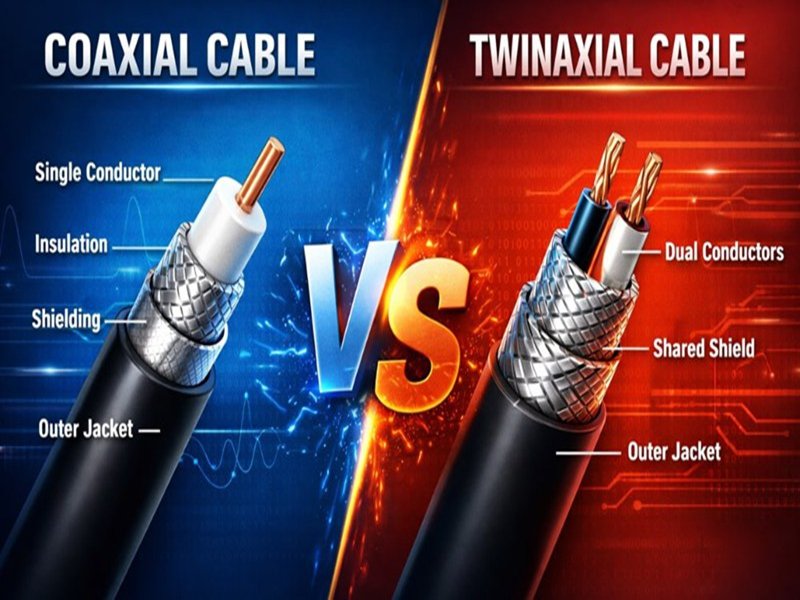
A coaxial cable is a shielded cable built around a single center conductor, with insulation and a surrounding metallic shield that shares the same axis (that’s why it’s called “coaxial”). This geometry is designed to keep impedance stable and to reduce EMI, so the signal stays clean at high frequencies.
How Is a Coaxial Cable Built?
A coaxial cable is usually made of four functional layers:
| Coaxial cable layer | What it does | Why customers should care |
|---|---|---|
| Center conductor | Carries the signal | Solid vs stranded changes loss and flexibility |
| Dielectric | Sets impedance & signal speed | Material affects stability, loss, and temperature rating |
| Shield (foil/braid) | Blocks EMI, reduces leakage | Coverage affects noise performance and isolation |
| Outer jacket | Protects from environment | Jacket decides oil/UV/flame/temperature resistance |
What often changes from project to project is not the connector—it’s the internal structure. Two coaxial cables can look similar outside but behave very differently electrically.
Here are common impedance targets:
| Coaxial cable impedance | Common use cases | Why it’s chosen |
|---|---|---|
| 50Ω coaxial cable | RF modules, antennas, test systems | Best match for RF power and reflection control |
| 75Ω coaxial cable | video, broadcast, CCTV | Optimized for low loss in video distribution |
| 93Ω coaxial cable | certain instrumentation | niche applications requiring specific matching |
At Sino-conn, customers often request a “spec sheet + drawing” package. We build that package from measurable parameters: OD, dielectric thickness, shielding structure, connector type, and the required impedance and frequency range. For most projects we can provide CAD-to-PDF drawings in about 3 days, and for urgent projects we can move much faster if the information is clear.
Why Does a Coaxial Cable Use Shielding?
Shielding is the reason coaxial cable is the “go-to” option in noisy environments. The shield acts like a barrier and a return path, helping the signal resist external interference.

Shield designs you’ll see in real projects:
| Shield design | What it includes | Practical effect |
|---|---|---|
| Single braid | braided copper/aluminum | decent EMI resistance, flexible |
| Foil + braid | foil wrap plus braid | stronger isolation, better for industrial EMI |
| Double braid / triple shield | multiple shields | high isolation, used in demanding RF/medical |
If you’re comparing coaxial cable vs twisted pair cable for an EMI-heavy environment, ask this question: “How much noise do I need to keep out?” In factories, hospitals, or near radio transmitters, that answer is usually “a lot.”
Customers often care about these electrical checks because they correlate with field failures:
| Electrical check | What it tells you | Why it matters |
|---|---|---|
| Attenuation (loss) | signal drop over length | prevents weak signals, poor performance |
| Return loss | reflection quality | bad return loss = unstable RF behavior |
| Shielding effectiveness | EMI protection level | noise problems usually show up here |
| VSWR (RF) | matching quality | higher VSWR often means performance risk |
From a sourcing perspective, this is also where “original vs compatible connector” questions appear. Original connectors can have longer lead times and less flexibility for small adjustments. Compatible alternatives can be quicker, more available, and cost-friendly while still meeting fit and function in many assemblies. The right choice depends on whether your project is certification-critical, brand-specified, or supply-chain sensitive.
Where Is Coaxial Cable Used Most?
Coaxial cable is strongest when frequency is high or the environment is noisy. Common application areas include RF communication, antenna feed lines, measurement systems, broadcast/video, medical electronics, and industrial sensing where stable impedance and EMI control matter.
Here is a practical application view:
| Application | Why coaxial cable is used | Common project concern |
|---|---|---|
| RF antenna systems | stable impedance, low radiation | loss control and connector reliability |
| Medical equipment | low noise requirement | shielding and compliance documentation |
| Broadcast / CCTV | 75Ω matching | stable video quality over distance |
| Test instruments | reflection control | return loss / VSWR |
| Industrial environments | EMI resistance | jacket durability + shielding |
Many European customers outsource coaxial cable assemblies because the supply chain for coaxial components, tooling, and mass production is stronger in Asia. In our daily work, engineers tend to send clearer specifications, while trading companies may only send a model number or photo.
What Specs Define a Coaxial Cable?
When customers ask for a coaxial cable spec sheet, they usually want measurable parameters that decide performance, assembly compatibility, and compliance.
Here’s a clear checklist style:
| Coaxial cable spec | Typical options | What it changes |
|---|---|---|
| Impedance | 50Ω / 75Ω / others | matching and reflection |
| Cable OD | small to large | routing, connector compatibility |
| Shield type | braid, foil, multi-shield | EMI resistance |
| Dielectric | PE, foam PE, PTFE, FEP | loss, temperature, stability |
| Bend radius | tighter vs larger | routing reliability |
| Temperature | standard vs high-temp | heat endurance |
| Jacket | PVC, LSZH, FEP, TPU | oil/UV/flame/corrosion resistance |
| Halogen / fluorine | halogen-free / low-smoke | safety and compliance |
Compliance and documentation are often the “decision factor” for medical, industrial, and regulated projects. Customers may request UL, ISO, RoHS, REACH, PFAS statements, COC, and COO. If you sell into multiple markets, it’s important to align the documentation with the destination country’s expectations early—before sampling.
Sino-conn production practice that customers care about:
- Most orders do not sit in inventory because cable assemblies are usually built to specification.
- Every order is confirmed by drawing before production.
- We do 100% inspection, including process checks and final checks before shipment.
What Is Twisted Pair Cable?
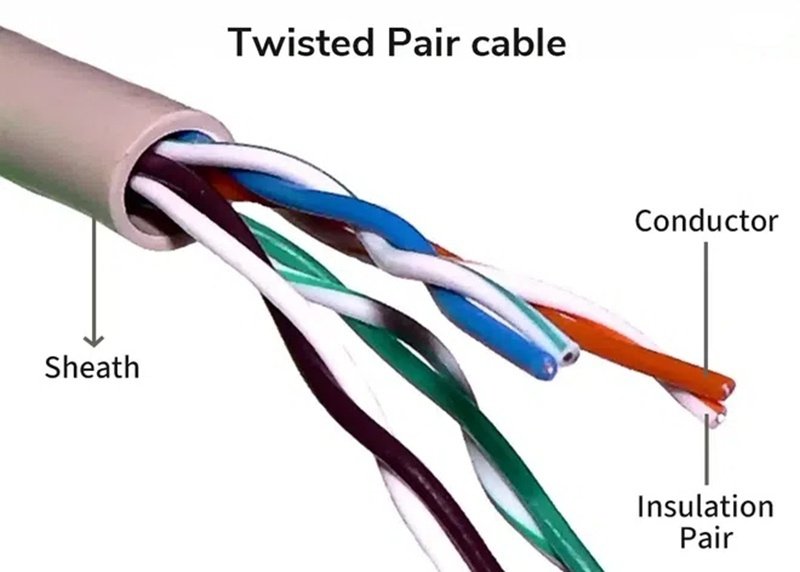
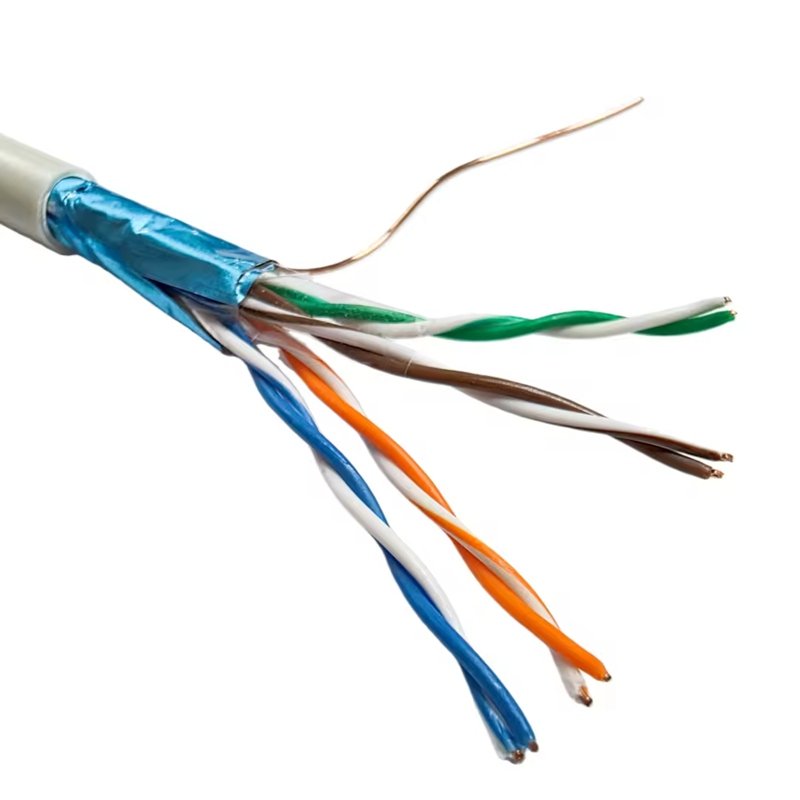
A twisted pair cable uses two conductors twisted together to carry a balanced (differential) signal. Instead of relying on a coaxial shield as the main defense, twisted pair fights interference by making both conductors “see” the same noise, so the receiver cancels it out.
How Does Twisted Pair Cable Reduce Interference?
When two wires are twisted, the electromagnetic field and induced noise tend to average out across the length. This is why twisted pair cable is widely used for Ethernet, telecom, and many industrial communication buses.
A practical way to understand coaxial cable vs twisted pair cable here is:
- Coaxial cable: “shield-first” structure
- Twisted pair cable: “balance-first” transmission
Twisted pair performance depends on twist consistency, pair geometry, and conductor balance. If manufacturing control is weak, you will see problems like crosstalk, unstable impedance, and increased error rates.
What Is the Difference Between UTP and STP Twisted Pair Cable?
UTP and STP are frequently confused. The difference is simply whether shielding is added around the pair or cable.
| Twisted pair type | Shielding | Where it fits best | Trade-off |
|---|---|---|---|
| UTP twisted pair cable | none | office networks, cost-sensitive builds | less EMI resistance |
| STP twisted pair cable | foil/braid | industrial networks, noisy areas | higher cost, less flexible |
When customers face random signal issues in industrial sites, moving from UTP to STP is a common upgrade. But STP also brings installation constraints: bigger OD and tighter bend requirements.
Where Is Twisted Pair Cable Commonly Used?
Twisted pair cable dominates in standardized data systems because it’s cost-effective, easy to deploy, and supported by mature connector ecosystems (RJ45 and industrial variants).
Typical scenarios:
- Ethernet cabling (CAT5e/CAT6/CAT6A)
- Telecom wiring
- Structured building networks
- Low-to-medium frequency data links
- Control and sensor systems (with correct design)
However, when the signal becomes RF-like, or when reflection control becomes critical, coaxial cable is often the safer option. This is where many engineering change requests happen: the system works at short length in a clean environment, then fails when deployed with long routing, bending, or EMI exposure.

What Specs Matter in Twisted Pair Cable?
Customers usually care about twisted pair specs that connect directly to speed, interference, and stability.
| Twisted pair spec | What it affects | What customers should confirm |
|---|---|---|
| Impedance (often 100Ω) | matching and reflections | define the standard requirement |
| Category rating | bandwidth and speed | CAT5e/CAT6/CAT6A etc. |
| Shield type | EMI performance | UTP vs STP decision |
| AWG | resistance and loss | longer runs need correct AWG |
| Jacket | durability | oil/UV/flame needs |
| Pair balance | noise cancellation | stability under EMI |
If a customer only provides a picture, these are exactly the missing details. In those cases, Sino-conn typically asks for one of the following to lock the spec: a part number, an existing sample, or at least known requirements like length, connector type, signal type, and environment. Once that’s clear, we can provide the drawing and spec sheet for approval before production.
Coaxial Cable vs Twisted Pair Cable — What Are the Core Differences?
When comparing coaxial cable vs twisted pair cable, the real differences show up in four areas: shielding structure, frequency capability, transmission distance, and installation flexibility. Coaxial cable uses a concentric shield to control impedance and isolate EMI. Twisted pair relies on balanced differential signaling and pair twisting to cancel noise. The better option depends on signal type, environment, and system tolerance for interference.
Now let’s break it down in measurable terms.
How Does Signal Structure Differ Between Coaxial Cable and Twisted Pair Cable?
The biggest structural difference is how the signal is carried.
| Aspect | Coaxial Cable | Twisted Pair Cable |
|---|---|---|
| Signal path | Single conductor + shield return | Two conductors (differential pair) |
| Reference | Shield acts as return path | Pair reference is each other |
| Geometry | Concentric (symmetrical around axis) | Parallel twisted pair |
| Impedance type | 50Ω / 75Ω (single-ended) | 100Ω differential (most common) |
Coaxial cable carries a single-ended signal referenced to the shield. That shield completely surrounds the conductor. This geometry makes impedance stable and predictable.
Twisted pair cable carries a differential signal. One conductor carries the positive signal, the other carries the negative. The receiver subtracts one from the other to cancel noise.
In practice:
- If your system is RF-based → coaxial cable matches the physics.
- If your system is Ethernet or balanced digital → twisted pair cable fits better.
The mistake we often see is using twisted pair for RF-like signals. It may function at short length, but as frequency increases, reflection and radiation become unstable.
Which Cable Handles EMI Better in Real Environments?
EMI behavior is not theoretical. It becomes visible when:
- The cable runs near motors.
- The cable passes next to switching power supplies.
- The device is installed in hospitals or factories.
- The system sits near radio transmitters.
Here is a realistic comparison:
| EMI Factor | Coaxial Cable | Twisted Pair (UTP) | Twisted Pair (STP) |
|---|---|---|---|
| External EMI blocking | High | Low | Medium |
| Signal leakage | Very low | Moderate | Lower |
| Shield continuity impact | Critical | N/A | Important |
| Grounding sensitivity | Yes | Less sensitive | Yes |
Coaxial cable uses physical shielding to block interference. Twisted pair relies on noise cancellation.
In clean office environments, twisted pair performs well. In harsh industrial EMI conditions, we frequently see twisted pair replaced by coaxial cable or at least STP.
A common field case:
A customer used UTP twisted pair inside industrial machinery. Signal jitter appeared randomly. Switching to STP improved stability, but not fully. Final solution was a shielded coaxial assembly because the signal was sensitive to RF noise.
The lesson: EMI strength and signal sensitivity must be evaluated together.
How Does Frequency Capability Separate Coaxial Cable and Twisted Pair Cable?
Frequency is one of the clearest dividing lines.
| Cable Type | Reliable Practical Frequency Range |
|---|---|
| CAT5e twisted pair | Up to 100 MHz |
| CAT6 twisted pair | Up to 250 MHz |
| CAT6A twisted pair | Up to 500 MHz |
| Shielded twisted pair (optimized) | < 1 GHz |
| Standard 50Ω coaxial cable | 1 MHz – 6 GHz |
| High-performance coaxial cable | Up to 18 GHz, 40 GHz+ |
If your signal includes:
- RF transmission
- Microwave communication
- Antenna feed
- Spectrum testing
- Signal generators
Twisted pair is simply not designed for that frequency range.
Why coaxial cable performs better at high frequency:
- Controlled dielectric thickness
- Uniform conductor spacing
- Full shielding
- Lower radiation loss
- Better return loss control
At higher frequencies, small geometry changes cause big performance changes. Coaxial cable geometry is stable by design.
How Does Attenuation Compare Between Coaxial Cable and Twisted Pair Cable?
Attenuation determines how much signal you lose over distance.
Attenuation increases with:
- Frequency
- Cable length
- Smaller conductor diameter
- Poor shielding
Here is a simplified example comparison at 1 GHz:
| Cable Type | Approx. Loss per 10 meters |
|---|---|
| Standard coaxial cable | 2–4 dB |
| Low-loss coaxial cable | 1–2 dB |
| Twisted pair cable | Significantly higher and unstable |
For Ethernet applications (100 meters at controlled frequency), twisted pair is standardized and optimized.
For RF at GHz levels, twisted pair loss increases dramatically and is unpredictable. Coaxial cable provides more stable loss curves.
If your design margin is small (for example in medical diagnostics or precision instruments), attenuation control becomes critical.
How Does Mechanical Behavior Differ Between Coaxial Cable and Twisted Pair Cable?
Mechanical behavior influences installation and long-term reliability.
| Mechanical Factor | Coaxial Cable | Twisted Pair Cable |
|---|---|---|
| Typical OD | Larger | Smaller |
| Bend radius | More restrictive | More flexible |
| Weight | Heavier | Lighter |
| Shield sensitivity to bending | Moderate | Less (UTP) |
| Flex-cycle performance | Depends on design | Good in many cases |
However, not all coaxial cables are stiff. Flexible coaxial designs exist using stranded conductors and soft jackets.
When customers need:
- Tight routing
- High flex cycles
- Robotic movement
- Compact devices
Cable structure must be selected carefully, regardless of cable type.
Which Cable Is More Cost-Stable in Long-Term Projects?
Initial cost is one thing. Failure cost is another.
Let’s compare lifecycle perspective:
| Factor | Coaxial Cable | Twisted Pair Cable |
|---|---|---|
| Initial cost | Higher | Lower |
| EMI failure risk | Lower | Higher (UTP) |
| RF performance risk | Very low | High |
| Replacement cost impact | Lower over time | Can increase if unstable |
For consumer electronics with tight cost control and moderate frequency, twisted pair makes sense.
For systems where signal stability is critical, replacing failed assemblies costs more than the price difference between cable types.
Which Is Better for High-Speed Signals — Coaxial Cable or Twisted Pair Cable?
For high-speed digital networks under standardized Ethernet protocols, twisted pair cable is optimized and cost-effective. For high-frequency RF, microwave, or sensitive analog signals, coaxial cable performs better due to stable impedance and superior shielding. The “better” cable depends entirely on signal type and system design.
Now let’s analyze in more technical detail.
How Does Impedance Control Differ in Coaxial Cable and Twisted Pair Cable?
Impedance is not just a number. It determines signal reflection and power transfer.
| Cable Type | Typical Impedance | Control Method |
|---|---|---|
| Coaxial cable | 50Ω, 75Ω | Fixed geometry between conductor and shield |
| Twisted pair cable | 100Ω differential | Pair spacing and twist balance |
Coaxial cable impedance is calculated based on:
- Inner conductor diameter
- Dielectric thickness
- Dielectric constant
- Shield inner diameter
This makes coaxial cable impedance extremely consistent if manufacturing is controlled.
Twisted pair impedance depends on:
- Pair spacing
- Twist rate
- Conductor symmetry
- Dielectric uniformity
If manufacturing tolerance drifts, impedance drift occurs.
For RF systems, impedance mismatch can cause:
- Signal reflection
- Reduced transmission power
- Increased heat
- System instability
This is why RF engineers prefer coaxial cable.
How Far Can Coaxial Cable Transmit Compared to Twisted Pair Cable?
Distance performance depends on signal type.
For digital Ethernet:
- Twisted pair: standardized 100 meters
For RF:
- Coaxial cable: practical and stable over longer ranges
However, attenuation must always be calculated.
Example decision logic:
If frequency < 500 MHz and differential digital → twisted pair
If frequency > 1 GHz and analog/RF → coaxial cable
If EMI environment is harsh → lean toward coaxial cable
Distance planning should consider:
- Attenuation per meter
- Connector insertion loss
- Temperature rise
- Shield continuity
Do Engineers Prefer Coaxial Cable or Twisted Pair Cable?
From experience, engineers choose based on system physics, not cost alone.
Engineering preference pattern:
| Engineer Type | Preference |
|---|---|
| RF engineer | Coaxial cable |
| Network engineer | Twisted pair cable |
| Medical system engineer | Often coaxial |
| Industrial automation engineer | STP or coax depending on EMI |
| Consumer electronics | Twisted pair for cost efficiency |
Price-sensitive OEM factories often prefer twisted pair if technically acceptable. But when signal stability becomes critical, the choice often shifts.
We’ve seen projects where customers initially selected twisted pair due to cost, but after repeated interference issues, moved to coaxial cable.
How Does Cost Compare Between Coaxial Cable and Twisted Pair Cable?
When customers compare coaxial cable vs twisted pair cable, cost is usually the first visible difference — but rarely the most important one.
In general, twisted pair cable is less expensive than coaxial cable for equivalent length. However, the total system cost depends on more than just cable price per meter. It includes connector type, assembly labor, shielding complexity, compliance documentation, testing requirements, and expected failure risk.
Here is a structural comparison:
| Cost Factor | Coaxial Cable | Twisted Pair Cable |
|---|---|---|
| Raw material | Higher (shield + dielectric) | Lower (2 conductors) |
| Connector cost | Higher (RF precision types) | Lower (RJ45, IDC, etc.) |
| Assembly complexity | Moderate to High | Low to Moderate |
| EMI performance cost | Built-in | Added via STP |
| Testing requirement | Often RF testing | Network certification |
| Failure risk in EMI-heavy env. | Lower | Higher (UTP) |
Why Coaxial Cable Costs More
Coaxial cable uses:
- More copper (shield + conductor)
- Controlled dielectric materials (PE, PTFE, FEP)
- Higher precision manufacturing
- RF-grade connectors (SMA, BNC, N-type, etc.)
For example:
- A basic Ethernet twisted pair assembly may cost significantly less per unit than a precision RF coaxial cable assembly.
- However, replacing failed RF cables in the field can cost more than choosing the correct cable initially.
Regional Pricing Considerations
From real sourcing experience:
| Region | Price Level Tendency |
|---|---|
| USA | Higher |
| Germany / France | Higher |
| Italy / Poland | Moderate |
| Japan | Slightly high |
| Korea | Moderate |
| India / Southeast Asia | Lower |
Industry also impacts price:
- Medical and military → higher spec, higher price
- Industrial automation → mid-range
- Consumer electronics → cost-sensitive
At Sino-conn, we provide multiple pricing tiers:
- Premium (original connectors, high-grade materials)
- Balanced (optimized cost-performance)
- Budget-compatible (cost-focused alternatives)
The key is clarity of application. Without knowing the environment and signal type, price comparisons are meaningless.
How Do You Choose Between Coaxial Cable and Twisted Pair Cable?
The decision is not about preference — it is about matching cable physics to system requirements.
Here is a simplified decision guide:
| Question | If Yes → | Suggested Cable |
|---|---|---|
| Is it RF or GHz frequency? | Yes | Coaxial cable |
| Is impedance critical (50Ω/75Ω)? | Yes | Coaxial cable |
| Is it Ethernet or differential data? | Yes | Twisted pair cable |
| Is EMI environment harsh? | Yes | Shielded coax or STP |
| Is budget extremely tight? | Yes | Twisted pair (if suitable) |
| Is signal precision critical? | Yes | Coaxial cable |
Environmental Factors That Influence Choice
When evaluating coaxial cable vs twisted pair cable, consider:
- Temperature range
- Oil exposure
- UV exposure
- Flame requirements
- Bending frequency
- Chemical resistance
- Halogen-free requirement
At Sino-conn, we frequently customize:
- LSZH jackets
- High-temperature FEP insulation
- Oil-resistant TPU
- UV-resistant PVC
- Corrosion-resistant structures
Cable choice must consider the full lifecycle environment — not just the lab test condition.
Do You Need Custom Coaxial Cable or Twisted Pair Cable Assemblies?
Standard catalog cables solve maybe 60–70% of applications. The remaining 30–40% require customization.
Customization usually involves:
- Length adjustment
- Pin definition (pinout mapping)
- Connector combination (mixed ends)
- Shielding upgrade
- Special jacket material
- Mechanical form factor
- Overmolding
- Labeling and compliance marking
Here is how a typical custom project works at Sino-conn:
| Step | What Happens |
|---|---|
| 1 | Customer sends model, drawing, or photo |
| 2 | We confirm electrical and mechanical parameters |
| 3 | CAD drawing provided (often within 3 days) |
| 4 | Drawing approval before production |
| 5 | Sample production (standard 2 weeks, urgent 2–3 days possible) |
| 6 | Mass production (3–4 weeks typical, urgent within 2 weeks possible) |
| 7 | 100% inspection (process + final + pre-shipment) |
There is no MOQ requirement — even 1 piece is acceptable for sampling.
How Should You Evaluate a Cable Assembly Supplier?
Choosing between coaxial cable vs twisted pair cable is only half the decision. The other half is choosing the supplier who can deliver consistent quality.
Key evaluation factors:
1. Technical Knowledge
Can the sales team:
- Explain impedance differences?
- Recommend connector alternatives?
- Discuss shielding coverage?
- Understand your industry requirements?
At Sino-conn, our sales team must understand:
- Connector model differences
- Production processes
- Electrical specifications
- Country-specific preferences
- Industry compliance expectations
Technical communication reduces project failure risk.
2. Drawing & Documentation Capability
A reliable supplier:
- Provides drawings before production
- Confirms pin definition
- Clarifies tolerance
- Supplies spec sheets
We often see projects fail because customers skip drawing confirmation. At Sino-conn, production does not begin until drawings are approved.
3. Response Speed
Speed influences conversion.
Our benchmarks:
- Quotation: as fast as 30 minutes
- Drawing: same day possible
- Urgent sample: 2–3 days
- Urgent mass production: within 2 weeks
For OEM factories under tight deadlines, response speed is often the deciding factor.
4. Quality Control
We perform:
- In-process inspection
- Final inspection
- Pre-shipment inspection
100% inspection is standard.
For regulated industries, we provide documentation support including UL, ISO, ROHS, REACH, PFAS, COC, and COO when applicable.
Final Thoughts: Coaxial Cable vs Twisted Pair Cable — It’s About Application, Not Preference

If your signal is:
- RF
- High-frequency
- EMI-sensitive
- Precision-critical
Coaxial cable is usually the safer path.
If your signal is:
- Differential data
- Ethernet-based
- Cost-sensitive
- Structured network
Twisted pair cable is often the practical choice.
But here’s what truly matters:
Most cable failures do not happen because the cable was “bad.”
They happen because the cable was mismatched to the environment.
If you are:
- An R&D engineer developing a new system
- An OEM factory under cost pressure
- A trading company needing fast confirmation
- A procurement manager comparing suppliers
Sino-conn can support you with:
- Technical consultation
- Spec confirmation
- Custom drawings
- Fast sampling
- Flexible connector options (original or compatible)
- No MOQ
- Competitive pricing tiers
- 100% inspection
If you have a model number, a drawing, or even just a photo — send it to us.
We will help you determine whether coaxial cable or twisted pair cable is the correct solution for your application, and provide a clear, measurable, production-ready proposal.
Let’s make sure your cable works