Skip to content

Modern electrical projects rarely fail because of dramatic mistakes. They fail because of small assumptions—like assuming two cables that “look similar” perform the same way. BX cable and MC cable are a classic example. To the untrained eye, both are metal-armored cables used in commercial and industrial wiring. Yet beneath the armor, their grounding methods, safety margins, and code acceptance differ in ways that can directly affect system reliability, inspection approval, and long-term maintenance.
BX cable and MC cable are not the same. While both are armored cables, BX relies on its metal sheath for grounding, whereas MC cable includes a dedicated grounding conductor. This structural difference makes MC cable safer, more reliable, and more widely accepted under modern electrical codes. As a result, MC cable has largely replaced BX cable in new commercial and industrial installations.
In practice, many engineers only learn this distinction after a failed inspection, a grounding issue, or an unexpected retrofit. Understanding why MC replaced BX—not just that it did—helps you make better decisions across compliance, cost, and performance. Let’s break it down clearly, starting from fundamentals and moving into real-world application.
What Is BX Cable?
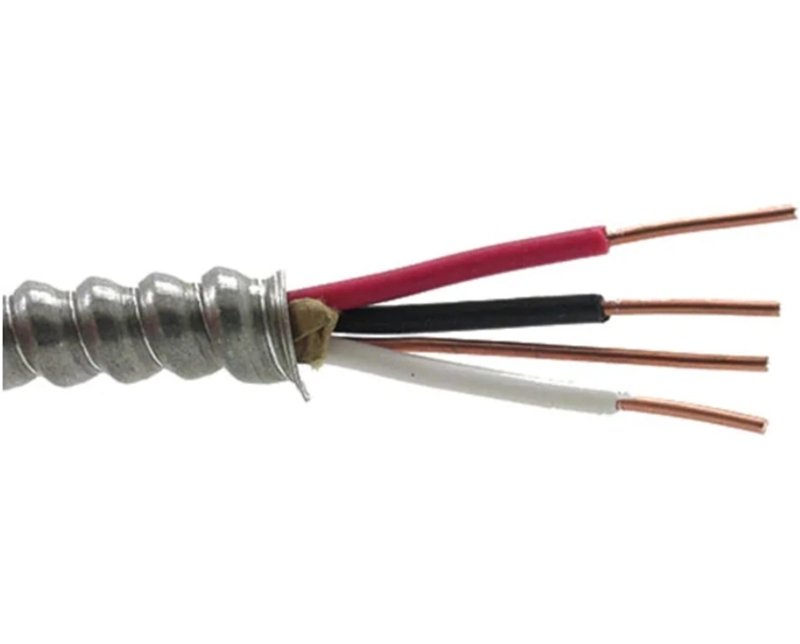
BX cable, also known as armored cable (AC), is an early form of metal-sheathed electrical cable where the metal armor itself serves as the grounding path. It was widely used in older commercial buildings but is now limited in modern applications due to grounding reliability concerns and evolving electrical codes.
What does BX cable stand for?
BX originally referred to a trade name that became shorthand for armored cable. Over time, the term “BX cable” became a generic label for early AC-type cables featuring spiral steel armor. Despite the common usage, not all armored cables are BX, and the terminology is often used incorrectly in the field.
How is BX cable constructed?
BX cable typically consists of insulated conductors wrapped inside a flexible metal armor, usually steel or aluminum. Crucially, traditional BX cable lacks a dedicated grounding conductor. Instead, it relies on the metal armor itself to act as the ground path. This design assumes perfect continuity across fittings and terminations—an assumption that does not always hold true in real installations.
Where is BX cable commonly used?
Historically, BX cable was common in mid-20th-century commercial buildings, apartments, and light industrial facilities. Today, it is most often encountered in renovations, legacy systems, or regions where older code allowances remain in effect.
What are the limitations of BX cable today?
The biggest limitation is grounding reliability. Corrosion, loose fittings, or improper installation can compromise the grounding path. As safety standards tightened, inspectors and engineers increasingly viewed BX as insufficient for modern electrical demands, particularly in environments with sensitive equipment or higher fault risks.
What Is MC Cable?
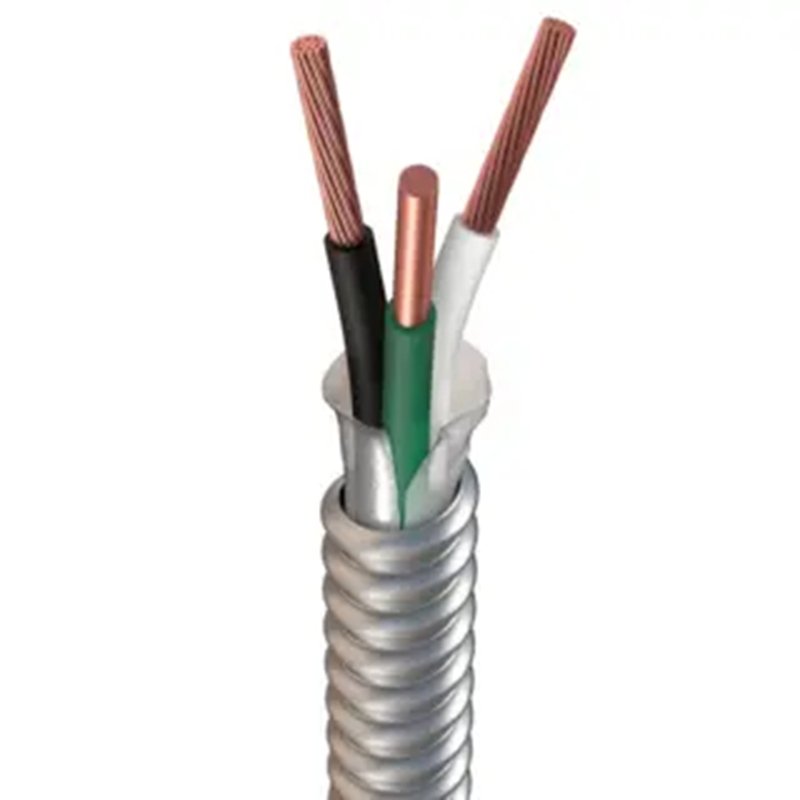
MC cable (Metal-Clad cable) is a modern armored cable that includes a dedicated grounding conductor inside the metal sheath. This design provides more reliable grounding, better safety performance, and broader acceptance under current electrical codes, making MC cable the preferred choice for most new installations.
What does MC cable mean?
MC stands for Metal-Clad. Unlike BX, MC cable was designed from the outset to meet evolving safety expectations. The inclusion of a grounding conductor was not an afterthought—it was the defining improvement.
How is MC cable constructed differently from BX?
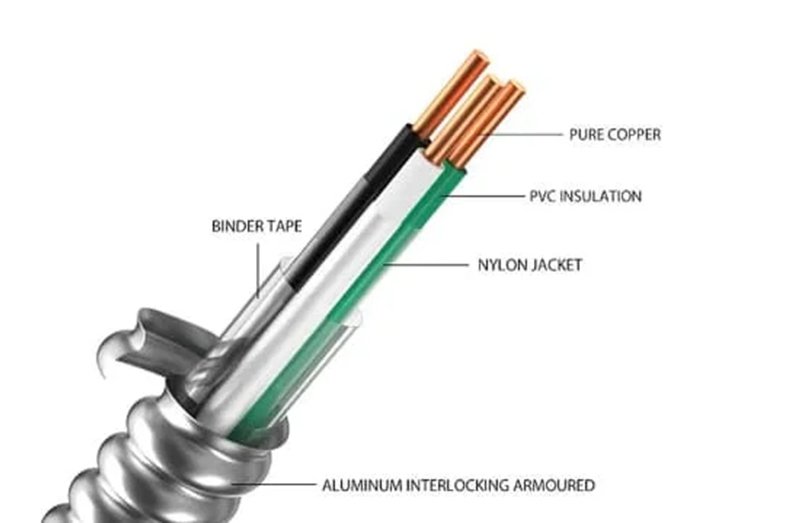
MC cable contains insulated phase conductors plus a separate, full-sized grounding conductor. The metal armor provides mechanical protection, but grounding no longer depends on armor continuity alone. This redundancy significantly improves safety and fault handling.
Where is MC cable typically installed?
MC cable is widely used in commercial buildings, industrial plants, hospitals, data centers, and manufacturing facilities. Its versatility allows it to meet fire ratings, EMI shielding needs, and mechanical protection requirements across many environments.
Why has MC cable largely replaced BX cable?
The answer is simple: predictable grounding. MC cable aligns better with modern NEC interpretations and reduces ambiguity during inspection. For engineers, it offers fewer surprises and clearer compliance pathways.
What Is the Difference Between BX and MC Cable?
At first glance, BX cable and MC cable appear nearly identical. Both feature a flexible metal armor, both are commonly used in commercial and industrial wiring, and both are often grouped under the broad category of “armored cable.” However, this surface-level similarity hides several fundamental structural and functional differences that directly affect safety, compliance, installation risk, and long-term reliability. Understanding these differences is critical before specifying either cable for a project.
The core distinction lies in how each cable handles grounding. Traditional BX cable relies on its metal armor—and sometimes a thin bonding strip—as the grounding path. MC cable, by contrast, incorporates a dedicated grounding conductor inside the armor. This single design choice cascades into meaningful differences in electrical performance, code acceptance, and real-world reliability.
Is BX the same as MC cable?
No. BX and MC cables are not interchangeable, even though they are often confused. Treating BX as equivalent to MC is one of the most common mistakes seen in renovations and cost-driven substitutions. From an electrical safety perspective, they are built on different assumptions: BX assumes mechanical continuity will remain intact over time, while MC assumes grounding must remain reliable regardless of armor condition.
Key structural and functional differences
| Aspect | BX Cable | MC Cable |
|---|---|---|
| Grounding method | Metal armor (and bonding strip) | Dedicated grounding conductor |
| Grounding reliability | Dependent on fittings and armor integrity | Independent and predictable |
| Code acceptance | Limited or legacy | Broad and modern |
| Installation tolerance | Low | High |
| Industrial suitability | Limited | Strong |
How grounding design changes everything
Grounding is not a theoretical concern—it determines how a system behaves during faults, short circuits, or insulation failure. With BX cable, grounding continuity can be compromised by corrosion, loose connectors, paint buildup, or improper termination. In contrast, MC cable’s copper grounding conductor provides a continuous, verifiable path that is far less sensitive to mechanical variables. This difference becomes especially important in environments with vibration, moisture, long cable runs, or frequent maintenance access.
Impact on safety, inspection, and long-term performance
Because MC cable separates mechanical protection from electrical grounding, it offers greater fault tolerance and more consistent performance over time. Inspectors generally prefer MC cable because compliance is easier to verify visually and electrically. From a lifecycle perspective, MC cable reduces the likelihood of unexpected rework, failed inspections, or grounding-related troubleshooting years after installation.
Fire rating, compliance, and modern expectations
MC cable is available in a wide range of configurations designed to meet modern requirements, including enhanced fire resistance, low-smoke materials, and compatibility with demanding industrial or commercial standards. BX cable options are more limited, reflecting its role as a legacy solution rather than a forward-looking one.
Why this difference matters to your project
Choosing between BX and MC cable is not simply about tradition or material cost. It is about risk management. MC cable aligns better with today’s electrical codes, inspection practices, and safety expectations. BX cable, while still encountered in older systems, is increasingly viewed as a compromise rather than a best practice.
In short: BX and MC cables may look similar, but their internal design philosophy is fundamentally different. For modern projects where safety, compliance, and long-term reliability matter, that difference should not be overlooked.
Which Is Better: BX or MC Cable?
MC cable is generally better for modern installations due to safer grounding, higher reliability, and broader code compliance. BX cable is mainly suited for legacy systems or limited applications.
Between MC cable and BX cable, which is safer?
MC cable. Dedicated grounding significantly lowers shock and fault risks.
Which cable is preferred under modern electrical codes?
MC cable aligns with contemporary NEC interpretations and inspector expectations.
Which option offers better long-term reliability?
MC cable performs better over decades, especially in industrial or commercial environments with mechanical stress.
How Do You Choose Between BX and MC Cable for Your Project?
Choosing between BX and MC cable is rarely about personal preference or habit. It is a risk-based engineering decision that balances electrical safety, regulatory compliance, installation conditions, and long-term reliability. While both cables fall under the category of armored wiring, modern projects increasingly demand predictable performance rather than legacy familiarity. Understanding how project-specific factors influence this choice is essential for avoiding costly rework, inspection delays, or performance issues later on.
At a high level, MC cable is the default choice for new installations, while BX cable is generally limited to repairs, extensions, or legacy compatibility. The question is not whether MC is “better” in theory, but whether the conditions of your project expose the weaknesses inherent in BX cable’s grounding design.
What factors determine whether BX or MC should be used?
The first factor is code compliance. Local and national electrical codes increasingly favor solutions with dedicated grounding conductors. Even where BX cable is technically allowed, inspectors often scrutinize its grounding continuity more closely. Choosing MC cable simplifies compliance and reduces uncertainty during inspection.
The second factor is installation environment. Projects involving vibration, moisture, temperature variation, or frequent access place higher stress on mechanical connections. Because BX relies on armor integrity for grounding, these conditions increase risk. MC cable’s internal grounding conductor remains electrically stable even if armor continuity degrades.
A third consideration is system criticality. For circuits powering sensitive equipment, control systems, or industrial machinery, grounding reliability is not optional. MC cable provides a clearer margin of safety in these applications.
How does the installation environment affect the choice?
In dry, low-vibration environments with limited mechanical stress, BX cable may function adequately, especially in short runs or existing systems. However, in industrial facilities, commercial buildings, or mixed-use spaces, conditions are rarely ideal. Vibration from machinery, thermal expansion, and long cable runs amplify the limitations of armor-based grounding.
MC cable performs more consistently in these environments because electrical grounding is independent of physical armor performance. This distinction is often overlooked during planning but becomes critical over the life of the installation.
How do cost, availability, and inspection risk compare?
| Decision Factor | BX Cable | MC Cable |
|---|---|---|
| Initial material cost | Lower | Moderate |
| Installation risk | Higher | Lower |
| Inspection predictability | Variable | High |
| Long-term maintenance | Potential issues | Minimal |
While BX cable may appear less expensive upfront, the hidden costs—failed inspections, additional grounding verification, or future retrofits—can quickly outweigh the savings. MC cable’s higher predictability often results in lower total project cost over time.
When should MC cable replace BX cable entirely?
MC cable should be selected whenever safety margins, compliance clarity, and long-term reliability are priorities. This includes new construction, major renovations, industrial environments, healthcare facilities, and commercial projects subject to strict inspection regimes. BX cable is best reserved for limited legacy applications where system continuity outweighs modernization.
Making the decision with confidence
Ultimately, choosing between BX and MC cable is about reducing uncertainty. MC cable aligns with modern electrical practices, minimizes inspection risk, and supports future system modifications. BX cable, while historically significant, represents an earlier design philosophy that assumes ideal conditions.
For projects where performance, safety, and compliance matter beyond day one, MC cable is not just a safer option—it is the more predictable engineering choice.
Are BX and MC Cables Still Used in Modern Industrial Applications?
MC cable is widely used in modern industrial applications, while BX cable is largely limited to legacy systems. Industrial environments increasingly demand customization, compliance, and predictable performance.

Are BX and MC cables still used in industrial facilities?
MC cable dominates new builds; BX appears mostly in older infrastructure.
How do modern industrial cable requirements differ from traditional BX and MC?
Industrial systems require defined grounding, EMI control, thermal resistance, and customization—areas where MC-based assemblies excel.
Can armored cables be customized for industrial use?
Yes. Length, conductor size, jacket material, grounding, and termination can all be tailored to application needs.
Frequently Asked Questions About BX vs MC Cable
- Is BX cable still allowed by electrical codes? In limited cases, depending on jurisdiction and application.
- Can BX cable be used without a separate ground wire? Traditionally yes, but this is exactly why it is being phased out.
- Is MC cable more expensive than BX? Slightly, but with lower long-term risk.
- Are MC and BX cables interchangeable? No. They should not be substituted without evaluation.

Ready to Specify or Customize Your Cable?
If you are evaluating BX versus MC cable, chances are you are already thinking beyond off-the-shelf solutions. At Sino-Conn, we support engineers, OEMs, and industrial buyers who need clarity, customization, and speed—whether you come with a drawing, a specification, or only a reference photo.
From rapid CAD drawings and flexible material choices to no-MOQ production and full compliance documentation, our team helps you move from uncertainty to a production-ready solution—fast.
Share your application details and let’s build the right cable together.