 Skip to content
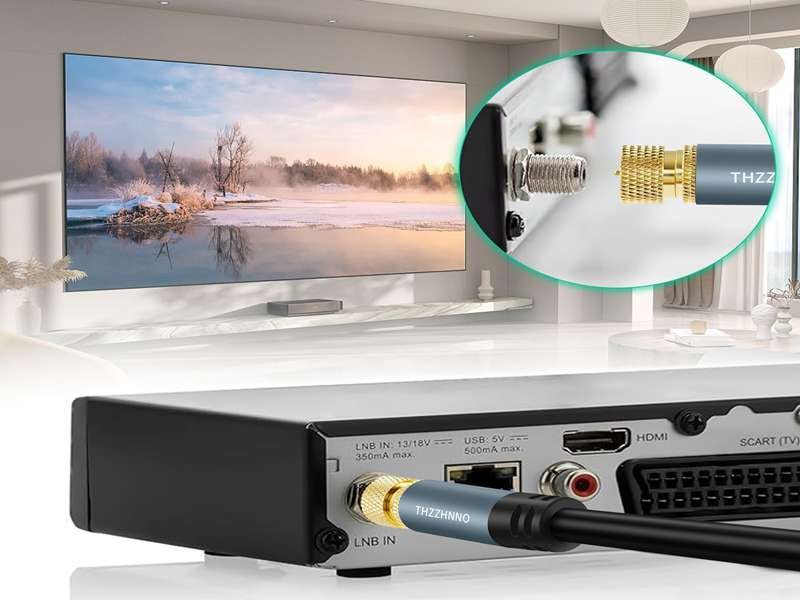
Most people first see an F Type coaxial cable behind a TV, satellite receiver, modem, CCTV DVR, or wall outlet. It looks ordinary: one round cable, one threaded metal connector, and a center wire inside. But in real projects, this small cable often decides whether the signal is stable or full of noise. A hotel TV system with hundreds of rooms, a broadband device shipped to thousands of users, or a CCTV installation running through a noisy electrical room cannot rely on “almost correct” cable assemblies. The connector must fit. The cable must match the frequency. The shielding must be strong enough. The jacket must survive the environment. The length must be controlled. The supplier must understand the details before quoting.
An F Type coaxial cable is a 75-ohm coaxial cable fitted with F Type connectors. It is mainly used for RF signal transmission in cable TV, satellite systems, broadband internet, CCTV, and signal distribution equipment. It works by carrying the signal through the center conductor while the dielectric, foil shield, braid shield, and outer jacket protect signal quality and reduce interference.
For buyers, the real question is not only “What is it?” The more useful question is, “Which F Type coaxial cable is safe for my product, my installation, and my customer?” A purchasing manager may only have a photo. An engineer may have a detailed drawing. An OEM factory may need the lowest workable cost. A distributor may need quick samples and a clean specification sheet. Sino-Conn meets these different needs by helping customers confirm connector type, cable structure, shielding, length, jacket material, drawing, sample lead time, and mass production quality before the order starts.
What Is F Type Coaxial Cable?
An F Type coaxial cable is a 75-ohm RF cable assembly that uses F Type connectors to transmit high-frequency radio frequency (RF) signals with low signal loss and excellent impedance stability. It is one of the most widely used coaxial cable solutions in the world, supporting cable television, satellite communication, broadband internet, CCTV, RF distribution equipment, antennas, and many commercial communication systems. Compared with many other RF connectors, the F Type connector has a simple structure, lower manufacturing cost, and dependable electrical performance, making it the preferred choice for millions of residential and commercial installations.
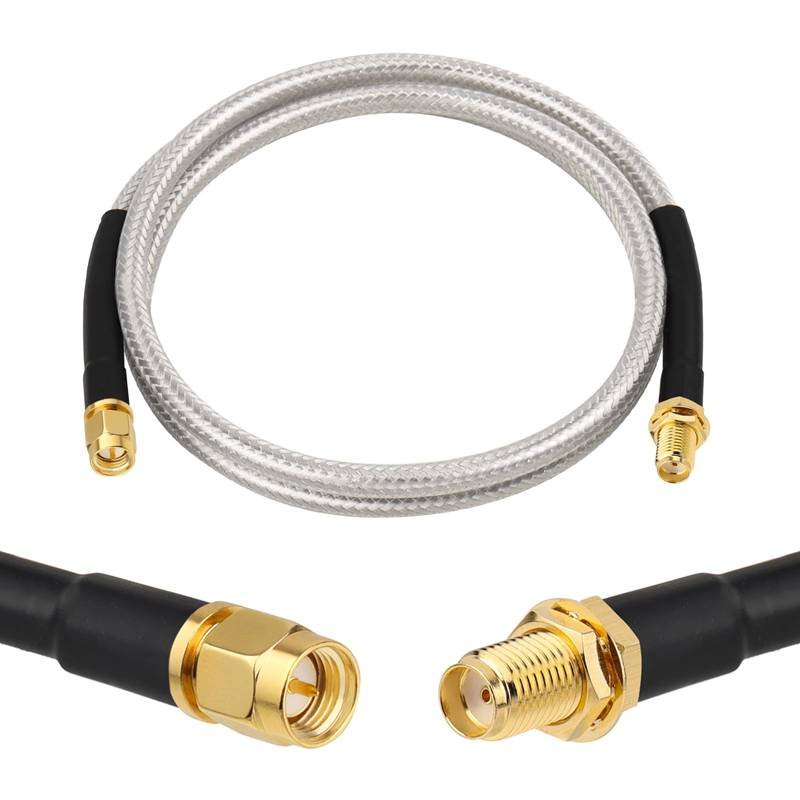
For engineers and OEM manufacturers, however, an F Type coaxial cable is much more than a cable with two connectors. Every component—from the center conductor and shielding layers to the connector plating and cable jacket—directly affects signal quality, installation efficiency, and long-term reliability. Choosing the right cable requires understanding not only the connector, but also the application, operating frequency, installation environment, and mechanical requirements.
What Makes F Type Coaxial Cable Different?
The F Type connector was developed specifically for 75-ohm RF systems and remains one of the most economical connector designs for high-frequency signal transmission. Unlike connectors such as SMA, BNC, or TNC, an F Type connector typically uses the cable’s own center conductor as the contact pin. This eliminates the need for a separate machined center pin, reducing manufacturing complexity while maintaining excellent electrical performance.
Although the design is simple, precision is critical. Even small variations in cable stripping dimensions, conductor length, or connector crimping can reduce return loss, increase insertion loss, or create intermittent signal problems.
Many buyers focus only on connector appearance, but experienced engineers know that two F Type coaxial cables that look identical externally can perform very differently internally.
Several factors determine the overall performance:
| Specification | Why It Matters |
|---|---|
| Characteristic impedance | Maintains signal stability and minimizes reflections |
| Cable attenuation | Determines signal loss over distance |
| Shielding effectiveness | Reduces electromagnetic interference |
| Connector precision | Ensures stable electrical contact |
| Cable flexibility | Simplifies installation in limited spaces |
| Environmental resistance | Extends service life in harsh conditions |
For example, a residential television cable may only require basic shielding because the installation environment is relatively clean. In contrast, a communication cabinet installed beside industrial motors or electrical equipment may require dual-shield or quad-shield construction to prevent electromagnetic interference.
This is why professional cable manufacturers rarely recommend products based solely on connector type. Instead, they evaluate the complete application before recommending the most suitable cable assembly.
What Is Inside F Type Coaxial Cable?
Every F Type coaxial cable consists of several carefully designed layers that work together to protect the RF signal. Removing or changing any one of these layers can significantly affect electrical performance.
The basic construction includes:
| Component | Function |
|---|---|
| Center Conductor | Carries RF signals |
| Dielectric Insulation | Maintains constant impedance and conductor spacing |
| Aluminum Foil Shield | Blocks high-frequency interference |
| Braided Shield | Improves shielding effectiveness and mechanical strength |
| Outer Jacket | Protects against abrasion, moisture, UV exposure, chemicals, and mechanical damage |
While this structure appears simple, each material can be customized depending on the project.
For example, the center conductor may be:
- Bare copper for maximum conductivity
- Tinned copper for corrosion resistance
- Copper-clad steel for cost-sensitive television and broadband systems
Likewise, the outer jacket can be selected according to the installation environment.
| Jacket Material | Recommended Application |
|---|---|
| PVC | Indoor commercial and residential installations |
| PE | Outdoor antenna systems |
| LSZH | Public buildings, transportation, hospitals |
| TPU | Flexible industrial equipment |
| UV-resistant PE | Long-term outdoor exposure |
| Oil-resistant PVC | Factory automation equipment |
Shielding is another major consideration.
Common shielding structures include:
- Single foil shield
- Foil plus braided shield
- Double foil plus braided shield
- Quad shield
- Customized multi-layer shielding
Many customers automatically request quad shielding because it sounds like the highest specification. However, more shielding also increases cable diameter, stiffness, weight, and termination difficulty. In many OEM products, a properly designed dual-shield cable delivers excellent signal integrity while making installation much easier.
At Sino-Conn, our engineers regularly help customers select shielding based on the actual operating environment instead of recommending the highest-cost option by default.
Which F Type Coaxial Cable Is Most Common?
Although F Type connectors look similar, they are used with several different coaxial cable types. The three most common are RG59, RG6, and RG11.
Each serves a different purpose.
| Cable Type | Impedance | Approximate OD | Typical Frequency Performance | Common Applications |
|---|---|---|---|---|
| RG59 | 75Ω | 6.0 mm | Suitable for lower-frequency and shorter-distance transmission | CCTV, analog video |
| RG6 | 75Ω | 6.8–7.2 mm | Excellent balance of attenuation and flexibility | Digital TV, satellite, broadband |
| RG11 | 75Ω | About 10 mm | Lower attenuation over long distances | Distribution systems, commercial buildings |

Signal attenuation becomes increasingly important as cable length increases.
The following comparison illustrates the general trend.
| Cable Type | Relative Signal Loss | Recommended Distance |
|---|---|---|
| RG59 | Highest | Short runs |
| RG6 | Medium | Medium-distance installations |
| RG11 | Lowest | Long-distance trunk lines |
This is one reason why RG6 has become the industry standard for modern residential broadband and television installations. It provides lower attenuation than RG59 while remaining much easier to install than RG11.
However, standard cable types are not suitable for every application.
Many OEM devices require:
- Smaller cable diameter
- Increased flexibility
- Specific bending radius
- Customized connector orientation
- Special jacket materials
- Unique shielding structures
For these applications, custom coaxial cable assemblies provide much better overall performance than standard off-the-shelf products.
Why Do Engineers Pay Attention to More Than the Connector?
For engineers, the connector is only one part of the complete RF transmission system. The performance of the entire cable assembly depends on how well every component works together.
A typical engineering review often considers the following factors before approving a cable:
| Design Item | Engineering Consideration |
|---|---|
| Operating frequency | Higher frequencies require lower attenuation and better shielding |
| Cable routing | Tight bends may require smaller cable diameters |
| Connector orientation | Straight or right-angle connectors affect assembly space |
| Installation environment | Indoor, outdoor, high temperature, or industrial use |
| Mechanical movement | Static installation or repeated bending |
| Certification requirements | UL, RoHS, REACH, PFAS, LSZH, etc. |
For instance, a broadband modem manufacturer may require thousands of identical cable assemblies every month. Even a 2 mm variation in stripping length or connector position can affect automated assembly or final product appearance.
Similarly, a satellite equipment manufacturer may specify tighter impedance control because signal quality becomes more sensitive at higher operating frequencies.
These details are rarely visible in product photographs, but they have a significant impact on long-term performance.
This is why experienced suppliers invest considerable effort before production begins.
How Does Sino-Conn Help Customers Select the Right F Type Coaxial Cable?
One of the biggest challenges in the cable assembly industry is that customers often know what they need to connect, but not exactly which cable specification they need.
In our daily work, many inquiries begin with:
- A mobile phone photo
- An existing cable without markings
- A competitor’s sample
- A hand-drawn sketch
- A simple product description
This situation is especially common among distributors, purchasing teams, and maintenance engineers.
Instead of asking customers to identify every technical parameter themselves, Sino-Conn assists throughout the evaluation process.
Our engineering team helps customers confirm:
- Appropriate cable type
- Connector series
- Connector orientation
- Cable outer diameter
- Shielding construction
- Jacket material
- Overall length
- Custom labeling requirements
- Applicable compliance documents
- Packaging method
After technical confirmation, production drawings are prepared for customer approval before manufacturing starts. For standard projects, drawings are typically completed within around three working days, while simpler assemblies can often be prepared much faster.
Customers also have the flexibility to choose between original-brand connectors and high-quality compatible connectors based on project requirements, delivery schedule, and budget.
For prototype projects, many customers prefer compatible connectors because they reduce development cost while maintaining reliable mechanical compatibility. For production projects requiring approved component brands, original connectors can also be supplied.
One recent customer developing a broadband signal amplifier contacted Sino-Conn with only a damaged cable removed from an old device. There was no part number, no drawing, and no specification sheet. By measuring the cable diameter, identifying the connector dimensions, evaluating the shielding structure, and reviewing the installation space, our engineering team recreated the complete cable assembly. After prototype verification, the customer approved the design for mass production without making any changes to the equipment housing.
Projects like this demonstrate that selecting an F Type coaxial cable is not simply about finding a matching connector. It involves understanding how the cable will perform electrically, mechanically, and environmentally throughout the entire service life of the equipment. A supplier with strong engineering capabilities can often identify potential problems before production begins, saving both time and development cost while improving the reliability of the finished product.
Where Is F Type Coaxial Cable Used?
F Type coaxial cable is used anywhere a stable 75-ohm RF signal must be transmitted over short or long distances with minimal signal loss. While most people associate it with televisions, its applications extend far beyond home entertainment. Today, F Type coaxial cable is widely used in broadband internet infrastructure, satellite communication, CCTV systems, commercial buildings, hospitality projects, broadcast equipment, RF distribution networks, and OEM electronic devices. The reason is simple: it offers a reliable balance of electrical performance, mechanical durability, easy installation, and cost efficiency.
For equipment manufacturers and system integrators, selecting the correct application-specific cable is just as important as selecting the connector. A cable that performs perfectly in a living room may fail prematurely inside an outdoor communication cabinet or an industrial control room. Factors such as shielding effectiveness, jacket material, operating temperature, moisture resistance, UV resistance, bending radius, and cable routing all influence the final design.
Why Is F Type Coaxial Cable Used for TV?
Television remains the largest application for F Type coaxial cable worldwide. Whether signals come from a cable television provider, a rooftop antenna, or a satellite receiver, they must travel through coaxial cable before reaching the television or decoder.
Modern digital television systems operate at much higher frequencies than older analog systems. High-definition (HD), Full HD, and 4K broadcasting place greater demands on signal quality. Even a small increase in attenuation or impedance mismatch can cause noticeable image problems.
Common symptoms include:
- Pixelated images
- Frozen video
- Missing channels
- Intermittent reception
- Audio synchronization issues
- Signal dropouts during bad weather
In many cases, users blame the television or service provider, but installers often discover that poor-quality coaxial cable or improperly assembled connectors are the real cause.
The following table summarizes typical television installation requirements.
| Installation Type | Recommended Cable | Typical Shielding |
|---|---|---|
| Home TV | RG6 | Foil + Braid |
| Apartment Building | RG6 Quad Shield | Quad Shield |
| Hotel TV Network | RG6 | Double or Quad Shield |
| Community Antenna | RG11 Main Line + RG6 Branch Line | Quad Shield |
| Outdoor Antenna | UV Resistant RG6 | Double Shield |
Commercial television projects often require much tighter quality control than residential installations.
For example, a hotel with 300 guest rooms may require over 15 kilometers of coaxial cable. If only 2% of the cable assemblies develop loose connectors after installation, maintenance costs can quickly exceed the original cable purchase cost.
Because of this, professional installers usually evaluate more than just cable price.
Typical purchasing priorities include:
- Consistent connector dimensions
- Stable impedance
- Good return loss
- Reliable shielding
- Batch consistency
- Easy installation
- Long service life
One hospitality equipment supplier approached Sino-Conn while upgrading a hotel television distribution project. Their previous supplier provided cables with inconsistent connector torque, resulting in installers spending additional time tightening connectors during installation.
After reviewing the assembly process, Sino-Conn optimized the connector termination method and introduced torque verification during inspection. The customer reported smoother installation and fewer service calls after project completion.
This illustrates an important point: for commercial television systems, installation efficiency can be just as valuable as electrical performance.
Can F Type Coaxial Cable Carry Internet?
Many people are surprised to learn that millions of broadband internet connections around the world still rely on coaxial cable infrastructure.
Cable internet providers use DOCSIS technology to transmit both downstream and upstream digital data through existing coaxial cable networks. Modern DOCSIS 3.1 systems can support download speeds approaching 10 Gbps under suitable network conditions, while DOCSIS 4.0 continues to push bandwidth even further.
Although users experience broadband as “internet,” the physical transmission medium between the modem and the provider’s network is often an F Type coaxial cable.
This places much stricter demands on cable quality than many people realize.
Unlike television signals that may tolerate minor degradation, broadband communication requires:
- Stable impedance
- Low insertion loss
- Good return loss
- Excellent shielding
- Reliable connector contact
- Low signal leakage
A poorly terminated connector may still allow internet access, but customers often experience:
- Slow download speeds
- Unstable Wi-Fi performance
- Frequent modem reconnection
- Packet loss
- Increased latency
- Reduced upload speed
The cable itself is only one part of the system, but poor cable quality often becomes the weakest link.
The comparison below highlights the importance of proper cable selection.
| Project Factor | Low-Quality Cable | Properly Designed Cable |
|---|---|---|
| Connector Fit | Inconsistent | Stable |
| Shield Coverage | Low | High |
| Signal Leakage | Higher | Lower |
| Broadband Stability | Variable | Consistent |
| Expected Service Life | Shorter | Longer |
OEM manufacturers producing broadband gateways, cable modems, and network equipment also pay close attention to mechanical consistency.
For example, connector length tolerance, cable flexibility, and connector orientation all affect final assembly inside compact electronic products.
One broadband equipment customer contacted Sino-Conn after discovering that different cable suppliers delivered assemblies with small dimensional differences. Although each cable passed continuity testing, some interfered with internal cable routing, increasing assembly time.
After reviewing the product design, Sino-Conn standardized cable length tolerance, connector orientation, and packaging method. The customer reduced assembly variation and simplified production line management.
Which Industries Use F Type Coaxial Cable?
Although television and broadband account for a significant portion of global demand, F Type coaxial cable is widely used across many other industries.
Each industry focuses on different performance requirements.
| Industry | Typical Application | Primary Concern |
|---|---|---|
| Cable Television | TV Distribution | Stable RF Signal |
| Satellite Communication | Dish Connections | Low Signal Loss |
| Broadband Internet | Cable Modems | Shielding & Return Loss |
| CCTV | Video Transmission | Reliability |
| Hospitality | Hotel TV Systems | Installation Efficiency |
| Healthcare | Patient Entertainment Systems | Stable Long-Term Operation |
| Commercial Buildings | RF Distribution | Easy Maintenance |
| Telecommunications | Signal Distribution Cabinets | Low Attenuation |
| OEM Electronics | Internal RF Assemblies | Custom Design |
| Security Systems | Monitoring Equipment | Durable Cable Assemblies |
Although these applications all use F Type connectors, the cable assemblies themselves are rarely identical.
Consider several examples.
Telecommunications
Telecommunication companies often install hundreds or even thousands of cable assemblies inside distribution cabinets.
Space is limited.
Cable routing is complex.
Heat buildup must be considered.
These projects frequently require:
- Custom cable lengths
- Controlled bend radius
- Consistent connector orientation
- Batch identification labels
OEM Equipment Manufacturing
OEM customers typically purchase custom cable assemblies rather than standard retail cables.
Their priorities often include:
- Exact cable length
- Controlled stripping dimensions
- Customized packaging
- Production drawings
- Stable monthly supply
- Long-term product consistency
At Sino-Conn, many OEM customers begin with only prototype quantities before gradually increasing production volume after product approval.
Since there is no standard inventory for most custom cable assemblies, every project is manufactured according to customer specifications rather than modified from an existing product.
Security and CCTV
Although IP cameras continue to grow rapidly, coaxial cable remains widely used in many surveillance projects.
Existing analog and HD-over-coax systems still rely heavily on F Type connectors.
Security installers usually prioritize:
- Easy installation
- Flexible cable
- Stable video transmission
- Good shielding
- Weather-resistant outdoor jackets
Outdoor surveillance systems also require connectors capable of resisting moisture and corrosion for many years.
Hospitality Projects
Hotels often install hundreds of identical cable assemblies.
Unlike residential users, hotels care about long-term maintenance costs.
A cable failure inside one guest room affects not only repair costs but also customer satisfaction.
Therefore, purchasing departments often request:
- Consistent cable appearance
- Uniform cable length
- Batch traceability
- Stable delivery schedule
- Reliable documentation
These seemingly small details greatly simplify future maintenance.
How Does the Installation Environment Affect F Type Coaxial Cable?
The same F Type connector can be used in dramatically different environments.
Selecting the correct cable structure is essential.
| Installation Environment | Recommended Features |
|---|---|
| Indoor Residential | Standard PVC Jacket |
| Outdoor Installation | UV Resistant Jacket |
| Coastal Area | Corrosion Resistant Connector |
| Factory | Oil Resistant Jacket |
| Public Building | LSZH Jacket |
| Communication Cabinet | Flexible Cable, Controlled Bend Radius |
| High EMI Environment | Double or Quad Shield |
Ignoring environmental factors often leads to premature cable failure.
For example:
- PVC jackets exposed to long-term sunlight may crack.
- Poor plating may corrode in coastal environments.
- Excessively stiff cable may break after repeated bending.
- Insufficient shielding may introduce interference near industrial equipment.
This is why experienced engineers rarely specify cable based only on connector type.
Instead, they evaluate the complete operating environment before selecting materials.
How Does Sino-Conn Support Different Industries?
Every industry has different purchasing priorities.
Some customers focus on engineering support.
Others emphasize lead time, documentation, certifications, or production consistency.
Rather than offering one standard product, Sino-Conn develops cable assemblies around the customer’s actual application.
Typical customization support includes:
- Custom cable length
- Original or compatible connectors
- Straight or right-angle connectors
- Shielding optimization
- Jacket material selection
- UV-resistant, oil-resistant, LSZH, and flexible jacket options
- OEM logo and cable marking
- Production drawings
- UL, RoHS, REACH, PFAS and related compliance documentation when required
- Custom packaging for production lines
One European distributor recently approached Sino-Conn after receiving repeated requests from customers for replacement F Type cable assemblies that were no longer available from the original equipment manufacturer. The only reference available was a worn sample cable.
Our engineering team identified the connector series, measured the cable outer diameter, analyzed the shielding structure, recreated the assembly drawing, and produced prototype samples within the customer’s evaluation schedule.
After successful field testing, the distributor added the product to its long-term catalog, allowing it to continue supporting customers without redesigning the equipment.
Projects like this demonstrate that successful cable sourcing depends not only on manufacturing capability but also on engineering experience, communication efficiency, and the ability to translate a customer’s application into a reliable production solution. For many OEM manufacturers, distributors, and system integrators, these capabilities are just as important as the cable itself.
How Do You Choose F Type Coaxial Cable?
Choosing the right F Type coaxial cable is not simply a matter of selecting an RG6 cable with F connectors. For a home television, almost any standard cable may appear to work. However, for OEM equipment, commercial installations, telecommunications projects, or long-term outdoor applications, the wrong cable can lead to higher signal attenuation, unstable connections, repeated maintenance, or even complete system failure.
Professional buyers rarely ask only about price. They usually want to know whether the cable will fit inside the equipment, whether it can pass electrical testing, whether it will survive the operating environment for years, and whether every production batch will be consistent. These questions directly affect product quality, installation efficiency, and overall project cost.
Before selecting an F Type coaxial cable, it is helpful to evaluate the project from five perspectives:
- Signal transmission requirements
- Mechanical installation requirements
- Environmental conditions
- Manufacturing consistency
- Long-term supply capability
Ignoring any one of these factors may result in additional engineering changes, delayed production, or costly field replacements.
Which F Type Coaxial Cable Is Best?
The “best” F Type coaxial cable depends entirely on the application. A cable designed for a satellite antenna on a rooftop has very different requirements from one installed inside a broadband modem or a television cabinet.
The first step is choosing the correct cable type.
| Cable Type | Characteristic Impedance | Typical OD | Best Application | Relative Signal Loss |
|---|---|---|---|---|
| RG59 | 75Ω | About 6 mm | CCTV, analog video, short cable runs | High |
| RG6 | 75Ω | About 6.8–7.2 mm | Digital TV, broadband, satellite | Medium |
| RG11 | 75Ω | About 10 mm | Long-distance RF distribution | Low |
| Mini RG6 | 75Ω | Smaller than RG6 | Compact equipment | Medium-High |
| Custom Coax | 50Ω or 75Ω | Customized | OEM products | Project-specific |
Many customers immediately choose RG11 because it has lower attenuation than RG6. However, that decision is not always correct.
RG11 is thicker, heavier, and significantly less flexible. In equipment with limited internal space, installers often struggle to route RG11 without exceeding the recommended bending radius. Excessive bending may deform the dielectric layer, changing the cable impedance and reducing signal quality.
RG6 remains the most widely used cable because it offers an excellent balance between electrical performance, installation convenience, and cost.
For OEM products, standard cable models are not always the ideal solution.
Many equipment manufacturers require:
- Reduced cable diameter
- Smaller bending radius
- Lightweight construction
- Flexible jackets
- Controlled cable stiffness
- Customized shielding
These requirements are difficult to achieve using standard catalog cables.
Instead, custom cable assemblies provide better integration with the customer’s equipment.
At Sino-Conn, engineers regularly recommend alternative cable structures after reviewing the customer’s installation space rather than simply following a generic cable specification.
How Does Shielding Improve F Type Coaxial Cable?
Signal interference is one of the most common reasons customers replace existing coaxial cable assemblies.
Many buyers request “double shield” or “quad shield” because they have heard these terms before, but relatively few understand when higher shielding is actually beneficial.
The purpose of shielding is to protect RF signals from external electromagnetic interference while preventing signal leakage from the cable itself.
Typical shielding options include:
| Shield Structure | Shield Coverage | Flexibility | Recommended Application |
|---|---|---|---|
| Aluminum Foil | Basic | Excellent | Residential TV |
| Foil + Copper Braid | Good | Good | Broadband, CCTV |
| Double Foil + Braid | Better | Moderate | Commercial RF systems |
| Quad Shield | Excellent | Lower | Satellite, telecommunications |
| Customized Multi-layer Shield | Project-specific | Project-specific | Industrial OEM equipment |
Although quad-shield cables provide stronger EMI protection, they are not always the best choice.
Increasing shielding also means:
- Larger cable diameter
- Higher cable weight
- Reduced flexibility
- Higher connector termination difficulty
- Increased material cost
For example, an indoor broadband modem may only require dual shielding because the cable length is short and the interference level is relatively low.
By contrast, a cable running alongside high-voltage power lines or industrial motors may require quad shielding to maintain stable RF performance.
One industrial customer initially specified quad-shield RG6 for a communication cabinet. After evaluating the cable routing, Sino-Conn found that the cable needed to pass through several tight bends inside the enclosure.
Instead of using a stiffer quad-shield cable, we recommended a high-quality dual-shield construction with optimized braid coverage. The customer maintained excellent RF performance while reducing cable stiffness, simplifying installation, and lowering material cost.
The lesson is simple: shielding should match the environment, not just the specification sheet.
What Should You Check Before Buying F Type Coaxial Cable?
Many sourcing problems occur because buyers focus on connector appearance while overlooking critical technical details.
Two F Type coaxial cable assemblies may look almost identical but differ significantly in performance and service life.
Before requesting a quotation, it is worth confirming the following information.
| Item | Questions to Ask |
|---|---|
| Cable Type | RG6, RG59, RG11, or custom coax? |
| Operating Frequency | What frequency range will the cable carry? |
| Cable Length | Is attenuation acceptable over this distance? |
| Connector Style | Straight, right-angle, bulkhead, waterproof? |
| Connector Material | Nickel-plated or gold-plated? |
| Shielding | Single, dual, tri, or quad shield? |
| Jacket Material | PVC, PE, TPU, LSZH, UV-resistant? |
| Installation Environment | Indoor, outdoor, factory, coastal area? |
| Compliance | UL, RoHS, REACH, PFAS or other required documents? |
| Quantity | Prototype, pilot run, or mass production? |
Many customers cannot answer all of these questions immediately, and that is completely normal.
At Sino-Conn, a large percentage of new inquiries begin with only one of the following:
- A sample cable
- A mobile phone photo
- A drawing without specifications
- A damaged cable
- A product manual
Our engineering team helps identify the missing information before production starts.
This includes:
- Measuring cable outer diameter
- Identifying connector type
- Confirming shielding structure
- Recommending jacket material
- Preparing production drawings
- Reviewing manufacturability
This collaborative process reduces communication errors and helps customers receive quotations that accurately reflect their application instead of generic catalog products.
How Do Connector Quality and Materials Affect Performance?
Many purchasing decisions are made by comparing connector prices, but connector quality directly influences long-term reliability.
Several factors deserve attention.
| Connector Feature | Impact on Performance |
|---|---|
| Thread Precision | Smooth installation and secure mating |
| Plating Quality | Corrosion resistance and stable conductivity |
| Contact Accuracy | Consistent signal transmission |
| Crimp Quality | Mechanical reliability |
| Material Strength | Resistance to repeated installation |
Outdoor applications require even greater attention.
Moisture, temperature changes, and salt spray gradually attack poorly plated connectors. Corrosion increases contact resistance and eventually causes intermittent signal loss.
For coastal installations, corrosion-resistant materials should always be considered.
Customers also frequently ask whether they should select original-brand connectors or compatible connectors.
Both options have advantages.
| Connector Type | Advantages |
|---|---|
| Original Brand | Certified compatibility, preferred for approved vendor lists |
| High-Quality Compatible | Lower cost, faster availability, greater customization flexibility |
Sino-Conn supports both solutions.
Many prototype projects begin with compatible connectors to reduce development costs, while some production projects later transition to original-brand connectors according to customer requirements.
Why Are Drawings and Samples So Important?
Even experienced engineers occasionally overlook small mechanical details.
A connector body that is only a few millimeters longer than expected may interfere with a product enclosure.
A cable exit angle may block a nearby PCB.
A cable that is slightly too stiff may increase assembly time on the production line.
This is why production drawings should always be confirmed before manufacturing begins.
At Sino-Conn, every custom cable assembly is reviewed before production.
Typical engineering support includes:
- CAD drawing preparation
- PDF drawing approval
- Cable specification confirmation
- Connector orientation review
- Pin configuration verification where applicable
- Cable length confirmation
- Material confirmation
For standard projects, production drawings are generally completed within approximately three working days, while simple projects can often be completed much sooner.
After drawing approval, prototype samples allow customers to verify:
- Mechanical fit
- Electrical performance
- Cable routing
- Connector accessibility
- Assembly process
Customers who complete prototype validation before mass production usually experience significantly fewer production changes later.
How Do Lead Time and Manufacturing Capability Influence Your Decision?
The lowest quotation is not always the lowest total cost.
If a supplier cannot deliver on time or maintain consistent quality across multiple production batches, delays can affect the customer’s entire manufacturing schedule.
When evaluating a supplier, buyers should consider more than unit price.
| Evaluation Item | Why It Matters |
|---|---|
| Engineering Support | Helps solve technical issues early |
| Drawing Capability | Reduces manufacturing errors |
| Sample Lead Time | Speeds up product validation |
| Production Capacity | Supports future volume growth |
| Inspection Process | Improves consistency |
| Communication Speed | Reduces project delays |
| Customization Capability | Simplifies OEM development |
Sino-Conn supports projects from a single prototype to high-volume production.
Typical project schedules include:
| Project Stage | Typical Lead Time |
|---|---|
| Technical review | Usually within 1 working day |
| Drawing preparation | Around 3 working days |
| Standard samples | About 2 weeks |
| Urgent samples | As fast as 2–3 days, depending on material availability |
| Mass production | Generally 3–4 weeks |
| Expedited production | Around 2 weeks for qualified projects |
One European OEM customer developing a new RF signal distribution unit originally purchased cable assemblies from three different suppliers. Although each supplier delivered functional samples, connector dimensions varied slightly, resulting in inconsistent assembly on the production line.
After reviewing the customer’s requirements, Sino-Conn standardized connector positioning, cable stripping dimensions, finished cable length, and inspection procedures. The revised cable assemblies improved installation consistency and eliminated repeated assembly adjustments.
This example highlights an important purchasing principle. The right F Type coaxial cable is not simply the one with the lowest price or the highest specification. It is the cable assembly that integrates seamlessly into your product, performs reliably throughout its service life, and can be manufactured consistently from the first prototype to full-scale production.
How Can F Type Coaxial Cable Be Customized?
Although F Type coaxial cable has been standardized for decades, very few OEM manufacturers actually purchase completely standard cable assemblies. In real-world projects, almost every customer has unique requirements related to cable length, connector orientation, installation space, shielding performance, jacket materials, packaging, or production documentation.
For a television installer, a standard one-meter cable may be perfectly acceptable. However, for a communication equipment manufacturer producing thousands of devices every month, an extra 100 mm of cable may increase assembly time, affect airflow inside the enclosure, or interfere with nearby components. Likewise, choosing the wrong connector angle or cable diameter may require redesigning the entire product housing.
This is why custom cable assemblies have become the preferred solution for OEM equipment manufacturers, telecommunications companies, distributors, and system integrators. A well-designed custom cable not only improves electrical performance but also reduces installation time, simplifies manufacturing, and lowers long-term maintenance costs.
At Sino-Conn, almost every F Type coaxial cable project is built according to customer requirements rather than from finished inventory. From a single prototype to high-volume production, each cable assembly is designed around the customer’s application instead of forcing the application to fit a standard cable.
Which Parts of F Type Coaxial Cable Can Change?
One of the biggest misconceptions is that customization only means changing the cable length. In reality, nearly every component of an F Type coaxial cable assembly can be optimized for a specific project.
The following table summarizes the most common customization options.
| Custom Item | Available Options | Customer Benefit |
|---|---|---|
| Cable Length | 100 mm to over 100 meters | Eliminates unnecessary cable and improves installation |
| Cable Type | RG59, RG6, RG11, Mini RG6, custom coax | Matches attenuation and mechanical requirements |
| Connector Type | F Male, F Female, Bulkhead, Right Angle, Waterproof | Fits different equipment interfaces |
| Connector Material | Brass, Zinc Alloy, Customized Materials | Balances durability and cost |
| Plating | Nickel, Gold, Custom Finish | Improves corrosion resistance |
| Shielding | Single, Dual, Tri, Quad, Customized | Matches EMI environment |
| Jacket Material | PVC, PE, TPU, LSZH, Oil-resistant, UV-resistant | Suitable for different environments |
| Jacket Color | Black, White, Gray, Blue or custom | Simplifies cable identification |
| Cable Printing | Logo, Part Number, Serial Number | Supports OEM branding |
| Packaging | Individual Bag, Label, Bulk, Production Kit | Improves warehouse and assembly efficiency |
Many customers are surprised by how much customization can improve production efficiency.
For example, replacing a straight connector with a right-angle connector may reduce installation depth by 30–50 mm inside a communication cabinet. Likewise, reducing cable length from one meter to 650 mm can eliminate excess cable routing, making production faster and improving airflow inside electronic equipment.
These improvements may seem minor individually, but they become significant when thousands of products are assembled every month.
How Is Custom F Type Coaxial Cable Designed?
A successful custom cable project begins with understanding the customer’s application rather than immediately quoting a price.
At Sino-Conn, the engineering team first reviews how the cable will actually be used.
Typical questions include:
- What equipment will the cable connect?
- Is the installation indoor or outdoor?
- Will the cable move during operation?
- What operating frequency will it carry?
- How much installation space is available?
- Are there nearby power cables or motors?
- Does the customer require specific certifications?
- Is the project for prototypes or mass production?
Once these questions are answered, the engineering team evaluates both electrical performance and mechanical feasibility before recommending a cable structure.
The normal development process includes:
| Project Stage | Purpose |
|---|---|
| Requirement Review | Understand application and operating environment |
| Engineering Evaluation | Confirm cable type, shielding and connector compatibility |
| Drawing Preparation | Generate CAD and PDF drawings for approval |
| Material Selection | Confirm connectors, cable, jacket and accessories |
| Sample Production | Build prototypes for validation |
| Customer Testing | Verify fit and electrical performance |
| Mass Production | Begin manufacturing after approval |
| Quality Inspection | Perform multiple inspection stages before shipment |
Many cable suppliers simply manufacture according to the customer’s drawing.
Sino-Conn often supports projects even before drawings exist.
Approximately a large portion of customer inquiries begin with:
- A damaged cable
- A sample without part numbers
- A mobile phone photo
- A competitor’s product
- A simple installation sketch
In these situations, our engineers identify the connector family, cable diameter, shielding structure, stripping dimensions, and connector orientation before preparing production drawings.
This significantly reduces engineering time for customers who do not have complete documentation.
Which Custom Options Improve Performance the Most?
Not every customization affects electrical performance equally.
Some changes improve installation, while others directly influence signal quality and long-term reliability.
The table below summarizes the most common engineering improvements.
| Custom Feature | Primary Improvement |
|---|---|
| Shorter Cable Length | Lower attenuation and cleaner installation |
| Better Shielding | Improved EMI resistance |
| Right-Angle Connector | Reduced installation space |
| Flexible Cable | Smaller bending radius |
| UV-resistant Jacket | Longer outdoor service life |
| LSZH Jacket | Improved fire safety in public buildings |
| Oil-resistant Jacket | Better industrial durability |
| Waterproof Connector | Increased outdoor reliability |
For example, one telecommunications customer originally specified a standard one-meter RG6 assembly because it was readily available.
After reviewing the equipment layout, Sino-Conn recommended reducing the cable length to 720 mm and changing one connector to a right-angle version.
The results included:
| Improvement | Customer Benefit |
|---|---|
| Cable routing | Cleaner internal layout |
| Assembly time | Reduced by approximately 15% |
| Connector stress | Lower after installation |
| Airflow | Improved inside enclosure |
| Product appearance | More organized cable management |
The electrical performance remained unchanged, but the mechanical improvements reduced production time and simplified assembly.
This demonstrates that customization often creates value beyond signal transmission alone.
Can Original and Compatible Connectors Be Used?
Another common question concerns connector sourcing.
Many customers ask whether they should choose original-brand connectors or compatible alternatives.
The answer depends on the project rather than a single rule.
Original-brand connectors are often selected when:
- Approved vendor lists are required.
- End customers specify a particular manufacturer.
- Certification or traceability requirements exist.
- Long-term product consistency is critical.
Compatible connectors are commonly selected because they offer:
- Lower purchasing cost
- Faster availability
- Greater flexibility for customization
- Shorter lead times
- Stable mechanical compatibility for many commercial applications
Comparison:
| Connector Type | Original Brand | High-Quality Compatible |
|---|---|---|
| Purchase Cost | Higher | Lower |
| Lead Time | Usually Longer | Usually Shorter |
| Custom Flexibility | Limited | Greater |
| Inventory Availability | Depends on Brand | Generally Better |
| Mechanical Compatibility | Excellent | Excellent for qualified products |
At Sino-Conn, both options are available.
Many development projects begin with compatible connectors because engineers want to validate product functionality before investing in higher-cost branded components. Once the design is finalized, customers can continue with compatible connectors or transition to original brands according to procurement requirements.
This flexibility helps customers control development budgets without sacrificing future production options.
How Does Sino-Conn Support OEM Customization?
Successful OEM projects require much more than manufacturing capability.
Customers expect suppliers to provide engineering support throughout product development.
At Sino-Conn, customers receive assistance with:
- Cable specification recommendations
- Connector selection
- Shielding evaluation
- Material recommendations
- CAD drawing preparation
- Rapid prototype production
- OEM cable printing
- Product labeling
- Packaging optimization
- Compliance documentation including UL, RoHS, REACH, PFAS, COC and COO where required
- Production traceability
One European OEM customer developing a broadband signal distribution unit approached Sino-Conn with only an early mechanical prototype. The engineering team had not yet finalized the cable routing, and no production drawing existed.
After discussing the installation space and operating conditions, Sino-Conn proposed two cable routing options, three connector configurations, and different shielding structures. Prototype samples were supplied for evaluation, allowing the customer to compare installation efficiency before locking the final design.
Because the cable assembly was optimized during the development stage rather than after mass production started, the customer avoided redesigning the enclosure and shortened the product development cycle.
What Information Should You Send Before Requesting a Quote?
Providing more technical information at the beginning of a project usually results in faster quotations and fewer engineering revisions.
The following information is particularly useful.
| Information | Purpose |
|---|---|
| Product Drawing | Defines dimensions and interface |
| Sample Cable | Confirms actual construction |
| Cable Length | Determines attenuation and manufacturing process |
| Operating Environment | Selects appropriate jacket material |
| Connector Type | Matches equipment interface |
| Annual Quantity | Optimizes material sourcing and pricing |
| Certification Requirements | Confirms compliance documents |
| Packaging Requirements | Supports production or distribution |
If complete specifications are unavailable, there is no need to delay the project.
Many Sino-Conn customers simply send photographs, basic dimensions, or existing cable samples. Our engineering team works with them to identify the missing specifications and prepare production drawings before manufacturing begins.
This collaborative approach is especially valuable for distributors, maintenance teams, and OEM manufacturers replacing obsolete cable assemblies where original documentation is no longer available.
Ultimately, successful customization is not about adding more options—it is about selecting the right combination of cable, connector, materials, and manufacturing process to match the customer’s application. When these decisions are made early in the project, the finished cable assembly becomes easier to install, more reliable in service, and more economical throughout the entire product lifecycle.

Why Choose Sino-Conn F Type Coaxial Cable?
Finding an F Type coaxial cable supplier is relatively easy. Finding a supplier that can support engineering discussions, prepare accurate drawings, manufacture consistent cable assemblies, and continue supplying the same quality over the next several years is much more difficult.
For many OEM manufacturers, the cable itself represents only a small percentage of the finished product cost. The larger costs often come from engineering changes, delayed product launches, installation issues, field maintenance, warranty replacements, and supply chain interruptions. Choosing the right manufacturing partner can reduce all of these hidden costs.
This is why many customers evaluate more than price before placing an order. They want to know:
- Can the supplier understand my application?
- Can they identify problems before production?
- Can they support prototypes and mass production?
- Can they deliver the same quality every time?
- Can they respond quickly when engineering changes occur?
At Sino-Conn, these questions are part of every project. Rather than simply manufacturing according to a part number, our engineering and production teams work together to build cable assemblies that fit the customer’s product, production process, and long-term purchasing plan.
How Does Sino-Conn Build F Type Coaxial Cable?
A reliable cable assembly starts long before production begins.
Every custom project begins with a technical review to understand how the cable will actually be used. Even when customers provide detailed drawings, our engineering team still checks whether the selected cable, connector, shielding, and materials are suitable for the application.
For projects where information is incomplete, we help customers fill in the missing details before manufacturing starts.
Typical project review includes:
| Engineering Review | Why It Matters |
|---|---|
| Cable type | Confirms electrical performance |
| Connector series | Ensures correct mating interface |
| Connector direction | Prevents installation interference |
| Cable length | Improves assembly efficiency |
| Shielding structure | Matches EMI environment |
| Jacket material | Matches operating conditions |
| Mechanical space | Confirms bending radius and routing |
| Certification requirements | Ensures compliance documentation |
Many inquiries received by Sino-Conn do not begin with complete drawings.
Instead, customers often send:
- A cable removed from existing equipment
- Several photographs
- A hand sketch
- A mechanical drawing without cable specifications
- A competitor’s sample
This situation is particularly common among distributors, maintenance teams, and companies replacing discontinued cable assemblies.
Instead of asking customers to determine every specification themselves, our engineers identify:
- Cable outer diameter
- Connector family
- Shielding construction
- Cable stripping dimensions
- Connector orientation
- Suitable replacement materials
Once confirmed, CAD drawings are prepared and sent to the customer for approval before production begins.
For standard projects, drawings are generally completed within approximately three working days, while straightforward assemblies can often be completed much faster.
This engineering confirmation process greatly reduces production mistakes and ensures both parties have the same understanding of the finished cable.
What Makes Sino-Conn F Type Coaxial Cable Reliable?
Consistency is one of the most important factors in cable assembly manufacturing.
Producing ten good samples is relatively easy.
Producing ten thousand cable assemblies with the same dimensions, stripping length, connector positioning, and electrical performance requires standardized manufacturing processes.
At Sino-Conn, quality control is integrated throughout production instead of relying only on a final inspection.
The manufacturing process typically includes several inspection stages.
| Inspection Stage | Inspection Purpose |
|---|---|
| Incoming Materials | Verify connectors, cable and accessories |
| In-Process Inspection | Monitor assembly dimensions and workmanship |
| Finished Product Inspection | Verify mechanical and electrical quality |
| Pre-Shipment Inspection | Confirm packaging, labels and quantities |
Depending on customer requirements, inspection items may include:
- Visual inspection
- Cable length verification
- Connector positioning
- Pull force testing
- Continuity testing
- Open circuit testing
- Short circuit testing
- Appearance inspection
- Packaging verification
Unlike many standard retail cables, OEM cable assemblies often require much tighter dimensional tolerances.
For example, if a cable assembly is installed inside a communication module, a connector positioned only 2–3 mm outside tolerance may prevent the enclosure from closing correctly.
Likewise, inconsistent stripping dimensions can affect connector contact quality, resulting in unstable RF performance after repeated installation.
These small details are difficult to detect visually but become obvious during production or field installation.
This is why process control is just as important as final testing.
Why Do OEM Manufacturers Work with Sino-Conn?
OEM customers usually have different priorities than distributors or installers.
Their concerns often include:
- Stable long-term supply
- Engineering support
- Drawing accuracy
- Batch consistency
- Fast prototype development
- Flexible customization
- Production scalability
Many OEM products require several prototype revisions before final approval.
Changing connector direction, shortening cable length, adjusting shielding, or selecting a different jacket material are common engineering changes during product development.
Sino-Conn supports these development stages instead of waiting until the design is finalized.
Typical OEM support includes:
| Engineering Service | Available |
|---|---|
| Cable recommendation | ✔ |
| Connector recommendation | ✔ |
| CAD drawing | ✔ |
| PDF drawing confirmation | ✔ |
| Sample production | ✔ |
| Prototype revision | ✔ |
| OEM logo printing | ✔ |
| Customized packaging | ✔ |
| Compliance documents | ✔ |
Many development projects begin with only one or two samples before moving to pilot production and eventually full-scale manufacturing.
Because our engineering records, drawings, and production documents remain consistent throughout the project, customers avoid rebuilding documentation every time production volume increases.
How Does Sino-Conn Help Reduce Overall Project Cost?
Many purchasing teams compare suppliers only by unit price.
However, the purchase price of a cable is only one part of the total project cost.
The table below compares two sourcing approaches.
| Cost Factor | Low Initial Price | Optimized Custom Solution |
|---|---|---|
| Unit Price | Lower | Slightly Higher |
| Engineering Changes | More Frequent | Reduced |
| Installation Time | Longer | Faster |
| Production Efficiency | Lower | Higher |
| Field Maintenance | Higher | Lower |
| Warranty Risk | Higher | Lower |
| Total Ownership Cost | Often Higher | Often Lower |
For example, shortening a cable from one meter to 700 mm may save only a small amount of material, but it can:
- Reduce installation time
- Improve airflow inside equipment
- Simplify cable routing
- Reduce connector stress
- Improve product appearance
When multiplied across thousands of units, these improvements often create much greater savings than a small reduction in cable price.
This is why many experienced procurement teams discuss the complete application with suppliers before requesting quotations.
Why Do Customers Continue Working with Sino-Conn?
Many first-time customers begin with prototype quantities.
The reasons are simple.
They want to evaluate:
- Engineering capability
- Communication speed
- Sample quality
- Drawing accuracy
- Production consistency
Once these areas are verified, projects often move naturally into larger production quantities.
Several factors contribute to long-term cooperation.
Fast Technical Response
Many engineering projects operate on tight schedules.
Waiting several days for a simple technical answer can delay an entire development program.
Sino-Conn responds quickly to technical discussions, drawing revisions, and quotation updates so customers can continue moving projects forward.
Flexible Manufacturing
Every customer has different requirements.
Some require only one prototype.
Others require thousands of cable assemblies every month.
Sino-Conn supports:
- Prototype quantities starting from one piece
- Small pilot production
- Medium-volume manufacturing
- Long-term OEM production
There is no requirement to wait until high production volumes before discussing custom solutions.
Flexible Connector Options
Different projects have different purchasing strategies.
Some customers require original-brand connectors because of approved vendor lists.
Others prioritize shorter lead times or lower development costs.
Sino-Conn supports both original and high-quality compatible connectors.
This flexibility allows customers to balance:
- Budget
- Supply stability
- Delivery schedule
- Product positioning
Stable Lead Time
Project planning depends heavily on reliable delivery.
Typical project schedules include:
| Project Stage | Typical Lead Time |
|---|---|
| Engineering evaluation | Usually within 1 working day |
| CAD drawing | Around 3 working days |
| Standard samples | Approximately 2 weeks |
| Urgent samples | As fast as 2–3 days depending on material availability |
| Mass production | Around 3–4 weeks |
| Expedited production | Around 2 weeks for qualified projects |
Having predictable lead times allows OEM manufacturers to coordinate PCB production, enclosure manufacturing, and final assembly more effectively.
Customer Case 1 – Replacing a Discontinued Cable Assembly
A European distributor received repeated requests for an F Type coaxial cable assembly that was no longer available from the original equipment manufacturer.
The customer had:
- No production drawing
- No specification sheet
- Only one used cable
Sino-Conn analyzed the sample, identified the connector family, measured the cable structure, recreated the production drawing, and produced prototype samples for evaluation.
After customer approval, the cable entered regular production and became a permanent replacement solution for the distributor’s aftermarket business.
Customer Case 2 – Improving Manufacturing Efficiency
A communications equipment manufacturer originally purchased standard one-meter cable assemblies from multiple suppliers.
Although the cables met electrical requirements, operators spent unnecessary time arranging excess cable inside each product.
After reviewing the production process, Sino-Conn recommended:
- Custom cable length
- Right-angle connector
- Improved packaging sequence
- Optimized cable routing
The customer reported:
| Improvement | Result |
|---|---|
| Assembly efficiency | Improved noticeably |
| Internal cable management | More consistent |
| Connector stress | Reduced |
| Product appearance | Cleaner |
| Production repeatability | Improved |
The project demonstrated that mechanical optimization can create measurable production benefits without changing electrical specifications.
Customer Case 3 – Supporting Product Development
A North American RF equipment company was developing a new broadband communication product.
During development, connector orientation changed three times as the PCB layout evolved.
Instead of requiring large minimum order quantities for every revision, Sino-Conn supported multiple prototype iterations, updated CAD drawings after each engineering change, and produced revised samples for validation.
Once the product entered mass production, the approved drawings and manufacturing process were transferred directly into volume production, allowing the customer to maintain the same validated design throughout the product lifecycle.
For many OEM manufacturers, this continuity between prototype development and mass production is one of the most valuable aspects of working with a dedicated cable assembly manufacturer.
Ultimately, customers choose Sino-Conn not simply because we manufacture F Type coaxial cables, but because we help reduce engineering uncertainty, improve manufacturing efficiency, and provide reliable support from the first prototype through long-term production. That combination of engineering expertise, flexible customization, consistent quality, and responsive communication helps customers launch products faster while reducing risk throughout the entire supply chain.
Ready to Customize Your F Type Coaxial Cable?
Whether you need a single engineering prototype, a replacement for an existing cable assembly, or high-volume OEM production, choosing the right manufacturing partner can significantly reduce development time and improve long-term product reliability.
At Sino-Conn, we support customers throughout the entire project—from technical consultation and drawing preparation to prototype development, mass production, and quality control. Our engineering team works closely with you to recommend the most suitable cable structure, connector configuration, shielding solution, and materials based on your actual application rather than offering a one-size-fits-all product.
If you already have drawings, simply send them to us for review. If you only have a sample cable or a product photo, we can help identify the specifications and develop a matching solution.
Contact Sino-Conn today to request a quotation, discuss your project with our engineering team, or start developing a custom F Type coaxial cable assembly that fits your exact requirements.



