Skip to content

RCA cables have been around for over 80 years, yet they still remain one of the most widely used analog cable standards in home audio, video systems, automotive head units, broadcast equipment, DJ setups, and consumer electronics. Even in an era dominated by HDMI, Bluetooth, Wi-Fi casting, and digital optical connections, RCA cables continue to serve critical roles because of their simplicity, compatibility, affordability, and durability. But despite being common and easy to recognize, most users don’t actually understand how RCA cables work, which types exist, what the color codes mean, what signal format each cable carries, or how to choose the correct RCA cable for audio or video applications—especially when custom cable assemblies are required for OEM/ODM projects.
RCA cables are analog transmission cables used for audio and video signals. They consist of a center conductor that carries the signal and an outer shield that provides ground and EMI protection. RCA cables are available in audio, composite video, component video, and digital variants. They are still widely used in TVs, speakers, amplifiers, gaming consoles, DVD players, automotive systems, and custom OEM devices. Their simplicity and compatibility make them a universal analog connection standard.
As you continue through this guide, you’ll discover why RCA cables are still surprisingly relevant—and why engineers, buyers, and OEM factories continue to request custom-made RCA assemblies for devices in industries like consumer electronics, automotive infotainment, home theater equipment, and professional audio systems. Let’s begin with the basics so you know exactly what you’re working with.
What Is an RCA Cable and How Does It Work?
An RCA cable is an analog signal cable that transfers audio or video through a central conductor while using an outer shield as ground. The connector uses a simple pin-and-ring structure that mates with RCA jacks on audio and video devices. RCA cables work by carrying a low-voltage analog signal from one device to another, relying on shielding, proper impedance, and quality materials to minimize noise, interference, and signal loss.
RCA cables operate on a straightforward principle: the cable carries an analog electrical signal through a center conductor, while the outer ring and braided shield act as a grounding path. Because analog signals are continuous waveforms, any noise introduced into the cable directly alters the output sound or picture.
What Components Make Up an RCA Cable?
A standard RCA cable consists of:
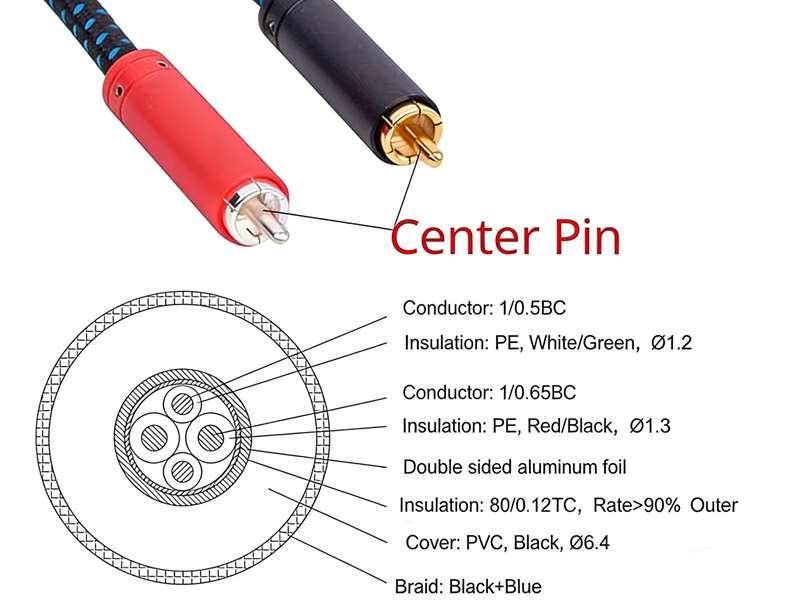
- Center Conductor: Typically copper or tinned copper that carries the analog signal.
- Dielectric Insulation: Separates the signal conductor from the shield.
- Braided Shield / Foil Shield: Provides EMI protection and completes the ground circuit.
- Outer Jacket: PVC, PE, or custom materials such as TPU or LSZH depending on the application.
- RCA Connector: Metal plug with a signal pin in the middle and ground ring on the outside.

Higher-end RCA cables may include:
- Dual-braid shielding
- Gold-plated connectors
- Oxygen-free copper (OFC)
- Larger OD for improved noise rejection
How Does RCA Signal Transmission Work?
RCA cables transmit low-voltage analog signals, so the cable’s shield and impedance consistency are crucial. Since analog waveforms degrade gradually, a poor-quality RCA cable will introduce:
- Hum
- Static noise
- Ground loop interference
- Video distortion
- Color bleeding
- Loss of dynamic range in audio
Most RCA cables operate at an impedance of 75 ohms, especially composite and component video variants. Using an audio RCA cable (not 75Ω) for video often leads to poor imaging or signal degradation.
What Are the Common RCA Color Codes and Their Meanings?
RCA color codes help avoid confusion in multi-channel setups:
| Color | Usage | Signal Type |
|---|---|---|
| Red | Right audio | Analog audio |
| White / Black | Left audio | Analog audio |
| Yellow | Composite video | Analog video |
| Green | Component Y | Luminance |
| Blue | Component Pb/Cb | Color difference |
| Red | Component Pr/Cr | Color difference |
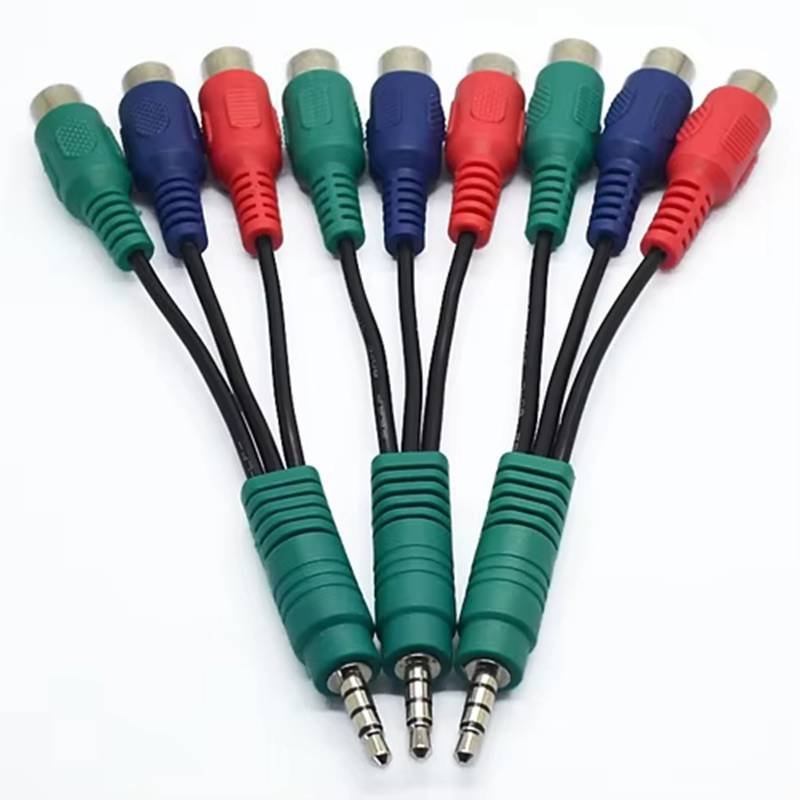
OEM engineering clients frequently request custom color coding, customized strain reliefs, and custom labeling for assembly-line compatibility—services Sino-conn already provides with CAD drawings and rapid prototyping.
Which Types of RCA Cables Are Available Today?
Modern RCA cables include stereo audio RCA, composite video RCA, component video RCA, digital coaxial RCA (SPDIF), subwoofer RCA, mini-RCA variants, and high-performance shielded RCA cables. Each type carries different analog or digital signals and uses specific impedance, shielding, and connector structures. Choosing the correct RCA cable ensures stable sound quality, clear video, and proper compatibility with home theater, automotive, and OEM electronic devices.
Although RCA connectors look similar on the outside, the internal construction, impedance, shielding, and intended signal format vary significantly across different RCA cable types. Selecting the wrong type can cause sound distortion, video noise, or complete signal incompatibility. Below is the complete, engineering-level breakdown of all RCA cable types used in modern devices, including technical specs and OEM considerations.
What Is the Difference Between Audio RCA and Video RCA?
Audio RCA cables are designed for low-frequency analog signals, while video RCA cables must support higher bandwidth and maintain a precise 75-ohm impedance.
Audio RCA Cable
- Used for L/R stereo audio
- Frequency range: 20 Hz – 20 kHz
- Impedance: not standardized (usually 50–75Ω but not critical)
- Shielding: single braid or foil/braid
- Color codes: Red (Right) + White/Black (Left)
- Often made with more flexible PVC jackets
Video RCA Cable
- Used for standard-definition analog video
- Bandwidth: up to 6 MHz
- Impedance: strict 75Ω required
- Color code: Yellow
- Heavier shielding required to prevent interference
- Must maintain geometric consistency to avoid color bleeding
Why this matters:
Using an audio RCA cable for video can immediately cause:
- Fuzzy images
- Dot crawl
- Luma/chroma bleeding
- Rolling flicker
- Loss of color
OEM engineers often specify true 75Ω coaxial structure for video RCA to ensure clean transmission.
What Are Composite, Component, and Digital RCA Cables?
These three categories carry completely different signal structures.
1. Composite RCA Cable (Yellow)
Composite RCA is the simplest video standard, carrying all picture data through a single conductor.
- Colors: Yellow
- Signal type: analog luminance + chrominance combined
- Impedance: 75Ω
- Frequency: up to ~6 MHz
- Use cases: older TVs, VCRs, DVD players, CCTV monitors
Pros:
- Extremely compatible
- Low cost
Cons:
- Lowest video quality
- Susceptible to interference
2. Component RCA Cables (Green / Blue / Red)
Component RCA separates video into three independent signals to improve image quality:
| Plug | Signal | Description |
|---|---|---|
| Green (Y) | Luminance | Brightness + sync |
| Blue (Pb/Cb) | Chrominance | Blue color difference |
| Red (Pr/Cr) | Chrominance | Red color difference |
- Quality: supports 480p, 720p, 1080i
- Impedance: 75Ω each
- Bandwidth: higher than composite
- Use cases: older HDTVs, projectors, DVD players, retro consoles
Component RCA was the main HD analog format before HDMI.
3. Digital Coaxial RCA Cable (SPDIF)
Digital coax RCA carries encoded digital audio signals.
- Colors: typically Orange
- Impedance: strict 75Ω
- Bandwidth: high (up to 10 MHz+)
- Use cases: home theater receivers, Blu-ray players, sound systems
- Supports: PCM audio, Dolby Digital, DTS

Unlike analog RCA, SPDIF is digital, meaning:
- Less noise
- Longer transmission distances
- Requires precise impedance and shielding
For OEM projects, Sino-conn often manufactures true 75Ω digital coaxial RCA for AVR manufacturers.
Are There Subwoofer RCA Cables?
Yes. Subwoofer RCA cables are optimized for LFE (Low-Frequency Effects) channels.
Characteristics:
- Single mono RCA plug
- Heavy shielding (low-frequency noise is easily introduced)
- Longer lengths (3 m – 15 m)
- Flexible to route around home theater setups
- Often marked “SUB OUT” or color-coded purple
Because low-frequency signals are sensitive to ground noise, Sino-conn often designs:
- Double-shielded subwoofer RCA
- Soft PVC or TPU for long runs
- Gold-plated plugs to prevent corrosion
What Are High-Quality or Audiophile RCA Cables?
Audiophile-grade RCA cables are still widely used in:
- Hi-Fi systems
- Studio monitors
- Vinyl turntables
- DAC-to-amplifier connections
- Professional recording equipment
These cables may include:
- Oxygen-Free Copper (OFC)
- Silver-plated conductors
- Dual or triple shielding
- Thick OD (6–10 mm)
- Fabric-braided jackets
- Gold-plated precision connectors
OEM customers often request:
- Branding on connectors
- Custom jacket colors
- Molded strain relief
- Directional ground wiring
Sino-conn supports high-end analog cable manufacturing with tight impedance control and premium shielding.
What Is Mini-RCA and Where Is It Used?
Mini-RCA (also called 2.5 mm RCA or micro RCA) is used in compact devices.
Applications:
- Automotive camera systems
- Portable DVD players
- Compact audio equipment
- Specialized industrial devices
- Embedded electronics where space is limited
Sino-conn frequently produces:
- Mini RCA ↔ Normal RCA
- Mini RCA ↔ Bare wire harnesses
- Custom molded mini-RCA with watermark printing
What Are RCA Cables Used For in Modern Devices?
RCA cables are used in modern devices to transmit analog audio, composite video, component video, and digital coaxial signals. They remain common in TVs, DVD/Blu-ray players, gaming consoles, amplifiers, subwoofers, car stereos, DJ equipment, projectors, and legacy AV systems. RCA cables provide simple, low-latency, universally compatible signal transmission, making them valuable for home theater, automotive infotainment, professional audio, and OEM embedded electronics.

Although digital connections like HDMI and optical audio have become mainstream, RCA cables still play an essential role across multiple industries because of their analog signal integrity, universality, cost efficiency, and integration simplicity. Many modern devices, especially professional equipment, automotive systems, and OEM-specific electronics, still rely heavily on RCA connectivity.
RCA thrives where low latency, broad compatibility, and simple analog circuitry matter more than digital bandwidth. It also remains vital for devices designed to support older equipment or legacy workflows—use cases where digital interfaces may be unnecessary, incompatible, or too costly.
Below is a complete breakdown of how RCA cables are used in contemporary products and why industries continue to depend on them.
Do RCA Cables Still Work With Today’s TVs and Sound Systems?
Yes—thousands of models still support RCA as secondary or fallback analog inputs/outputs.
Modern usage scenarios include:
- TVs (mid-range and budget models): Often retain composite input (yellow port) and stereo audio inputs for backward compatibility with old game consoles and DVD players.
- Soundbars & Home Theater Receivers: Many still include RCA AUX input, L/R stereo input, or subwoofer pre-out for analog integration.
- Amplifiers & Powered Speakers: Most analog input stages still rely on RCA for high SNR audio signals.
- Turntables / Phono Preamps: Vinyl audio systems universally use RCA due to analog nature of phono output.
Digital doesn’t eliminate analog—rather, RCA provides a stable and universally accepted analog option.
Which Devices Commonly Use RCA Inputs/Outputs?
RCA is used in 15+ categories of modern devices:
Home Entertainment Devices
- DVD/Blu-ray players
- Projectors
- Media boxes & IPTV set-top boxes
- Retro gaming consoles
- Older camcorders
- Classic Hi-Fi receivers
Professional Audio Equipment
- DJ controllers
- Mixers / audio interfaces
- Studio monitors
- Instrument processors
- PA systems
- Karaoke machines
Automotive Electronics
- Aftermarket head units
- Backup camera systems
- In-car amplifiers
- Subwoofer inputs
- Rear-seat entertainment screens
Industrial & Commercial Systems
- CCTV video systems (composite signals)
- Test and measurement equipment
- Broadcast patch bays
- Medical training simulators
- Industrial machine interfaces
Consumer Electronics
- Portable DVD players
- Retro game emulation devices
- Media converters (RCA → HDMI)
RCA’s universal analog nature ensures that devices across various industries can communicate without requiring expensive or complex digital circuitry.
How Do RCA Cables Compare to HDMI, AUX, or Optical Connections?
Many OEM buyers and engineers often ask:
“Why would anyone still use RCA when HDMI exists?”
The answer is: different signal philosophy.
1. RCA vs HDMI
| Feature | RCA | HDMI |
|---|---|---|
| Signal Type | Analog | Digital |
| Latency | Very low | Moderate |
| Cost | Very low | Higher |
| Circuit complexity | Simple | Complex |
| Compatibility | Universal | Requires format matching |
RCA wins in legacy support, audio warmth, analog mixing, and ultra-low latency.
HDMI wins in HD video and multichannel audio.
2. RCA vs AUX (3.5 mm)
- RCA has separated L/R channels, reducing crosstalk.
- RCA connectors are more robust than 3.5 mm jacks.
- RCA is preferred in home audio and studio equipment for durability.
3. RCA vs Optical (Toslink)
Optical avoids electrical noise but:
- Has higher latency
- Is fragile and requires precise alignment
- Cannot transmit analog signals
Thus many analog-heavy systems still prefer RCA.
4. RCA vs Bluetooth
Bluetooth introduces:
- Compression
- Latency
- Pairing issues
RCA remains superior for real-time performance in studios, DJ setups, musical instruments, and automotive systems.
Why RCA Is Still Essential in OEM and Sino-conn Customer Projects
Sino-conn’s OEM clients keep selecting RCA because:
1. RCA integrates easily into electronics
No encoding, no complex ICs—just analog circuitry.
2. RCA is cost-efficient
Mass-market consumer devices benefit from low BOM cost.
3. RCA supports legacy + modern hybrid workflows
Many new devices must stay compatible with older AV equipment.
4. RCA is extremely customizable
Sino-conn offers:
- Custom lengths
- Custom jacket materials
- Custom shielding (single, double, quad)
- Custom OD (3–7 mm)
- Precision molding
- Custom color coding
- Mini RCA or right-angle RCA
- Automotive-grade RCA assemblies
- Custom pin-outs (rare but required for some OEM devices)
5. RCA remains vital in automotive audio/video
Especially for camera harnesses, amplifier connections, and LFE (subwoofer) lines.
This explains why RCA remains a stable product in cable assembly manufacturing.
How Do You Choose the Right RCA Cable for Your Application?
Choose the right RCA cable by identifying whether you need stereo audio, composite video, component video, or digital coaxial signals. Consider cable length, shielding, connector material, impedance, outer diameter, and environmental conditions. For OEM applications, custom RCA cables may be required to match device specifications, connector orientation, pin definitions, or material compliance standards.
Selecting an RCA cable may seem simple, but choosing the wrong type can cause severe signal degradation, noise, or full incompatibility. Engineers and buyers must evaluate not only the signal format but also shielding, impedance, jacket material, and connector quality. For OEM projects, matching the cable design to the device’s internal layout becomes even more important.
Sino-conn frequently supports engineers who require custom RCA assemblies with precise tolerances, unique connector combinations, or specific materials to accommodate UL/ROHS/PFAS compliance. Understanding how to choose the correct cable ensures stable long-term performance.
What Cable Length, Shielding, and OD Should You Consider?
Longer RCA cables require stronger shielding to reduce noise. For audio, lengths under 3 meters are common; for video, longer cables need 75Ω impedance accuracy. Shielding options include single braid, double braid, or foil + braid combinations. Outer diameter also affects handling, flexibility, and interference rejection. For example, a 6 mm OD cable typically offers better EMI performance than a 3 mm OD thin cable.
Is Connector Material (Gold/Nickel) Important for Signal Quality?
Gold-plated RCA connectors resist oxidation and maintain a stable contact surface over time, which is ideal for low-voltage audio signals. Nickel-plated connectors are more durable and cost-effective, commonly used in consumer electronics. For high-performance audio systems, many users prefer gold plating because it retains conductivity even in humid or corrosive environments.
How Do You Match RCA Cable Specifications to Your Device?
Video cables must be 75Ω to maintain picture clarity. Audio cables may use more flexible or lightweight materials. Digital coaxial (SPDIF) requires precise impedance to prevent jitter. OEM devices may also require:
- Custom length
- Custom boot or molding
- Specific bending radius
- Flame-retardant jacket
- Halogen-free materials
- Custom ring color coding
- Reverse or mini RCA connectors
Sino-conn supports all these custom requirements through engineering consultation and rapid CAD-to-PDF drawing services.
How Do You Troubleshoot RCA Cable Problems?
To troubleshoot RCA cables, check for loose connectors, bent pins, oxidation, broken shielding, or damaged jackets. Test continuity with a multimeter and inspect for noise, static, or weak video signals. Common issues include poor grounding, cable breaks, improper impedance, or interference. Replacing or re-terminating the cable usually solves the problem.
RCA cable failures often show up as hum, static, buzzing audio, or distorted video. Because RCA carries analog signals, even minor damage can visibly degrade performance. Most issues result from physical wear, poor shielding, or improper cable type for the application.
Why Is There Noise or Static in RCA Audio?
Noise typically comes from ground loops, loose connectors, insufficient shielding, or broken internal conductors. Audio systems with high gain—such as amplifiers and mixers—magnify even small RCA cable defects. Checking cable continuity, ensuring tight connector seating, and using better-shielded cables usually resolves these issues.
Why Do RCA Video Signals Lose Color or Become Distorted?
Composite video relies heavily on maintaining 75Ω impedance. Using the wrong type of cable, or using thin unshielded audio RCA cables for video, causes color bleeding, flickering, or rolling images. Damaged shielding or long cable lengths also degrade video quality.
How Can You Test RCA Cables for Continuity and Shielding?
Testing involves:
- Multimeter continuity test
- Shield-to-ring test for grounding
- Visually checking pin contact
- Flexing the cable while monitoring output
- Using a signal generator and monitor for video
- Checking for oxidation or looseness
OEM engineers often ask Sino-conn to re-manufacture custom RCA cables after discovering that off-the-shelf cables fail quality tests.
When Should You Use Custom RCA Cable Assemblies?
Use custom RCA cable assemblies when standard cables cannot meet your requirements for length, connector type, shielding level, impedance stability, color coding, material compliance, or pin-out definitions. Custom-made RCA assemblies are essential for OEM products, automotive infotainment systems, professional audio gear, gaming devices, and industrial equipment where precise performance, durability, and engineering compatibility are required.

Although off-the-shelf RCA cables are widely available, many engineering teams, trade buyers, and OEM manufacturers eventually find that commercial retail cables simply cannot meet the exact requirements of their products. Custom RCA assemblies solve these limitations by allowing complete control over length, connector type, cable OD, shielding, materials, color coding, and pin definitions.
Sino-conn works with global engineering departments, automotive factories, consumer electronics brands, and IoT device manufacturers who rely on RCA interfaces within their devices. In these contexts, precise engineering—not generic retail cables—determines performance and product reliability.
Do You Need Custom Lengths, OD, or Connector Types?
Many OEM products pack electronics into tight spaces, meaning a 1-meter retail cable won’t fit. Engineers often need exact lengths such as 120 mm ± 3 mm or 600 mm ± 1%, especially for automotive infotainment or internal device wiring. Custom outer diameters (3 mm, 4 mm, 6 mm) or flexible soft-PVC/TPU jackets are often required to achieve specific routing shapes or bending radii.
Custom connectors—mini RCA, metal RCA, right-angle RCA, panel-mount RCA—are frequently requested to meet unique enclosure designs.
What Custom Pin-Out or Definition Requirements Are Common?
Although RCA connectors typically transmit a single signal per plug, many OEM products require modified definitions, reversed pin assignments, or integrated RCA bundles with grouped jackets. This includes:
- Audio-left + audio-right + ground bundles
- Automotive reverse camera RCA harnesses
- RCA + power hybrid assemblies
- RCA cables integrated into multi-pin automotive connectors
- Custom markings or printed encoding for production line assembly
Sino-conn provides CAD drawings (PDF format) within 30 minutes to 3 days, ensuring engineers can verify definitions before production.
How Can Sino-conn Provide OEM/ODM RCA Cables With Fast Lead Time?
Sino-conn specializes in rapid prototyping and flexible custom cable assembly manufacturing, offering:
- NO MOQ (1 piece starting)
- Sample lead time: 2–3 days
- Mass production: 2 weeks
- Original or alternative RCA connectors (customer chooses based on cost/performance)
- UL, ISO, RoHS, REACH, PFAS, COC/COO certified materials
- 100% full inspection (process + final + pre-shipment QC)
- Strong price advantages for commercial, automotive, and consumer electronics projects
Because European and American manufacturers rarely produce their own coaxial cables, many turn to Sino-conn to deliver stable, cost-effective RCA solutions with short lead times and strict quality control.
Conclusion
RCA cables have played a foundational role in audio-video technology for more than eight decades. Even in today’s digital world, they remain relevant in audio systems, automotive units, gaming devices, studio equipment, and countless OEM products. Understanding what RCA cables are, how they work, the types available, and how to select the right version empowers engineers, product designers, and procurement teams to build stable and high-performance systems.
But when businesses need precision, custom lengths, better shielding, material compliance, or unique connector combinations, off-the-shelf RCA cables simply aren’t enough.
This is where Sino-conn becomes your ideal technical partner.
Sino-conn’s engineering and manufacturing team is ready to support you with fast response times, expert technical guidance, and high-quality cable assembly solutions.
Contact Sino-conn now for a free consultation, technical drawing, or OEM quote.
Let us help you build reliable RCA cable assemblies tailored to your exact product requirements.