Skip to content
Are RF Cable Assemblies Reliable for High Frequency Applications
- andy

When it comes to high-frequency technologies—think 5G base stations, radar systems, or advanced satellite communications—the unseen heroes are often the cables making those signals possible. Engineers know that not every cable is created equal, especially when dealing with frequencies that stretch into the gigahertz range. Here’s the truth: a poor-quality assembly can make or break the performance of your entire system.
RF cable assemblies are suitable for high frequency applications when designed with low-loss conductors, stable dielectric materials, precision shielding, and matched impedance (50Ω or 75Ω). These assemblies minimize insertion loss, reduce reflections, and protect against EMI, making them essential in radar, satellite, telecom, and medical systems. With flexible or semi-rigid options, they provide both durability and performance for demanding environments.
Now imagine you’re setting up a radar test station. Everything is running smoothly until you notice signal distortions at 18 GHz. After days of troubleshooting, you discover the culprit: a substandard coaxial assembly. Frustrating, right? This is exactly why choosing the right RF cable assembly isn’t just a technical choice—it’s a strategic decision. In the next sections, we’ll break down what RF assemblies really are, what materials and designs matter, and how Sino-conn helps clients worldwide solve these challenges with speed and precision.
What Are RF Cable Assemblies and How Do They Work?
An RF cable assembly is a pre-engineered cable with connectors designed to transmit radio frequency signals with minimal loss. It works by carrying high-frequency electrical energy through a conductive core, insulated by a dielectric, shielded to block EMI, and finished with connectors like SMA, N-type, or BNC.
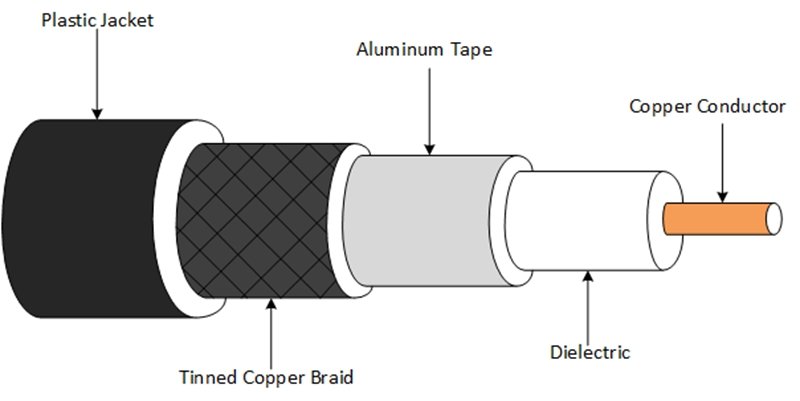
At its core, an RF cable assembly isn’t just “a wire with connectors.” It’s a carefully balanced system where every element plays a role:
- Conductor: Usually silver-plated copper, chosen for conductivity.
- Dielectric: PTFE or FEP for low dielectric loss.
- Shielding: Braided copper or foil layers to stop EMI.
- Jacket: PVC, PUR, or LSZH to resist heat, oil, or UV.
Why does this matter? Because at higher frequencies, even small imperfections amplify losses. For instance, a poorly matched connector can add 0.5 dB of reflection loss at 10 GHz—enough to degrade radar resolution.
Sino-conn engineers emphasize impedance matching (50Ω or 75Ω), phase stability, and mechanical durability. Clients often request quick-turn samples (as fast as 3 days) for prototypes, while large-volume orders scale within 2–4 weeks. This agility helps engineers avoid downtime while maintaining reliable performance.
Adding to this, Sino-conn provides CAD-to-PDF drawings within hours so customers can validate every design detail before production. This ensures what you test in the lab matches what you deploy in the field.
Which Materials Ensure Best Performance in High Frequency Transmission?
The best RF cable assemblies use silver-plated copper conductors, PTFE or FEP dielectrics, double-layer shielding, and durable jackets like PUR or LSZH. These materials ensure low loss, high flexibility, and resistance to heat, chemicals, and EMI.
Material choices aren’t just technical—they’re strategic. Here’s why:
- Conductor: Silver-plated copper lowers resistance, reducing insertion loss.
- Dielectric: PTFE is stable across wide temperature ranges, critical in aerospace.
- Shielding: Multi-layer copper braid + foil reduces EMI in crowded telecom sites.

- Jacket: LSZH materials meet European safety codes, while PUR excels in industrial robotics.
Common Materials and Benefits
| Component | Material Options | Benefit in High Frequency Use |
|---|---|---|
| Conductor | Silver-plated copper | Low resistance, high conductivity |
| Dielectric | PTFE, FEP | Low loss, high temp stability |
| Shielding | Copper braid + foil | EMI suppression, low leakage |
| Jacket | PUR, LSZH | Durability, safety compliance |
Sino-conn clients in Europe particularly demand RoHS and REACH compliance. OEMs, on the other hand, prefer cost-effective substitutes with quick delivery, while research engineers focus on dielectric stability. This is why Sino-conn offers both premium branded and cost-effective equivalents, balancing performance and budget without compromising signal integrity.
How Do RF Cable Assemblies Solve High Frequency Challenges?
RF cable assemblies solve high frequency challenges by reducing signal loss, ensuring impedance stability, and shielding against EMI. Using precision materials and custom designs, they guarantee reliability in applications such as radar, 5G, satellites, and medical imaging.
When engineers push into higher frequencies—10 GHz, 18 GHz, even 40 GHz—the system’s weakest link is often the cable assembly. Three critical issues dominate:
- Insertion Loss (Signal Attenuation)
- Standard coaxial cables can lose up to 1 dB per meter at 10 GHz, equivalent to a 20% signal reduction.
- Sino-conn low-loss assemblies reduce this by up to 40%, using silver-plated copper and optimized PTFE dielectrics.
- Impedance Mismatch & Reflections
- Even a small deviation from 50Ω can create VSWR (Voltage Standing Wave Ratio) above 1.5:1, leading to distortion.
- Precision connectors (SMA, N, TNC) are CNC-machined to tight tolerances, achieving VSWR <1.2:1 across wide frequency bands.
- Electromagnetic Interference (EMI)
- In crowded telecom or aerospace environments, external EMI can cripple system accuracy.
- Sino-conn combats this with double-shielded copper braid + foil, achieving shielding effectiveness above 90 dB.
Case Study: Medical Imaging Application
A European MRI equipment manufacturer needed halogen-free, flame-retardant RF assemblies operating at 128 MHz and harmonics. Their challenges:
- High safety compliance (LSZH, RoHS, REACH).
- Zero tolerance for signal noise (affects imaging quality).
- Fast delivery for prototype trials.
Sino-conn provided a custom PTFE dielectric, halogen-free jacket, and precision SMA connectors. Turnaround: drawings in 30 minutes, samples in 3 days, certification package in 48 hours. Result: a successful prototype, followed by bulk orders with OEM pricing.
High Frequency Challenges & Sino-conn Solutions
| Challenge | Impact on System | Sino-conn Solution |
|---|---|---|
| Signal Loss | Lower power, reduced sensitivity | Low-loss conductor + PTFE dielectric |
| Reflections (VSWR) | Distorted signals, component damage | Precision 50Ω impedance matching |
| EMI | Noise, data errors | Double shielding, >90 dB attenuation |
| Harsh Environments | Heat, oil, UV degradation | PUR / LSZH jackets, flame retardant |
Why This Matters
Every 0.1 dB of loss matters in aerospace radar. Every millisecond of downtime matters in telecom. Every trace of EMI matters in medical imaging. That’s why Sino-conn doesn’t treat RF assemblies as commodities—they’re engineered solutions tailored to each client’s critical environment.
With a no MOQ policy, clients can validate designs quickly, scale with confidence, and always receive assemblies backed by ISO, UL, RoHS, and REACH certifications.
Are Different Types of RF Cable Assemblies Suitable for Every Application?
Different RF cable types suit different needs: semi-rigid for aerospace, semi-flexible for lab testing, flexible for telecom, low-loss for long runs, and jumpers for short, modular connections.

Choosing “the best” RF assembly depends on your environment:
- Semi-rigid: Aluminum jacket, stable but hard to bend. Best for aerospace.
- Semi-flexible: Retains performance while easier to install.
- Flexible: Withstands repeated bending, ideal for telecom.
- Low-loss: Essential for base stations needing long runs.
- Jumpers: Fast, modular connections in test environments.
Clients often ask: Do all RF cables work for high frequency? The answer is no—each type has a sweet spot. Sino-conn’s engineers help match type to use case, often via quick-turn CAD diagrams for validation.
Do Cost, Manufacturer, and Customization Impact High Frequency Performance?
Yes. Costs vary by material and connector choice. Branded assemblies offer guaranteed specs but longer lead times and higher prices. Custom Sino-conn solutions balance cost, speed, and compliance without sacrificing performance.
Price is always on the table, but context matters:
- End-users (like telecom operators) prefer branded connectors, even at premium costs.
- OEM factories care about price-volume balance, needing large orders at stable quality.
- Distributors seek flexibility—fast quotes and availability.
Sino-conn supports all three with a no MOQ policy, starting from a single prototype to bulk shipments. With 30-minute quotes and 3-day sample turnaround, clients don’t just save money—they save time.
Comparison: Branded vs. Sino-conn Equivalent
| Aspect | Branded OEM | Sino-conn Custom |
|---|---|---|
| Price | High | Flexible options |
| Lead Time | 4–6 weeks | 2–3 weeks |
| Customization | Limited | High (length, pin-out, shielding) |
| Stock | Often limited | Large inventory |
Conclusion:
High frequency applications—from 5G to medical imaging—depend on precision-engineered RF cable assemblies. Materials, design, and manufacturer expertise all shape performance. Sino-conn doesn’t just deliver cables—it delivers speed, customization, and confidence. Whether you need 1 piece prototype or thousands of OEM assemblies, Sino-conn ensures 100% inspection, fast lead times, and compliance with global certifications.
Ready to customize your RF cable assembly? Contact Sino-conn today to discuss your requirements and request a tailored quote.
Related Keywords :RF cable assemblies, radio frequency cable, coaxial cable, high frequency applications, low loss cable, SMA connector, RF jumper, custom RF assemblies, EMI shielding, Sino-conn

With over 18 years of OEM/ODM cable assemblies industry experience, I would be happy to share with you the valuable knowledge related to leather products from the perspective of a leading supplier in China.
manufacturer catalogue
Custom Micro Coaxial Cable →
Custom RF Coaxial Cable Assembly →
Custom FFC(Flat Flexible Cable) →
Custom Patch Cable →
Custom Circular Connector Cables →
Custom D-Sub Analog Cable →
Custom Power Cord →
Custom Fiber Optical Transceiver →
Custom Receptacle Connectors →
Get A Sample Now From Factory→
Latest blogs


Here, developing your OEM/ODM custom cable assemblies collection is no longer a challenge—it’s an excellent opportunity to bring your creative vision to life.