Skip to content
RCA to Digital Audio Signal Conversion Principles
- andy

In the world of audio engineering, one small detail often determines whether your sound system works flawlessly or leaves you frustrated: the type of cable and signal conversion you choose. RCA to digital audio conversion has become a hot topic because most modern receivers, TVs, and soundbars are built around digital interfaces (optical or coaxial), while many legacy players and amplifiers still rely on RCA connections. This mismatch creates both confusion and opportunity.
RCA to digital audio conversion refers to the process of transforming analog RCA signals or coaxial RCA signals into digital audio formats such as optical (TOSLINK) or SPDIF. This conversion allows legacy devices like DVD players, VCRs, and stereo systems to connect seamlessly with modern home theaters, TVs, or soundbars. It typically requires either a dedicated cable assembly or an active converter such as an ADC or DAC, depending on the signal type.
But here’s where most people get stuck: many assume that a single cable can magically convert analog RCA into digital audio. The reality is more nuanced, and understanding the principles can save you time, money, and frustration. Imagine pulling out your old DVD player, excited to relive vintage classics, only to find your sleek new soundbar doesn’t even have RCA inputs. At this moment, knowing how RCA to digital audio works is the difference between silence and a cinematic experience. Let’s dive deeper.
Fundamentals of RCA and Digital Audio
RCA carries both analog and digital signals depending on the connector type. Traditional red-and-white RCA plugs transmit analog stereo audio, while single orange RCA jacks often carry digital SPDIF. Digital audio, on the other hand, includes optical (TOSLINK) and coaxial SPDIF formats, both designed for clean, interference-free transmission.
RCA cables were invented in the 1940s and became the default for analog audio for decades. The familiar red and white connectors represent right and left stereo channels. However, with the rise of digital systems in the late 1990s and 2000s, audio shifted toward SPDIF (Sony/Philips Digital Interface), transmitted via either a coaxial RCA plug (usually orange) or optical fiber (TOSLINK).
The distinction matters because not every RCA cable is digital. Many users are surprised to learn that the orange RCA on their DVD player is digital, while the red/white pair is purely analog.

A quick comparison table clarifies:
| Connector | Signal Type | Use Case |
|---|---|---|
| RCA (Red/White) | Analog | Stereo audio from VCR, DVD, amplifiers |
| RCA (Orange) | Digital Coaxial SPDIF | Digital audio from DVD, Blu-ray, sound cards |
| Optical (TOSLINK) | Digital Optical | TVs, soundbars, modern receivers |
Understanding this difference is the first step to knowing what kind of conversion is necessary.
Signal Conversion Principles Explained
RCA to digital audio conversion is not a simple cable swap—it requires understanding signal types. Analog RCA needs an ADC (Analog-to-Digital Converter), digital RCA (coaxial SPDIF) may only need a format converter to optical, and digital-to-analog requires a DAC. Simple passive cables cannot convert between analog and digital because the signals are fundamentally different.
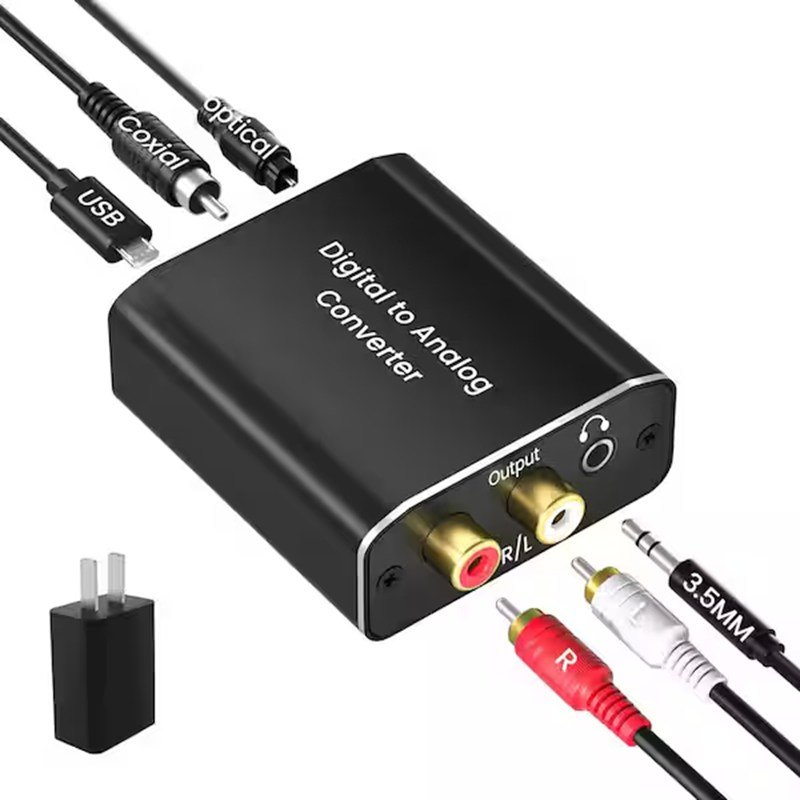
When discussing RCA to digital audio, the biggest source of confusion lies in the difference between analog and digital RCA outputs. To clarify:
- Analog RCA to Digital (ADC Required)
- Red/white RCA connectors output analog waveforms.
- To convert these into a digital signal (optical or coaxial), an ADC is needed.
- Example: A VCR or cassette deck with only RCA outputs → a modern AV receiver with optical input.
- Without an ADC, the digital system cannot interpret the analog wave.
- Digital Coaxial RCA to Optical (Format Conversion)
- The orange RCA jack on DVD/Blu-ray players is digital SPDIF.
- Conversion to optical is possible using a digital format converter (no ADC/DAC needed).
- Both signals are digital, only the medium (copper vs. optical fiber) changes.
- Digital to Analog RCA (DAC Required)
- Common in TVs and soundbars where the only output is optical.
- Requires a DAC to produce RCA analog for legacy amplifiers or powered speakers.
- Example: TV optical out → vintage stereo amplifier with RCA input.
- Common Misconceptions
- Many users believe an RCA-to-optical cable alone can do the job.
- Reality: cables cannot convert signal types. Only electronic converters can translate between analog and digital.
Practical Scenarios Table
| Source Device | Output | Target Device | Conversion Needed |
|---|---|---|---|
| VCR / Cassette Player | RCA Red/White (Analog) | AV Receiver (Optical) | ADC Converter |
| DVD Player | RCA Orange (Coaxial Digital) | Soundbar (Optical) | Format Converter |
| TV | Optical Digital | Amplifier (RCA Analog) | DAC Converter |
| Blu-ray Player | RCA Orange (Digital) | AV Receiver (Coaxial) | Direct Cable (No Converter) |
Key Takeaway for Customers
- Analog RCA → Digital: Needs ADC.
- Digital RCA ↔ Optical: Needs format converter.
- Digital → Analog RCA: Needs DAC.
- No converter = no sound.
At Sino-conn, our engineers help customers choose the right cable assembly for each scenario. We don’t just sell cables—we ensure your system works the first time, whether you’re building a home theater, professional studio, or automotive infotainment system.
Variations and Product Types
RCA to digital audio comes in several forms: coaxial RCA cables, optical digital audio cables (used with converters), digital audio out to RCA cables, and full custom harness assemblies. The correct product depends on whether you’re converting analog to digital, digital to analog, or simply matching digital formats.
- RCA to Digital Coaxial Cable: Single RCA (orange) used for SPDIF.
- RCA to Optical Digital Audio Cable: Typically paired with converters for analog-to-digital transmission.
- Digital Audio Out Cable to RCA: Converts modern TV optical out into RCA input for older speakers.
- Custom Assemblies: Designed for OEMs in automotive infotainment, pro audio, or home theaters.
Is digital optical better than RCA?
Optical offers complete immunity to electromagnetic interference, making it ideal for long runs or noisy environments. However, digital coaxial RCA often delivers more consistent bandwidth and robustness in professional setups. The choice depends on application needs.
Materials and Cable Construction Impact
A cable’s construction directly determines signal integrity, noise immunity, return loss, and long‑term reliability. For RCA to digital audio (coaxial SPDIF or optical interconnects used with converters), the right material stack reduces jitter and attenuation while keeping impedance stable—especially over longer runs or in EMI‑heavy environments.
Construction Essentials
- Conductor — Use Oxygen‑Free Copper (OFC) for low resistance and stable high‑frequency performance; silver‑plated copper (SPC) can further reduce skin‑effect losses on longer or higher‑bandwidth runs. Match AWG to length and bend requirements.
- Dielectric — A low‑loss PE/foamed‑PE dielectric helps maintain the target 75 Ω characteristic impedance for coaxial digital audio and minimizes return loss.
- Shielding — At minimum, a 100% aluminum foil shield blocks high‑frequency interference; adding a tinned‑copper braid (≥85–90% coverage) improves low‑frequency EMI and mechanical robustness.
- Connectors — Gold‑plated 75 Ω RCA pins and precision optical ferrules limit contact resistance and oxidation; proper strain relief preserves impedance at the termination.
- Jacket — PVC offers cost‑effective flexibility; TPU/PE improves abrasion, oil/UV resistance, and high‑temperature performance. Choose materials that meet project safety and environmental requirements.
Typical RCA to Digital Audio Cable Specifications
| Parameter | Specification Range | Industrial / OEM Option |
|---|---|---|
| Outer Diameter (OD) | 3.0 mm – 8.0 mm | Custom OD up to 12 mm |
| Bend Radius | ≥ 5 × OD | Flexible grade: ≥ 3 × OD |
| Operating Voltage | 30 V – 300 V | Customized per application |
| Temperature Resistance | −20 °C to +80 °C | High‑temp: up to +105 °C |
| Flame Rating | VW‑1 / FT1 | UL94 V‑0 available |
| Halogen‑Free Option | Optional | Yes, eco‑compliant versions |
| EMI Shielding Level | 60 dB @ 1–10 MHz | > 90 dB (double‑shielded) |
For OEM and industrial deployments, Sino‑conn qualifies builds to UL, ISO, RoHS, REACH (and project‑specific COC/COO/PFAS statements when required). We document impedance targets, shielding effectiveness, and environmental ratings in the datasheet, and provide CAD‑to‑PDF drawings for approval before production.
Manufacturing, Standards, and Customization
Sino-conn offers custom RCA to digital audio cable assemblies with full compliance to UL, ISO, RoHS, and REACH standards. Clients can customize length, shielding, connectors, and pin-outs. Prototyping is available within days, with bulk delivery in 2–4 weeks.

At Sino-conn, customization is not an option—it’s a standard.
- Compliance: UL, ISO, RoHS, REACH, PFAS.
- Customization: Cable length, connector type (original or compatible), shielding level, temperature resistance, flame retardancy, halogen-free options.
- Lead Time: 2–3 days for urgent samples, 2–4 weeks for bulk orders.
- MOQ: No minimum order—1 piece up to mass production.
- Customer Service: Engineers provide CAD-to-PDF drawings within 30 minutes to 3 days for approval before manufacturing.
Conclusion
RCA to digital audio conversion may sound technical, but it’s the bridge between legacy and modern audio worlds. From understanding the basics of RCA versus digital formats, to choosing the right conversion principles, materials, and products, one fact stands out: quality cables and assemblies make all the difference.
At Sino-conn, we combine expertise, speed, and flexibility to deliver RCA to digital audio solutions that are not only reliable but fully tailored to your needs. Whether you are a distributor, OEM, or engineer, our team is ready to help you design and manufacture the perfect solution.
Contact Sino-conn today for a custom RCA to digital audio cable assembly and get your project moving.
Related Keywords :RCA to digital audio, RCA to optical, RCA to SPDIF, digital audio cable, audio signal conversion, ADC DAC converter, optical vs RCA, coaxial audio, cable assemblies, Sino-conn

With over 18 years of OEM/ODM cable assemblies industry experience, I would be happy to share with you the valuable knowledge related to leather products from the perspective of a leading supplier in China.
manufacturer catalogue
Custom Micro Coaxial Cable →
Custom RF Coaxial Cable Assembly →
Custom FFC(Flat Flexible Cable) →
Custom Patch Cable →
Custom Circular Connector Cables →
Custom D-Sub Analog Cable →
Custom Power Cord →
Custom Fiber Optical Transceiver →
Custom Receptacle Connectors →
Get A Sample Now From Factory→
Latest blogs


Here, developing your OEM/ODM custom cable assemblies collection is no longer a challenge—it’s an excellent opportunity to bring your creative vision to life.