Skip to content
Single-Mode Fiber Optic Patch Cable vs Multimode: Complete Comparison
- andy

When choosing the right fiber optic solution for your network, the debate often narrows down to single-mode vs. multimode patch cables. For IT managers, telecom engineers, and data center designers, this decision shapes not just today’s connectivity but tomorrow’s scalability. With the exponential growth of cloud applications, 5G, and AI-driven workloads, the importance of selecting the right fiber optic backbone cannot be overstated.
Single-mode fiber patch cables are designed for long-distance, high-bandwidth transmission using laser light, making them ideal for telecom, metro, and backbone networks. Multimode fiber cables, with larger cores and LED/VCSEL light sources, are best suited for short-distance applications such as data centers, LANs, and campus networks. The key difference lies in distance, bandwidth, and cost of deployment.
Think of it this way: a single-mode patch cable is like a bullet train traveling seamlessly across cities, while multimode resembles a city subway—efficient, cost-effective, but best kept within short hops. In the following sections, we’ll break down the performance, costs, use cases, and why Sino-conn is the partner global clients trust for custom fiber assemblies.
Performance Factors: Bandwidth, Distance, and Attenuation
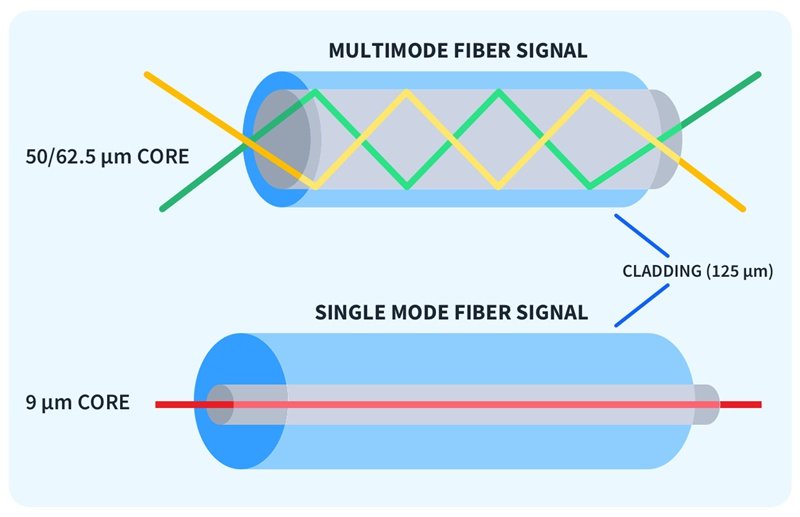
Single-mode fiber delivers virtually unlimited bandwidth and distances exceeding 100 km with minimal attenuation, while multimode supports shorter links (up to 400–600 m depending on OM grade) due to modal dispersion.
When engineers compare single-mode and multimode, performance metrics are always the first to evaluate. These three factors—bandwidth, distance, and attenuation—are the technical backbone that determines whether your network can scale or stall.
1. Bandwidth Capacity
Single-mode fiber (SMF) has a small 8–10 µm core and uses a single light path, meaning there’s no modal dispersion. This characteristic allows it to support extremely high bandwidth, theoretically unlimited, constrained only by the transceiver electronics. For example, 400G and 800G Ethernet standards are already running stably over single-mode infrastructure.
Multimode fiber (MMF), by contrast, has a larger core (50 µm or 62.5 µm) that carries multiple light modes. While this design makes MMF easier to align and terminate, it also introduces modal dispersion—light rays take slightly different paths and arrive at different times. This reduces effective bandwidth. For instance:
- OM3 multimode supports 10G up to 300 m
- OM4 multimode supports 10G up to 400–550 m
- OM5, the latest standard, can extend distance slightly but still cannot compete with single-mode’s scalability.
Supported Ethernet Standards by Fiber Type
| Ethernet Standard | Single-Mode Fiber | Multimode Fiber (OM3/OM4) |
|---|---|---|
| 1G Ethernet | 5,000 m+ | 300–500 m |
| 10G Ethernet | 10–40 km | 300–550 m |
| 40G Ethernet | 10–40 km | 100–150 m |
| 100G Ethernet | 40–80 km | 100–150 m |
| 400G Ethernet | 80–100 km+ | Limited (special OM5) |
2. Transmission Distance
Distance is where the gap widens further.
- Single-mode: Capable of 40 km, 80 km, and beyond 100 km depending on the transceiver and amplification used. This makes it the global standard for long-haul telecom, metro backbones, and submarine links.
- Multimode: Typically effective for 100–500 m links, ideal for LAN environments, server rooms, and campus networks.
In other words, if your application requires crossing a city or a country, multimode isn’t an option.
3. Attenuation & Signal Integrity
Attenuation is the gradual loss of signal strength per kilometer:
- Single-mode fiber averages 0.35 dB/km at 1310 nm and 0.20 dB/km at 1550 nm.
- Multimode fiber, on the other hand, averages 3.0–3.5 dB/km at 850 nm.
This 10x difference is why hyperscalers (Google, AWS, Meta) deploy single-mode almost exclusively for their data transport. Lower attenuation means less need for repeaters, amplifiers, and maintenance costs.
4. Comparative Table
| Feature | Single-Mode Fiber | Multimode Fiber |
|---|---|---|
| Core Size | 8–10 µm | 50 µm / 62.5 µm |
| Light Source | Laser (1310/1550 nm) | LED or VCSEL (850 nm) |
| Bandwidth | Virtually unlimited | Limited by modal dispersion |
| Distance | 40–100+ km | 300–550 m |
| Attenuation | 0.35 dB/km (1310 nm) | 3.5 dB/km (850 nm) |
| Typical Use | Telecom, backbone, WAN | LAN, data centers, campus |
5. Critical Perspective
While single-mode clearly dominates in performance, multimode has its niche. In confined spaces like a data center row, multimode provides lower transceiver cost, easier termination, and less strict alignment requirements. For enterprises where distances rarely exceed 300 m, multimode can still be the smarter choice in terms of initial CAPEX.
However, with the rise of 400G/800G interconnects and the trend toward future-proof infrastructure, many organizations are shifting to single-mode despite higher optics costs. In essence, the higher the bandwidth and longer the distance, the more single-mode makes economic sense over time.
Cost & Installation: Total Cost of Ownership
Single-mode cables are cheaper per meter but require costlier transceivers and precise installation, while multimode cables are pricier per meter yet use lower-cost optics and are easier to terminate.
Cost considerations are complex. At first glance, single-mode cabling is less expensive—yellow-jacketed fiber reels often cost 20–40% less than multimode. However, the economics shift when you factor in transceivers. A 10G multimode SFP+ module can cost $200, while its single-mode equivalent might exceed $500.
Installation complexity is another factor. Single-mode requires tight tolerances, often necessitating pre-terminated assemblies or fusion splicing. Multimode, with its forgiving larger core, is easier to connectorize in the field, saving labor hours.
Power consumption should not be overlooked: single-mode optics generally consume more power, which can scale significantly across thousands of ports in hyperscale data centers.
From a TCO (total cost of ownership) lens, multimode may offer lower upfront CAPEX in contained environments. But for organizations seeking scalability and reduced OPEX from future upgrades, single-mode often wins out.
Application Scenarios: Which One Fits Best?
Single-mode fiber excels in telecom, long-haul, and metropolitan networks, while multimode is best for short-range applications like LANs, data centers, and campus interconnects.
The choice of cable isn’t just technical; it’s situational.
- Single-mode dominates in ISPs, backbone, and metro networks where 10 km, 40 km, or even 100 km links are routine. Its low attenuation and vast bandwidth make it indispensable for carriers and government infrastructure.
- Multimode thrives in enterprise LANs, where 100–500 m is sufficient. Its cost-effective optics and easier handling make it the go-to in server farms.
FAQ Integration:
What is a single mode fiber patch cord?
→ A single-mode patch cord is a fiber jumper with 8–10 µm core designed to connect telecom or data center equipment for long-distance transmission.
What is single mode fiber optic cable used for?
→ It’s widely used for internet backbones, metropolitan area networks, submarine cables, and long-haul telecom.
Is OM4 single mode or multimode?
→ OM4 is multimode fiber, optimized for 850 nm transmission, supporting up to 550 m at 10G or 100G with VCSEL optics.
Is 1310 single mode or multimode?
→ 1310 nm is a wavelength primarily associated with single-mode transmission, though some multimode systems can operate at 1310 nm for legacy reasons.
Ultimately, choosing between the two comes down to how far your data needs to travel, how fast, and at what budget.
Sino-conn’s Advantage in Cable Assemblies
Sino-conn offers fully customizable fiber patch cables with rapid turnaround, no MOQ, strict quality checks, and global certifications, making it a trusted partner for OEMs and end-users.
What sets Sino-conn apart isn’t just product—it’s partnership. Clients gain:
- Customization: Tailored lengths, connectors (LC, SC, MPO/MTP), jackets (PVC, LSZH), and pin-outs.

- Speed: Quotes and drawings in 30 minutes; samples in 2–3 days; bulk in 2–4 weeks.
- Flexibility: No MOQ—start with a single piece.
- Certifications: UL, ISO, RoHS, REACH, COC, COO, ensuring compliance worldwide.
- Quality Assurance: 3-stage inspection (in-process, finished, pre-shipment) for 100% reliability.
Whether you’re an OEM factory needing large volume with competitive pricing, a trade distributor seeking flexible inventory, or an engineer requiring precise prototypes, Sino-conn adapts to your needs with proven expertise.
To complement these service advantages, Sino-conn also provides reliable product specifications that meet global standards. Below is a snapshot of our most common single-mode and multimode fiber patch cable parameters, giving you a clear idea of the performance benchmarks you can expect:
Typical Sino-conn Fiber Patch Cable Parameters
| Parameter | Single-Mode Fiber Patch Cable | Multimode Fiber Patch Cable |
|---|---|---|
| Core/Cladding Size | 9/125 µm | 50/125 µm or 62.5/125 µm |
| Insertion Loss | ≤0.3 dB | ≤0.3 dB |
| Return Loss | ≥50 dB (UPC) / ≥60 dB (APC) | ≥35 dB |
| Operating Temperature | -20°C to +70°C | -20°C to +70°C |
| Jacket Material | PVC, LSZH, TPU | PVC, LSZH, TPU |

Conclusion
In the single-mode vs multimode debate, there is no universal winner—only the right choice for your application. But when it comes to sourcing fiber patch cables that are certified, customizable, and delivered fast, Sino-conn stands out.
Ready to future-proof your network with the right fiber solution? Contact Sino-conn today for a tailored quotation and discover how our expertise can accelerate your project.
Related Keywords :single mode fiber, multimode fiber, fiber patch cable, OM4 fiber, 1310nm fiber, fiber optic comparison, data center cabling, telecom fiber, fiber cost analysis, Sino-conn

With over 18 years of OEM/ODM cable assemblies industry experience, I would be happy to share with you the valuable knowledge related to leather products from the perspective of a leading supplier in China.
manufacturer catalogue
Custom Micro Coaxial Cable →
Custom RF Coaxial Cable Assembly →
Custom FFC(Flat Flexible Cable) →
Custom Patch Cable →
Custom Circular Connector Cables →
Custom D-Sub Analog Cable →
Custom Power Cord →
Custom Fiber Optical Transceiver →
Custom Receptacle Connectors →
Get A Sample Now From Factory→
Latest blogs


Here, developing your OEM/ODM custom cable assemblies collection is no longer a challenge—it’s an excellent opportunity to bring your creative vision to life.