Skip to content
What Are Battery Cables and How Do They Work?
- andy

When you start your car, fire up a boat engine, or connect a solar storage system, one unsung hero quietly makes everything possible—the battery cable. Without this heavy-duty conductor, the stored energy in your battery simply couldn’t flow to the starter, ignition, lights, or electronic control systems. Yet despite its importance, many people overlook how much engineering goes into making a cable that can carry hundreds of amps safely and reliably.
Battery cables are thick, insulated conductors designed to transfer high current between a battery and an electrical system. They are essential for starting engines, powering onboard electronics, and ensuring stable energy delivery in vehicles, boats, solar arrays, and industrial machines. Built with copper or aluminum conductors and insulated with materials like PVC, XLPE, or silicone, these cables are tailored for durability, flexibility, and safety under demanding conditions.
Think of a battery cable as the bloodstream of your power system: if it clogs, overheats, or breaks down, the entire system suffers. That’s why choosing the right cable isn’t just about size—it’s about materials, design, certifications, and reliability in the environments you face. And here’s where the story gets interesting: Sino-conn has spent years engineering battery cables that meet international standards and customer-specific needs. Stick around, because in the next sections, we’ll break down everything you need to know—what they are, what they’re made of, the problems they solve, and how you can get the perfect custom solution.
What Is a Battery Cable and Why Is It Important?
A battery cable is a heavy-gauge wire designed to transfer high current between a battery and an electrical system, ensuring reliable starting, grounding, and energy flow in vehicles, marine equipment, and energy storage systems.
Battery cables are not like ordinary wires. They carry hundreds of amps at the moment of ignition, which is why size, materials, and insulation matter so much. In vehicles, they connect the positive terminal to the starter motor and alternator, and the negative terminal to the chassis ground. In boats, they must resist salt corrosion, while in solar and UPS systems, they handle continuous charging and discharging cycles.

- Critical for ignition: If your starter cable fails, the engine won’t even turn over.
- Safety component: Proper grounding reduces fire and shock hazards.
- Efficiency factor: High-quality cables minimize voltage drop, improving performance.
A 2019 automotive study showed that poor-quality battery cables can increase starting resistance by up to 30%, leading to unnecessary fuel consumption and shortened battery life. Clearly, choosing the right cable pays for itself in reliability and cost savings.
Battery Cable Applications, Risks, and Benefits
| Application | Key Role | Risk of Poor Cable | Benefit of Quality Cable |
|---|---|---|---|
| Automobiles & Trucks | Starting engines, grounding, powering electronics | Hard starting, voltage drop, battery drain | Reliable ignition, longer battery life |
| Marine Vessels | Withstand salt, humidity, vibration | Corrosion, short circuits, safety hazards | Durable performance in harsh environments |
| Solar & UPS Systems | Continuous charging/discharging | Overheating, energy loss | Stable energy delivery, higher efficiency |
| Industrial Equipment | Power for heavy-duty machines | Downtime, electrical failure | Safe, consistent power supply |
This table shows why selecting the right battery cable is a mission-critical decision—not just for performance, but for safety, efficiency, and long-term cost savings.
Which Materials Are Commonly Used in Battery Cables?
Battery cables are typically made from conductive cores like copper or aluminum paired with protective jackets such as PVC, XLPE, or silicone. Each material directly impacts performance—conductivity, heat resistance, flexibility, corrosion protection, and ultimately, the cable’s lifespan.
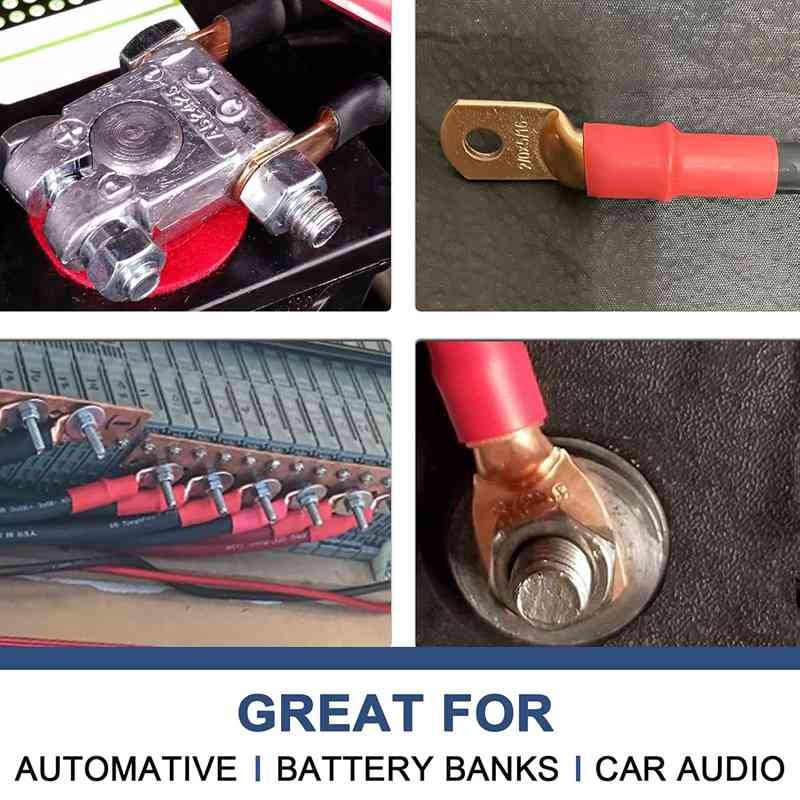
Conductors: The Heart of Power Flow
- Oxygen-Free Copper (OFC)
- Why it matters: Industry standard for most automotive and industrial battery cables.
- Benefits: Low resistance, high conductivity, excellent durability.
- Applications: Cars, trucks, UPS systems where consistent performance is critical.
- Tinned Copper
- Why it matters: Adds a protective layer of tin over copper strands.
- Benefits: Prevents oxidation and corrosion in humid or salty environments.
- Applications: Marine vessels, offshore rigs, outdoor solar systems.
- Aluminum Alloy
- Why it matters: Lightweight alternative to copper, ~40% lighter.
- Benefits: Reduces vehicle weight, improves fuel efficiency in EVs.
- Applications: Electric vehicles, large-scale energy storage, aerospace.
Quick Insight: A 25mm² copper cable can carry ~150A safely, while the same size in aluminum must be upsized to ~35mm² for equal performance.
Insulation & Jacket: The Armor of the Cable
- PVC (Polyvinyl Chloride)
- Pros: Affordable, abrasion-resistant.
- Cons: Limited heat range (-40°C to 105°C).
- Best for: Passenger vehicles, indoor UPS setups.
- XLPE (Cross-Linked Polyethylene)
- Pros: Withstands 125–150°C, oil/chemical resistant.
- Cons: Slightly stiffer, higher cost than PVC.
- Best for: Electric vehicles, industrial machinery, heavy trucks.
- EPDM / Neoprene
- Pros: Excellent flexibility, weather-resistant, flame retardant.
- Best for: Outdoor and engine compartment wiring.
- Silicone Rubber
- Pros: Ultra-flexible, heat tolerance up to 200°C.
- Cons: Higher cost, softer jacket requires careful handling.
- Best for: Aerospace, military, or environments with extreme thermal cycling.
Extra Protection Options
- Braided Copper Shielding: Blocks EMI, critical for EVs and hybrid vehicles.
- Aluminum Foil Wraps: Lightweight EMI protection for portable devices.
- Halogen-Free Jackets: Eco-compliance, smoke- and toxin-free in case of fire.
Comparison Table: Conductor + Jacket Combinations
| Conductor + Jacket | Temp Range | Key Strength | Typical Use Case |
|---|---|---|---|
| Copper + PVC | -40°C ~ 105°C | Cost-effective | Standard cars & trucks |
| Tinned Copper + XLPE | -50°C ~ 150°C | Anti-corrosion, heat resistant | Marine, industrial |
| Copper + Silicone | -60°C ~ 200°C | Extreme flexibility | Aerospace, military |
| Aluminum + XLPE | -40°C ~ 150°C | Lightweight, high-voltage | EV battery packs |
Why Sino-conn’s Material Expertise Matters
At Sino-conn, we help customers balance cost, performance, and environment needs:
- Marine engineers prefer tinned copper + XLPE for saltwater resistance.
- EV manufacturers often specify aluminum + orange XLPE for safety and weight savings.
- Aerospace clients request copper + silicone for flexibility under thermal stress.
Every inquiry we receive is analyzed by our engineering team, and within 3 days (sometimes 30 minutes), we provide a full CAD-to-PDF drawing plus detailed specs—OD, flexibility rating, EMI shielding %, flame rating, and compliance certificates (UL, ISO, RoHS, REACH).
What Types of Battery Cables Exist?
Battery cables come in multiple types including single-core cables, lugged cables with terminals, braided flexible cables, heavy-duty thick-gauge cables, shielded cables for EMI control, and custom harnesses with multiple branches.
- Standard Single Cables – Simple, cost-effective, widely used in cars.
- Lugged Cables – Pre-crimped ends, easy to install and replace.
- Braided Flexible Cables – High flexibility, ideal for tight spaces.
- Heavy-Duty Cables – Extra-thick for trucks, RVs, and marine.
- Shielded Cables – Protect electronics from electromagnetic interference.
- Custom Harnesses – For EVs and solar, combining power + control wiring.

For example, EV manufacturers often request bright orange XLPE battery cables to comply with ISO standards for high-voltage safety. Marine engineers, on the other hand, demand tinned copper lugs and waterproof insulation to prevent saltwater damage. Sino-conn provides CAD-to-PDF drawings so customers can validate every detail before production.
How Do Battery Cables Solve Common Power Issues?
Battery cables solve problems like overheating, corrosion, EMI interference, and installation challenges by using thicker conductors, corrosion-proof coatings, shielding, and flexible insulation designs.
- Overheating under high current → Solved with large copper conductors that lower resistance.
- Cracking and aging in heat/oil → Solved with XLPE or silicone jackets.
- Saltwater corrosion → Solved with tinned copper conductors and sealed lugs.
- Tight installation spaces → Solved with fine-strand, flexible cable designs.
- EMI problems in EVs and hybrid systems → Solved with shielded cable structures.
| Problem | Solution | Result |
|---|---|---|
| Overheating | Larger gauge copper | Lower heat, longer lifespan |
| Corrosion | Tinned copper + sealed ends | Extended service in marine use |
| EMI | Braided shielding | Stable electronics |
| Space limits | Flexible stranded wire | Easy routing & installation |
Every challenge in power transmission has a cable-engineering solution. This is why Sino-conn insists on 3-level quality control—process, final, and pre-shipment inspection—to ensure cables perform as promised.
Do Battery Cables Need Certifications and Testing?
Yes, battery cables require certifications like UL, ISO, RoHS, and REACH to confirm they meet safety, environmental, and performance standards in different markets.
- UL – Ensures flame resistance and safety.
- ISO/TS Standards – Guarantees automotive-grade performance.
- RoHS & REACH – Verifies eco-compliance for global sales.
- PFAS-Free – Meets new environmental regulations.
For procurement teams, documentation is as important as the product. Sino-conn provides full COC/COO certificates along with detailed reports on:
- Outer diameter
- Flexibility rating
- Flame-retardant grade
- Impedance values
- EMI shielding %
This removes import/export risk and speeds up customs clearance, allowing customers in EU, US, and Asia-Pacific to source with confidence.
How Can Sino-conn Support Your Battery Cable Needs?
Sino-conn offers custom battery cable solutions with unmatched flexibility:
- Speed: CAD drawings in 30 minutes–3 days, samples in 2–3 days, bulk in 2–3 weeks.
- Flexibility: No MOQ, 1 piece minimum order.
- Choice: Genuine or equivalent connectors available.
- Accuracy: 100% CAD-to-PDF drawing confirmation before production.
- Quality: Triple QC inspection ensures reliability.
Customers range from trade distributors looking for ready stock, to OEM factories focused on bulk pricing, to engineers and R&D teams requiring unique designs. Sino-conn adapts to each profile, offering the right mix of cost, speed, and quality.
Conclusion
Battery cables are the arteries of modern energy systems, powering vehicles, boats, solar setups, and industrial machines with safety and reliability. From copper conductors to XLPE jackets and EMI shielding, every design detail solves a specific problem—overheating, corrosion, interference, or limited installation space.
At Sino-conn, we go beyond selling cables. We provide mission-critical assurance through customization, fast turnaround, and global compliance.
Looking for custom-built battery cables that meet UL, ISO, RoHS, REACH, and your exact design specs?
Contact Sino-conn today to request drawings, samples, or a quote—your reliable power connection starts here.
Related Keywords :battery cable, automotive wiring, power cable, energy storage cable, marine cable, flexible battery cable, heavy duty cable, cable assemblies, custom wiring, Sino-conn

With over 18 years of OEM/ODM cable assemblies industry experience, I would be happy to share with you the valuable knowledge related to leather products from the perspective of a leading supplier in China.
manufacturer catalogue
Custom Micro Coaxial Cable →
Custom RF Coaxial Cable Assembly →
Custom FFC(Flat Flexible Cable) →
Custom Patch Cable →
Custom Circular Connector Cables →
Custom D-Sub Analog Cable →
Custom Power Cord →
Custom Fiber Optical Transceiver →
Custom Receptacle Connectors →
Get A Sample Now From Factory→
Latest blogs


Here, developing your OEM/ODM custom cable assemblies collection is no longer a challenge—it’s an excellent opportunity to bring your creative vision to life.