 Skip to content
Which Flexible Flat Cable Types Are Best for Your Application
- andy
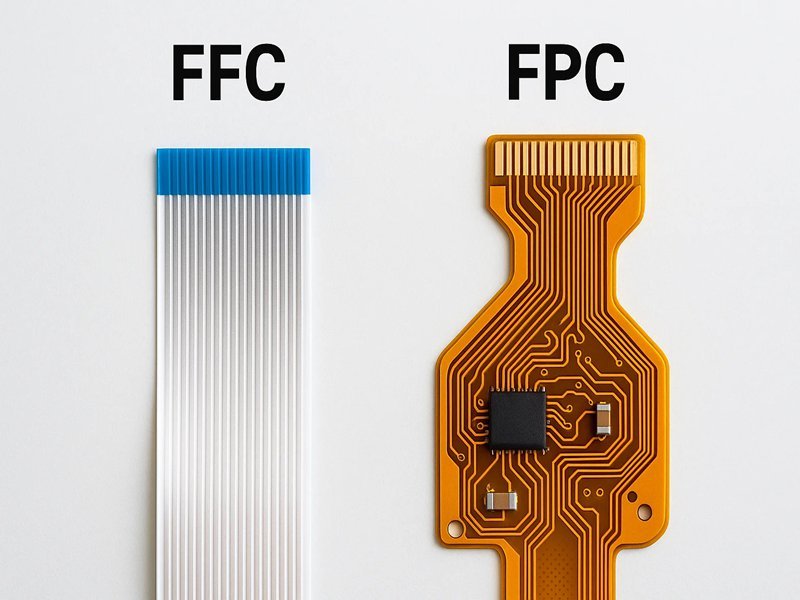
Choosing the right cable is rarely just about price—it’s about reliability, performance, and matching your unique design needs. Flexible flat cables (FFC) have become indispensable in modern electronics because they solve issues that traditional round wires simply can’t: saving space, reducing weight, and offering better flexibility in compact devices. Think about laptops, smartphones, printers, or even your car’s dashboard—all of them rely on FFC technology to work smoothly.
The best flexible flat cable type depends on your application. Shielded FFCs work best in noisy environments, halogen-free FFCs are ideal for eco-friendly compliance, and gold-plated or gold-plated shielded FFCs are perfect for high-reliability electronics. Standard FFCs remain the cost-effective choice for everyday OEM production. Your selection should be based on pitch, contact type, environment, and performance requirements.
At Sino-conn, we’ve seen engineers, OEMs, and even first-time buyers all ask the same question: “Which type of FFC is truly the best?” In this article, we’ll break down the most common FFC types, their strengths and weaknesses, and even share insider knowledge from years of working with global customers. By the end, you’ll not only understand the differences—you’ll know exactly which type of cable is right for your project. Let’s dive in.
Comparing Common FFC Variants: Standard, Halogen-Free, Gold-Plated, Shielded
Standard FFCs are the most cost-effective and widely used. Halogen-free FFCs meet global environmental and fire-safety standards. Gold-plated FFCs ensure superior conductivity and long-term reliability in high-performance devices. Shielded FFCs are critical in automotive, telecom, or industrial systems where EMI protection is required. Choosing the best type depends on your application environment, compliance requirements, and reliability expectations.
When customers ask, “Which FFC type should I choose?” it’s rarely just a technical question—it’s about balancing cost, compliance, and performance. Below we break down the four most common types of FFCs and where they fit best.
1. Standard FFCs – Everyday Workhorse
- Applications: Consumer electronics, laptops, printers, home appliances
- Strengths: Low cost, fast production, widely available connector compatibility
- Performance: Good for low-voltage, low-noise environments
- Limitations: Not ideal for high-EMI or harsh environments
Example: A laptop screen-to-motherboard connection often uses a standard FFC because it’s cost-sensitive and operates in a relatively controlled environment.
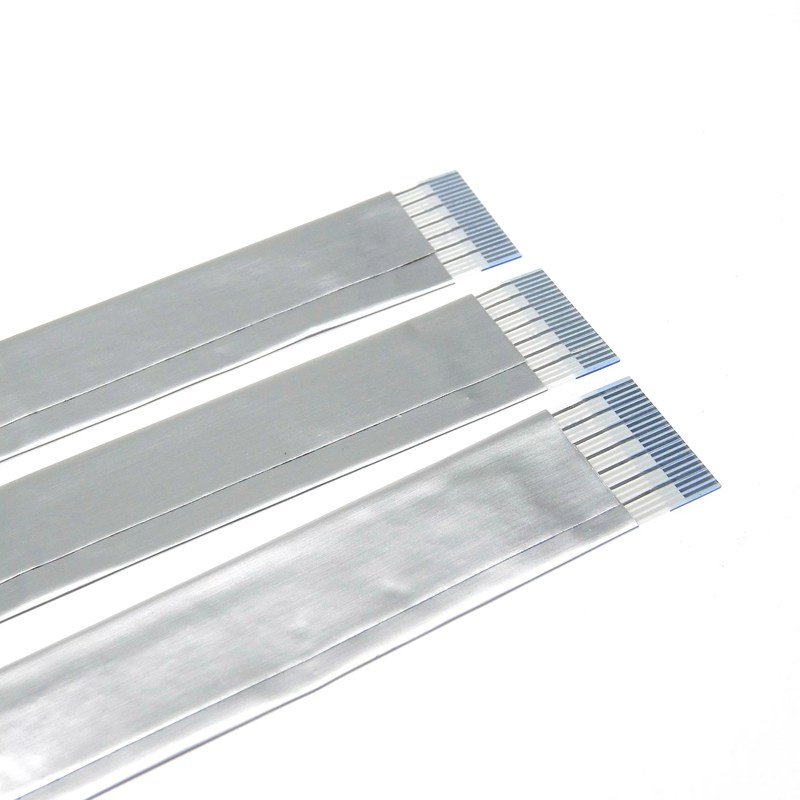
Standard FFC Typical Specifications
| Parameter | Range / Value | Notes |
|---|---|---|
| Conductor Pitch | 0.5 mm / 1.0 mm / 1.25 mm / 2.54 mm | Most common OEM standards |
| Number of Conductors | 4 – 80 pins | Customizable on request |
| Cable Thickness | 0.10 – 0.30 mm | Depending on insulation material |
| Operating Voltage | Up to 60V | For consumer and light industrial use |
| Operating Temperature | -20°C to +80°C | Standard PET insulation |
2.Halogen-Free FFCs – Eco & Safety First
- Applications: Automotive interiors, medical electronics, European markets (RoHS, REACH)
- Strengths: Free from chlorine/bromine, lower toxicity during combustion, safer disposal
- Performance: Flame-retardant, compliant with strict fire and smoke standards
- Limitations: Slightly higher cost than standard FFCs
Example: In a car’s infotainment system, halogen-free FFCs are often mandated to meet EU fire safety standards and reduce toxic emissions in case of accidents.
3. Gold-Plated FFCs – High Reliability, Long-Term Use
- Applications: Aerospace, military equipment, medical devices, precision instruments
- Strengths: Gold-plated contacts prevent oxidation, reduce signal loss, and provide stable connections even after thousands of mating cycles
- Performance: Excellent for high-frequency signals, harsh environments, and critical applications
- Limitations: Higher price point compared to standard FFCs
Example: A surgical robotic arm may rely on gold-plated FFCs to ensure no signal interruption during operations, where even microsecond failures are unacceptable.
4. Shielded FFCs – Noise-Resistant Performer
- Applications: Telecom, industrial automation, automotive dashboards
- Strengths: Added aluminum foil or braided shielding reduces EMI and crosstalk
- Performance: Stable data transmission in high-noise or high-speed environments
- Limitations: Slightly thicker and less flexible, cost increase compared to non-shielded types
Example: An automotive ADAS (advanced driver-assistance system) uses shielded FFCs to ensure sensor data isn’t corrupted by surrounding electronic interference.

Expanded Comparison Table
| Cable Type | Best For | Benefits | Cost Impact | Compliance/Certifications | Flexibility |
|---|---|---|---|---|---|
| Standard FFC | Mass production OEMs, consumer electronics | Lowest cost, fast lead time, widely compatible | $ | Basic RoHS | High |
| Halogen-Free | Eco-regulated, automotive, medical | Flame-retardant, non-toxic, eco-compliant | $$ | RoHS, REACH, UL94-V0 | High |
| Gold-Plated | Aerospace, defense, medical, precision | Superior conductivity, anti-corrosion, long lifespan | $$$ | ISO, UL, MIL standards | Medium |
| Shielded | Automotive, telecom, industrial | EMI protection, stable signal integrity | $$$ | EMC compliance | Medium |
Why This Matters to Buyers
- Trade Buyers → often need quick specs. They benefit from simple tables and clear cost/performance breakdowns.
- Engineers → want to know about conductivity, EMI protection, and compliance standards.
- OEMs → care about lead time, MOQ, and large-scale availability.
At Sino-conn, we don’t just sell FFCs—we advise. Clients send us a part number, drawing, or even just a picture, and we recommend whether standard, halogen-free, gold-plated, or shielded is the best fit.
FFC vs FPC (Flexible Printed Circuit): Which Suits Your Needs?
FFC is a simple flat cable with parallel conductors, while FPC is a printed circuit with complex traces and sometimes components. FFCs are cheaper and flexible, FPCs allow more design freedom but cost more.
This is one of the most common customer questions: “Is FFC the same as FPC?” The short answer: no.
- Structure: FFCs are made of straight, parallel copper conductors laminated between films. FPCs, on the other hand, are like mini printed circuit boards—etched copper patterns on a flexible substrate.
- Flexibility: Both bend, but FFCs excel at simple, repetitive bending in tight spaces. FPCs handle more complex 3D routing.
- Cost: FFCs are significantly cheaper to produce, making them ideal for mass-market devices. FPCs cost more due to etching, layering, and sometimes embedding components.
- Customization: FPCs can integrate resistors, capacitors, or complex routing. FFCs are limited to straight conductor paths but can be customized in pitch, length, pin-out, and connectors.
In practice:
- A laptop screen cable will often be an FFC.
- A foldable smartphone hinge cable will likely use an FPC.
Both have their place. At Sino-conn, we often guide clients through this choice by reviewing their CAD drawings and recommending the most cost-effective and functional option.
Design Considerations: Pitch, Contact Orientation, Reinforcements & Shielding
Key FFC design factors include pitch (distance between conductors), contact orientation (same side vs opposite side), reinforcement (for mechanical stability), and shielding (for EMI protection).
Design is where engineers either succeed or face costly redesigns. Here’s why:
- Pitch: The most common are 0.5 mm and 1.0 mm. A smaller pitch saves space but requires more precision in assembly.

- Contact Orientation: A-type (contacts same side) vs D-type (opposite sides). Choosing incorrectly means the cable simply won’t fit.
- Reinforcements: Extra stiffeners at the ends prevent breakage during mating/unmating. Without them, even the best FFC can fail under repeated stress.
- Shielding: Optional but often necessary in noisy environments. This can add thickness and cost but prevents data loss or malfunction.
Many buyers underestimate these details. We once had a client who ordered 1,000 units of an FFC—only to discover the pitch didn’t match their connector. At Sino-conn, we solve this with CAD drawings provided within 30 minutes, so clients confirm before production starts. This small step saves thousands in wasted costs.
Application-Driven Selection: Matching FFC Type to Use Case
The best FFC type depends on application: laptops and smartphones use standard/shielded FFCs, industrial and automotive rely on halogen-free or shielded, while medical and aerospace often require gold-plated versions.
Every industry has unique demands:
- Consumer Electronics: Laptops, smartphones, tablets—tight spaces, fast production cycles, cost pressure. Standard FFCs dominate here.
- Automotive: High heat, vibration, and EMI mean shielded or halogen-free FFCs are common.
- Medical Devices: Reliability is everything—gold-plated FFCs ensure long-term stability.
- Industrial Equipment: Requires durability under stress—shielded or halogen-free FFCs offer both safety and performance.
- OEMs vs Trade Buyers: OEMs value price and delivery. Trade buyers often just send part numbers and want quick specs and quotes.
Sino-conn adapts to both: samples in as little as 3 days, bulk in 2 weeks, and no MOQ (1 pc start). That flexibility is why many engineers stay with us after the first prototype.
Industry Applications and Recommended FFC Types
| Industry | Typical Applications | Recommended FFC Type | Key Priorities |
|---|---|---|---|
| Consumer Electronics | Laptops, smartphones, tablets | Standard or Shielded FFC | Cost, compact size, speed |
| Automotive | Dashboards, infotainment, ADAS | Shielded or Halogen-Free FFC | EMI resistance, safety |
| Medical Devices | Surgical tools, monitoring systems | Gold-Plated FFC | Reliability, long-term use |
| Industrial Equipment | Robotics, automation systems | Shielded or Halogen-Free FFC | Durability, noise immunity |
| Aerospace/Defense | Avionics, navigation systems | Gold-Plated Shielded FFC | Precision, harsh environment |
Conclusion:
Choosing the right FFC isn’t about finding a one-size-fits-all product—it’s about matching the right type to your application, compliance needs, and budget. Sino-conn offers:
- Expert support: 30-minute drawings, accurate quotes, video communication.
- Customization: Pin-outs, lengths, connectors, materials, shielding, and more.
- Quality assurance: 100% inspection—process, final, and pre-shipment.
- Flexibility: No MOQ, fast samples, scalable bulk production.
- Certifications: UL, ISO, RoHS, REACH, PFAS, COC, COO.
Ready to find the best flexible flat cable for your project? Contact Sino-conn today to request a custom quote and see how quickly we can bring your design to life.
Related Keywords :flexible flat cable, FFC types, FPC vs FFC, cable assemblies, shielded FFC, gold plated FFC, halogen free cable, electronic connectors, Sino-conn cables, custom cable solutions

With over 18 years of OEM/ODM cable assemblies industry experience, I would be happy to share with you the valuable knowledge related to leather products from the perspective of a leading supplier in China.
manufacturer catalogue
Custom Micro Coaxial Cable →
Custom RF Coaxial Cable Assembly →
Custom FFC(Flat Flexible Cable) →
Custom Patch Cable →
Custom Circular Connector Cables →
Custom D-Sub Analog Cable →
Custom Power Cord →
Custom Fiber Optical Transceiver →
Custom Receptacle Connectors →
Get A Sample Now From Factory→
Latest blogs


Here, developing your OEM/ODM custom cable assemblies collection is no longer a challenge—it’s an excellent opportunity to bring your creative vision to life.

