Skip to content
Types of Cables — Complete Guide
- andy

In the modern industrial world, cables are the invisible highways that carry data, power, and control signals through every piece of equipment — from automated factories and smart sensors to medical imaging systems and satellites.
Engineers rarely see them once they’re installed, yet the right cable choice determines whether a system runs reliably or fails under load, vibration, or interference.
There are many types of cables, each designed for a specific function — such as power cables for electricity transmission, coaxial and fiber optic cables for data, control cables for automation, and ribbon or USB cables for compact electronics. Their performance depends on conductor material, insulation, shielding, and jacket design. The right cable ensures efficient, interference-free, and durable operation in any OEM or industrial environment.
Consider this scenario: a medical equipment engineer prototypes a new imaging system using a generic data cable. It works fine in the lab, but once installed in the hospital’s EMI-rich environment, the screen flickers. Replacing it with a properly shielded coaxial cable solves the issue instantly. Understanding cable types isn’t just technical trivia — it’s a critical design decision that protects performance, compliance, and reliability.
What Is a Cable and How Does It Work?
A cable is a bundle of conductors insulated and protected by layers of dielectric, shielding, and jacketing materials. Its main purpose is to transmit power, data, or control signals between devices while minimizing electrical losses, interference, and mechanical stress.
What Are the Main Functions of a Cable?
Cables serve three fundamental roles:
- Transmission — Carry electrical or optical signals efficiently.
- Isolation — Prevent short circuits through insulation.
- Protection — Resist heat, oil, chemicals, UV, and mechanical strain.
An industrial cable might power a robotic arm, while another transmits sensor data in real time. Both rely on precise impedance control and durable insulation to maintain accuracy and uptime.
How Does Cable Construction Affect Performance?
Cable performance depends on its internal architecture:
Conductor: Usually copper (solid or stranded) or aluminum.
Insulation: Polyethylene, fluoropolymer, or silicone to maintain dielectric stability.
Shielding: Foil or braided copper to block electromagnetic interference (EMI).
Jacket: External protective layer (PVC, LSZH, PUR) that resists abrasion and temperature extremes.
Each layer contributes to the cable’s overall electrical impedance, flexibility, and lifespan.
Key Electrical Parameters
- Voltage rating (up to 600V for low-voltage control cables).
- Current capacity (depends on cross-sectional area and conductor material).
- Characteristic impedance (important for signal cables, e.g., 50Ω for RF, 100Ω for Ethernet).
- EMI resistance and shielding effectiveness (measured in dB).
- Flexural endurance (number of bend cycles before failure).
What Are the Main Types of Cables?
In engineering and industrial applications, cables are categorized by function, structure, and signal type. While the materials and specifications may vary, all cables share a single goal — to transmit energy or information reliably under specific electrical, mechanical, and environmental conditions.

Broadly speaking, the main categories include power cables, data and signal cables, control cables, fiber optic cables, and flat or ribbon cables. Each is engineered with a distinct internal structure to meet its intended performance and safety requirements.
The main types of cables are power cables, data/signal cables, control cables, fiber optic cables, and flat ribbon cables.Power cables carry current; data and signal cables transmit information; control cables handle automation signals; fiber optics use light for long-distance communication; and ribbon cables connect compact electronic systems.
Their differences lie in conductor size, shielding, insulation, and overall construction.
1. Power Cables
Power cables are designed primarily to transmit electrical energy from a source to equipment or devices.
They use larger conductor cross-sections and thicker insulation layers to handle higher voltages and currents safely.
Typical characteristics:
- Conductors: Solid or stranded copper/aluminum, sized according to current load (AWG or mm²).
- Insulation: PVC, XLPE, or rubber for voltage isolation and thermal resistance.
- Voltage range: 300V–600V (low-voltage), up to several kilovolts for industrial power lines.
- Shielding: Usually unshielded; shielding may be added for EMI-sensitive environments.
- Applications: Motor power lines, battery systems, AC power cords, industrial distribution panels.
| Example | Voltage Rating | Structure | Common Use |
|---|---|---|---|
| Battery Cable | 12–48V DC | Copper + PVC | EV batteries, UPS systems |
| Power Cord | 110–240V AC | 3-core (L, N, G) | Appliances, lab instruments |
| Industrial Power Harness | 300–600V | Multi-core + sheath | Motors, automation panels |
Power cables are typically evaluated for current capacity, voltage drop, and temperature rise, ensuring that electrical efficiency and safety are maintained even under continuous load.
2. Data and Signal Cables
Data and signal cables are built to transfer electrical or optical signals between electronic components with minimal loss or distortion.
Unlike power cables, their key focus is impedance stability, crosstalk reduction, and EMI protection.
Common types include:
- Coaxial cables — one central conductor surrounded by insulation, a metallic shield, and an outer jacket. Used in RF, video, and antenna systems.
- Ethernet cables — twisted-pair copper conductors (Cat5e to Cat8), standardized for digital networks.
- Fiber optic cables — glass or plastic fibers that transmit data as pulses of light, ideal for long distances or high bandwidth.
- USB and LVDS cables — for computer peripherals, display connections, and embedded systems.
- Micro coaxial cables — miniature versions for medical and aerospace electronics.
Design priorities:
Precise geometry, consistent pair twisting, and quality shielding are essential to preserve signal integrity. Even slight deviations can alter impedance or introduce phase noise at high frequencies.
| Cable Type | Impedance | Typical Frequency | Common Application |
|---|---|---|---|
| Coaxial | 50–75 Ω | Up to GHz range | RF, CCTV, antennas |
| Ethernet (Cat6a) | 100 Ω | Up to 500 MHz | Networking, PLC |
| Fiber Optic | N/A | Optical | Data centers, sensors |
| LVDS | 100 Ω | <500 MHz | Displays, control systems |
3. Control Cables
Control cables are multi-core assemblies used to transmit low-voltage signals that control machines, automation equipment, or instrumentation systems.
Unlike data cables, which handle high-frequency communication, control cables are optimized for noise immunity, mechanical endurance, and stable signal transmission in dynamic environments.
Key characteristics:
- Voltage rating: Typically ≤300V.
- Core count: 2 to 50+ conductors, often color-coded or numbered for wiring clarity.
- Shielding: Optional foil or braid for noise suppression.
- Flexibility: High-flex types withstand >5 million bending cycles.
- Applications: PLCs, sensors, conveyor systems, CNC machines, and robotics.
A subcategory known as servo cables combines power and feedback lines for motor control, where shielding minimizes electrical interference between conductors.
4. Fiber Optic Cables
Fiber optic cables transmit data using light signals rather than electricity, providing unmatched bandwidth and EMI resistance.
Each cable contains one or more optical fibers, made of glass or plastic, encased in protective coatings and sometimes armored jackets.
Typical structure:
- Core: Carries the light signal.
- Cladding: Reflects light back into the core.
- Buffer coating: Protects against mechanical damage.
- Strength member: Kevlar or steel wire for tension resistance.
- Outer jacket: PVC, LSZH, or PE for environmental protection.
Main types:
- Single-mode (SMF): Small core (~9 μm), long-distance transmission up to tens of kilometers.
- Multi-mode (MMF): Larger core (50–62.5 μm), shorter distances with high throughput.
Fiber optics are used in telecommunications, data centers, medical endoscopy, and sensing systems, where low attenuation (<0.3 dB/km) and high isolation are essential.
5. Flat and Ribbon Cables
Flat and ribbon cables provide compact, flexible interconnections within electronic devices or equipment housings.
Their parallel conductor layout supports simultaneous multi-signal transmission in tight spaces.
Features:
- Shape: Flat, with evenly spaced parallel conductors.
- Connection: Typically terminated using IDC (insulation displacement connectors).
- Applications: Computers, printers, LCDs, and industrial control panels.
- Advantages: Easy routing, low profile, ideal for compact electronics.
- Limitations: Lower EMI protection and distance capability compared to twisted-pair designs.
| Cable Type | Conductor Form | Typical Use | Benefit |
|---|---|---|---|
| Flat Ribbon | Parallel copper | Internal wiring | Space saving |
| FFC (Flexible Flat Cable) | Printed conductor | Displays, electronics | Lightweight, flexible |
| Spiral Cable | Coiled round | Handheld devices | Extension capability |
6. Hybrid and Specialized Cables
In many OEM or industrial systems, engineers require hybrid cables — custom assemblies that combine power, data, and control functions within a single sheath.
This approach simplifies installation, reduces weight, and improves routing efficiency in compact systems.
Examples include:
- Ethernet + Power (PoE) cables for automation networks.
- Signal + power harnesses for robotics or sensors.
- Medical hybrid cables combining electrical and fluidic channels.
Hybrid cables often use segmented shielding and multi-layer jackets to maintain signal isolation while accommodating mixed current and voltage paths.
Different cable types exist not only because of electrical requirements but also due to environmental constraints, signal behavior, and safety standards.
Choosing between them requires understanding how geometry, material, shielding, and conductor size interact to achieve desired performance.
In essence:
- Power cables move energy.
- Data cables move information.
- Control cables move instructions.
- Fiber optics move light.
- Flat and hybrid cables move efficiency into compact systems.
For engineers, distinguishing between these categories forms the foundation for reliable circuit and system design — ensuring that each connection supports performance rather than limiting it.
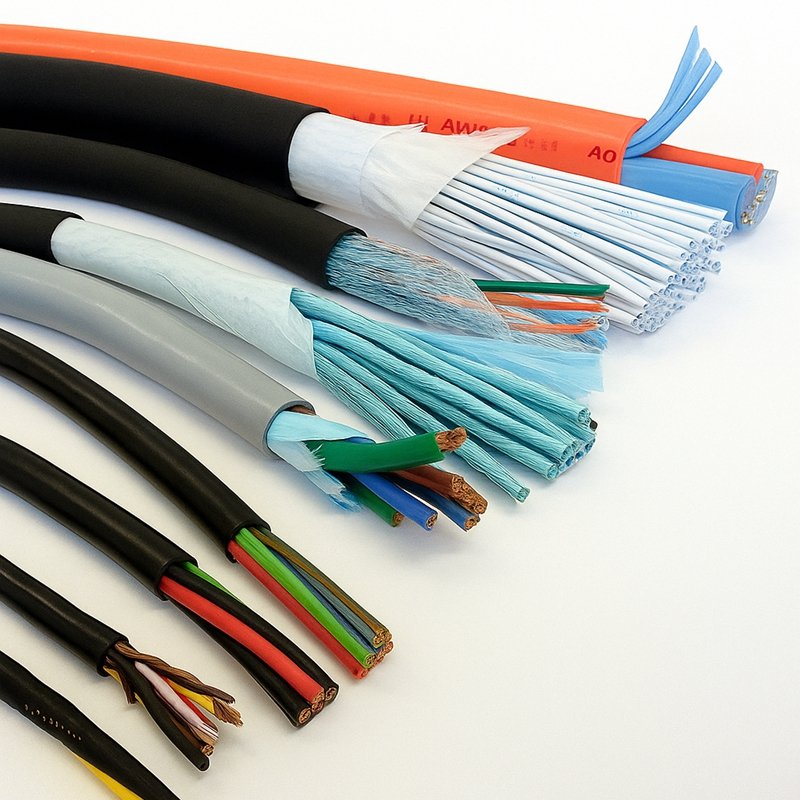
How Are Cables Classified by Application and Material?
Cables are classified by application (data, power, control) and material (copper, aluminum, fiber). Their insulation and jacket materials — PVC, LSZH, PUR, or FEP — define flexibility, temperature range, and chemical resistance.
By Application
- Power Cables: Carry electrical current.
- Data Cables: Transfer information at high frequencies.
- Control Cables: Transmit command signals.
- Hybrid Cables: Combine data + power in one assembly for compact designs.
By Conductor Material
| Material | Conductivity | Weight | Cost | Notes |
|---|---|---|---|---|
| Copper | Excellent | Moderate | Medium | Most common, durable |
| Aluminum | Good | Light | Low | Used in large-scale power |
| Tinned Copper | Very good | Slightly higher | Medium | Corrosion-resistant |
| Fiber Glass | N/A | Very light | Medium-high | Optical signal transmission |
By Structure
- Single-core – simple, rigid, used for fixed installations.
- Multi-core – flexible, supports complex circuits.
- Shielded / Twisted pair – used in data and communication.
- Flat – compact and easy to route.
How Does Jacket Material Affect Cable Durability?
| Material | Temp Range | Resistance | Application |
|---|---|---|---|
| PVC | –20°C to +75°C | General purpose | Indoor wiring |
| LSZH | –20°C to +80°C | Low smoke, halogen-free | Public buildings |
| PUR | –40°C to +80°C | Oil, abrasion | Industrial machines |
| FEP | –70°C to +200°C | High temp, chemical | Aerospace, defense |
Selecting the correct jacket ensures performance longevity under mechanical, thermal, and chemical stress.
Which Cable Types Are Commonly Used in Different Industries?
Every industry relies on specific cable types tailored to its environment — industrial automation uses shielded Ethernet and control cables, while medical and defense systems demand high-flex, low-toxicity, or radiation-resistant designs.
| Industry | Environment | Common Cable Type | Key Features |
|---|---|---|---|
| Industrial Automation | Oil, EMI, vibration | Cat6a S/FTP PUR | Shielded, flexible |
| Medical Equipment | Sterile, low toxicity | Cat6 LSZH, LVDS | Non-halogen, precise |
| Aerospace & Military | High vibration, temp | Coaxial, TPE/FEP | Lightweight, shielded |
| Data Centers | Controlled, dense | Cat8 S/FTP | High bandwidth |
| Consumer Electronics | Compact, mobile | USB, FFC | Flat, space-saving |
Each field imposes distinct reliability, safety, and compliance requirements. In automation, for example, cables must endure millions of flex cycles. In medical environments, low-smoke and halogen-free materials are mandatory for safety certification.
How Do Engineers Choose the Right Cable for Their Project?
To choose the right cable, engineers evaluate signal type, voltage, environment, temperature, EMI exposure, and movement. Matching electrical performance to physical conditions prevents signal degradation and downtime.
Electrical and Environmental Criteria
- Signal Type: Analog, digital, or mixed.
- Distance: Up to 100 m for twisted pair, shorter for high frequencies.
- Voltage Rating: Ensure dielectric breakdown margin.
- EMI Environment: Shielded cable for >3V/m EMI zones.
- Temperature: Use PUR/FEP jackets for extreme ranges.
Mechanical Considerations
- Bend Radius: ≥4× cable diameter.
- Flex Cycles: High-flex cables exceed 5 million cycles.
- Pull Strength: ≥50 N for industrial-grade harnesses.
Example Cable Selection Matrix
| Environment | Function | Recommended Cable | Notes |
|---|---|---|---|
| Office Network | Data | Cat6 UTP | Cost-effective |
| Factory Floor | Control | Cat6a S/FTP PUR | EMI-resistant |
| Medical Device | Data | Micro-coax LSZH | Compact, clean |
| Outdoor Power | Energy | PVC/PUR power cable | UV-resistant |
| Aerospace | Communication | Coaxial FEP | Lightweight |
Are Cables Customizable for OEM and R&D Applications?
Yes. OEM and engineering projects often require custom cable assemblies — tailored in length, shielding, connector type, material, and pin configuration — to fit specific system requirements and standards.
What Aspects Can Be Customized?
- Length: 10 cm to 100 m precision cutting.
- Pin-out Definition: T568B or custom layouts.
- Connector: RJ45, M12, D-sub, Molex, or medical-grade.
- Jacket Material: PVC, LSZH, PUR, TPE.
- Color Coding: For function identification.
Sino-conn’s Engineering Capabilities
- CAD Drawings: 30 minutes for standard designs.
- Samples: 2–3 days (urgent), 2 weeks (standard).
- Mass Production: 2–4 weeks.
- Certifications: UL, ISO, RoHS, REACH, PFAS-free.
- Quality: 3-step inspection (process, final, shipment).
- MOQ: No minimum — from 1 prototype piece upward.
Custom solutions allow engineers to design around space, flexibility, and performance limits — ensuring the cable functions as an integral part of the final system, not a constraint.
Why Is Quality Control Essential in Cable Manufacturing?
Strict quality control guarantees electrical stability, safety, and product lifespan.
Each cable must pass tests for continuity, insulation resistance, shielding effectiveness, and mechanical durability before delivery.
Key Quality Tests
| Test Type | Purpose | Measurement |
|---|---|---|
| Continuity | Detect open/short circuits | Ω reading |
| Impedance | Verify signal integrity | 50–100Ω ±5% |
| Shielding | EMI suppression | ≥60 dB isolation |
| Bending | Flex endurance | ≥5M cycles |
| Temperature | Thermal stability | –40°C to +80°C |
Sino-conn’s Quality Workflow
- Process Inspection — monitor assembly and crimping.
- Final Inspection — full electrical test.
- Pre-Shipment Review — visual + mechanical integrity.
This three-stage control ensures every assembly meets OEM drawing and international compliance before dispatch.
FAQ About Cable Types and Usage
Q1: What is the difference between coaxial and fiber cables?
Coaxial cables use electrical signals, while fiber uses light. Fiber offers higher bandwidth and EMI immunity but is more fragile.
Q2: Are power and control cables interchangeable?
No. Power cables handle high current; control cables transmit low-voltage signals. Using one for the other risks failure or noise interference.
Q3: Do shielded cables always perform better?
Only in high-EMI environments. In low-noise areas, unshielded versions are more flexible and cost-effective.
Conclusion
Cables may seem simple, but in engineering, they are precision components that define performance and reliability.
From material selection to shielding design, every detail affects the outcome. Knowing how to identify and apply each cable type gives OEM engineers control over both design efficiency and field performance.

At Sino-conn, every project begins with understanding — not assumption.
Our team helps engineers design and prototype custom cable assemblies that meet exact mechanical, electrical, and environmental requirements.
- Fast prototyping: 3-day samples
- No MOQ: 1 piece accepted
- Certified Quality: UL, ISO, RoHS, REACH
- Flexible manufacturing: Original or alternative connectors
Ready to build your next reliable cable solution?
Contact Sino-conn’s engineering team today — get your CAD drawing and quotation within 30 minutes.
Related Keywords :types of cables, electrical cable types, coaxial cable, fiber optic cable, power and control cables, data cables, OEM cable assemblies, industrial cables, cable materials, sino-conn

With over 18 years of OEM/ODM cable assemblies industry experience, I would be happy to share with you the valuable knowledge related to leather products from the perspective of a leading supplier in China.
manufacturer catalogue
Custom Micro Coaxial Cable →
Custom RF Coaxial Cable Assembly →
Custom FFC(Flat Flexible Cable) →
Custom Patch Cable →
Custom Circular Connector Cables →
Custom D-Sub Analog Cable →
Custom Power Cord →
Custom Fiber Optical Transceiver →
Custom Receptacle Connectors →
Get A Sample Now From Factory→
Latest blogs


Here, developing your OEM/ODM custom cable assemblies collection is no longer a challenge—it’s an excellent opportunity to bring your creative vision to life.