Skip to content
Custom Medical Wire Harness Manufacturer
Struggling to Find a Medical Wire Harness That Truly Matches Your Design?
Custom medical cable projects often run into problems when the supplier cannot follow the actual design details. Pin definitions get mixed, shielding is simplified, or materials are replaced without clear confirmation. These issues usually appear during testing, not at the quotation stage.
SINO-CONN works directly from real requirements — drawings, samples, or even early-stage concepts. The focus is not only to produce cables, but to make sure the structure, signal performance, and assembly method all match the intended application.
What You Can Expect:
- Fast engineering feedback with clear structure and pinout confirmation
- Support for custom designs including shielding, materials, and hybrid structures
- Flexible production from prototype to volume orders without MOQ limits
- 100% inspection before shipment to ensure consistency
Looking for a Medical Cable Manufacturer That Can Actually Turn Your Design into a Stable Product?
About SINO-CONN
SINO-CONN is a Shenzhen-based manufacturer established in 2007, focused on custom wire harness and cable assemblies for applications where structure, signal stability, and long-term reliability matter.
In many medical cable projects, the challenge is not finding a supplier, but finding one that can understand incomplete or non-standard requirements. It is common to receive only part of the information — a connector model, a rough drawing, or an existing sample. SINO-CONN handles these projects by working from function and structure, not just part numbers.
Daily engineering work includes:
- Defining pin assignment and wiring layout based on system requirements
- Designing cable structure (conductors, insulation, shielding layers, outer jacket)
- Reviewing signal integrity and EMI risks before sampling
- Preparing CAD drawings (PDF) within 24 hours, faster for urgent projects
All orders go through drawing confirmation before production to avoid rework and delays.
Production is supported by an in-house sample workshop and multiple assembly lines, allowing both rapid prototyping and stable batch manufacturing.
- Prototype lead time: typically 2 weeks, urgent in 2–3 days
- Mass production: typically 3–4 weeks
- MOQ: no limitation, starting from 1 piece
SINO-CONN maintains long-term cooperation with cable manufacturers, connector suppliers, and overmolding factories, making it possible to combine different materials and components into a complete cable assembly solution.
The focus is not only to build cables, but to make sure they can be produced consistently and perform reliably in real medical equipment.


If You’ve Ever Faced Delays, Unstable Performance, or Repeated Rework — These Issues Are More Common Than You Think
common Issues about customizing medical cable
In medical cable projects, most problems do not appear at the quotation stage. They usually show up later — during sampling, testing, or even after installation. By that point, time has already been lost.
Some of the most common situations seen in real projects include:
Drawings are accepted but not truly understood
Pin assignments are incorrect, or shielding structure is simplified during production. These issues are often discovered only after samples are tested
Multiple sample revisions slow down the project
Initial samples may take 2–4 weeks, and each adjustment adds another cycle. Projects that should move quickly end up delayed by months
Signal instability or EMI problems during testing
Especially in imaging or monitoring equipment, small changes in cable structure can affect performance
MOQ or supplier limitations during development
Some suppliers cannot support small batches, making early validation difficult
Communication gaps between engineering and production
Requirements need to be explained multiple times, and technical feedback is limited

At SINO-CONN, these risks are addressed early through detailed engineering review, fast drawing support, and full confirmation before production. This helps reduce rework and keeps projects moving forward without unnecessary delays.
Why Engineers and OEM Manufacturers Choose SINO-CONN
When Your Project Can’t Afford Delays or Rework, Here’s Why Teams Choose SINO-CONN
In medical cable projects, the real cost is not only the unit price. Delays in sampling, repeated revisions, or unstable performance during testing can affect the entire development schedule. Many teams choose to work with SINO-CONN after experiencing these issues with previous suppliers.
What makes the difference is how projects are handled from the beginning.
Engineering response that goes beyond basic confirmation
Drawings are typically prepared within 24 hours. Pin assignment, cable structure, and shielding are reviewed before sampling, reducing the need for multiple revisions
Fast prototyping without setup barriers
A dedicated sample workshop allows urgent samples in 2–3 days. There is no MOQ, so early-stage validation can move forward without delay
Flexible sourcing based on real project needs
Both original connectors and compatible alternatives are available. This helps balance cost, lead time, and availability without affecting function
Stable transition from prototype to production
Once drawings are confirmed, the same structure is maintained through batch production, avoiding inconsistencies
Full inspection instead of sampling checks
Each cable is inspected during production, after assembly, and before shipment to ensure consistency
Direct and practical communication
Questions are handled based on actual structure and use conditions, reducing repeated explanations

The result is a more predictable process, where design, sampling, and production move forward with fewer interruptions.
Product Types we are manufacture
Medical Wire Harness Solutions Built for Different Equipment, System Integration, and Connection Requirements

Patient Monitoring Wire Harness (ECG, Vital Signs Systems)
Used for continuous signal transmission between sensors and control units.
SINO-CONN builds flexible multi-core harnesses with stable connections and optimized routing to ensure reliable long-term monitoring.

Imaging Equipment Wire Harness (Ultrasound, CT, MRI)
Designed for complex internal connections where signal stability and system integration are critical.
SINO-CONN supports multi-layer shielding and structured harness layouts to maintain performance in high-demand environments.

Surgical Equipment Wire Harness
Applied in systems requiring high reliability and secure connections.
SINO-CONN designs harness structures with reinforced connectors and controlled assembly to ensure stable performance during operation.

Diagnostic Equipment Wire Harness
Used for data transmission and system integration in testing devices.
SINO-CONN builds harnesses with organized internal structure and shielding to ensure accurate and consistent signal performance.

Portable Medical Device Wire Harness
Designed for compact systems with limited internal space.
SINO-CONN controls cable size and routing to fit tight installations while maintaining reliable electrical connections.

Micro Wire Harness (Hearing Devices, Small Medical Systems)
Used in miniature medical devices requiring extremely small wiring solutions.
SINO-CONN supports ultra-fine wire processing and compact harness structures for space-constrained applications.

Hybrid Wire Harness (Signal + Power Integration)
Combines signal and power transmission in one harness system.
SINO-CONN separates internal layouts to reduce interference and ensure stable system operation.

Flexible Medical Wire Harness (Movable Equipment)
Used in applications where harnesses are frequently bent or repositioned.
SINO-CONN uses fine-stranded conductors and optimized routing to improve flexibility and durability.

Custom Connector Wire Harness Assemblies
Designed for specific interface requirements across different medical systems.
SINO-CONN supports connectors such as I-PEX, HRS, KEL, Molex, TE, Amphenol, JAE, and compatible alternatives for flexible sourcing.
Medical Cable Applications
Designed Based on Real Equipment, Space Constraints, and Performance Requirements

Imaging Systems (CT, MRI, Ultrasound)
These systems require stable transmission of high-frequency signals while operating in environments sensitive to interference. Cable layout, shielding effectiveness, and impedance control directly affect image quality.
SINO-CONN designs multi-layer shielding structures (foil + braid) and optimizes internal layout to maintain signal stability without increasing stiffness, ensuring consistent performance during long operating cycles.

Patient Monitoring Devices (ECG, Vital Signs Monitoring, Wearable Monitors)
Cables are used continuously and often subjected to repeated movement and reconnection. Signal stability and mechanical durability are both critical.
SINO-CONN uses fine-stranded conductors and flexible cable structures, combined with reinforced strain relief, to maintain stable connections and reduce failure at stress points.

Surgical and Treatment Equipment (Electrosurgical Units, Therapy Devices)
Frequent repositioning and bending during use place stress on cable structures, especially near connectors.
SINO-CONN reinforces connection areas through overmolding and adjusts internal structure to distribute stress evenly, improving durability under repeated handling.

Portable Medical Devices (Handheld Diagnostic Equipment, Mobile Systems)
Limited internal space requires compact cable structures that remain flexible without affecting performance.
SINO-CONN controls outer diameter and conductor layout, using compact silicone and micro cable designs to ensure reliable performance in confined installations.

Hearing Devices (Hearing Aids, Assistive Listening Systems)
These devices require extremely small cable assemblies with stable signal transmission in very limited space. Cable size and flexibility directly affect device performance and user comfort.
SINO-CONN builds micro cable assemblies using fine conductors and controlled outer diameter, ensuring reliable signal transmission while maintaining flexibility for small-form-factor designs.

Rehabilitation and Therapy Equipment (Motion Systems, Recovery Devices)
These systems operate for extended periods and involve repeated movement cycles, requiring cables that maintain performance over time.
SINO-CONN selects wear-resistant materials and optimized internal structures to support long-term use, ensuring consistent performance under continuous operation.
Real Medical Cable Projects Delivered for Global Clients — From Prototype to Stable Production
Michael R. | R&D Engineer | United States
Project: Patient Monitoring Cable Assembly
Michael’s team was facing signal instability during testing. The existing cable supplier met basic specifications, but performance was inconsistent in real use.
SINO-CONN reviewed the cable structure and identified issues in shielding and conductor layout. Updated drawings were provided within 24 hours, and revised samples were delivered in 5 days.
- Quantity: 3,000+ units
- Result: Signal stability improved, testing failures significantly reduced
Lukas H. | Hardware Engineer | Germany
Project: Medical Imaging Cable (CT System)
Lukas needed a cable assembly with strict shielding requirements. The initial design was difficult to manufacture consistently, causing delays in validation.
SINO-CONN optimized the internal structure and confirmed pin assignment and shielding layers before sampling. Samples were delivered within one week.
- Quantity: Prototype + small batch production
- Result: Improved manufacturability and consistent performance
David K. | Technical Manager | Israel
Project: Hybrid Cable (Signal + Power Integration)
David’s project required combining signal and power into one cable due to limited installation space. Previous solutions resulted in interference issues.
SINO-CONN developed a hybrid cable with separated shielding layers and optimized internal layout. Samples were tested and approved before moving into production.
- Quantity: Ongoing orders
- Result: Reduced installation complexity and stable long-term operation

Projects like these typically start with incomplete information or performance issues. Clear engineering review and fast sample turnaround help move from concept to stable production without unnecessary delays.
Engineering & Design Capability
Engineering Built for Accurate Wiring, Structured Harness Layout, and Reliable System Integration in Medical Equipment
In medical wire harness assemblies, reliability depends on more than just correct connections. Complex systems require accurate pin mapping, stable routing, proper connector integration, and structures that can be consistently manufactured.
At SINO-CONN, engineering work focuses on defining every detail early, ensuring that the harness performs correctly in real equipment and can be produced without variation.

Pinout Definition & Electrical Mapping — Eliminating Wiring Errors Before Production
Accurate pin assignment is critical in multi-channel medical systems.
- Support for simple, cross, and complex multi-channel pinout configurations
- Pin mapping defined and verified in CAD drawings before assembly
- 100% continuity testing applied to confirm each connection
- Drawing preparation: standard within 24 hours, urgent cases as fast as 30 minutes
Clear pinout definition prevents miswiring and reduces debugging time during system integration.
Harness Routing & Layout Design — Matching Real Equipment Installation Conditions
Wire harness performance is strongly influenced by routing and layout.
- Design of branch structures, cable paths, and bundling methods
- Routing optimized to avoid sharp bends, stress points, and interference zones
- Length control from 30 mm to 10 meters+, depending on application
- Layout adjusted based on enclosure space and assembly requirements
Proper routing improves installation efficiency and long-term durability.
Connector Integration & Interface Matching — Ensuring Mechanical and Electrical Compatibility
Connector selection affects both performance and manufacturability.
- Support for connectors such as I-PEX, HRS, KEL, Molex, TE, Amphenol, JAE
- Option for original connectors or compatible alternatives
- Control of orientation, locking type, and interface alignment
- Verification of mating compatibility before sampling
This ensures reliable connection and avoids assembly issues during installation.
Micro Wire Harness Development — Supporting Compact and High-Density Systems
Modern medical devices often require compact wiring solutions.
- Support for ultra-fine wire and micro harness structures
- Capability for coaxial cables down to 50AWG
- Processing of enamel wire with OD as small as 0.01 mm
- Structure optimized for limited installation space
This enables integration in small medical devices and high-density systems.
Shielding & Signal Protection Design — Reducing Interference in Multi-Signal Systems
Even in wire harnesses, signal integrity is critical.
- Integration of foil, braided, or combined shielding within harness structures
- Separation of signal and power lines in hybrid harnesses
- Layout designed to minimize cross-interference between channels
Shielding is considered together with routing and structure.
Design for Manufacturability (DFM) — Ensuring Repeatable Production
Engineering must ensure that designs can be produced consistently.
- Structure simplified where possible to reduce assembly variation
- Critical dimensions and tolerances defined in drawings
- Assembly feasibility reviewed before sampling
Once approved, the same design is maintained from prototype to mass production.
Rapid Engineering Response & Iteration — Shortening Development Cycles
Medical projects often require quick adjustments.
- Fast response to design changes and technical questions
- Sample production in 2–3 days for urgent validation
- Engineering feedback based on testing results
This reduces development time and speeds up project progress.
Result: Accurate Wiring, Controlled Structure, and Reliable Harness Performance in Real Medical Systems
Engineering at SINO-CONN ensures that every harness is correctly designed, easy to assemble, and stable in operation — from prototype to batch production.
Materials & Technologies
Materials and Technologies Selected for Harness Integration, Reliable Connections, and Long-Term Performance in Medical Systems
Medical wire harness performance depends on how different materials are combined and assembled. Signal stability, mechanical reliability, and long-term durability are influenced not only by individual components, but by how conductors, insulation, connectors, and protection structures work together.
At SINO-CONN, materials are selected based on application requirements such as routing, connector interface, and environmental conditions, then verified through sample builds before production.

Wire Types & Conductor Selection — Matching Signal, Power, and Structural Requirements
Different applications require different conductor structures.
- Support for electronic wire, signal wire, multi-core cable, and coaxial cable assemblies
- Capability for ultra-fine coaxial structures down to 50AWG
- Fine-stranded conductors used to improve flexibility and routing performance
- Wire selection based on current, signal type, and installation conditions
This ensures that the harness meets both electrical and mechanical requirements.
Ultra-Fine Wire & Micro Harness Capability — Enabling Compact Medical Devices
For miniature medical systems, space is often a critical limitation.
- Processing capability for enamel wire with OD as small as 0.01 mm
- Suitable for micro wire harness and compact device integration
- Supports precise routing in limited installation space
This capability is used in small medical devices and precision systems.
Shielding Materials & EMI Control — Maintaining Signal Stability in Complex Systems
Medical equipment often operates in environments with multiple signal sources.
- Shielding options include aluminum foil, braided shielding, and combined structures
- Multi-layer shielding used for high-sensitivity applications
- Shielding integrated into harness layout to reduce cross-interference
Shielding design is aligned with harness routing and connector placement.
Insulation & Jacket Materials — Supporting Mechanical and Environmental Performance
Insulation and outer protection affect both durability and installation.
- Materials selected based on temperature range, flexibility, and mechanical stress
- Options available for oil resistance, UV resistance, corrosion resistance, and flame resistance
- Halogen-free and environmentally compliant materials supported when required
Material selection is matched to real application conditions rather than fixed specifications.
Connector Integration & Supply Chain Support — Ensuring Compatibility and Flexibility
Connectors are critical to harness performance and delivery.
- Support for brands such as I-PEX, HRS, KEL, Molex, TE, Amphenol, JAE, and others
- Both original connectors and compatible alternatives available
- Connector sourcing optimized based on cost, lead time, and application requirements
Long-term supplier cooperation ensures stable availability.
Harness Structure & Routing Technologies — Combining Materials into Functional Systems
Harness performance depends on structure and layout.
- Support for multi-branch harness, complex routing, and bundled cable structures
- Internal layout designed to reduce stress and avoid interference
- Length customization from 30 mm to 10 meters+
Structure is defined during engineering to ensure proper installation and long-term reliability.
Material Verification Through Sampling — Ensuring Real Performance Before Production
Material selection is verified through actual builds.
- Prototype lead time: standard 2 weeks, urgent 2–3 days
- Material and structure tested for fit, performance, and durability
- Adjustments made before mass production
This ensures that selected materials perform reliably in real medical applications.
Customization Options
Every Detail Can Be Defined — With Clear Options, Real Limits, and Engineering Support Behind Each Choice
In medical cable assemblies, customization is not only about flexibility, but about making sure every detail fits the actual device and use conditions. At SINO-CONN, each parameter is defined clearly during the engineering stage and confirmed through drawings before production.

Cable Length — Defined Based on Installation and Routing Requirements
Cable length can be customized from short internal connections (30 mm) to long external cables (up to 10 meters or more) depending on the application.
- Tight tolerance control available for critical installations
- Length adjusted based on routing path, bending radius, and connector position
- Multiple lengths can be produced within the same project
Pin Assignment (Pinout) — Fully Customized Wiring Between Connectors
Pinout is defined based on your system requirements and confirmed through drawings before production.
- Support for 1:1, cross, or complex multi-channel wiring
- Double-check process during drawing and production stages
- Continuity testing performed to verify every connection
Connector Selection — Original or Compatible Options Available
Different connector types can be used depending on availability, cost, and project requirements.
- Support for board-to-board, coaxial, waterproof, and custom connectors
- Both original branded connectors and compatible alternatives available
- Connector orientation and locking mechanisms can be adjusted
Shielding Structure — Designed Based on Signal Sensitivity
Shielding is customized depending on signal type and EMI requirements.
- Options include foil shielding, braided shielding, or combined multi-layer shielding
- Separate shielding for signal and power lines in hybrid cables
- Structure adjusted during engineering stage to reduce interference
Cable Materials — Selected Based on Flexibility, Durability, and Environment
Material selection is based on actual usage conditions rather than fixed specifications.
- Common options: silicone (high flexibility), TPU (wear resistance), PVC, and other specialized materials
- Designed for repeated bending, temperature resistance, or specific environments
- Outer diameter (OD) controlled based on space constraints
Overmolding and Strain Relief — Protection for Long-Term Use
Connection points are reinforced to prevent failure during repeated use.
- Overmolding applied for improved durability and sealing
- Strain relief designed based on bending direction and stress points
- Custom shapes available depending on installation requirements
All customization details are reflected in CAD drawings, typically prepared within 24 hours, and confirmed before production. Samples are built for validation to ensure the design performs as expected.
The result is a cable assembly that fits your equipment, works reliably, and can be produced consistently.
Custom Process
From Initial Concept to Stable Mass Production — A Process Designed for Accurate Wiring, Clear Structure, and Reliable Delivery
Medical wire harness projects often involve complex wiring, multiple connectors, and strict reliability requirements. Delays usually occur when pinout is unclear, routing is not defined, or structure is adjusted too late during sampling.
At SINO-CONN, the process is structured to define all key details early, ensuring that the harness can be built correctly and produced consistently.

Step 1 — Requirement Review & Application Clarification
Projects often start with incomplete data — a drawing, sample, or connector model.
- Review of pinout requirements, connector types, and system interfaces
- Understanding of installation space, routing path, and mechanical constraints
- Identification of application conditions (movement, temperature, environment)
This step ensures that engineering decisions are based on real use conditions.

Step 2 — Engineering Definition & Harness Structure Design
The harness structure is defined before production begins.
- Pin assignment (pinout) clearly mapped based on system requirements
- Wire type, cable structure, and shielding defined
- Harness routing and layout designed to avoid interference or stress points
- CAD drawings prepared within 24 hours, urgent cases in as fast as 30 minutes
Clear structure definition reduces errors and avoids repeated revisions.

Step 3 — Drawing Confirmation Before Sampling
All details are confirmed with you before sampling.
- Verification of pinout, connector orientation, and wiring sequence
- Confirmation of harness layout, branch structure, and lengths
- CAD-to-PDF drawings provided for approval
This step ensures that the harness can be assembled correctly from the start.

Step 4 — Prototype Production & Functional Validation
Samples are produced for testing and verification.
- Standard sample lead time: about 2 weeks
- Urgent samples: 2–3 days
- Used to verify fit, wiring accuracy, and system integration
This stage helps identify issues before moving into production.

Step 5 — Engineering Optimization Based on Feedback
Adjustments are made if needed.
- Modification of routing to improve installation
- Adjustment of connector orientation or harness layout
- Optimization of structure for better durability and assembly
This step ensures the final design matches real application needs.

Step 6 — Mass Production with Controlled Consistency
Production follows confirmed drawings and approved samples.
- Same materials, connectors, and processes used
- Production lead time: standard 3–4 weeks, urgent within 2 weeks
- No MOQ, supporting both small and large orders
Consistency is maintained across batches.

Step 7 — Full Inspection, Packaging & Delivery
Each harness is verified before shipment.
- 3 times full inspection applied (process, finished, pre-shipment)
- 100% continuity testing to confirm wiring accuracy
- Packaging designed to protect harness structure and connectors
Shipping is arranged based on project requirements (express, air, or sea).
Ask Us About Free Samples
Hey, don’t hesitate to try & feel the FREE SAMPLES before making up your decision
Quality Control
Quality Control Focused on Connection Accuracy, Harness Structure, and Batch Consistency — Verified at Every Stage
In medical wire harness assemblies, reliability depends on correct connections, stable structure, and consistent production. Many issues are not visible from the outside, such as incorrect pinout, weak crimping, or internal stress in routing.
At SINO-CONN, quality control is applied throughout the entire process, ensuring that each harness performs correctly in real equipment and remains consistent across batches.

In-Process Inspection — Controlling Critical Assembly Operations
Inspection is carried out during key production steps to prevent defects before completion.
- Verification during cutting, stripping, crimping, and soldering
- Inspection of crimp quality to ensure secure electrical connection
- Checking wire integrity, especially for fine and multi-core wires
- Monitoring correct routing of wires within harness structures
This stage reduces hidden defects that could lead to connection failure during use.
Pinout & Wiring Verification — Ensuring Correct Electrical Mapping
Incorrect wiring is one of the most critical risks in medical harnesses.
- Pin assignment verified against approved drawings before assembly
- Wiring checked during and after assembly
- 100% continuity testing performed to confirm correct connections
- Detection of open circuits, short circuits, or miswiring
This ensures that every harness matches the required electrical design.
Post-Assembly Inspection — Verifying Structure and Workmanship
After assembly, each harness is checked to ensure structural correctness.
- Connector positioning and locking condition
- Cable routing and bundling quality
- Harness dimensions and layout consistency
- Visual inspection of insulation and outer protection
This ensures that the harness fits properly into the final equipment.
Pre-Shipment Full Inspection — 100% Check Before Delivery
Before shipment, every unit is inspected again.
SINO-CONN applies 3 times full inspection:
- During production
- After assembly
- Before shipment
- No sampling — 100% of harnesses are checked
- Both visual and structural verification included
This ensures consistency across the entire order.
Mechanical Reliability Check — Ensuring Long-Term Stability
Medical harnesses often experience movement or stress during installation and use.
- Inspection of strain relief areas and bending points
- Verification of connector stability under handling
- Checking harness routing to avoid stress concentration
This helps prevent early failure in real applications.
Batch Consistency & Traceability — Maintaining Repeatable Production Quality
Consistency is critical for OEM production.
- Production batches are recorded and tracked
- Materials and components linked to each batch
- Same structure maintained from sample to mass production
This ensures repeatable performance across multiple orders.
Standards and Process Control — Supporting Medical-Level Manufacturing
Production follows defined standards:
- ISO system for process control
- IPC/WHMA-A-620 for wire harness assembly quality
These standards ensure consistent workmanship and stable production results.
Quality control at SINO-CONN is designed not only to detect defects, but to prevent them — ensuring that every wire harness performs reliably in real medical equipment.
Certifications & Compliance
Need Cables That Meet Industry Standards and Compliance Requirements? Here’s What We Support
In medical and high-reliability applications, compliance is not optional. Material selection, production processes, and documentation all need to meet specific standards, especially when products are used in regulated environments.
At SINO-CONN, compliance is considered from the beginning of the project, not added later.
Quality management system
Production follows ISO 9001 standards, ensuring consistent processes from incoming materials to final inspection
Manufacturing standard
Cable assemblies are produced according to IPC/WHMA-A-620, widely used for wire harness quality requirements
Material compliance
Materials can meet requirements such as RoHS, REACH, and PFAS, depending on project specifications
Traceability support
Production batches and materials can be tracked to support quality control and documentation needs
Documentation availability
Certificates such as COC (Certificate of Conformity) and COO (Certificate of Origin) can be provided when required





For projects involving specific regulatory requirements, material selection and production details can be adjusted accordingly during the engineering stage.
The goal is to ensure that cable assemblies not only function correctly, but also meet the compliance expectations required for your application and market.
Logistics & Trade
Lead Time, Shipping, and Delivery — Planned Around Your Project Timeline, Not Ours
In medical cable projects, delays often come from unclear timelines or slow response between sampling and production. At SINO-CONN, lead time and shipping are planned together with the project schedule, so each stage can move forward without unnecessary waiting.
Lead time is defined clearly before order confirmation:
- Prototype lead time Standard: about 2 weeks Urgent projects: 2–3 days (depending on structure and materials)
- Mass production lead time Standard: 3–4 weeks Urgent production: within 2 weeks when schedule requires
During production, progress updates are provided so timing remains predictable.
Shipping methods are selected based on urgency and cost:
- Express shipping (DHL / FedEx) Typically 3–7 days transit time, commonly used for samples and urgent orders
- Air freight Around 5–10 days, used for medium-volume shipments when time is still critical
- Sea freight Around 18–30 days, used for larger orders where cost efficiency is the priority
Trade terms can be arranged based on your logistics setup, including EXW, FOB, or delivery with duties included.
For ongoing OEM projects, more flexible arrangements such as scheduled shipments or extended payment terms (30–90 days) can also be discussed.

The goal is simple — align production and delivery with your actual project timeline, so testing, validation, and product launch are not delayed by avoidable logistics issues.
Frequently Asked Questions
Questions That Usually Come Up Before Moving Forward with a Medical Cable Project
1. Can you build based on our drawing or an existing sample?
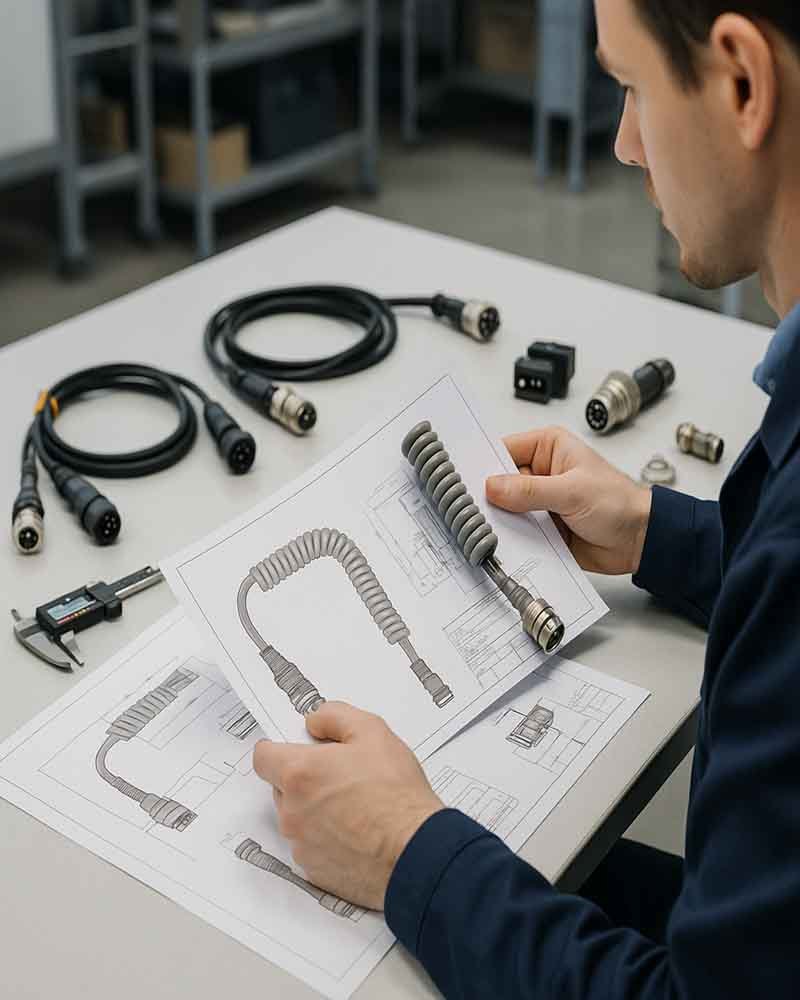
Yes. Most projects start from drawings, samples, or connector models. Missing details such as pinout or structure are clarified during engineering review before production.
2. How quickly can drawings be prepared?
Standard turnaround is within 24 hours. For urgent projects, basic drawings can be provided much faster to support quick validation.
3. What is your typical lead time for samples and production?
Samples usually take about 2 weeks. Urgent samples can be completed in 2–3 days. Mass production is typically 3–4 weeks depending on quantity and complexity.
4. Do you require a minimum order quantity?
No MOQ. Orders can start from 1 piece, which helps during development and testing stages.
5. Do you use original connectors or compatible alternatives?
Both options are available. Original components can be used, or compatible alternatives can be selected based on cost, availability, and project needs.
6. How is product quality controlled?
Each cable goes through in-process inspection, post-assembly inspection, and pre-shipment full inspection. Electrical testing is performed to verify connections.
7. Can you support urgent or time-sensitive projects?
Yes. Sample and production schedules can be adjusted depending on urgency, and express shipping is commonly used for fast delivery.
8. What information is needed to start a project?
A drawing, sample, or basic specifications such as connector type, cable length, and pin assignment are enough to begin.
9. Can you support long-term or repeat production?
Yes. Once the design is confirmed, the same structure is maintained for consistent batch production.
10. How do we communicate during the project?
Technical details can be discussed directly. Drawings and updates are shared clearly to reduce repeated clarification.
Have a Medical Cable Project in Mind?
Start with What You Have — We’ll Help You Move It Forward
Most medical cable projects do not begin with complete information. It is common to have only part of the details — a connector model, a rough drawing, or an existing cable that needs improvement. What matters is getting the structure defined early so testing and production can move forward without delays.
At SINO-CONN, projects usually start with a quick review of the available information. Based on that, drawings can be prepared, key details clarified, and a workable cable structure defined before sampling.
You can start with:
- A drawing (complete or partial)
- A physical sample
- Connector part numbers
- Or a basic description of the application
From there, the engineering team will help define pin assignment, cable structure, materials, and production details.
- Drawing support typically within 24 hours
- Sample production available in 2–3 days for urgent needs
- Flexible production from 1 piece to large-volume orders
Clear communication and early confirmation help reduce rework and keep the project on schedule.
Send your information and receive a clear response on structure, lead time, and quotation.