Skip to content
What Are the Different HDMI Cable Types?
- andy
Every day, video and audio systems are getting more demanding: from 1080p streaming, to 4K HDR gaming, to 8K and beyond. Yet many users still plug in the same “old” HDMI cable and hope for the best. The truth is: not all HDMI cables are created equally, and choosing the wrong type can mean signal loss, reduced performance, or even compatibility issues.
In brief summary: HDMI cable types differ by their certified bandwidth and feature-set (Standard, High-Speed, Premium, Ultra High-Speed) and you choose the one based on your resolution, refresh rate and special features like Ethernet or eARC.
Imagine you are an OEM designing a kiosk for a stadium, or an integrator wiring a 8 K digital signage array: you need not only the right connector but the right “custom” cable — shielded, impedance-matched, tailorable in length and material. Stick around and we’ll walk you through each type, what it means for your project, and how Sino‑Conn’s custom capabilities can meet even the toughest specs.
What Is an HDMI Cable and How Does It Work?
Summary: An HDMI cable is a digital transmission link combining multiple shielded data channels to carry video, audio, data and control signals; correct impedance and shielding ensure high-bandwidth performance and stable link.
The term HDMI stands for High‑Definition Multimedia Interface. It was created to simplify the connector landscape in audio-video systems by combining video, audio and auxiliary control/data into one interface.
From a cable-assembly perspective, here are key technical features:
- The internal construction typically includes multiple shielded twisted-pairs plus additional conductors for data/control. For example, the HDMI specification describes four shielded twisted pairs plus seven separate conductors.
- Characteristic impedance is about 100 Ω (±15%) for the differential pairs, which matters when you’re transmitting high-rate digital signals.
- Shielding (EMI/RFI), attenuation, crosstalk and skew are practical issues that affect cable length, build quality and system reliability. Many cheaper cables may work for short runs at 1080p but struggle at 4K/60+ or 8K. Crutchfield writes that for 4K UHD you “may need a faster HDMI cable than HD or Standard-definition signals”.
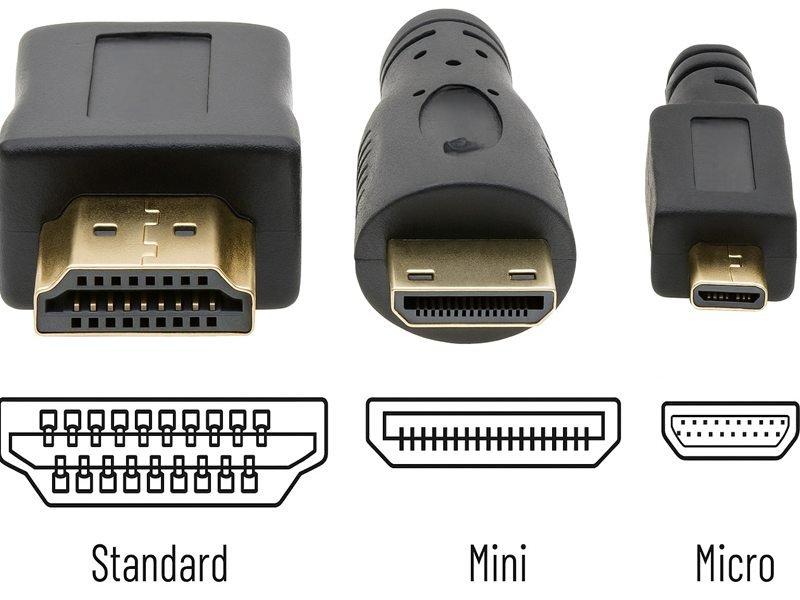
- Different connector sizes: Standard HDMI (Type A), Mini (Type C), Micro (Type D), Automotive (Type E) — though these refer to physical size rather than bandwidth rating.
From the standpoint of Sino-Conn serving engineering, OEM and custom projects, this means: when a customer sends a photo or model number, you still need to ask: what bandwidth? what length? what shielding? what bending radius? what material? Because those mechanical/structural details directly affect the performance and manufacturability of the cable assembly.
In short: understanding what the HDMI cable is and how it works sets the foundation for selecting or customizing the right assembly for your project.

Which HDMI Cable Types Are Common Today?
The main HDMI cable types certified by the HDMI Licensing Administrator are Standard, High-Speed, Premium High-Speed and Ultra High-Speed (plus variants with Ethernet) — each supports a defined maximum bandwidth and application use-case
Let’s break down each category and what it means in practice — and also explore how a cable manufacturer like Sino-Conn handles these distinctions in custom assemblies.
Standard HDMI Cable (Category 1)
This type is certified for up to 74.25 MHz TMDS clock (approx. 10.2 Gb/s) and is generally sufficient for resolutions up to 1080i/60 or 720p/60.
From a manufacturing perspective this means simpler conductors, less stringent shielding, lower cost materials — but also lower future-proofing. For low-cost consumer cables, this may suffice. For professional applications (4K/8K, long runs, EMI-sensitive environments), it may not.
High-Speed HDMI Cable (Category 2)
Certified up to 340 MHz TMDS clock (approx. 18 Gb/s) and supports 1080p, 4K@30Hz, 3D, etc.
When customizing, this type demands better conductor gauge, improved shielding, and careful attention to impedance match and crosstalk. For example, Sino-Conn may specify outer diameter (OD), bending radius, conductor size, shielding layers, to meet this category under a custom spec sheet.
Premium High-Speed HDMI Cable
Designed for 4K@60 Hz with HDR, expanded color spaces, up to ~18 Gb/s but with higher reliability, lower EMI, and it’s certified under the “Premium HDMI Cable Certification” label.
For industrial, broadcast or high-end AV installations, this type is a sweet spot — good performance and cost-effectiveness. As a custom manufacturer you need to deliver the spec sheet: parameters like OD, conductor material, shielding, impedance, test results, etc.
Ultra High-Speed HDMI Cable (HDMI 2.1 / 48 Gb/s)
Introduced alongside HDMI 2.1, supports 8K@60Hz, 4K@120Hz, 48 Gb/s (and up to 96 Gb/s in newer Ultra96 specification)
From the manufacturing side, this is the most challenging: high bandwidth demands require premium materials, very strict shielding and impedance control, often custom connectors or plating, and “future-proofing” in the spec sheet. At Sino-Conn we can tailor length, bending radius, jacketing (oil-resistant, UV-resistant, halogen-free), provide full spec, CAD drawings, sample in 2-3 days, bulk production in 2 weeks — exactly for these demanding projects.

HDMI Cable with Ethernet / eARC
Some cables include the HDMI Ethernet Channel (HEC) or eARC (Enhanced Audio Return Channel) support, allowing network data or advanced audio signals to travel via the HDMI link. hdmi.org+1
When customizing, you must specify: Do you require Ethernet? eARC? What conductor size for the extra data pair? What level of shielding? What jacket rating (flame-retardant, halogen-free) given the installation environment (e.g., commercial AV, broadcast, industrial signage)?
Table: HDMI Cable Type Comparison
| Cable Type | Max Bandwidth | Typical Use Case | Key Manufacturing Considerations |
|---|---|---|---|
| Standard HDMI (Cat 1) | ~10.2 Gb/s | 1080i, general consumer | Lower cost, simpler shielding, shorter runs |
| High-Speed HDMI (Cat 2) | ~18 Gb/s | 1080p, 4K@30, 3D | Better gauge, improved shielding, moderate length |
| Premium High-Speed HDMI | ~18 Gb/s with HDR | 4K@60, HDR, expanded color | High-quality materials, certification label |
| Ultra High-Speed HDMI | 48–96 Gb/s | 4K@120, 8K, 10K, VRR, eARC | Premium materials, tight impedance control, custom lengths/environments |
| HDMI + Ethernet / eARC | as above + data | Networked AV, advanced audio | Additional conductors/pairs, higher spec jacketing |
From the viewpoint of your cable-assembly business (Sino-Conn): when a customer says “I need HDMI cable type”, you now ask: what resolution/refresh rate? what length/lifespan? what shielding/jacket spec? what environment (oil/UV/industrial)? what certification (UL/ISO/RoHS/REACH)? Are you building a standard consumer product, a trade-spec OEM bundle, or a high-end broadcast installation? Your ability to provide full spec sheets, CAD drawings within 30 minutes, support custom pin-outs, lengths, materials — is your competitive edge.
How Do HDMI Versions (1.4, 2.0, 2.1) Affect Cable Selection?
Summary: HDMI specification versions (1.4, 2.0, 2.1) define maximum resolution, refresh rates and features; to fully leverage them you may need cables certified for the corresponding bandwidth (e.g., Ultra High-Speed for HDMI 2.1).
Understanding HDMI version numbers is essential when selecting or customizing an HDMI cable assembly. But it’s also a point of confusion — the version number printed on a cable is not always meaningful, and as the HDMI.org site notes, cables should carry speed-rating labels rather than version numbers.
What do the versions mean?
- HDMI 1.4 (released 2009): Introduced features like 4K (@24Hz/30Hz), Audio Return Channel (ARC), HDMI Ethernet Channel (HEC) in some cases.
- HDMI 2.0 (released 2013): Increased bandwidth (~18 Gb/s), allows 4K@60Hz, HDR, wider color spaces.
- HDMI 2.1 (released 2017): Major leap — up to 48 Gb/s, supports 4K@120Hz, 8K@60Hz, 10K, VRR (Variable Refresh Rate), ALLM (Auto Low Latency Mode), eARC (Enhanced Audio Return Channel).
Why cable selection matters
If your system is pushing 4K@60Hz HDR (HDMI 2.0 territory) then a Premium High-Speed cable is sufficient. But if you are working on 8K/60Hz, 4K/120Hz or next-gen gaming consoles, you need a cable certified for Ultra High-Speed (for HDMI 2.1 features). Simply plugging an older cable may work in many cases but you risk not reaching full performance, or encountering stability/compatibility issues. Crutchfield points out: “TVs and components that support HDMI 2.1 are also backward-compatible … but the full bandwidth is only supported with the new cables.”
Custom cable-assembly challenges
From the manufacturer’s angle (like Sino-Conn), this means:
- You must ask the correct bandwidth/refresh specification up-front.
- Provide specs for shielding, impedance, conductor material, jacket durability (oil, UV, high temperature).
- Provide CAD drawings and spec sheet that list parameters: OD, bending radius, flexibility, shielding layers, impedance, current rating, voltage, etc.
- Offer versions with or without Ethernet, eARC, custom lengths, custom pin-out — because many integration projects (industrial signage, broadcast racks, military/medical) have special requirements (e.g., no-halogen, high-flex, UV resistant).
- Explain to customers the trade-offs: e.g., a “one size fits all” cable may cost more but save installation/maintenance time; a simpler cable might cost less but fail prematurely or limit future upgrades.
Critical thinking perspective
While version numbers and ratings help guide selection, remember that system performance is only as strong as its weakest link. An HDMI cable assembly may meet “Ultra High-Speed” spec but if the connectors aren’t anchored properly, shielding isn’t adequate for the installation (e.g., industrial environment with EMI), or bending radius is violated, you’ll run into problems. So for custom manufacturing, the full specification sheet — including durability (temperature, oil, UV), mechanical tolerances, test results — is just as important as marketing labels. Sino-Conn’s approach: full spec sheet + CAD drawing + custom build + 3-stage inspection – is the professional way.
Do You Need a Certified or Custom HDMI Cable?
Summary: Yes — for mission-critical, high-performance, long-run or specialized-environment projects, certified HDMI cables (with appropriate speed rating) or fully custom assemblies (length, shielding, jacket, connectors) are strongly recommended.
In consumer retail you’ll often find “cheap HDMI cables” and the marketing blur may say “Supports 8K”, etc. But for professional integrators, OEMs, medical, military or industrial applications, there are far more considerations beyond just “it plugs in”.
Why certification matters
Certification by the HDMI Licensing Administrator means the cable has been tested per specification and labelled accordingly — for example “Ultra High-Speed HDMI Cable Certified”. Certified cables give a baseline guarantee of bandwidth and performance. Without certification, you may be buying a cable that “says” 48Gb/s but hasn’t been verified in test labs, which can lead to failures in the field.
Why custom cable assemblies matter
Here’s where Sino-Conn’s full-service manufacturing shines:
- Length: standard retail lengths may not suit OEM racks, signage systems, custom projection setups. You may need 25 m runs, odd lengths, or breakout assemblies.
- Pin-out / connector definition: some clients bring a photo, but don’t know the exact specification. At Sino-Conn you reverse-engineer, supply drawings, and can support non-standard pin-outs or dual ends.
- Material & environment specs: For industrial or military use you may need oil-resistant, UV resistant, halogen-free jackets, high flex life, high temperature, corrosion resistance.
- Shielding & impedance: In EMI-rich environments (factory floor, broadcast truck, medical imaging suite) shielding and impedance control are critical to signal integrity.
- Certifications & quality control: Sino-Conn offers full spec sheets, UL/ISO/RoHS/REACH/PFAS/COC/COO, 100% full inspection (process + final + pre-shipment).
- Manufacturing responsiveness: sample in 2–3 days, bulk as fast as 2 weeks for urgent orders, no MOQ (1 pc start) — ideal for prototypes or custom runs.
Decision making: certified off-the-shelf vs. custom assembly
- If you are a consumer plugging your Apple TV into your living-room TV, a certified Premium High-Speed retail cable may suffice.
- If you’re installing signage in a stadium, medical imaging racks, avionics or defense equipment, you’ll benefit from a custom cable assembly tailored to your spec sheet.
- The cost difference may be modest compared to the engineering risk of a failed cable run, downtime, warranty claims, or upgrade limitations.
Critical viewpoint
It’s not always necessary to go “top of the line” Ultra High-Speed if your system doesn’t demand it (e.g., 1080p/60HD). But failing to specify correctly upfront can lead to hidden costs later. As your manufacturing partner, Sino-Conn helps you define what you actually need, rather than what the marketing fluff tells you. It’s this engineering-guided approach (spec sheet, drawing, custom build, inspection) that separates a reliable install from a repeated service call.
How Can You Customize an HDMI Cable for Your Application?
Summary: You can customize an HDMI cable in length, connector type/pin-out, materials (conductor, jacket), shielding, bending radius, and compliance to environmental/industry specs — all of which Sino-Conn supports with fast CAD drawing, specification sheets and production.
When a customer approaches you (Sino-Conn) asking for “HDMI cable”, what questions should you ask? What customization options should you present? Let’s explore the major customization dimensions and how they influence manufacturing and application performance.
Length & U-shape / harness integration
Standard retail HDMI cables may be 1–3 m. But for integration into custom equipment, you might need 5 m, 10 m, or more. Longer runs increase attenuation and signal loss. You may need active or optical HDMI cables for very long runs, or thicker gauge and special construction. As a manufacturer we note: “What is your length? What is your bending radius? Are you routing through conduits, or tight installations?” If you report your length and environment, Sino-Conn will tailor conductor gauge, shielding, and test accordingly.
Connector type & pin-out
Some customers come with a photo or a model number, but lack full technical details. At Sino-Conn we reverse-engineer: we provide CAD drawing to customer in 30 minutes (or faster) and deliver PDF drawings for confirmation. Connector variants: Type A (standard) 19 pins, Type C (Mini) 19 pins, Type D (Micro) 19 pins, Type E (Automotive) locking, etc. manhattanproducts.us Also, some custom systems require non-standard pin-outs (e.g., flipped or swapped lines), dual ends, right-angle, locking mechanisms, etc. You as the business must be ready to ask: “What is the pin-out? What ends? Straight or right-angle? Locking?”
Materials, jacket & environmental specs
For industrial/medical/military applications, you may need: halogen-free jacket, oil-resistance, UV resistance, high-temperature rating, corrosion resistance, high-flex life, etc. You may also require cable OD, bending radius, and flexibility specs (as your spec sheet says: OD, bend radius, flexibility, high temp, anti-oil, anti-UV, anti-corrosion, halogen-free, no fluorine). As Sino-Conn, you supply spec sheets listing all these parameters, list conductor materials, shielding layers, jacket material and certifications (UL, ISO, RoHS, REACH, PFAS,…).
Shielding, impedance and performance specs
Because HDMI is a high-bandwidth digital link, you must control impedance (100 Ω differential typical), skew between pairs, crosstalk, insertion loss, return loss, etc. In custom cable assemblies, you may provide full test reports. For example: “Our cable has 24 AWG conductors, quad shielding, 30 dB minimum attenuation at 5 GHz, bent radius 10× cable OD, guaranteed data passing to 48 Gb/s for 8K/60Hz.” Your spec sheet should list all essential electrical/mechanical parameters. Sino-Conn’s requirement: we provide full specification, part number, material list, and deliver drawings before production, then do 3-stage inspection (process, final, pre-shipment) to ensure quality.
Certification & documentation
Customers (especially trade, R&D, OEM, medical, military) will ask for certifications: UL, ISO, RoHS, REACH, PFAS, COC (certificate of conformity), COO (country of origin). Sino-Conn includes these as part of service. Moreover, for custom builds, supplying the PDF drawing, spec sheet and a manufacturing compliance sheet (material list, test results, inspection sign-off) is a differentiator.
Lead time, MOQ, pricing
Typical consumer cables may be stocked. For custom assemblies, Sino-Conn provides: sample in ~2 weeks (or even 2-3 days for urgent), bulk in 3-4 weeks (or as fast as 2 weeks for urgent), no minimum order quantity (MOQ starts from 1 pc). Pricing varies by customization level: brand-terminal users pay most, OEM lower, trade-reseller lowest margin. Pricing also varies by region: US highest, Japan high, Korea a bit lower, India/SE Asia lower; Europe varies (Italy/Poland lower, Germany/France higher). Industry also affects price: medical/military highest, commercial mid, consumer lowest.
Why customizing makes sense
By customizing you align the cable to your application — you minimize unsold inventory, avoid “good-enough” that fails, ensure installation reliability, optimize cost based on true requirement rather than over-spec, and future-proof the system. For example, an 8K digital signage may run for years — spec’ing Standard HDMI cable may simply fail within months, costing downtime. So as a professional cable-assembly manufacturer, Sino-Conn’s ability to ask the right questions, supply drawings, custom build, test and document is your value proposition.
Are All HDMI Cables the Same? (Myths vs Facts)
Summary: No — while many HDMI cables may look similar and “work”, their certified bandwidth, build quality, shielding, materials and suitability for installations vary greatly; understanding the differences avoids cost-errors and failures.
Let’s address common myths and then explore what really matters — from a more critical, customer-centered viewpoint.
Myth #1: “All HDMI cables do the same thing — just buy the cheapest.”
In many standard consumer setups (1080p, short run) a cheap HDMI cable may work. Indeed some users report “my cheap cable works fine”. As one Reddit user commented:
“…The only difference in HDMI cables is whether they are rated for “high speed” which includes nearly all cables made in the last few years…” Reddit
But that doesn’t mean “cheapest always acceptable” especially when your system pushes the edges (4K/60Hz HDR, 8K, long runs, professional installation, industrial environment). The risk: signal dropouts, corrupted frames, rework. For professional installations, reliability and correct spec matter more than price alone.
Myth #2: “If a cable is more expensive it must be better.”
Not necessarily true. Some markup is for branding, retail packaging, or very niche premium features (silver-plated conductors, exotic materials). What matters is the certified speed rating and whether the cable meets your spec requirements. An expensive cable might claim “8K ready” but if it lacks proper shielding or is too long for the format, you may still run into issues. The key from your manufacturer: ask for test data and spec sheet, not just price.
Myth #3: “Any HDMI cable will support future formats because they are backward compatible.”
Backward compatibility is true: newer HDMI versions and devices will often work with older cables — but you may not get full feature support (e.g., 4K@120Hz, VRR, 8K/60) if the cable is under-rated. As indicated earlier, a device may be HDMI 2.1 capable but if your cable is only “High-Speed” you’re limited.
From a manufacturing viewpoint: you must trust the spec, test the cable for the desired bandwidth, and document it.
What really matters — facts you must check
- Speed rating / certification label: Standard / High-Speed / Premium / Ultra High-Speed.
- Length and attenuation: longer cables have more signal loss; custom runs need proper gauge and materials.
- Build quality: conductor size, shielding layers, connector quality, jacket durability.
- Test data: Especially for custom builds, you want test reports for impedance, attenuation, skew, EMI, bending radius, flex life.
- Environmental suitability: oil/UV resistance, flame rating, halogen-free, high temperature, mechanical stress.
- Certifications & documentation: UL, ISO, RoHS, REACH, PFAS, etc; spec sheet & CAD drawings before production.
- Manufacturing controls: full-inspection (in-process, final, pre-shipment) as Sino-Conn provides.
Why the customer-centered view matters
If you’re a trade-buyer, OEM or engineer, consider: how will this cable perform in your real installation? Will it be hidden behind walls, routed through conduits, exposed to heat or UV? Will it carry 4K@60Hz or 8K@60Hz? Will you ever upgrade? Are OEM turn-around times and customization flexibility important? Sino-Conn’s value proposition addresses these questions: rapid quoting, custom drawings, no MOQ, full inspection, certification, and competitive pricing tailored per region and industry.
Final takeaway
So: Are all HDMI cables the same? No. Many may look similar and “work” in simple cases, but for high-performance, custom, or mission-critical systems you must treat the cable assembly as a precision engineered component — not just “plug and play”. Partnering with a company like Sino-Conn ensures you get not only the right type but the right build for your application, with documentation and quality assurance to match.
Why Choose Sino-Conn as Your Custom HDMI Cable Manufacturer?

Sino-Conn offers rapid engineering support, fully customized HDMI cable assemblies (length, pin-out, materials, environment specs), full documentation and certification, flexible MOQ (1 pc), fast lead times, and inspection protocols — making it a strong partner for OEMs, trade-buyers and engineers.
Now that you understand HDMI cable types, versions and what really matters, let’s talk about why working with Sino-Conn gives you a competitive advantage and peace of mind in your cable-assembly sourcing.
Rapid response and drawing support
At Sino-Conn, we pride ourselves on fast turnaround: quoting and drawing (CAD to PDF) typically within 30 minutes for standard requests, or ~3 days for more detailed custom builds; urgent sample requests can be delivered in 2–3 days, and bulk orders in 2 weeks for urgent runs (standard 3–4 weeks).
When a customer sends you a picture or part number without full spec, our engineers will dig into the parameters: conductor gauge, OD, shielding, jacket material, bending radius, environment, certifications. This engineering-first approach distinguishes us from generic commodity suppliers.
Full customization and no MOQ
We support full customization: length, pin-out, both ends, connector type, jacket material (oil/UV/flame-retardant/halogen-free), shielding levels, flexibility, temperature/potential. We accept MOQ starting 1 pc, which is ideal for prototypes, test runs, or highly specialized applications.
This flexibility allows trade buyers, R&D engineers, OEMs and others to test with confidence without committing to large inventories — then scale up when ready.
Certifications, quality control & documentation
Our cables come with full documentation: specification sheet (parameters, dimensions, model), material list, test report, CAD drawing, and relevant certifications (UL, ISO, RoHS, REACH, PFAS, COC, COO).
We implement 100% full-inspection: process inspection, result inspection, pre-shipment inspection — three levels to ensure every cable leaving our line meets your standards.
This is especially critical for industries such as medical, military, broadcast, industrial automation — where failure is not an option.
Region and industry pricing flexibility
We understand that price expectations vary by region and industry. For example, North America customers often expect higher price but demand higher reliability; Japan, Korea, India, SE Asia each have different cost structures; Europe varies by country; medical/military industries have higher cost tolerance compared to commercial/consumer.
We offer tiered pricing accordingly: brand-terminal, OEM, trade-reseller — helping you optimize cost based on your role.
Also we stock inventory and respond quickly — so you’re not facing weeks of delay.
Engineering partnership and longevity
Rather than a one-off sale, we aim to be your long-term cable-assembly partner. Whether you are a trade distributor sending us model numbers, or a design engineer planning next-gen signage, or an OEM expecting large volumes but tight schedule — we support you from spec to drawing to sample to mass production.
Our experience in coaxial, HDMI, fiber, LVDS, etc gives us broad perspective. For HDMI specifically we understand high-speed digital transmission, shielding, impedance, EMI — critical when cables transition from HDTV boxes to industrial racks, medical imaging or display walls.
Why this matters for you
- You get a cable that fits your real-world application rather than “maybe works”.
- You reduce risk of installation failure, signal dropouts, warranty claims.
- You save cost by optimizing length/materials rather than over-buying “racehorse” cable for a simple application.
- You get support and documentation which your end-customer may demand (especially in regulated industries).
- You get speed to market — quick quoting, drawing, sample, production.
Final Call to Action
If your next project involves HDMI cable assemblies — whether standard consumer use, high-end broadcast, industrial automation, medical imaging or OEM product design — don’t settle for “one-size fits all”. At Sino-Conn, we can customize HDMI cable assemblies to meet your exact spec: bandwidth, length, jacket material, shielding, connector type, drawing & spec sheet, certification and fast lead time.
Contact us today to request a quote, send your sample photo or spec sheet, and let our engineering team provide you the drawing and price — often in as little as 30 minutes. Let’s get your HDMI solution built right, built fast, built to last.
Related Keywords :hdmi cable types, high-speed hdmi cable, ultra high speed hdmi, premium hdmi cable, hdmi 2.1 cable, custom hdmi cable manufacturer, hdmi cable specification, shielding impedance hdmi, hdmi cable customization, hdmi cable applications

With over 18 years of OEM/ODM cable assemblies industry experience, I would be happy to share with you the valuable knowledge related to leather products from the perspective of a leading supplier in China.
manufacturer catalogue
Custom Micro Coaxial Cable →
Custom RF Coaxial Cable Assembly →
Custom FFC(Flat Flexible Cable) →
Custom Patch Cable →
Custom Circular Connector Cables →
Custom D-Sub Analog Cable →
Custom Power Cord →
Custom Fiber Optical Transceiver →
Custom Receptacle Connectors →
Get A Sample Now From Factory→
Latest blogs


Here, developing your OEM/ODM custom cable assemblies collection is no longer a challenge—it’s an excellent opportunity to bring your creative vision to life.