Skip to content
Ethernet Cable Types: What to Choose, How to Specify
- andy

In the fast-moving digital world, even the smallest component can make or break performance. Whether you’re streaming 4K video, managing an AI data center, or wiring an industrial robot, the Ethernet cable silently carries the lifeblood of your network — data. Yet, many professionals still ask: What Ethernet cable type should I use? Cat5e, Cat6, or Cat8? Do I need shielding? How does PoE affect my design?
In short: Ethernet cable types differ by speed, bandwidth, shielding, and application. Cat5e supports 1Gbps, Cat6 handles up to 10Gbps, Cat6a and Cat7 add better shielding for data centers, and Cat8 reaches 25–40Gbps for high-end servers. The right type depends on distance, interference, and installation environment.
At Sino-conn, we’ve helped thousands of engineers, OEMs, and integrators pick and customize the right Ethernet cable assemblies — from flat PoE cables for smart homes to fully shielded Cat8 harnesses for data centers. Imagine plugging in your next server rack and everything just works — fast, stable, interference-free. That’s the beauty of choosing right from the start.
What Are the Main Ethernet Cable Categories (Cat5e–Cat8)?
Ethernet cables are categorized from Cat5e to Cat8, each supporting different speeds and frequencies. Cat5e runs at 1Gbps, Cat6/6a up to 10Gbps, Cat7 at 10Gbps with improved shielding, and Cat8 at 25–40Gbps for data centers. The higher the category, the faster and more interference-resistant the cable.
Ethernet categories (short for “Category”) define performance standards like frequency, speed, and signal integrity. Below is a quick comparison table of the most common types used today:
| Category | Max Speed | Frequency | Typical Use | Shielding |
|---|---|---|---|---|
| Cat5e | 1 Gbps | 100 MHz | Home & office LAN | UTP/FTP |
| Cat6 | 10 Gbps (≤55m) | 250 MHz | Business networks | UTP/STP |
| Cat6a | 10 Gbps (≤100m) | 500 MHz | Data centers | F/UTP, S/FTP |
| Cat7 | 10 Gbps | 600 MHz | Industrial, enterprise | S/FTP |
| Cat8 | 25–40 Gbps (≤30m) | 2000 MHz | Servers, AI computing | S/FTP |
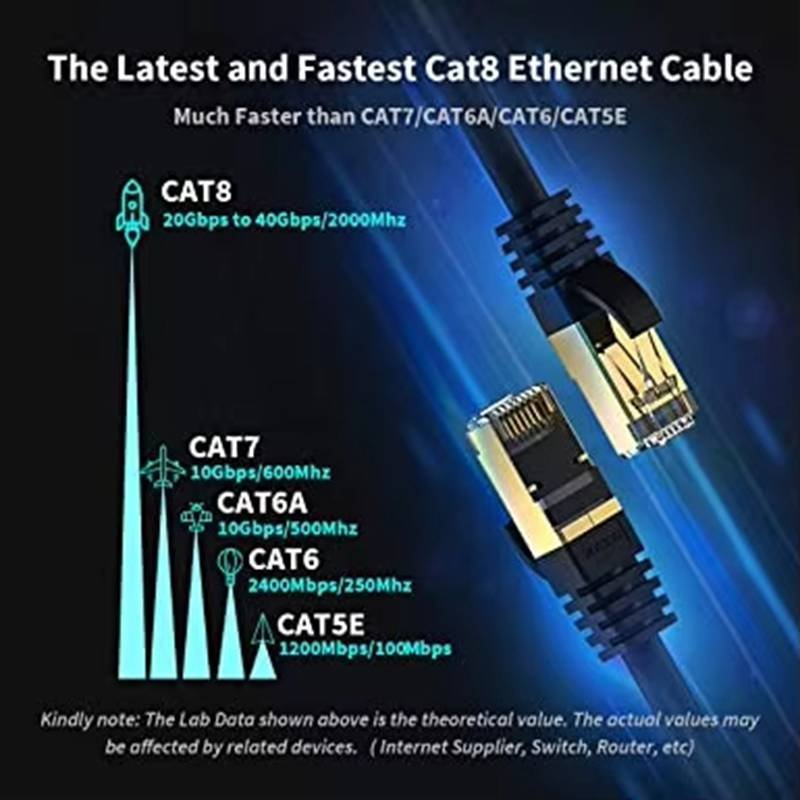
Each step up improves bandwidth, but also adds cost, thickness, and sometimes rigidity. For general users, Cat6 offers the sweet spot of performance and price. For enterprise backbones, Cat6a or Cat8 is non-negotiable.
Which Is Better: Cat5 vs Cat5e vs Cat6 vs Cat6a?
Cat6a is the best all-around Ethernet cable type for most modern applications. It delivers 10Gbps speeds up to 100 meters, provides excellent shielding against EMI, and fully supports PoE++, making it ideal for both professional and enterprise networks. Cat5e and Cat6 are fine for small offices or home use but may limit future performance.
Understanding the Real Differences
When choosing between Cat5, Cat5e, Cat6, and Cat6a, you’re really comparing generations of evolution in how Ethernet cables manage speed, bandwidth, and interference control. Let’s break it down with clear, quantifiable data:
| Cable Type | Max Speed | Bandwidth | Distance | PoE Support | EMI Protection | Typical Use |
|---|---|---|---|---|---|---|
| Cat5 | 100 Mbps | 100 MHz | ≤100m | Basic | Low | Legacy systems (obsolete) |
| Cat5e | 1 Gbps | 100 MHz | ≤100m | PoE/PoE+ | Moderate | Homes, small offices |
| Cat6 | 10 Gbps (≤55m) | 250 MHz | ≤55m | PoE+/PoE++ | High | SMBs, indoor LANs |
| Cat6a | 10 Gbps (≤100m) | 500 MHz | ≤100m | Full PoE++ | Excellent | Enterprise & industrial networks |
Performance Perspective
- Cat5 → Cat5e: The jump from 100Mbps to 1Gbps may not sound huge today, but it revolutionized early broadband and LAN setups. However, it’s already outdated for modern applications.
- Cat6: The biggest leap in data integrity — with better twisted-pair spacing and thicker insulation, reducing crosstalk (NEXT) by 45% compared to Cat5e.
- Cat6a: The current sweet spot. It doubles bandwidth and fully supports 10GBASE-T Ethernet over 100 meters. Ideal for data-heavy workflows like cloud computing, 4K/8K video streaming, and industrial automation.
According to the Telecommunications Industry Association (TIA), Cat6a is now the minimum recommended category for new structured cabling installations.
That means if you’re building or upgrading your network today, Cat6a ensures you won’t need another overhaul for the next 10 years.
Installation & Cost Insight
| Factor | Cat5e | Cat6 | Cat6a |
|---|---|---|---|
| Cable Diameter (mm) | ~5.3 | ~6.0 | ~7.3 |
| Flexibility | Excellent | Good | Fair |
| Typical Cost (per meter) | $0.10–$0.15 | $0.20–$0.35 | $0.35–$0.60 |
| Installation Complexity | Easy | Moderate | Slightly higher due to shielding |
| Future-Proof Lifespan | 5 years | 8 years | 10–15 years |
Pro tip from Sino-conn engineers: For industrial or commercial clients, Cat6a’s initial cost is offset by long-term performance and maintenance savings. You avoid bandwidth limitations and costly re-cabling later.
PoE and Shielding Considerations
- PoE Load: Cat6a supports up to 100W (PoE++), ideal for IP cameras, LED lighting, and Wi-Fi 6 access points.
- Shielding Advantage: In electrically noisy environments — such as factories or near heavy equipment — Cat6a’s F/UTP or S/FTP shielding maintains stable performance and prevents signal drops.
Sino-conn’s Cat6a assemblies use 23AWG oxygen-free copper (OFC) conductors with double-layer shielding, ensuring consistent transmission and minimal heat under full PoE++ load.
Each assembly is 100% tested for NEXT, return loss, and impedance balance, guaranteeing enterprise-grade reliability.
Final Recommendation
If your goal is cost-effective longevity, Cat6a wins.
- It’s backward compatible with Cat5e and Cat6 hardware.
- It supports all modern network technologies (10GBASE-T, PoE++, HDBaseT).
- It’s certified for both indoor and industrial use cases.
For simple home setups, Cat6 is acceptable. But for any professional-grade or commercial installation, Cat6a is the standard that future-proofs your investment — and Sino-conn can customize it to your exact length, connector type, and shielding needs.
Which Cable Should You Use for Home, Office, or Data Center?
For home or small offices, Cat6 is usually sufficient. For enterprise and data centers, choose Cat6a or Cat8 for maximum bandwidth and reliability.
Your environment determines your cable:
- Home & Small Office: Cat5e or Cat6 — flexible, affordable, supports 4K streaming and gaming.
- Corporate Office: Cat6a — reliable for large networks, VoIP, and cloud-based systems.
- Data Center / AI Cluster: Cat8 — designed for ultra-high speed (25–40Gbps) and low latency.

Which Is Better: RJ45 or Cat6?
RJ45 is the connector, while Cat6 is the cable type. A Cat6 cable uses RJ45 connectors. The key is matching the connector quality to the cable’s category and shielding.
Many users confuse connectors with cable categories. RJ45 refers to the 8P8C modular plug; it’s used across Cat5e to Cat8. However, the connector’s internal design (gold plating, pin geometry, shield crimping) affects signal integrity.
Sino-conn offers original and alternative RJ45 connectors, both tested to meet TIA/EIA and ISO/IEC standards — giving customers flexibility in cost and lead time.
How Do Materials and Construction Impact Performance and Safety?
High-purity copper conductors, double shielding, and LSZH jackets improve signal performance, EMI resistance, and fire safety. Poor materials reduce speed and longevity.
Ethernet cables aren’t just copper and plastic — their construction defines their durability and reliability:
- Conductors:
- Oxygen-Free Copper (OFC) ensures minimal resistance.
- Tinned Copper resists corrosion in humid environments.
- CCA (Copper-Clad Aluminum) cuts cost but lowers performance.
- Insulation & Shielding:
- Foamed PE reduces capacitance for higher frequency stability.
- S/FTP design gives superior EMI immunity, ideal for industrial and data center use.
- Outer Jacket:
- PVC – general indoor use.
- LSZH – emits no toxic fumes, standard in public buildings.
- PUR or PE – outdoor, oil-resistant, UV-proof options.

At Sino-conn, we help clients choose materials to match application needs — for example, LSZH Cat6a for office buildings or UV-resistant PE Cat8 for outdoor networks.
Are Shielded Cables Better Than UTP for Your Environment?
Yes — in areas with heavy EMI, shielded cables (FTP/STP/SFTP) outperform UTP. But for clean office spaces, unshielded cables are simpler and cheaper.
Shielding prevents electromagnetic interference from motors, transformers, or fluorescent lights.
However, over-shielding can add bulk and grounding complexity.
- UTP: Affordable, easy to terminate, good for homes/offices.
- FTP/STP: Adds foil or braid shields, ideal for industrial areas.
- S/FTP: Each pair shielded + overall braid — ultimate protection for data centers.
Sino-conn engineers often advise combining shielding with proper grounding and high-quality connectors — achieving stable performance without overspending.
Do PoE, Outdoor, and Automotive Applications Require Special Designs?
Absolutely. PoE, outdoor, and automotive Ethernet cables require thicker conductors, durable jackets, and advanced shielding to handle power, weather, or vibration.
PoE Ethernet: Must carry both data and up to 90W of power. Sino-conn’s PoE+ and PoE++ cables use 23–24AWG OFC conductors to minimize heat.
Outdoor / Waterproof: Equipped with PE jackets, drain wires, and IP67/IP68 connectors. Perfect for security cameras and access points exposed to weather.
Industrial Ethernet: Uses PUR jackets and M12 connectors to withstand oil, vibration, and chemicals.
Automotive Ethernet: Follows IEEE 100BASE-T1 / 1000BASE-T1 standards — lightweight, high-speed, designed for ADAS systems and in-vehicle communication.
Every industry has unique requirements, and Sino-conn’s design team delivers custom-engineered harnesses within 2–3 weeks, fully tested and certified.
How to Evaluate Quality, Certifications, Lead Times, and Custom Options?
Check certifications (UL, ISO, RoHS, REACH), review test reports, and confirm drawing approval before production. Sino-conn provides quick samples (2–14 days), no MOQ, and full customization.
Choosing a cable supplier isn’t just about price. A reliable partner ensures:
- Certifications: UL, ISO, RoHS, REACH, PFAS, CoC/COO compliance.
- Testing: Continuity, impedance, crosstalk (NEXT), return loss.
- Documentation: PDF drawings (from CAD), specs, and sample validation before production.
- Customization: Adjust length, pin-out, molding, materials, or branding.
- Response Time: Quotes and drawings ready in 30 minutes; samples in 3 days; mass production in 2–4 weeks.
Sino-conn’s engineers and sales experts collaborate closely with clients — from concept to shipment — ensuring every cable performs perfectly in its real-world application.
Conclusion:
From Cat5e to Cat8, from PoE to outdoor cables, the right Ethernet assembly is the foundation of reliable connectivity. At Sino-conn, we combine engineering expertise, rapid prototyping, and global manufacturing to deliver high-quality Ethernet cable assemblies — with no MOQ, fast turnaround, and complete certification support.
Related Keywords :medical cables, cable manufacturer, medical devices, custom cables, medical cable supplier, patient safety, electronics cables, OEM cables, signal integrity, biocompatible cables

With over 18 years of OEM/ODM cable assemblies industry experience, I would be happy to share with you the valuable knowledge related to leather products from the perspective of a leading supplier in China.
manufacturer catalogue
Custom Micro Coaxial Cable →
Custom RF Coaxial Cable Assembly →
Custom FFC(Flat Flexible Cable) →
Custom Patch Cable →
Custom Circular Connector Cables →
Custom D-Sub Analog Cable →
Custom Power Cord →
Custom Fiber Optical Transceiver →
Custom Receptacle Connectors →
Get A Sample Now From Factory→
Latest blogs


Here, developing your OEM/ODM custom cable assemblies collection is no longer a challenge—it’s an excellent opportunity to bring your creative vision to life.